Black Carrots Market Size
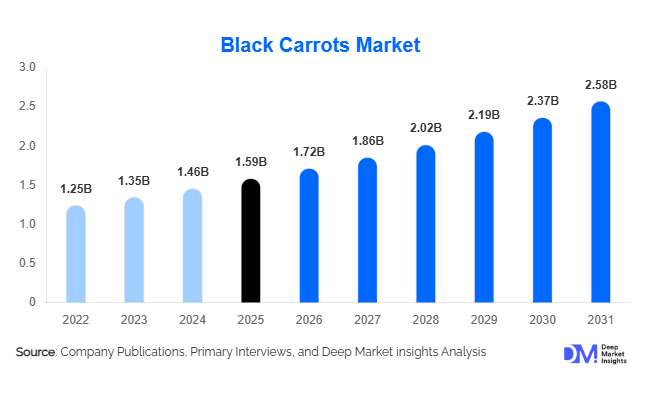
According to Deep Market Insights, the global black carrots market size was valued at USD 1.59 billion in 2025 and is projected to grow from USD 1.72 billion in 2026 to reach USD 2.58 billion by 2031, expanding at a CAGR of 8.4% during the forecast period (2026–2031). The black carrots market growth is primarily driven by the increasing adoption of natural food colorants, growing demand for antioxidant-rich functional ingredients, and expanding applications across food & beverages, nutraceuticals, pharmaceuticals, and cosmetics. Black carrots have emerged as one of the most commercially important sources of anthocyanins, offering superior color stability and health benefits compared to several alternative natural pigments. Rising consumer preference for clean-label products, stringent regulations on synthetic food additives, and increased investments in natural ingredient processing are further accelerating market expansion worldwide.
Key Market Insights
- Black carrot extracts have become one of the fastest-growing natural colorant sources, driven by global food manufacturers replacing synthetic dyes in beverages, confectionery, dairy products, and processed foods.
- Food & beverage applications account for approximately 45% of total market demand, making this the largest application segment globally.
- Asia-Pacific dominates the market with nearly 38% share, supported by large-scale cultivation and processing operations in India and Turkey.
- Nutraceutical applications are the fastest-growing segment, fueled by increasing demand for antioxidant-rich dietary supplements and functional nutrition products.
- Europe remains a key consumption hub, driven by stringent regulations on artificial food colorants and growing clean-label food adoption.
- Technological advancements in anthocyanin extraction, spray drying, and concentrate production are improving product quality, shelf life, and commercial scalability.
Black Carrots Market Latest Trends
Natural Food Colorant Adoption Accelerating Globally
Food manufacturers across developed and emerging economies are increasingly transitioning from synthetic dyes toward naturally derived colorants. Black carrot extract has emerged as one of the preferred alternatives due to its high anthocyanin concentration and exceptional color stability across varying pH levels. Beverage companies, confectionery manufacturers, dairy processors, and bakery producers are incorporating black carrot-derived pigments into reformulated clean-label products. Regulatory scrutiny surrounding artificial food additives in Europe and North America is further accelerating demand. Several multinational food companies have initiated long-term sourcing agreements with black carrot ingredient suppliers to ensure secure access to natural color solutions.
Expansion of Functional Nutrition and Wellness Applications
Consumer demand for health-promoting ingredients continues to strengthen the commercial value of black carrots. Anthocyanins derived from black carrots are increasingly being incorporated into dietary supplements, antioxidant blends, sports nutrition products, functional beverages, and preventive healthcare formulations. Growing awareness regarding oxidative stress management, cardiovascular wellness, and immune support has enhanced the attractiveness of black carrot ingredients among nutraceutical manufacturers. The trend is further supported by rising healthcare expenditures, aging populations, and preventive health strategies being adopted globally.
Black Carrots Market Drivers
Growing Demand for Clean-Label Food Ingredients
Consumers increasingly prefer foods and beverages containing recognizable and naturally sourced ingredients. This trend has encouraged manufacturers to replace synthetic additives with plant-derived alternatives. Black carrot extracts provide a clean-label solution that meets both consumer expectations and regulatory requirements. The ability of black carrot anthocyanins to deliver stable coloration across multiple food applications makes them particularly attractive for large-scale commercial adoption.
Expansion of Functional Food and Beverage Markets
The rapid growth of the functional food and beverage industry is creating substantial demand for black carrot ingredients. Manufacturers are utilizing black carrot powders, concentrates, and extracts to enhance both nutritional value and visual appeal. Functional beverages, wellness shots, fortified dairy products, and nutritional snacks increasingly feature black carrot-derived ingredients due to their antioxidant profile and natural positioning. As consumers seek products that combine health benefits with convenience, black carrot demand continues to rise.
Rising Applications in Nutraceuticals and Cosmetics
Beyond food applications, black carrot extracts are finding increasing acceptance in nutraceutical and cosmetic formulations. Anthocyanin-rich ingredients are widely utilized in antioxidant supplements, anti-aging skincare products, and wellness formulations. Cosmetic manufacturers are particularly attracted to naturally sourced active ingredients that support premium product positioning. The diversification of applications across multiple industries is strengthening overall market resilience and expanding revenue opportunities.
Black Carrots Market Restraints
Agricultural Supply Volatility
Black carrot production remains concentrated within a limited number of agricultural regions, exposing the market to climatic variability, water shortages, disease outbreaks, and seasonal production fluctuations. Supply constraints can affect raw material availability and increase pricing volatility for processors and ingredient manufacturers. Such disruptions create challenges for long-term procurement planning and production scheduling.
Higher Cost Compared to Synthetic Alternatives
Despite growing acceptance of natural ingredients, black carrot-derived colorants remain more expensive than conventional synthetic dyes. Cost-sensitive manufacturers, particularly in developing economies, may continue relying on lower-cost synthetic alternatives. In addition, extraction, concentration, and processing technologies add further costs throughout the value chain. Price competitiveness remains a key challenge for broader market penetration.
Black Carrots Market Industry Key Opportunities
Expansion of Natural Colorant Substitution Programs
Governments, regulatory agencies, and food manufacturers worldwide are encouraging the replacement of synthetic additives with naturally derived alternatives. Black carrot extracts are well-positioned to benefit from this transition due to their strong coloring properties and established safety profile. Ingredient suppliers can capitalize on this opportunity by developing customized formulations for beverages, confectionery, bakery, and dairy applications. As reformulation programs continue across major food brands, demand for black carrot-derived anthocyanins is expected to accelerate significantly.
Growth of Export-Oriented Processing Infrastructure
Emerging production hubs such as India and Turkey are witnessing increasing investments in processing facilities, extraction plants, spray-drying units, and cold-chain infrastructure. These investments support value-added exports rather than raw agricultural commodity shipments. Companies capable of integrating cultivation, processing, extraction, and international distribution can secure stronger margins and establish competitive advantages in global ingredient markets. Growing exports to Europe, North America, Japan, and South Korea present substantial long-term opportunities for producers and processors.
Report Scope
| Report Metric | Details |
|---|---|
| Market Size in 2025 | USD 1.59 Billion |
| Market Size in 2026 | USD 1.72 Billion |
| Market Size in 2031 | USD 2.58 Billion |
| CAGR | 8.4% (2026-2031) |
| Base Year for Estimation | 2025 |
| Historical Data | 2022-2024 |
| Forecast Period | 2026-2031 |
| Report Coverage | Revenue Forecast, Competitive Landscape, Supply Chain Disruption, Growth Factors, Environment & Regulatory Landscape and Trends |
| Geographies Covered | North America, Europe, APAC, Middle East and Africa, LATAM |
| Countries Covered | U.S., Canada, U.K., Germany, France, Spain, Italy, Russia, Nordic, Benelux, Rest of Europe, China, Korea, Japan, India, Australia, Singapore, Taiwan, South East Asia, Rest of Asia-Pacific, UAE, Turky, Saudi Arabia, South Africa, Egypt, Nigeria, Rest of MEA, Brazil, Mexico, Argentina, Chile, Colombia, Rest of LATAM |
Explore more data points, trends and opportunities Download Free Sample Report
Product Form Insights
Black carrot extract constitutes the leading product form in the global market, contributing approximately 29% of total revenue, driven primarily by its high anthocyanin concentration, strong pigmentation stability, and extensive adoption as a natural food colorant in clean-label reformulation initiatives across processed food and beverage industries. Its dominance is further reinforced by accelerating regulatory restrictions on synthetic dyes, prompting manufacturers to shift toward plant-derived alternatives that offer both functional and nutritional value. Black carrot concentrates are witnessing robust growth momentum, particularly within beverage manufacturing, where formulation stability, color intensity retention, and compatibility with acidic systems make them highly preferred for juices, flavored waters, and functional drinks. Black carrot powders are gaining strong traction in nutraceutical and functional food applications due to their ease of incorporation, longer shelf life, and flexible dosing characteristics, enabling their widespread use in dietary supplements, bakery enrichment, and instant nutritional mixes. Fresh black carrots continue to maintain steady demand in regional culinary markets, especially across Asia-Pacific and the Middle East, where traditional dietary patterns and fresh produce consumption remain strong. Frozen and dried variants are increasingly integrated into export-oriented supply chains, supported by improved preservation technologies and growing international trade in specialty agricultural commodities, thereby enabling year-round availability and expanding global market reach.
Grade Insights
Food-grade black carrots dominate the market with approximately 63% share of total value, supported by strong and sustained demand from beverage processors, confectionery manufacturers, dairy producers, and bakery companies that rely on natural colorants and functional ingredients to meet evolving consumer expectations for clean-label and additive-free products. The primary growth driver for this segment is the rapid global transition away from synthetic food additives, reinforced by stringent regulatory frameworks and rising consumer preference for naturally derived ingredients. Nutraceutical-grade black carrot ingredients are experiencing accelerated growth, fueled by increasing incorporation of anthocyanin-rich extracts in dietary supplements, antioxidant formulations, and preventive health products, particularly in urbanized and health-conscious populations. Pharmaceutical-grade applications, while relatively niche, are expanding steadily as herbal medicine and plant-based therapeutic formulations gain renewed scientific and commercial interest, especially in immunity support and cardiovascular wellness segments. Cosmetic-grade black carrot extracts are also gaining significant momentum as the beauty and personal care industry intensifies its focus on clean beauty formulations, leveraging natural pigments and bioactive compounds for anti-aging, skin brightening, and antioxidant skincare solutions.
Application Insights
The food and beverage sector remains the dominant application area, accounting for nearly 45% of global demand, primarily driven by the accelerating shift toward natural food colorants as manufacturers reformulate products to comply with regulatory standards and meet consumer demand for transparency in ingredient sourcing. Functional beverages and fortified nutritional foods represent the fastest-growing sub-segments within this category, supported by rising health consciousness and demand for immunity-boosting and antioxidant-rich consumption options. Nutraceutical applications are witnessing double-digit growth across multiple regions, fueled by expanding awareness of preventive healthcare and increasing demand for plant-based dietary supplements with scientifically supported health benefits. Cosmetic and personal care applications are expanding steadily as formulators integrate black carrot extracts into premium skincare products targeting anti-aging, skin repair, and oxidative stress reduction, aligning with the broader clean beauty movement. Animal nutrition applications, though comparatively smaller in scale, are gradually gaining traction as feed manufacturers explore natural pigmentation enhancers and functional additives that support animal health and product quality differentiation.
Distribution Channel Insights
Direct industrial sales account for approximately 42% of total market revenue, primarily driven by long-term contractual relationships between ingredient processors and large-scale food and beverage manufacturers seeking supply security, consistent quality standards, and customized formulation support. The expansion of this channel is reinforced by increasing vertical integration and strategic sourcing practices among major industry participants. Ingredient distributors continue to play a crucial role in enabling regional market penetration, particularly for small and medium-sized manufacturers that rely on intermediaries for access to standardized and specialty ingredients. Wholesale channels remain essential for facilitating bulk movement of black carrot products across international trade routes, supporting large-volume transactions and export-oriented supply chains. Online distribution channels are gaining notable traction, especially for powdered forms and nutraceutical ingredients, as digital procurement platforms and e-commerce adoption streamline purchasing processes and broaden access to smaller buyers and emerging health-focused brands. Specialty ingredient suppliers are increasingly important in delivering technical expertise, customized solutions, and formulation support, reflecting the growing complexity and innovation-driven nature of the natural ingredients market.
End-Use Industry Insights
Food and beverage manufacturers represent the largest end-use segment, accounting for approximately 47% of total market demand, with growth primarily driven by the global shift toward natural ingredients, clean-label formulations, and consumer-driven demand for transparency and health-oriented food products. Nutraceutical manufacturers constitute the fastest-growing end-user category, supported by expanding global demand for antioxidant supplements, functional nutrition products, and plant-based wellness solutions that emphasize preventive healthcare. Pharmaceutical companies are increasingly exploring anthocyanin-based compounds for herbal formulations, adjunct therapies, and wellness-oriented medicinal products, reflecting broader interest in botanical drug development. Cosmetic and personal care manufacturers are integrating black carrot-derived ingredients into high-value skincare formulations, particularly in anti-aging, skin protection, and revitalization products aligned with clean beauty trends. Animal feed producers are gradually adopting black carrot-based additives to enhance pigmentation, improve feed functionality, and align with the growing preference for natural and non-synthetic feed ingredients across livestock and aquaculture industries.
Explore more data points, trends and opportunities Download Free Sample Report
Black Carrots Market Segmentations
By Product Form
- Fresh Black Carrots
- Frozen Black Carrots
- Dried Black Carrots
- Black Carrot Juice
- Black Carrot Concentrate
- Black Carrot Powder
- Black Carrot Extract
By Grade
- Food Grade
- Nutraceutical Grade
- Pharmaceutical Grade
- Cosmetic Grade
By Cultivation Type
- Conventional Black Carrots
- Organic Black Carrots
By Application
- Food & Beverage
- Nutraceuticals
- Pharmaceuticals
- Cosmetics & Personal Care
- Animal Nutrition
By Distribution Channel
- Direct Industrial Sales
- Ingredient Distributors
- Wholesale Markets
- Online Retail
- Specialty Ingredient Suppliers
Regional Insights
Asia-Pacific
Asia-Pacific leads the global market with approximately 38% share, driven by its dual role as both a major production hub and rapidly expanding consumption base. India plays a central role in cultivation and processing, supported by favorable agro-climatic conditions, cost-efficient production systems, and expanding extraction infrastructure that enables strong export competitiveness. China is experiencing rising demand for natural food ingredients, fueled by rapid growth in the beverage, nutraceutical, and functional food industries alongside increasing health awareness among urban consumers. Japan and South Korea are key contributors to premium segment demand, driven by advanced food technology ecosystems and strong consumer preference for high-quality functional ingredients. Australia supports regional growth through increasing adoption of clean-label foods and functional nutrition products. The region’s dominance is further reinforced by strong agricultural output, expanding processing capabilities, rising export orientation, and rapid urbanization-driven dietary shifts, making Asia-Pacific the fastest-growing regional market over the forecast period.
Europe
Europe accounts for approximately 31% of global demand and remains a highly influential consumption region due to stringent regulatory frameworks restricting synthetic food colorants, which has significantly accelerated the adoption of natural alternatives such as black carrot-derived pigments. Germany, France, the United Kingdom, Italy, and Spain represent the key demand centers, supported by highly developed food processing industries and strong consumer emphasis on sustainability and clean-label products. Germany alone contributes around 8% of global demand, underpinned by its advanced ingredient manufacturing ecosystem and leadership in food innovation. The primary growth drivers in Europe include strict food safety regulations, rising consumer preference for transparency in food sourcing, and increasing corporate sustainability commitments that prioritize plant-based and environmentally responsible ingredients. These structural factors continue to reinforce steady long-term market expansion across the region.
North America
North America represents approximately 18% of global market revenue, led predominantly by the United States, where large-scale food manufacturers are actively reformulating products to eliminate artificial additives and align with clean-label expectations. The key growth driver in this region is the rapid expansion of functional beverages, dietary supplements, and naturally colored processed foods, supported by strong consumer awareness of health and wellness trends. Canada is also contributing to market growth through increasing adoption of plant-based nutrition and clean-label food innovations. The region benefits from a highly developed nutraceutical industry, strong retail penetration of health-focused products, and continuous innovation in functional food formulations, all of which collectively support sustained demand for black carrot-derived ingredients.
Latin America
Latin America is an emerging market for black carrot ingredients, with Brazil and Argentina leading regional demand due to expanding food processing capabilities and growing consumer preference for natural additives in beverages and packaged foods. The primary growth driver in the region is the gradual modernization of the food and beverage industry, coupled with increasing incorporation of natural colorants to meet evolving consumer expectations. Functional beverage manufacturers are increasingly adopting plant-based ingredients to differentiate product offerings in competitive retail markets. Although current penetration levels remain lower compared to more mature regions, rising health awareness, expanding urban populations, and increasing investment in food processing infrastructure are expected to drive long-term market growth potential.
Middle East & Africa
The Middle East and Africa region is characterized by a dual dynamic of production and import-driven consumption. Turkey serves as a key global cultivation and export hub for black carrots, benefiting from established agricultural expertise and strong supply chain integration. In the Gulf Cooperation Council countries, including the UAE and Saudi Arabia, rising imports of natural food ingredients are driven by rapid expansion of food processing industries, hospitality sectors, and health-focused consumer trends. South Africa is witnessing increasing demand for functional nutrition and clean-label food products, supported by growing awareness of dietary health benefits. The region’s growth is further supported by government initiatives aimed at agricultural modernization, food security enhancement, and diversification of food manufacturing capabilities, all of which are expected to strengthen long-term market development.
Key Players in the Black Carrots Market
- Döhler Group
- Oterra A/S
- GNT Group
- Symrise AG
- Sensient Technologies Corporation
- SECNA Natural Ingredients Group
- Asya Taste
- Erkon Konsantre
- Ariza Tarim
- Holland Ingredients
- Znatural Foods
- Nutraonly
- FoodRGB
- Kalsec Inc.
- Naturex (Givaudan)