Leather Goods Market Size
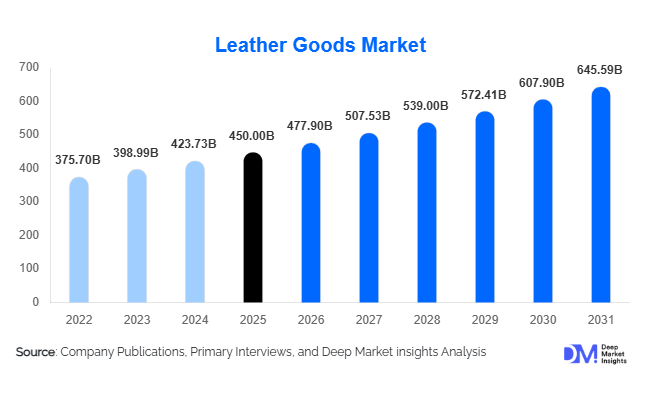
According to Deep Market Insights, the global leather goods market size was valued at USD 450.0 billion in 2025 and is projected to grow from USD 477.90 billion in 2026 to reach USD 645.59 billion by 2031, expanding at a CAGR of 6.2% during the forecast period (2026–2031). The leather goods market growth is primarily driven by rising global luxury consumption, increasing demand for fashion-oriented accessories, expanding automotive leather applications, and the rapid penetration of e-commerce and omnichannel retail channels across emerging economies.
Key Market Insights
- Luxury leather goods dominate high-value revenue generation, with premium brands accounting for a significant share of global profitability despite lower volume contribution.
- Asia-Pacific is the largest manufacturing and consumption hub, driven by China and India’s expanding middle-class population and fashion-driven demand.
- Automotive leather applications are expanding rapidly, particularly in electric and premium vehicles integrating high-end interiors.
- E-commerce penetration is reshaping distribution models, enabling direct-to-consumer luxury sales and improving global brand reach.
- Sustainability and vegan leather alternatives are influencing product innovation, pushing manufacturers toward eco-friendly tanning and bio-based materials.
- Europe remains the global luxury craftsmanship hub, particularly Italy and France, which dominate premium leather exports.
Leather Goods Market Trends
Shift Toward Sustainable and Alternative Materials
The leather goods industry is undergoing a structural transformation with increasing adoption of sustainable tanning processes, recycled leather, and plant-based alternatives. Regulatory pressure in Europe and consumer awareness in North America are pushing brands toward low-carbon production systems. Companies are investing heavily in waterless tanning, chrome-free processing, and circular economy models. Vegan leather made from pineapple fiber, mushrooms, and bio-polymers is gaining traction in fashion and automotive sectors, reshaping product development strategies globally.
Digitalization and Premium E-Commerce Expansion
Luxury leather brands are increasingly adopting digital-first strategies, including AI-driven personalization, virtual try-ons, and direct-to-consumer platforms. Online luxury sales are growing rapidly, particularly among younger consumers in Asia-Pacific and North America. Social commerce and influencer-led marketing are significantly impacting purchasing decisions. Brands are also integrating blockchain-based authentication systems to combat counterfeiting and enhance transparency across global supply chains.
Leather Goods Market Drivers
Rising Global Luxury Consumption
The expansion of high-net-worth populations across Asia-Pacific, the Middle East, and North America is significantly driving demand for luxury leather goods. Premium handbags, wallets, footwear, and apparel are increasingly viewed as status symbols. Emerging economies such as India and China are witnessing strong aspirational consumption patterns, fueling growth in branded leather products and accelerating premiumization across urban markets.
Growth of Automotive and Industrial Applications
Leather usage in automotive interiors is expanding rapidly, particularly in electric vehicles and luxury cars where premium interiors are a key differentiator. Automotive manufacturers are integrating high-quality leather seating, dashboards, and trims to enhance user experience. Additionally, industrial applications such as protective gear and upholstery are contributing steady demand, supported by global manufacturing and infrastructure growth.
Leather Goods Market Restraints
Rising Competition from Synthetic and Vegan Alternatives
The increasing adoption of synthetic leather and bio-based alternatives is creating competitive pressure on traditional leather manufacturers. Ethical concerns, environmental sustainability, and cost advantages of synthetic materials are shifting consumer preferences, particularly in mid-range fashion segments. This trend is forcing traditional manufacturers to invest in innovation and sustainability to maintain market relevance.
Raw Material Price Volatility
The leather industry is highly dependent on livestock-derived raw materials, which are subject to supply fluctuations, regulatory changes, and environmental conditions. Price volatility of animal hides directly impacts production costs and profit margins. This instability creates challenges for manufacturers in maintaining consistent pricing and long-term supply chain efficiency.
Leather Goods Market Opportunities
Expansion of Sustainable Luxury Ecosystem
There is a growing opportunity for brands to develop sustainable luxury leather goods using eco-friendly tanning processes and recyclable materials. Consumers are increasingly willing to pay premium prices for ethically produced products. This shift is encouraging investment in green manufacturing technologies and circular production systems, especially in Europe and North America.
Growth of Direct-to-Consumer Luxury Channels
Digital commerce is enabling leather goods manufacturers to bypass traditional retail channels and engage directly with consumers. This model improves profit margins and enhances brand control over customer experience. Emerging markets in Asia-Pacific are particularly driving this shift, supported by increasing smartphone penetration and digital payment adoption.
Report Scope
| Report Metric | Details |
|---|---|
| Market Size in 2025 | USD 450 Billion |
| Market Size in 2026 | USD 477.90 Billion |
| Market Size in 2031 | USD 645.59 Billion |
| CAGR | 6.2% (2026-2031) |
| Base Year for Estimation | 2025 |
| Historical Data | 2022-2024 |
| Forecast Period | 2026-2031 |
| Report Coverage | Revenue Forecast, Competitive Landscape, Supply Chain Disruption, Growth Factors, Environment & Regulatory Landscape and Trends |
| Geographies Covered | North America, Europe, APAC, Middle East and Africa, LATAM |
| Countries Covered | U.S., Canada, U.K., Germany, France, Spain, Italy, Russia, Nordic, Benelux, Rest of Europe, China, Korea, Japan, India, Australia, Singapore, Taiwan, South East Asia, Rest of Asia-Pacific, UAE, Turky, Saudi Arabia, South Africa, Egypt, Nigeria, Rest of MEA, Brazil, Mexico, Argentina, Chile, Colombia, Rest of LATAM |
Explore more data points, trends and opportunities Download Free Sample Report
Product Type Insights
Leather footwear remains the dominant product category in the global leather goods market, accounting for approximately 35% of total market share in 2025. This leadership is primarily driven by its essential daily usage, strong integration with both formal and casual fashion trends, and the widespread presence of large-scale manufacturing hubs in Asia-Pacific and Europe. Rising urbanization, expanding working-class populations, and increasing demand for durable yet stylish footwear continue to reinforce this segment’s global dominance. Additionally, innovations in comfort technology, lightweight soles, and sustainable leather alternatives are further accelerating demand across both premium and mass-market categories.
Leather bags and luggage represent the second-largest segment with nearly 28% share, supported by the rapid growth of global travel, tourism recovery post-pandemic, and increasing demand for luxury handbags as status symbols. Premium branding by global luxury houses and the expansion of e-commerce-driven handbag sales are significantly boosting this category. Leather accessories, including wallets, belts, and small leather goods, account for approximately 15% share, driven by frequent replacement cycles, gifting culture, and strong penetration in both developed and emerging markets. Leather apparel holds nearly 12% share, led by high-end fashion jackets and coats, particularly in Europe and North America where seasonal demand and luxury fashion cycles are strong. Industrial leather goods, including automotive interiors and upholstery applications, contribute around 10% share, with steady growth driven by increasing automotive production, EV interior upgrades, and infrastructure expansion globally.
Application Insights
Fashion and lifestyle applications dominate the leather goods market, accounting for nearly 45% of total demand. This dominance is driven by strong luxury branding, rising disposable incomes, and the increasing influence of global fashion trends, particularly among younger consumers. The automotive segment holds approximately 20% share, supported by premium vehicle production, rising demand for electric vehicles, and the use of leather in high-end interior customization. Furniture and home décor applications contribute around 15%, fueled by growing demand for luxury interiors, premium housing developments, and hospitality sector expansion. Industrial and protective applications make up the remaining share, supported by manufacturing, construction, and safety equipment industries.
Emerging applications such as smart leather materials integrated with sensors and wearable technologies are gaining traction, particularly in automotive seating systems and luxury fashion accessories. These innovations are expected to create new high-value revenue streams in the long term as digitalization and material science converge within the leather ecosystem.
Distribution Channel Insights
Offline retail remains the dominant distribution channel in the leather goods market, accounting for approximately 55% of global sales. Luxury boutiques, departmental stores, and exclusive brand outlets continue to play a critical role in high-value purchases, where physical experience and brand interaction are essential. However, online retail is rapidly expanding and now contributes around 30% share, driven by the rise of e-commerce platforms, direct-to-consumer (D2C) brand strategies, and increasing digital adoption among younger consumers.
Specialty stores account for approximately 10% share, focusing on handcrafted, niche, and premium leather products that emphasize craftsmanship and uniqueness. Wholesale and OEM channels contribute the remaining share, primarily serving industrial applications such as automotive interiors, upholstery, and bulk institutional procurement. The shift toward omnichannel retail strategies is increasingly blurring traditional boundaries between offline and online purchasing journeys.
Explore more data points, trends and opportunities Download Free Sample Report
Leather Goods Market Segmentations
By Product Type
- Leather Footwear
- Leather Bags & Luggage
- Leather Accessories
- Leather Apparel
- Industrial Leather Goods
By Application
- Fashion & Lifestyle
- Automotive
- Furniture & Home Décor
- Industrial & Protective Applications
- Emerging Smart Leather Applications
By Distribution Channel
- Offline Retail
- Online Retail
- Specialty Stores
- Wholesale & OEM Channels
Regional Insights
North America
North America accounts for approximately 22% of the global leather goods market, with the United States being the primary contributor. The region’s growth is driven by strong luxury consumption, high disposable income levels, and increasing demand for premium and branded leather products. Automotive leather applications also play a significant role due to the strong presence of premium vehicle manufacturers. Additionally, advanced e-commerce infrastructure and high digital penetration are accelerating online leather goods sales. Rising luxury lifestyle adoption, strong automotive interior demand, high e-commerce penetration, and increasing preference for sustainable and ethically sourced leather products.
Europe
Europe holds nearly 27% market share, led by Italy, France, and Germany, which collectively form the global center for luxury leather craftsmanship. The region benefits from strong heritage brands, high fashion consciousness, and established export networks. Europe also leads in sustainability innovation, with strict environmental regulations driving eco-friendly leather production and circular economy initiatives. Strong luxury fashion ecosystem, dominance of heritage brands, stringent sustainability regulations, and high export-oriented production of premium leather goods.
Asia-Pacific
Asia-Pacific dominates the global leather goods market with approximately 38% share and is also the fastest-growing region. China and India are the primary growth engines, supported by rapid urbanization, rising middle-class income, and expanding retail infrastructure. The region is also a major global manufacturing hub, supplying both mass-market and premium leather goods worldwide. Expanding middle-class population, rapid urbanization, strong manufacturing base, increasing luxury consumption, and rapid growth of organized retail and e-commerce platforms.
Latin America
Latin America accounts for around 6% of the global market, with Brazil and Mexico leading regional demand. Growth is driven by rising disposable incomes, increasing fashion awareness, and gradual expansion of organized retail networks. The region is also witnessing growing interest in imported luxury leather goods and mid-range fashion accessories. Expanding middle-income population, rising fashion retail penetration, increasing import of luxury goods, and gradual urban retail modernization.
Middle East & Africa
The Middle East & Africa region holds approximately 7% market share, supported by strong luxury demand in countries such as the UAE, Saudi Arabia, and Qatar. High-income consumer bases, tourism-driven retail growth, and strong demand for premium imported leather goods are key contributors. Africa is also emerging as a manufacturing and sourcing hub, particularly for raw hides and semi-processed leather materials. High luxury spending capacity, tourism-driven retail expansion, increasing demand for premium imported leather goods, and growing leather processing industries in Africa.
Key Players in the Leather Goods Market
- LVMH
- Kering
- Hermès
- Tapestry Inc.
- Prada Group
- Chanel
- Richemont
- Burberry Group
- Capri Holdings
- VF Corporation
- Samsonite International
- Tod’s Group
- Fossil Group
- Wolverine World Wide
- Deckers Outdoor Corporation