Baby Skincare Products Market Size
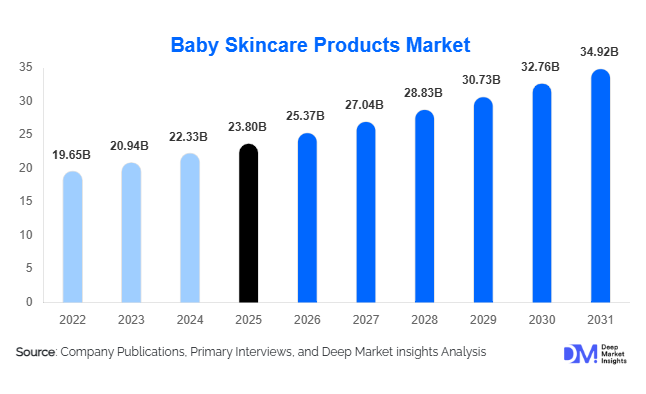
According to Deep Market Insights, the global baby skincare products market size was valued at USD 23.8 billion in 2025 and is projected to grow from USD 25.37 billion in 2026 to reach USD 34.92 billion by 2031, expanding at a CAGR of 6.6% during the forecast period (2026–2031). The market growth is primarily driven by increasing parental awareness regarding infant skin health, rising demand for natural and organic skincare formulations, growing disposable income levels across emerging economies, and continued innovation in dermatologist-tested and hypoallergenic baby care products. The market is also benefiting from premiumization trends, expanding e-commerce penetration, and the growing prevalence of sensitive skin and eczema-related conditions among infants.
Key Market Insights
- Natural and organic baby skincare products are gaining significant traction, as parents increasingly seek clean-label formulations free from parabens, sulfates, synthetic fragrances, and harsh chemicals.
- Premium baby skincare products account for the largest revenue share globally, supported by strong consumer preference for clinically tested, dermatologist-approved, and hypoallergenic formulations.
- Asia-Pacific dominates the global market, led by China, India, Japan, and South Korea, supported by large infant populations and increasing household spending on infant wellness.
- India represents the fastest-growing national market, driven by rising birth rates, increasing urbanization, and expanding availability of premium baby care products.
- E-commerce has become a major distribution channel, enabling brands to reach digitally connected parents through direct-to-consumer platforms and online marketplaces.
- Innovation in microbiome-friendly and therapeutic baby skincare is creating new growth opportunities for manufacturers targeting eczema-prone and sensitive infant skin.
Baby Skincare Products Market Trends
Growing Preference for Clean-Label and Organic Formulations
Consumer preferences are rapidly shifting toward baby skincare products formulated with naturally derived ingredients, organic plant extracts, and environmentally sustainable sourcing practices. Parents are increasingly scrutinizing ingredient labels and prioritizing products that avoid controversial chemicals. Manufacturers are responding by introducing certified organic lotions, creams, oils, and diaper care products enriched with ingredients such as calendula, chamomile, shea butter, aloe vera, and coconut oil. Premium brands are further differentiating themselves through cruelty-free certifications, vegan formulations, and sustainable packaging solutions. This trend is particularly strong across North America and Europe but is increasingly influencing purchasing behavior in emerging economies as well.
Rise of Therapeutic and Sensitive-Skin Solutions
The growing prevalence of infant eczema, dryness, allergies, and skin sensitivities is driving demand for specialized skincare products. Manufacturers are increasingly developing therapeutic formulations that support skin barrier function, reduce irritation, and provide targeted relief for dermatological conditions. Pediatricians and dermatologists are playing a greater role in influencing product recommendations, encouraging adoption of clinically validated solutions. New product launches increasingly emphasize hypoallergenic properties, fragrance-free compositions, microbiome-friendly ingredients, and pediatric testing protocols. This trend is expected to significantly expand the premium skincare category during the forecast period.
Baby Skincare Products Market Drivers
Increasing Awareness of Infant Skin Health
Growing awareness among parents regarding the importance of specialized infant skincare is one of the primary growth drivers. Unlike adult skin, infant skin is thinner, more sensitive, and more vulnerable to environmental irritants. Educational campaigns by healthcare providers, pediatricians, and baby care brands have increased understanding of proper skincare practices, leading to greater demand for moisturizing lotions, barrier creams, and therapeutic skincare products. Rising healthcare literacy across both developed and developing economies continues to strengthen market expansion.
Premiumization of Baby Care Products
The baby skincare market continues to benefit from premiumization trends as parents increasingly prioritize product quality and safety over price considerations. Premium formulations containing organic ingredients, dermatologically tested compounds, and clinically proven active ingredients are achieving faster growth than conventional products. Consumers are willing to pay higher prices for trusted brands that offer superior efficacy, ingredient transparency, and safety assurances, resulting in improved margins for manufacturers.
Baby Skincare Products Market Restraints
Stringent Product Safety Regulations
Infant skincare products are subject to rigorous regulatory requirements across major markets. Compliance with safety standards, ingredient restrictions, testing protocols, and certification requirements increases product development costs and lengthens commercialization timelines. Smaller manufacturers often face challenges meeting these regulatory expectations, limiting market entry and expansion opportunities.
Volatility in Natural Raw Material Costs
The growing use of botanical extracts, essential oils, and organic ingredients has increased exposure to fluctuations in agricultural commodity prices. Supply chain disruptions, adverse weather conditions, and changing agricultural yields can significantly impact ingredient availability and manufacturing costs. These cost pressures can affect profit margins and pricing strategies, particularly in premium product segments.
Baby Skincare Products Market Opportunities
Expansion of Organic and Sustainable Baby Care
The continued shift toward organic and environmentally responsible products presents a major growth opportunity for market participants. Parents increasingly associate natural ingredients with improved safety and efficacy, creating opportunities for manufacturers to launch certified organic product lines. Sustainable packaging initiatives, carbon-neutral manufacturing processes, and ethical sourcing programs are becoming important differentiators. Companies capable of combining product safety, environmental responsibility, and premium quality are expected to gain significant competitive advantages over the coming years.
Personalized and Technology-Driven Infant Skincare
Advancements in dermatological research and digital health technologies are creating opportunities for personalized baby skincare solutions. Emerging technologies enable customized recommendations based on skin type, environmental factors, and specific skin conditions. Manufacturers are investing in microbiome research, AI-assisted skin assessment tools, and direct-to-consumer subscription models that offer tailored skincare regimens. These innovations are expected to create new premium segments while strengthening consumer engagement and brand loyalty.
Report Scope
| Report Metric | Details |
|---|---|
| Market Size in 2025 | USD 23.8 Billion |
| Market Size in 2026 | USD 25.37 Billion |
| Market Size in 2031 | USD 34.92 Billion |
| CAGR | 6.6% (2026-2031) |
| Base Year for Estimation | 2025 |
| Historical Data | 2022-2024 |
| Forecast Period | 2026-2031 |
| Report Coverage | Revenue Forecast, Competitive Landscape, Supply Chain Disruption, Growth Factors, Environment & Regulatory Landscape and Trends |
| Geographies Covered | North America, Europe, APAC, Middle East and Africa, LATAM |
| Countries Covered | U.S., Canada, U.K., Germany, France, Spain, Italy, Russia, Nordic, Benelux, Rest of Europe, China, Korea, Japan, India, Australia, Singapore, Taiwan, South East Asia, Rest of Asia-Pacific, UAE, Turky, Saudi Arabia, South Africa, Egypt, Nigeria, Rest of MEA, Brazil, Mexico, Argentina, Chile, Colombia, Rest of LATAM |
Explore more data points, trends and opportunities Download Free Sample Report
Product Type Insights
Baby lotions dominated the global baby skincare products market, accounting for approximately 32% of total revenue in 2025, making them the leading product category worldwide. The segment's leadership is primarily driven by the increasing emphasis on daily infant skincare routines and the widespread recommendation of moisturization by pediatricians and dermatologists to support healthy skin barrier development. Rising incidences of dry skin conditions among infants, particularly in urban environments with greater exposure to pollution and air-conditioned indoor settings, have further accelerated demand. Premium lotion variants formulated with natural ingredients, ceramides, oat extracts, shea butter, and hypoallergenic ingredients are witnessing particularly strong adoption across North America and Europe.
Baby creams represent the second-largest product segment, supported by growing demand for diaper rash creams, protective barrier creams, and therapeutic formulations designed to address skin irritation, redness, and dermatitis. The increasing prevalence of diaper dermatitis and eczema among newborns continues to drive product innovation and premiumization within this category. Meanwhile, baby oils maintain strong demand throughout Asia-Pacific, particularly in India, China, Indonesia, and other markets where infant massage remains deeply embedded in cultural childcare practices. Baby sunscreen products are emerging as one of the fastest-growing categories globally, fueled by increasing awareness regarding UV-related skin damage, growing outdoor recreational activities among young families, and expanding pediatric recommendations for sun protection products.
Ingredient Type Insights
Natural ingredient-based formulations accounted for approximately 41% of global market revenue in 2025, making them the leading ingredient category. Their dominance is being driven by growing parental concerns regarding synthetic chemicals, preservatives, artificial fragrances, and potential allergens commonly found in conventional skincare products. Consumers increasingly associate botanical ingredients such as aloe vera, calendula, chamomile, coconut oil, jojoba oil, and shea butter with improved safety, gentleness, and skin compatibility for infants.
The strongest growth momentum is currently observed within the organic-certified product segment, supported by rising consumer willingness to pay premium prices for products carrying recognized organic certifications and clean-label claims. The segment is benefiting from broader wellness and sustainability trends influencing household purchasing behavior globally. While conventional formulations continue to maintain significant volume sales, particularly across price-sensitive emerging markets, demand is gradually shifting toward premium natural alternatives. Furthermore, hypoallergenic, fragrance-free, and dermatologist-tested formulations are gaining substantial traction as rising cases of infant eczema, allergies, and skin sensitivities encourage parents to seek clinically validated skincare solutions with minimal irritation risk.
Distribution Channel Insights
Supermarkets and hypermarkets remained the leading distribution channel, accounting for approximately 34% of global sales in 2025. Their dominance is supported by broad product availability, strong consumer trust, competitive pricing structures, and the convenience of one-stop shopping for household and baby care essentials. Large retail chains continue to benefit from extensive promotional activities, product bundling strategies, and dedicated baby care sections that encourage impulse purchases and brand visibility.
Pharmacies and drugstores continue to maintain an important market position, particularly for therapeutic, dermatologist-recommended, and premium skincare products. Parents often associate pharmacy-purchased baby skincare products with higher safety standards and medical credibility. However, online retail is the fastest-growing distribution channel globally, driven by increasing internet penetration, smartphone adoption, and changing consumer shopping behaviors. E-commerce marketplaces, direct-to-consumer platforms, and subscription-based baby care services are enabling brands to engage consumers more effectively while expanding market reach into underserved regions. Social media marketing, parenting influencers, digital product reviews, and personalized recommendation algorithms are further strengthening online purchasing activity and accelerating channel growth.
End-User Insights
Individual households accounted for approximately 81% of global market demand in 2025, making them by far the largest end-user segment. The segment's leadership is driven by increasing parental focus on preventive skincare practices and growing awareness regarding the long-term importance of maintaining infant skin health. Parents are increasingly incorporating specialized skincare products, including lotions, creams, oils, and therapeutic formulations, into daily childcare routines, creating recurring demand across multiple product categories.
The institutional segment, including hospitals, maternity centers, neonatal intensive care units (NICUs), and pediatric clinics, is emerging as an important growth contributor. Hospitals and maternity centers are increasingly implementing standardized neonatal skincare protocols that prioritize clinically tested and hypoallergenic products. Demand from NICUs is expanding as healthcare providers adopt specialized skincare solutions designed for premature and medically vulnerable infants. Additionally, pediatric clinics are increasingly recommending dermatologist-approved products for infants suffering from eczema, dermatitis, and allergy-related skin conditions, creating opportunities for premium and therapeutic baby skincare brands to strengthen market penetration.
Explore more data points, trends and opportunities Download Free Sample Report
Baby Skincare Products Market Segmentations
By Product Type
- Baby Lotions
- Baby Creams
- Baby Oils
- Baby Powders
- Baby Ointments
- Baby Sunscreen Products
- Baby Lip Care Products
- Baby Skin Cleansing Products
- Baby Skin Treatment Products
- Baby Gift & Skincare Kits
By Ingredient Type
- Natural Formulations
- Organic Certified Products
- Plant-Based Formulations
- Conventional/Synthetic Formulations
- Hypoallergenic Formulations
- Fragrance-Free Formulations
- Dermatologist-Tested Formulations
By Distribution Channel
- Supermarkets & Hypermarkets
- Pharmacies & Drugstores
- Specialty Baby Stores
- Department Stores
- Online Retail
- Direct Selling
By End User
- Individual Households
- Hospitals & Maternity Centers
- Neonatal Intensive Care Units (NICUs)
- Daycare Centers
- Pediatric Clinics
Regional Insights
Asia-Pacific
Asia-Pacific accounted for approximately 40% of global market revenue in 2025, making it the largest regional market. The region's leadership is supported by its large infant population base, rising disposable incomes, rapid urbanization, and increasing healthcare awareness among parents. China remains the largest market within the region, benefiting from continued premiumization of infant care products and strong demand for imported and clinically tested baby skincare brands. India represents the fastest-growing national market globally, driven by high birth rates, growing middle-class purchasing power, increasing penetration of organized retail channels, and rising awareness regarding infant hygiene and skincare. Japan and South Korea contribute significantly through demand for technologically advanced, dermatologically tested, and premium skincare formulations. Additionally, the widespread cultural practice of infant massage across several Asian countries continues to support strong demand for baby oils and moisturizing products.
North America
North America accounted for approximately 28% of global market revenue in 2025, with the United States representing the dominant market. Regional growth is primarily driven by high consumer spending power, widespread adoption of premium and organic baby skincare products, and strong parental awareness regarding ingredient safety and infant wellness. The increasing prevalence of infant eczema and sensitive skin conditions has accelerated demand for therapeutic and dermatologist-recommended products. Consumers across the United States and Canada are also highly receptive to clean-label, fragrance-free, and environmentally sustainable formulations. The region's advanced e-commerce ecosystem, strong healthcare infrastructure, and active pediatric recommendation networks continue to support premium product adoption and market expansion.
Europe
Europe accounted for approximately 22% of global market revenue in 2025, with Germany, France, the United Kingdom, Italy, and Spain representing the largest national markets. Regional demand is being driven by stringent product safety regulations, increasing consumer focus on sustainability, and strong preference for organic and natural formulations. European parents place significant emphasis on ingredient transparency, dermatological testing, and environmentally responsible manufacturing practices. The region's mature retail infrastructure and high purchasing power support strong penetration of premium baby skincare brands. Furthermore, growing demand for certified organic products and sustainable packaging solutions continues to encourage innovation and premiumization across the European market.
Latin America
Latin America is experiencing steady growth, led primarily by Brazil and Mexico. Market expansion is being supported by increasing urbanization, improving healthcare access, rising disposable incomes, and expanding awareness regarding infant skincare and hygiene. The growth of organized retail and e-commerce platforms has significantly improved product accessibility across major metropolitan areas. Premium baby skincare products are gradually gaining acceptance among middle-income consumers, while multinational brands continue to expand their presence through localized product offerings and affordability-focused pricing strategies.
Middle East & Africa
The Middle East and Africa market is witnessing consistent growth driven by rising healthcare expenditure, improving retail infrastructure, and growing consumer awareness regarding infant wellness. Saudi Arabia and the United Arab Emirates are leading regional demand, supported by high per-capita income levels, strong preference for premium imported products, and expanding premium retail channels. In Africa, countries such as South Africa and Egypt are benefiting from improving healthcare systems, increasing urban populations, and greater access to branded baby care products. Rising birth rates across several African countries, combined with growing investments in maternal and child healthcare programs, are expected to create long-term growth opportunities for baby skincare manufacturers throughout the region.
Key Players in the Baby Skincare Products Market
- Johnson & Johnson
- Procter & Gamble
- Unilever
- Beiersdorf AG
- Laboratoires Expanscience (Mustela)
- Sebapharma GmbH & Co. KG
- Himalaya Wellness Company
- Pigeon Corporation
- Artsana Group (Chicco)
- The Honest Company
- California Baby
- Kenvue Inc.
- Weleda AG
- Burt's Bees Baby
- Sanosan GmbH