Automatic Hair Curler Market Size
According to Deep Market Insights, the global automatic hair curler market size was valued at USD 1,720 million in 2025 and is projected to grow from USD 1,879.96 million in 2026 to reach USD 2,932.58 million by 2031, expanding at a CAGR of 9.3% during the forecast period (2026–2031). The automatic hair curler market growth is primarily driven by increasing consumer interest in personal grooming, the expansion of digital beauty culture through social media platforms, and continuous technological innovation in hair styling appliances. Automatic curlers provide users with consistent salon-like results while reducing the complexity associated with traditional curling irons, making them increasingly popular among both professional stylists and everyday consumers.
The market has evolved rapidly as manufacturers introduce advanced features such as intelligent heat control systems, anti-tangle sensors, ceramic and tourmaline-coated barrels, and cordless lithium-ion powered styling devices. The growing popularity of DIY hair styling and the rising influence of beauty influencers and digital tutorials are also contributing significantly to market expansion. Furthermore, the increasing availability of these products through e-commerce platforms has improved accessibility in emerging markets. As consumers increasingly prioritize convenience, hair protection technologies, and portability, the demand for automatic hair curlers is expected to remain strong throughout the forecast period.
Key Market Insights
- Home styling appliances are becoming mainstream beauty essentials, with automatic hair curlers offering convenient and consistent styling results without professional assistance.
- Technological innovation in ceramic, tourmaline, and titanium barrel coatings is improving heat distribution while reducing hair damage, increasing consumer adoption.
- North America currently dominates the market due to high consumer spending on personal care appliances and strong brand penetration.
- Asia-Pacific is the fastest-growing region, supported by expanding middle-class income levels and growing online beauty retail channels.
- E-commerce platforms are reshaping product distribution, enabling direct-to-consumer sales, influencer-driven marketing, and wider product availability.
- Cordless and smart hair styling tools are emerging as key innovation areas, with manufacturers integrating sensors, fast heating systems, and portable battery technology.
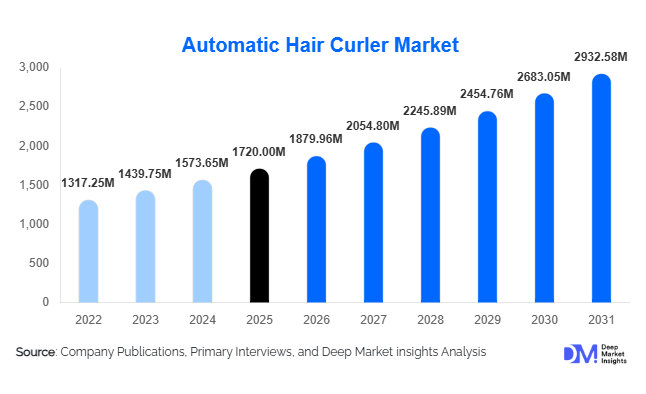
What are the latest trends in the automatic hair curler market?
Rise of Smart Beauty Appliances
Smart technology integration is becoming a defining trend within the automatic hair curler market. Manufacturers are increasingly introducing devices equipped with intelligent heat sensors, automatic curl timers, and customizable temperature settings that adjust based on hair type and styling preferences. These smart devices help reduce hair damage while improving styling efficiency, making them particularly attractive to consumers who prioritize hair health and ease of use. Some premium brands are experimenting with Bluetooth-enabled styling tools that allow users to control device settings through mobile applications, store preferred styling profiles, and access guided tutorials. As the broader beauty technology ecosystem evolves, automatic hair curlers are expected to become part of connected personal care routines, particularly among tech-savvy consumers.
Growing Demand for Cordless and Travel-Friendly Styling Tools
Portability has become a key purchasing factor in the hair styling appliances market. Cordless automatic hair curlers powered by rechargeable lithium-ion batteries are gaining popularity among consumers who frequently travel or require on-the-go styling solutions. These devices eliminate the inconvenience of power cords and provide flexibility for styling in different environments. Improvements in battery capacity and rapid charging technology have made cordless styling tools more reliable and efficient. Additionally, lightweight and compact product designs are appealing to younger consumers who prefer convenient beauty solutions that can easily fit into travel kits or handbags. This trend is expected to drive innovation in battery-powered beauty appliances across global markets.
What are the key drivers in the automatic hair curler market?
Increasing Consumer Focus on Personal Grooming
Personal grooming has become an important aspect of modern lifestyle trends worldwide. Consumers are increasingly investing in beauty and personal care appliances that enable them to achieve professional styling results at home. The rise of digital beauty content, including tutorials and influencer-driven product reviews, has significantly influenced consumer purchasing behavior. Automatic hair curlers provide a convenient alternative to traditional styling tools by simplifying the curling process and delivering consistent results. This convenience factor has made them especially popular among younger consumers and working professionals who seek quick and reliable styling solutions.
Expansion of the Global Beauty Appliances Industry
The broader beauty appliances industry, including hair dryers, straighteners, and curling tools, continues to experience steady growth as consumers prioritize convenience and self-care. Automatic hair curlers are benefiting from this expansion due to their ability to replicate salon-quality styling results without requiring professional skills. Advances in heating technologies, ionic conditioning, and ceramic coatings have enhanced product performance while improving hair protection. These innovations encourage consumers to upgrade their styling devices more frequently, supporting long-term market growth.
What are the restraints for the global market?
High Cost of Premium Styling Devices
Although automatic hair curlers offer superior convenience and styling efficiency, premium devices often carry significantly higher price tags compared to conventional curling irons. High-end models equipped with advanced technologies such as smart heat sensors and cordless battery systems may cost more than USD 200. This price barrier can limit adoption among price-sensitive consumers, particularly in developing markets where affordability remains a key purchasing factor.
Competition from Traditional Hair Styling Tools
Traditional curling irons and manual styling tools continue to compete with automatic curlers due to their lower price points and versatility. Many professional stylists prefer manual tools because they allow greater control over curl shapes and styling techniques. This preference can slow the adoption of automatic curlers in certain professional segments of the hair styling industry.
What are the key opportunities in the automatic hair curler industry?
Expansion in Emerging Beauty Markets
Emerging economies such as India, Brazil, Indonesia, and Vietnam represent significant growth opportunities for automatic hair curler manufacturers. Rapid urbanization, increasing disposable incomes, and expanding middle-class populations are driving demand for personal grooming products in these regions. The growth of beauty salons and freelance stylists is also increasing professional demand for efficient styling equipment. Companies that establish strong distribution networks and localized product offerings in these markets can benefit from significant long-term demand growth.
E-Commerce and Social Commerce Expansion
Online retail channels are becoming increasingly important for the distribution of personal care appliances. E-commerce platforms allow consumers to easily compare products, read reviews, and access influencer recommendations before making purchasing decisions. Social media marketing and live-streamed product demonstrations are also influencing consumer behavior, particularly among younger demographics. By leveraging digital marketing strategies and direct-to-consumer sales channels, brands can expand their global reach and improve customer engagement.
Report Scope
| Report Metric | Details |
|---|---|
| Market Size in 2025 | USD 1720 Million |
| Market Size in 2026 | USD 1879.96 Million |
| Market Size in 2031 | USD 2932.58 Million |
| CAGR | 9.3% (2026-2031) |
| Base Year for Estimation | 2025 |
| Historical Data | 2022-2024 |
| Forecast Period | 2026-2031 |
| Report Coverage | Revenue Forecast, Competitive Landscape, Supply Chain Disruption, Growth Factors, Environment & Regulatory Landscape and Trends |
| Geographies Covered | North America, Europe, APAC, Middle East and Africa, LATAM |
| Countries Covered | U.S., Canada, U.K., Germany, France, Spain, Italy, Russia, Nordic, Benelux, Rest of Europe, China, Korea, Japan, India, Australia, Singapore, Taiwan, South East Asia, Rest of Asia-Pacific, UAE, Turky, Saudi Arabia, South Africa, Egypt, Nigeria, Rest of MEA, Brazil, Mexico, Argentina, Chile, Colombia, Rest of LATAM |
Explore more data points, trends and opportunities Download Free Sample Report
Product Type Insights
Fully automatic curlers dominate the product segment, accounting for more than half of global market demand. These devices feature rotating chambers that automatically wrap hair strands and create consistent curls with minimal user effort. Their ease of use has made them particularly popular among home consumers who may not have professional hairstyling experience. Semi-automatic curlers remain widely used due to their lower price points and greater styling flexibility. Cordless automatic curlers are emerging as one of the fastest-growing product categories due to increasing demand for portable beauty appliances. Multi-styling devices that combine curling, waving, and straightening functions are also gaining popularity as consumers seek versatile grooming tools that reduce the need for multiple styling appliances.
Application Insights
Home styling applications account for the largest share of the automatic hair curler market, representing approximately 70% of global demand. The growing popularity of do-it-yourself grooming and the widespread availability of online beauty tutorials have encouraged consumers to invest in professional-grade styling tools for personal use. Professional salons represent the second-largest application segment, as stylists use automatic curlers to improve efficiency when handling high volumes of clients. Additionally, the entertainment and fashion industries are emerging as niche application segments where hairstylists require reliable styling tools for film productions, fashion shows, and media appearances. Beauty training institutes and cosmetology schools also contribute to demand by incorporating automatic styling tools into professional training programs.
Distribution Channel Insights
Online retail platforms have become the dominant distribution channel for automatic hair curlers, accounting for more than half of global sales. E-commerce marketplaces and brand-owned websites enable consumers to access a wide variety of styling devices while comparing prices, reviews, and product features. Offline retail channels such as beauty specialty stores, consumer electronics retailers, and department stores continue to play an important role in product demonstrations and brand visibility. Professional salon distributors represent another key channel, supplying high-end styling equipment directly to salons and hairstylists. Increasing integration of influencer marketing and social media promotions is further strengthening digital distribution channels within the industry.
End-User Insights
Individual consumers represent the largest end-user segment in the automatic hair curler market, accounting for more than two-thirds of global demand. These users primarily purchase styling devices for home grooming purposes and are influenced by online beauty trends, influencer recommendations, and product reviews. Professional salons also contribute significantly to market demand as stylists adopt automatic curlers to enhance productivity and maintain consistent styling quality. Beauty schools and training institutes represent a smaller but stable segment, as these institutions incorporate modern styling tools into their training programs to prepare students for professional careers in hairstyling.
Explore more data points, trends and opportunities Download Free Sample Report
Automatic Hair Curler Market Segmentations
By Product Type
- Fully Automatic Curlers
- Semi-Automatic Curlers
- Cordless Automatic Curlers
- Multi-Styling Automatic Curlers
By Barrel Material
- Ceramic Barrel Curlers
- Tourmaline Ceramic Curlers
- Titanium Barrel Curlers
- Ceramic-Coated Aluminum Curlers
By Power Source
- Corded Electric Curlers
- Rechargeable Battery Curlers
- Dual-Mode Curlers (Corded + Rechargeable)
By Distribution Channel
- Online Retail
- Beauty Specialty Stores
- Consumer Electronics Stores
- Department Stores / Hypermarkets
- Professional Salon Distributors
By End-User
- Individual Consumers (Home Styling)
- Professional Salons & Stylists
- Beauty Schools & Training Institutes
- Film, Fashion & Entertainment Industry Stylists
Regional Insights
North America
North America holds the largest share of the global automatic hair curler market, accounting for approximately 32% of total revenue in 2025. The United States represents the dominant country in this region due to high consumer spending on beauty and personal care products. The presence of major beauty appliance brands, strong e-commerce penetration, and widespread adoption of home grooming tools support regional market growth. Consumers in North America also show strong demand for premium styling devices equipped with advanced heat protection technologies.
Europe
Europe accounts for nearly 25% of the global automatic hair curler market, with major demand coming from countries such as Germany, the United Kingdom, France, and Italy. European consumers tend to prioritize hair health and product durability, driving demand for ceramic and tourmaline-coated styling devices. The region also has a strong professional salon industry, which contributes to demand for high-performance styling equipment.
Asia-Pacific
Asia-Pacific represents one of the fastest-growing regions in the market, accounting for approximately 30% of global demand. China is both a major manufacturing hub and a large consumer market for hair styling appliances. Japan and South Korea demonstrate strong demand due to fashion-forward beauty cultures and high adoption of innovative beauty technologies. India is also emerging as a high-growth market due to expanding e-commerce platforms and rising consumer awareness of personal grooming products.
Latin America
Latin America represents a smaller but steadily expanding market, led primarily by Brazil and Mexico. Growing beauty consciousness and expanding salon industries are supporting demand for hair styling appliances in these countries. Increasing online retail penetration is also improving product availability for consumers in the region.
Middle East & Africa
The Middle East and Africa region is experiencing gradual growth, particularly in countries such as the United Arab Emirates and Saudi Arabia. High disposable income levels and strong beauty culture in these markets contribute to increasing demand for premium styling devices. Additionally, expanding retail infrastructure and luxury beauty stores are improving product accessibility across major urban centers.