Artisanal Ice Creams Market Size
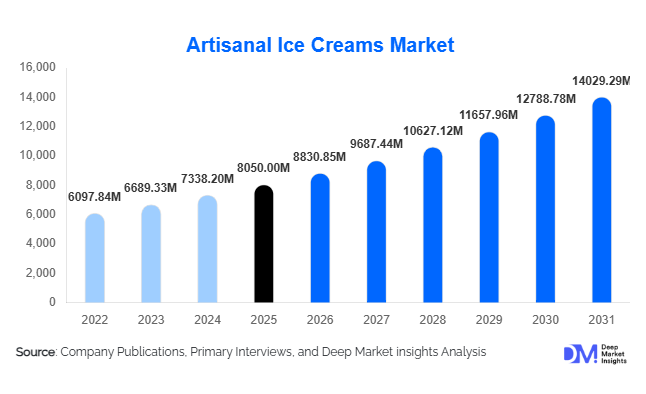
According to Deep Market Insights, the global artisanal ice creams market size was valued at USD 8,050 million in 2025 and is projected to grow from USD 8,830.85 million in 2026 to reach USD 14,029.29 million by 2031, expanding at a CAGR of 9.7% during the forecast period (2026–2031). The market growth is primarily driven by increasing consumer preference for premium, clean-label desserts, rising demand for innovative and gourmet flavors, and the growing influence of boutique dessert chains and café culture worldwide.
Key Market Insights
- Artisanal ice cream demand is shifting toward clean-label and natural ingredient-based products, reflecting increasing consumer awareness around health and transparency.
- Premium and gourmet flavors are gaining strong traction globally, driven by demand for unique and experiential dessert consumption.
- North America dominates the global market, supported by high disposable incomes and a mature premium dessert ecosystem.
- Asia-Pacific is the fastest-growing region, fueled by rising urbanization, westernization of diets, and expanding middle-class population.
- Direct-to-consumer (D2C) and online channels are rapidly expanding, enabling artisanal brands to scale beyond physical stores.
- Plant-based and dairy-free artisanal ice creams are emerging as a key growth segment, driven by veganism and lactose intolerance trends.
What are the latest trends in the artisanal ice creams market?
Rise of Gourmet and Experimental Flavors
Consumers are increasingly seeking novel taste experiences, leading to a surge in demand for gourmet and experimental flavors such as lavender, matcha, saffron, and salted caramel. Artisanal brands are focusing on seasonal and limited-edition offerings to create exclusivity and drive repeat purchases. This trend is particularly strong among millennials and Gen Z consumers who value uniqueness and social media-worthy food experiences. The incorporation of regional and culturally inspired flavors is also enhancing product differentiation and expanding global appeal.
Growth of Plant-Based and Clean-Label Products
The demand for dairy-free and clean-label ice creams is accelerating, driven by health-conscious consumers and the rise of vegan lifestyles. Artisanal producers are innovating with plant-based alternatives such as almond, oat, and coconut milk, offering comparable taste and texture to traditional dairy ice creams. Clean-label formulations, free from artificial additives and preservatives, are becoming a key selling point. This trend is further supported by regulatory emphasis on transparency and consumer demand for ethically sourced ingredients.
What are the key drivers in the artisanal ice creams market?
Growing Demand for Premium and Experiential Desserts
The increasing preference for premium food experiences is a major driver of the artisanal ice cream market. Consumers are willing to pay higher prices for products that offer superior quality, unique flavors, and authentic production methods. This trend is particularly evident in urban areas where disposable incomes are higher and consumers seek differentiated culinary experiences. Artisanal ice creams cater to this demand through small-batch production, high-quality ingredients, and creative flavor combinations.
Expansion of Café Culture and Boutique Dessert Chains
The rapid growth of café culture and specialty dessert outlets is significantly boosting demand for artisanal ice creams. These establishments provide a platform for brands to showcase their products and engage directly with consumers. The increasing number of boutique ice cream parlors and dessert cafés, particularly in emerging markets, is enhancing accessibility and driving market growth.
What are the restraints for the global market?
High Production Costs and Premium Pricing
Artisanal ice cream production involves high-quality ingredients and labor-intensive processes, leading to elevated production costs. This results in premium pricing, which can limit market penetration in price-sensitive regions. The challenge of maintaining affordability while preserving quality remains a key restraint for market players.
Cold Chain and Shelf-Life Limitations
The absence of preservatives in many artisanal ice creams results in shorter shelf life, necessitating efficient cold chain logistics. Maintaining product quality during transportation and storage can be challenging, particularly in regions with underdeveloped infrastructure. This constraint impacts scalability and distribution efficiency.
What are the key opportunities in the artisanal ice creams industry?
Expansion into Emerging Markets
Emerging economies in Asia-Pacific, Latin America, and the Middle East present significant growth opportunities due to rising disposable incomes and evolving consumer preferences. Urbanization and exposure to global food trends are driving demand for premium desserts in these regions. Companies can capitalize on this by introducing localized flavors and affordable premium offerings.
Direct-to-Consumer and Digital Expansion
The growth of e-commerce and direct-to-consumer models is enabling artisanal brands to reach a wider audience. Online platforms allow for personalized offerings, subscription models, and efficient customer engagement. Advancements in cold chain logistics are further supporting this trend, making it easier to deliver perishable products directly to consumers.
Report Scope
| Report Metric | Details |
|---|---|
| Market Size in 2025 | USD 8050 Million |
| Market Size in 2026 | USD 8830.85 Million |
| Market Size in 2031 | USD 14029.29 Million |
| CAGR | 9.7% (2026-2031) |
| Base Year for Estimation | 2025 |
| Historical Data | 2022-2024 |
| Forecast Period | 2026-2031 |
| Report Coverage | Revenue Forecast, Competitive Landscape, Supply Chain Disruption, Growth Factors, Environment & Regulatory Landscape and Trends |
| Geographies Covered | North America, Europe, APAC, Middle East and Africa, LATAM |
| Countries Covered | U.S., Canada, U.K., Germany, France, Spain, Italy, Russia, Nordic, Benelux, Rest of Europe, China, Korea, Japan, India, Australia, Singapore, Taiwan, South East Asia, Rest of Asia-Pacific, UAE, Turky, Saudi Arabia, South Africa, Egypt, Nigeria, Rest of MEA, Brazil, Mexico, Argentina, Chile, Colombia, Rest of LATAM |
Explore more data points, trends and opportunities Download Free Sample Report
Product Type Insights
The artisanal ice cream market is characterized by a diverse product portfolio, where differentiation in ingredients, texture, and perceived health benefits plays a crucial role in shaping consumer preferences. Among the various product types, gelato continues to dominate the global market, accounting for approximately 28% of total share. The strong performance of gelato can be attributed to its lower fat content, dense and creamy texture, and intense flavor profiles, which align well with the evolving preferences of health-conscious consumers seeking indulgence with moderation. Additionally, the influence of European dessert culture, particularly from countries such as Italy, has elevated gelato’s global appeal, making it a premium choice in urban markets and upscale foodservice environments. The leading segment driver for gelato lies in its ability to balance indulgence with perceived health benefits, alongside continuous innovation in exotic and locally inspired flavors.Dairy-free and vegan artisanal ice creams represent the fastest-growing product segment, driven by the rising adoption of plant-based diets and increasing awareness of lactose intolerance and dairy sensitivities. Manufacturers are leveraging alternative bases such as almond milk, coconut milk, oat milk, and cashew milk to create innovative offerings that cater to vegan and flexitarian consumers. The rapid expansion of this segment is further supported by sustainability concerns and the growing demand for environmentally friendly food options. Other product types, including sorbet and frozen custard, also play a vital role in enriching the artisanal ice cream landscape. Sorbet, known for its refreshing and dairy-free composition, appeals to consumers seeking light and fruit-forward desserts, particularly in warmer climates. Frozen custard, on the other hand, attracts consumers with its rich, creamy texture and premium positioning. These niche segments thrive on flavor experimentation, seasonal offerings, and gourmet positioning, contributing to the overall diversification of the market.
Application Insights
From an application standpoint, retail consumption continues to dominate the artisanal ice cream market, accounting for over 55% of total demand. The growth of this segment is primarily driven by increasing product availability across supermarkets, hypermarkets, and online platforms, enabling consumers to access premium offerings conveniently. The leading driver for the retail segment is the growing trend of at-home indulgence, where consumers seek high-quality dessert experiences without visiting foodservice outlets. Additionally, the expansion of private-label artisanal products and improved cold chain logistics have significantly enhanced product accessibility and shelf life, further supporting retail growth.The hospitality sector, including hotels, resorts, and luxury accommodations, represents another important application area for artisanal ice creams. These establishments utilize premium frozen desserts as part of their value proposition to enhance guest satisfaction and brand perception. Artisanal ice creams are often featured in buffets, specialty dessert menus, and in-room dining services, particularly in high-end properties. The driver for this segment is the expansion of global tourism and the increasing emphasis on delivering premium culinary experiences to travelers.Emerging applications, such as alcohol-infused ice creams and health-focused variants enriched with probiotics, low sugar, or functional ingredients, are further expanding the market scope. These innovative offerings cater to niche consumer segments seeking novelty and added health benefits, thereby creating new growth opportunities for manufacturers. The key driver for these emerging applications is the rising demand for functional and experiential food products that go beyond traditional consumption patterns.
Distribution Channel Insights
Distribution channels play a critical role in determining the reach and accessibility of artisanal ice cream products. Artisanal ice cream parlors and boutique stores continue to dominate the market, contributing approximately 40% of total sales. These outlets offer an immersive and personalized consumer experience, allowing customers to engage with the brand, sample unique flavors, and witness the craftsmanship behind the products. The leading driver for this segment is the experiential aspect of consumption, where consumers value authenticity, freshness, and direct interaction with the product.Supermarkets and hypermarkets are increasingly expanding their premium product offerings, making artisanal ice creams accessible to a broader consumer base. Retailers are dedicating more shelf space to high-quality, small-batch brands and private-label products, reflecting the growing demand for premium frozen desserts. The key driver for this channel is the convenience factor, combined with the rising penetration of organized retail in both developed and emerging markets.Foodservice distribution channels, including partnerships with restaurants, cafés, and hotels, continue to grow steadily. Manufacturers are collaborating with foodservice operators to supply customized products tailored to specific menus and customer preferences. This channel benefits from the rising demand for premium desserts in dining establishments and the expansion of the global foodservice industry. The driver for this segment is the increasing integration of artisanal ice creams into diverse culinary applications across the foodservice ecosystem.
End-Use Insights
In terms of end-use, retail consumers represent the largest segment, driven by increasing home consumption and the widespread availability of artisanal products through various distribution channels. Consumers are increasingly seeking premium, high-quality desserts for personal consumption, influenced by changing lifestyles and a growing inclination toward indulgent yet authentic food experiences. The leading driver for this segment is the shift toward premiumization in everyday consumption, where consumers are willing to spend more on superior-quality products.The foodservice industry is the fastest-growing end-use segment, supported by rising dining-out trends and the growing popularity of gourmet desserts. Restaurants, cafés, and dessert chains are incorporating artisanal ice creams into their offerings to attract customers and differentiate their menus. The key driver for this segment is the increasing consumer demand for unique and high-quality dining experiences, coupled with the expansion of the global foodservice sector.The hospitality and tourism sector also plays a significant role in the artisanal ice cream market, particularly in regions with strong tourism industries. Hotels, resorts, and cruise lines are leveraging artisanal ice creams to enhance their culinary offerings and provide memorable guest experiences. The driver for this segment is the growth of global tourism and the rising emphasis on premium hospitality services.
Explore more data points, trends and opportunities Download Free Sample Report
Artisanal Ice Creams Market Segmentations
By Product Type
- Gelato
- Sorbet & Sorbetto
- Frozen Custard
- Dairy-Free / Vegan Artisanal Ice Cream
- Traditional Premium Ice Cream
By Ingredient Sourcing
- Organic / Natural Ingredient-Based
- Conventional Ingredient-Based
- Locally Sourced / Farm-to-Table
By Distribution Channel
- Artisanal Ice Cream Parlors / Boutiques
- Supermarkets & Hypermarkets
- Online / Direct-to-Consumer
- Foodservice
Regional Insights
North America
North America holds the largest share of the artisanal ice cream market, accounting for approximately 35% of global demand in 2025. The United States leads the region due to strong consumer spending on premium desserts, a well-established artisanal food culture, and the presence of numerous small-batch producers and innovative brands. Canada also contributes significantly, supported by growing demand for organic, clean-label, and plant-based products.The regional growth is driven by several key factors, including high disposable incomes, a strong culture of premium food consumption, and the widespread availability of artisanal products across both retail and foodservice channels. Additionally, continuous innovation in flavors, including ethnic and fusion varieties, is attracting diverse consumer segments. The rapid expansion of e-commerce platforms and direct-to-consumer models is further enhancing market penetration. Furthermore, increasing health consciousness among consumers is encouraging the adoption of low-fat, low-sugar, and dairy-free options, thereby supporting overall market growth in the region.
Europe
Europe accounts for around 30% of the global artisanal ice cream market, with countries such as Italy, France, and Germany leading demand. Italy remains a key market due to its strong gelato heritage and deep-rooted artisanal traditions, while France and Germany drive growth through gourmet food trends and a high preference for natural and high-quality ingredients.The growth of the market in Europe is supported by a well-developed dairy industry, stringent regulatory standards ensuring product quality, and a strong emphasis on authenticity and craftsmanship. Consumers in the region exhibit a high willingness to pay for premium and artisanal products, further boosting market expansion. Additionally, the increasing demand for organic and sustainably sourced ingredients is encouraging manufacturers to adopt eco-friendly practices. Tourism also plays a significant role, as visitors seek authentic local dessert experiences, particularly in Southern European countries.
Asia-Pacific
Asia-Pacific is the fastest-growing region in the artisanal ice cream market, with a CAGR exceeding 11%. Countries such as China, India, and Japan are at the forefront of this growth. China’s expanding middle class and increasing exposure to Western food trends are significantly boosting demand, while India’s rapidly growing café culture and premium dessert chains are accelerating market development. Japan remains a mature market with steady demand for high-quality and innovative artisanal products.The regional growth is driven by rapid urbanization, rising disposable incomes, and changing consumer lifestyles that favor premium and indulgent food products. The increasing influence of Western culture, combined with the growing popularity of social media, is encouraging consumers to explore new and visually appealing dessert options. Additionally, the expansion of organized retail and e-commerce platforms is improving product accessibility across urban and semi-urban areas. The presence of a large युवा population and the rising trend of experiential dining further contribute to the strong growth outlook in the Asia-Pacific region.
Latin America
Latin America is experiencing steady growth in the artisanal ice cream market, particularly in countries such as Brazil and Mexico. Urbanization, increasing consumer awareness, and the gradual shift toward premium food products are key factors driving demand in the region.The market growth in Latin America is supported by the expansion of boutique dessert outlets and artisanal ice cream parlors, which are introducing consumers to high-quality and innovative products. The growing middle-class population and improving economic conditions are also contributing to increased spending on premium desserts. Additionally, the region’s rich availability of tropical fruits provides opportunities for unique and locally inspired flavor innovations, further enhancing market appeal.
Middle East & Africa
The Middle East & Africa region accounts for a smaller share of the global market but is witnessing strong growth, particularly in countries such as the United Arab Emirates and Saudi Arabia. High temperatures and a strong preference for cold desserts support consistent demand in this region.The growth of the artisanal ice cream market in the Middle East & Africa is driven by the rapid expansion of the luxury hospitality and tourism sectors, which are increasingly incorporating premium desserts into their offerings. Rising disposable incomes, urbanization, and the growing influence of Western lifestyles are also contributing to increased demand. Additionally, the development of modern retail infrastructure and the proliferation of high-end shopping malls are enhancing product availability. The region’s focus on premium experiences and indulgence continues to create favorable conditions for the growth of artisanal ice cream products.
Key Players in the Artisanal Ice Creams Market
- Unilever PLC
- Nestlé S.A.
- General Mills, Inc.
- Danone S.A.
- Blue Bell Creameries
- Tillamook County Creamery Association
- Amul (GCMMF)
- Dairy Farmers of America
- Häagen-Dazs
- Jeni’s Splendid Ice Creams
- Salt & Straw
- Graeter’s Ice Cream
- Van Leeuwen Ice Cream
- Lick Honest Ice Creams
- McConnell’s Fine Ice Creams