Tour Guide System Market Size
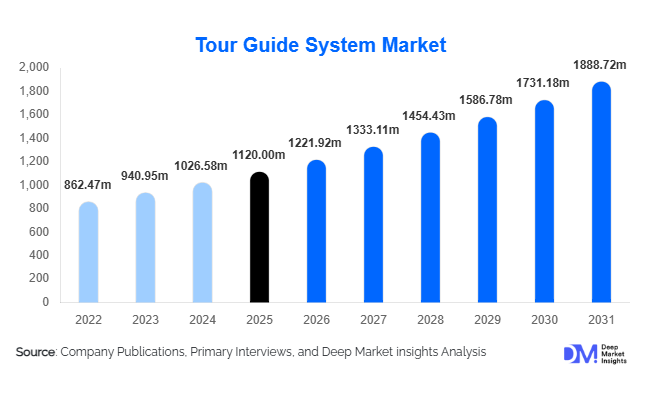
According to Deep Market Insights, the global Tour Guide System market size was valued at USD 1,120 million in 2025 and is projected to grow from USD 1221.92 million in 2026 to reach USD 1,888.72 million by 2031, expanding at a CAGR of 9.1% during the forecast period (2026–2031). The market is experiencing sustained growth due to the rapid digitalization of tourism infrastructure, increasing visitor traffic at museums and cultural heritage sites, and growing demand for multilingual communication solutions across tourism, education, and industrial tour environments. Tour guide systems have evolved beyond conventional wireless audio devices into integrated digital visitor engagement platforms incorporating artificial intelligence (AI), cloud-based content management, real-time translation capabilities, and smartphone connectivity.
The increasing focus on smart tourism initiatives by governments, destination management organizations, and cultural institutions is accelerating adoption globally. Modern tour guide systems enable operators to improve visitor experiences through enhanced audio clarity, personalized content delivery, navigation support, and multilingual accessibility. The rise of experiential tourism, cultural preservation initiatives, and large-scale tourism infrastructure investments across Asia-Pacific, Europe, and the Middle East continues to create favorable market conditions. Furthermore, technological advancements such as AI-powered translation engines, GPS-guided tours, augmented reality (AR), and mobile application-based audio guides are transforming the industry landscape and expanding revenue opportunities for technology providers and tourism operators alike.
Key Market Insights
- Wireless tour guide systems account for approximately 48% of global market revenue, driven by their extensive use in museums, guided city tours, factories, and cultural attractions.
- Museums and cultural heritage sites remain the largest application segment, contributing nearly 28% of global market demand in 2025.
- Europe dominates the global market with approximately 38% market share, supported by extensive tourism infrastructure and a high concentration of heritage sites.
- Asia-Pacific is the fastest-growing regional market, projected to expand at a CAGR exceeding 11% through 2031.
- Cloud-based and AI-enabled tour guide platforms are rapidly replacing traditional analog systems, creating recurring software revenue opportunities.
- Smartphone-based audio guide adoption is accelerating globally, reducing hardware dependence while improving visitor engagement and scalability.
- Multilingual translation technologies are emerging as a key differentiator, particularly for international tourism destinations and global events.
Tour Guide System Market Trends
AI-Powered Multilingual Visitor Experiences Driving Market Evolution
Artificial intelligence is fundamentally transforming tour guide systems by enabling real-time multilingual communication and personalized visitor engagement. Tourism operators increasingly deploy AI-driven translation engines capable of supporting dozens of languages simultaneously, enhancing accessibility for international visitors. Advanced speech recognition technologies now allow guides and institutions to deliver content dynamically based on visitor preferences, demographics, and location. AI-powered recommendations, conversational interfaces, and intelligent content adaptation are creating more immersive experiences while reducing operational complexity for tourism operators. As international travel continues to recover and diversify, AI-enabled tour guide systems are becoming a strategic investment for destinations seeking to attract global audiences.
Smartphone-Based and Cloud-Connected Guide Platforms Expanding Rapidly
The transition from dedicated hardware systems toward smartphone-enabled solutions represents one of the most significant developments in the market. Museums, city tourism agencies, and attraction operators are increasingly adopting app-based guide platforms that deliver audio, navigation, translation, and interactive content directly to visitors’ devices. Cloud-based content management systems enable operators to update information in real time, reduce hardware maintenance costs, and gather visitor analytics. The growing availability of high-speed mobile connectivity and widespread smartphone penetration are accelerating this transition. Operators also benefit from improved scalability and lower deployment costs, making cloud-connected systems particularly attractive for large attractions and multi-site tourism networks.
Tour Guide System Market Drivers
Growth in Global Cultural and Heritage Tourism
Cultural tourism continues to be one of the fastest-growing segments within the global tourism industry. Increasing visitor demand for authentic cultural experiences is driving investments in museums, heritage sites, historical monuments, and archaeological attractions. Tour guide systems play a critical role in enhancing visitor engagement, supporting multilingual communication, and improving educational value. Governments worldwide are allocating substantial funding toward heritage preservation and tourism modernization initiatives, directly contributing to market growth.
Expansion of Smart Tourism Infrastructure
The emergence of smart tourism ecosystems is significantly boosting demand for advanced visitor management technologies. Cities and tourism authorities are integrating digital guide systems into broader smart destination strategies that include digital ticketing, visitor analytics, navigation tools, and personalized tourism services. Countries such as China, Japan, South Korea, Saudi Arabia, and the UAE are investing heavily in tourism digitalization programs, creating favorable conditions for tour guide system adoption. Smart tourism initiatives also encourage integration with AR, VR, IoT sensors, and cloud-based visitor engagement platforms.
Rising Demand for Industrial and Educational Tours
Beyond tourism applications, demand for tour guide systems is increasing across industrial facilities, universities, manufacturing plants, research centers, and corporate campuses. Industrial tours require reliable communication systems to facilitate safe and efficient visitor experiences in noisy environments. Educational institutions are similarly adopting digital guide platforms to improve campus tours and visitor engagement. These emerging applications are expanding the addressable market beyond traditional tourism sectors and creating new growth opportunities for manufacturers and software providers.
Tour Guide System Market Restraints
High Initial Equipment and Infrastructure Costs
Despite technological advancements, deployment costs remain a significant barrier for smaller institutions and tourism operators. High-quality wireless systems, cloud platforms, translation software, and supporting infrastructure require substantial upfront investment. Smaller museums, heritage sites, and independent tour operators often face budget constraints that delay adoption. Ongoing maintenance, software updates, and hardware replacement requirements further increase total ownership costs.
Rapid Technology Obsolescence and Integration Challenges
The pace of technological innovation presents challenges for operators seeking long-term investments. Frequent advancements in wireless communication standards, software platforms, AI capabilities, and mobile technologies can shorten equipment lifecycles. Additionally, integrating new guide systems with existing visitor management platforms, ticketing systems, and digital infrastructure can be complex and resource-intensive. These challenges may slow adoption among organizations with limited technical expertise.
Tour Guide System Market Opportunities
Smart Heritage and Museum Modernization Programs
Governments and cultural institutions worldwide are investing in the digital transformation of museums and heritage sites. These modernization initiatives present significant opportunities for providers of cloud-based guide systems, AI-driven content platforms, and multilingual visitor engagement technologies. As destinations seek to improve accessibility and visitor satisfaction, demand for next-generation tour guide solutions is expected to accelerate.
AI-Powered Real-Time Translation Solutions
The growing diversity of international tourism creates substantial opportunities for AI-enabled translation technologies. Tour guide system providers that offer real-time multilingual communication capabilities can address a critical market need. Translation systems supporting dozens of languages simultaneously are increasingly becoming standard requirements for major tourism destinations, conferences, and cultural institutions.
Emerging Tourism Infrastructure in Asia and the Middle East
Rapid tourism development across Asia-Pacific and the Middle East is creating significant greenfield opportunities. Mega tourism projects in Saudi Arabia, the UAE, India, Indonesia, and Southeast Asia require advanced visitor communication technologies from inception. Vendors entering these markets can benefit from large-scale deployments and long-term service contracts as destinations continue expanding their tourism infrastructure.
Report Scope
| Report Metric | Details |
|---|---|
| Market Size in 2025 | USD 1120 million |
| Market Size in 2026 | USD 1221.92 million |
| Market Size in 2031 | USD 1888.72 million |
| CAGR | 9.10% (2026-2031) |
| Base Year for Estimation | 2025 |
| Historical Data | 2022-2024 |
| Forecast Period | 2026-2031 |
| Report Coverage | Revenue Forecast, Competitive Landscape, Supply Chain Disruption, Growth Factors, Environment & Regulatory Landscape and Trends |
| Geographies Covered | North America, Europe, APAC, Middle East and Africa, LATAM |
| Countries Covered | U.S., Canada, U.K., Germany, France, Spain, Italy, Russia, Nordic, Benelux, Rest of Europe, China, Korea, Japan, India, Australia, Singapore, Taiwan, South East Asia, Rest of Asia-Pacific, UAE, Turky, Saudi Arabia, South Africa, Egypt, Nigeria, Rest of MEA, Brazil, Mexico, Argentina, Chile, Colombia, Rest of LATAM |
Explore more data points, trends and opportunities Download Free Sample Report
Product Type Insights
Wireless tour guide systems represent the largest product category, accounting for approximately 48% of global market revenue in 2025. Their leadership is attributed to superior mobility, ease of deployment, and broad applicability across museums, city tours, industrial facilities, and educational institutions. RF-based and UHF digital systems continue to dominate professional deployments due to reliable signal quality and long-range communication capabilities. Intelligent digital tour guide systems incorporating AI, GPS navigation, and smartphone integration represent the fastest-growing category as tourism operators increasingly prioritize digital visitor experiences. Smartphone-based audio guide solutions are gaining momentum due to lower operating costs and improved scalability compared to traditional hardware-intensive systems.
Component Insights
Receivers constitute the largest component segment, accounting for approximately 30% of total market revenue, driven by high deployment volumes across guided tours and institutional environments. Headsets and earphones remain essential accessories, particularly in museums and large tourist attractions where audio clarity significantly influences visitor satisfaction. Software platforms and cloud-based content management systems are emerging as the fastest-growing components due to the increasing shift toward subscription-based business models. These platforms enable operators to manage multilingual content, visitor analytics, and real-time updates, creating recurring revenue streams and improving operational efficiency.
Deployment Model Insights
On-premise deployments continue to account for the largest share of installations, representing approximately 55% of the market, primarily due to legacy infrastructure and security preferences among museums, government institutions, and industrial facilities. However, cloud-based systems are rapidly gaining market share as organizations seek greater flexibility, scalability, and lower maintenance costs. Hybrid deployment models are also emerging, allowing operators to combine local control with cloud-enabled content management and analytics capabilities. The increasing adoption of SaaS-based visitor engagement solutions is expected to significantly reshape deployment preferences during the forecast period.
Application Insights
Museums and cultural heritage sites remain the dominant application segment, contributing approximately 28% of global market demand in 2025. The segment benefits from rising visitor numbers, government-supported heritage preservation initiatives, and growing demand for multilingual educational content. City sightseeing tours represent another significant application area, particularly in major tourism destinations where operators increasingly utilize digital guide platforms to enhance visitor experiences. Industrial and factory tours are emerging as a rapidly expanding application segment, supported by manufacturing transparency initiatives and growing interest in industrial tourism worldwide.
End-User Insights
Museums and cultural institutions account for the largest share of end-user demand, representing approximately 26% of global market revenue. These organizations continue investing heavily in digital visitor engagement technologies to improve accessibility and educational value. Tourism operators and travel agencies represent the second-largest user group, leveraging guide systems to differentiate services and enhance customer satisfaction. Government tourism authorities are increasingly deploying advanced tour guide technologies within national tourism development programs. Educational institutions and industrial facilities are also contributing to market expansion through growing adoption of guided visitor experiences and campus tour solutions.
Explore more data points, trends and opportunities Download Free Sample Report
Tour Guide System Market Segmentations
By Product Type
- Wireless Tour Guide Systems
- Wired Tour Guide Systems
- Audio Guide Systems
- Intelligent Digital Tour Guide Systems
By Application
- Museums and Cultural Heritage Sites
- Historical Monuments and Archaeological Sites
- City Sightseeing Tours
- Religious Tourism Sites
- Theme Parks and Entertainment Attractions
- Industrial and Factory Tours
- Educational Campus Tours
- Corporate Events and Conferences
- Cruise Tourism
- Adventure and Eco-Tourism
By End User
- Museums and Cultural Institutions
- Tourism Operators and Travel Agencies
- Government Tourism Authorities
- Educational Institutions
- Event Management Companies
- Religious Organizations
- Industrial Facilities
- Cruise Operators
By Deployment Model
- On-Premise Systems
- Cloud-Based Systems
- Hybrid Systems
Regional Insights
Europe
Europe dominates the global Tour Guide System market, accounting for approximately 38% of total revenue in 2025. Germany, France, Italy, Spain, and the United Kingdom represent the largest markets due to their extensive tourism infrastructure, large concentration of museums and UNESCO heritage sites, and strong government support for cultural preservation initiatives. Museums across Europe are increasingly adopting cloud-based guide systems, AI-powered translation tools, and smartphone-enabled visitor engagement platforms. Germany alone contributes approximately 8.5% of global market revenue, supported by a large museum network and strong industrial tour demand.
Asia-Pacific
Asia-Pacific accounts for approximately 29% of global market revenue and represents the fastest-growing regional market. China leads regional demand, benefiting from extensive smart tourism investments and digital infrastructure development. India is emerging as one of the fastest-growing national markets due to increasing tourism arrivals, heritage site modernization projects, and government-supported tourism initiatives. Japan and South Korea continue investing in advanced visitor communication technologies, particularly ahead of major international tourism events. The region is expected to register a CAGR exceeding 11.5% through 2031.
North America
North America holds approximately 23% of the global market, led by the United States and Canada. Demand is driven by museums, educational institutions, convention centers, and industrial facilities. The United States accounts for nearly 18% of global revenue, supported by strong technology adoption rates and a well-developed tourism ecosystem. Growing investments in digital visitor engagement and multilingual communication systems continue to support regional growth.
Latin America
Latin America represents approximately 4% of global market revenue, with Brazil and Mexico leading adoption. Cultural tourism development, increasing museum modernization efforts, and rising international visitor arrivals are driving market growth. The region remains relatively underpenetrated, creating opportunities for future expansion.
Middle East & Africa
The Middle East & Africa account for approximately 6% of global market revenue. Saudi Arabia and the UAE are experiencing strong demand due to large-scale tourism development programs and smart destination initiatives. Mega tourism projects under national diversification strategies are expected to generate substantial demand for advanced visitor communication technologies throughout the forecast period.
Key Players in the Tour Guide System Market
- Sennheiser
- Listen Technologies
- Williams AV
- Beyerdynamic
- Okayo Electronics
- MIPRO
- Orpheo Group
- Bosch
- Globibo
- MEDER CommTech
- Takstar
- Retekess
- Enersound
- Audetec
- TourAudio