Tarot Cards Market Size
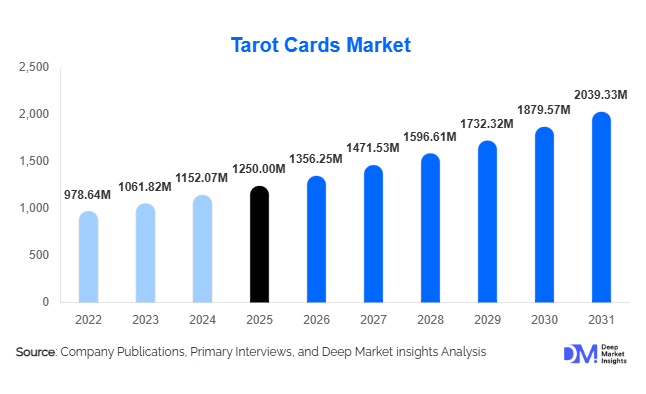
According to Deep Market Insights, the global tarot cards market size was valued at USD 1,250 million in 2025 and is projected to grow from USD 1,356.25 million in 2026 to reach USD 2,039.33 million by 2031, expanding at a CAGR of 8.5% during the forecast period (2026–2031). The tarot cards market growth is primarily driven by the rising global interest in spirituality, increasing adoption of alternative wellness practices, and the growing popularity of tarot as a tool for self-reflection and mindfulness.
Key Market Insights
- Tarot cards are increasingly integrated into modern wellness and self-care routines, positioning them as tools for introspection and emotional guidance.
- Digital tarot platforms and mobile applications are rapidly expanding, enabling real-time readings and subscription-based services.
- North America dominates the global market, supported by high consumer awareness and strong online retail penetration.
- Asia-Pacific is the fastest-growing region, driven by rising spiritual curiosity and increasing disposable incomes in countries like India and Japan.
- Independent artists and creators are reshaping product innovation, introducing highly customized and collectible tarot decks.
- Premiumization trends are gaining traction, with luxury tarot decks and eco-friendly materials driving higher margins.
What are the latest trends in the tarot cards market?
Personalization and Artistic Innovation Driving Demand
The tarot cards market is witnessing a surge in demand for personalized and artist-driven designs. Consumers increasingly prefer decks that reflect individual identities, cultural diversity, and unique artistic themes. Independent creators are leveraging crowdfunding platforms to launch niche tarot decks, often exceeding funding expectations. This trend has expanded the market beyond traditional formats, transforming tarot decks into collectible art pieces. Limited-edition releases, collaborations with illustrators, and thematic decks centered on astrology, mythology, and pop culture are gaining widespread popularity, particularly among younger demographics.
Digital Transformation and App-Based Tarot Readings
Technology integration is reshaping the tarot cards market through mobile applications, AI-powered readings, and virtual consultation platforms. Digital tarot tools provide users with instant access to readings, eliminating the need for physical decks. Subscription-based tarot services are also emerging, offering daily insights, guided interpretations, and personalized readings. These innovations are particularly appealing to Gen Z and millennials, who favor convenience and digital engagement. The integration of AI and data analytics is further enhancing user experience by delivering tailored interpretations based on user behavior and preferences.
What are the key drivers in the tarot cards market?
Growing Interest in Spirituality and Mental Wellness
The increasing focus on mental health and holistic well-being is a major driver of the tarot cards market. Consumers are turning to alternative practices such as tarot reading for self-reflection, stress relief, and emotional clarity. This trend has accelerated in the post-pandemic era, where individuals seek accessible and personalized wellness tools. Tarot cards are increasingly being positioned alongside meditation, journaling, and mindfulness practices, expanding their relevance in the broader wellness industry.
Influence of Social Media and Digital Content
Social media platforms such as Instagram, TikTok, and YouTube have significantly boosted the popularity of tarot cards. Influencers and professional tarot readers are creating engaging content, live readings, and tutorials, attracting millions of followers globally. This digital visibility has demystified tarot practices and made them more approachable for new users. Viral trends and online communities are playing a critical role in driving product demand and increasing market penetration.
What are the restraints for the global market?
Perception Challenges and Skepticism
Despite growing popularity, tarot cards continue to face skepticism in certain regions due to their association with pseudoscience. This perception limits adoption among conservative consumer groups and restricts institutional acceptance. The lack of standardized practices further adds to credibility concerns, posing a challenge for widespread mainstream adoption.
Market Fragmentation and Pricing Pressure
The tarot cards market is highly fragmented, with numerous small-scale creators and publishers entering the market. While this fosters innovation, it also leads to intense competition and pricing pressures. Smaller players often struggle to scale operations, while established brands face challenges in maintaining differentiation amid increasing product diversity.
What are the key opportunities in the tarot cards industry?
Expansion into Emerging Markets
Emerging economies such as India, Brazil, and Indonesia present significant growth opportunities for tarot card manufacturers. Rising disposable incomes, cultural openness to spirituality, and increasing internet penetration are driving demand in these regions. Localization strategies, including culturally relevant designs and multilingual content, can help companies tap into these high-growth markets effectively.
Integration with Wellness and Lifestyle Products
The convergence of tarot cards with the wellness industry is creating new revenue streams. Tarot decks are increasingly being bundled with journals, meditation guides, and self-help kits. This integration enhances the value proposition and attracts consumers seeking holistic lifestyle solutions. Wellness retreats and coaching services are also incorporating tarot as a complementary offering, further expanding its application scope.
Report Scope
| Report Metric | Details |
|---|---|
| Market Size in 2025 | USD 1250 Million |
| Market Size in 2026 | USD 1356.25 Million |
| Market Size in 2031 | USD 2039.33 Million |
| CAGR | 8.5% (2026-2031) |
| Base Year for Estimation | 2025 |
| Historical Data | 2022-2024 |
| Forecast Period | 2026-2031 |
| Report Coverage | Revenue Forecast, Competitive Landscape, Supply Chain Disruption, Growth Factors, Environment & Regulatory Landscape and Trends |
| Geographies Covered | North America, Europe, APAC, Middle East and Africa, LATAM |
| Countries Covered | U.S., Canada, U.K., Germany, France, Spain, Italy, Russia, Nordic, Benelux, Rest of Europe, China, Korea, Japan, India, Australia, Singapore, Taiwan, South East Asia, Rest of Asia-Pacific, UAE, Turky, Saudi Arabia, South Africa, Egypt, Nigeria, Rest of MEA, Brazil, Mexico, Argentina, Chile, Colombia, Rest of LATAM |
Explore more data points, trends and opportunities Download Free Sample Report
Product Type Insights
Traditional tarot decks continue to dominate the global tarot cards market, accounting for approximately 38% of total market share in 2025. Their leadership is primarily driven by strong historical credibility, standardized symbolism systems such as Rider-Waite and Marseille, and widespread adoption among both beginner and professional tarot readers. These decks remain the foundational entry point for new users, ensuring sustained demand across bookstores, metaphysical shops, and online platforms.
Modern and artistic tarot decks are emerging as a high-growth segment, supported by increasing consumer preference for personalization, storytelling, and visually rich interpretations. Independent artists and designers are heavily influencing this segment through crowdfunding platforms and social media-driven launches, making tarot decks a form of collectible art. Oracle cards are gaining traction as a more flexible, less structured alternative to traditional tarot systems, appealing to users seeking simplified spiritual guidance without rigid interpretations. Digital tarot products represent the fastest-evolving sub-segment, driven by mobile app adoption, AI-enabled readings, and subscription-based spiritual services. The key driver for digital growth is convenience and accessibility, particularly among Gen Z users who prefer instant, on-demand spiritual tools integrated into mobile ecosystems.
Application Insights
Personal use dominates the application landscape, contributing nearly 48% of the global market in 2025. This leadership is driven by the increasing integration of tarot cards into daily self-care routines, mindfulness practices, and emotional well-being activities. Consumers are increasingly using tarot for self-reflection, decision-making, and stress management, aligning with the broader global wellness movement.
Professional use, accounting for approximately 20% of the market, is expanding rapidly due to the rise of online tarot consultation platforms and virtual coaching services. Tarot readers and spiritual consultants are increasingly monetizing their services through digital platforms, social media engagement, and subscription-based sessions. Educational use is also growing steadily, driven by structured tarot workshops, certification programs, and online learning communities catering to beginners and enthusiasts seeking professional mastery.
Distribution Channel Insights
Online retail channels dominate the tarot cards market with a share of nearly 55% in 2025, driven by the expansion of global e-commerce platforms, ease of product discovery, and availability of niche and indie-designed tarot decks. The key growth driver is digital accessibility, allowing global consumers to access rare and artist-created decks that are not available in physical stores.
Direct-to-consumer channels, including artist websites and crowdfunding platforms, are rapidly expanding due to the rise of independent creators and community-backed product launches. Offline retail, such as bookstores, metaphysical shops, and specialty spiritual stores, continues to maintain relevance, particularly in urban regions and tourism-driven locations where experiential buying plays a key role in consumer engagement.
End-User Insights
Millennials represent the largest consumer base, accounting for approximately 40% of the market, driven by their openness to spirituality, self-development practices, and experiential lifestyle consumption. This group is highly influenced by social media trends and wellness culture integration.
Gen Z is the fastest-growing demographic segment, supported by strong digital engagement, influencer-driven tarot content, and mobile-first consumption habits. Professional spiritual practitioners form a high-value niche segment, contributing consistent recurring revenue through consultations, workshops, and digital readings, further strengthening the service-based ecosystem around tarot usage.
Explore more data points, trends and opportunities Download Free Sample Report
Tarot Cards Market Segmentations
By Product Type
- Traditional Tarot Decks
- Modern & Artistic Tarot Decks
- Oracle Cards
- Digital Tarot Products
By Application
- Personal Use
- Professional Use
- Educational & Training
- Collectibles & Gifting
By Distribution Channel
- Online Retail
- Direct-to-Consumer
- Offline Retail
- Subscription-Based Platforms
By End User
- Millennials
- Gen Z
- Gen X & Above
- Professional Spiritual Practitioners
Regional Insights
North America
North America leads the global tarot cards market with approximately 35% share in 2025. The region’s dominance is driven by high consumer awareness, strong penetration of online retail platforms, and a well-established community of professional tarot readers and wellness practitioners. The United States is the primary contributor, supported by rising interest in mental wellness and alternative spirituality, while Canada is witnessing steady growth due to increasing adoption of holistic lifestyle practices. expanding wellness industry integration, high digital content influence from social media platforms, and strong e-commerce infrastructure enabling niche product accessibility.
Europe
Europe accounts for approximately 28% of the global market, with strong contributions from the United Kingdom, France, Germany, and Italy. The region’s historical association with tarot cards provides cultural depth and sustained consumer interest. European consumers are increasingly favoring premium, eco-friendly, and ethically produced tarot decks, driving innovation in sustainable materials and artistic design. strong cultural heritage of tarot practices, rising demand for sustainable and ethical consumer goods, and growing popularity of experiential wellness tourism and spiritual workshops.
Asia-Pacific
Asia-Pacific is the fastest-growing regional market, with a CAGR exceeding 10% during the forecast period. Key countries include India, Japan, China, and Australia. India is emerging as a major growth hub due to cultural openness toward spirituality and increasing adoption of digital wellness platforms. Japan and Australia are contributing through mature wellness industries and a high demand for personalized spiritual tools. rising disposable incomes, strong influence of social media and digital spirituality trends, and increasing acceptance of alternative healing and self-guidance practices across urban populations.
Latin America
Latin America holds approximately 8% of the global market share, with Brazil and Mexico leading regional demand. The market is supported by strong cultural acceptance of spiritual and mystical practices, along with growing urbanization and expanding digital access to tarot-related content. cultural affinity toward spiritual traditions, increasing youth engagement with digital tarot platforms, and rising interest in personal development and emotional wellness practices.
Middle East & Africa
The Middle East & Africa region is gradually expanding, supported by increasing urbanization and growing interest in alternative wellness practices. The UAE and South Africa are leading markets, driven by high-income consumer bases and expanding wellness tourism sectors. Digital adoption is also playing a critical role in market penetration across younger demographics. rising urban middle-class population, expansion of luxury wellness and lifestyle markets, and increasing accessibility through digital tarot applications and online platforms.
Key Players in the Tarot Cards Market
- U.S. Games Systems
- Lo Scarabeo
- Hay House Publishing
- Llewellyn Worldwide
- Cartamundi (Fournier)
- Blue Angel Publishing
- Rockpool Publishing
- Schiffer Publishing
- Chronicle Books
- Sterling Publishing
- Insight Editions
- Penguin Random House
- Weiser Books
- AGM Urania
- Red Feather