Movie Theater Market Size
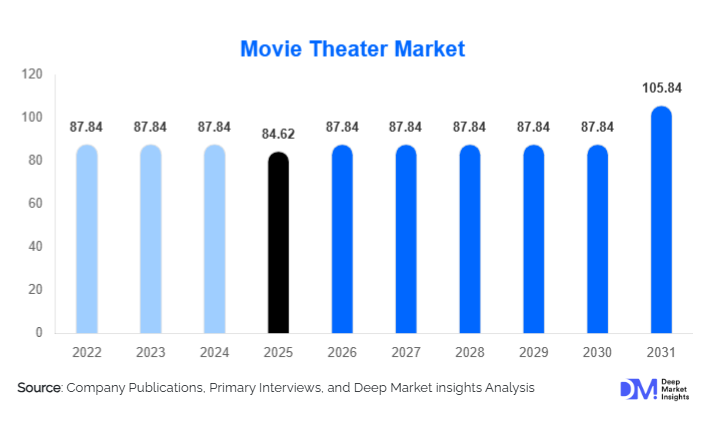
According to Deep Market Insights, the global movie theater market was valued at USD 84.62 billion in 2025 and is projected to grow from USD 87.84 billion in 2026 to reach USD 105.84 billion by 2031, expanding at a CAGR of 3.8% during the forecast period (2026–2031). The market continues to benefit from the recovery of theatrical attendance, increasing investments in premium cinema experiences, and the expansion of multiplex infrastructure across emerging economies. Rising consumer preference for immersive viewing technologies, premium large-format screens, luxury seating, and enhanced food and beverage offerings continues to strengthen industry performance. Additionally, the growing number of blockbuster film releases, digital ticketing platforms, and advanced projection technologies is supporting steady revenue generation across global cinema operators.
Key Market Insights
- Premium cinema experiences continue to reshape audience preferences, with IMAX, Dolby Cinema, and luxury recliner formats generating significantly higher per-screen revenues than conventional theaters.
- North America dominates the global market, supported by a mature multiplex network, high consumer spending on entertainment, and strong box office collections.
- Asia-Pacific represents the fastest-growing regional market, driven by rapid multiplex expansion, rising disposable incomes, and increasing urbanization across China, India, and Southeast Asia.
- Ticket sales remain the primary revenue source, while premium food & beverage offerings and digital advertising continue to increase their contribution to overall theater profitability.
- Digital transformation is accelerating across cinema chains, with AI-powered ticket pricing, mobile bookings, contactless payments, and personalized customer engagement becoming standard industry practices.
- Alternative content screenings, including live sports, concerts, esports tournaments, and corporate events, are creating new revenue opportunities beyond traditional movie exhibition.
Movie Theater Market Trends
Premium Cinema Experiences Continue to Drive Consumer Spending
Movie theater operators are increasingly investing in premium entertainment experiences to differentiate themselves from home streaming services. Luxury recliner seating, laser projection systems, immersive surround sound technologies, IMAX, Dolby Cinema, ScreenX, and 4DX formats are becoming major attractions for consumers seeking enhanced theatrical experiences. Premium large-format screens continue to command higher ticket prices while maintaining stronger occupancy rates during blockbuster releases. Cinema chains are also expanding premium food and beverage offerings, introducing gourmet dining, alcoholic beverages, and in-seat ordering services to improve customer satisfaction and increase concession revenues. These investments are transforming cinemas into premium entertainment destinations rather than conventional movie screening venues, allowing operators to improve profitability despite fluctuating attendance volumes.
Digital Technologies and Alternative Content Expanding Revenue Streams
Technological innovation continues transforming cinema operations worldwide. Mobile ticket booking applications, AI-powered pricing algorithms, digital loyalty programs, facial recognition-enabled access systems, and self-service kiosks are streamlining customer experiences while improving operational efficiency. Movie theaters are also diversifying their programming beyond traditional film screenings by hosting live concerts, international sporting events, esports competitions, anime festivals, educational screenings, and private corporate events. These alternative entertainment formats enable exhibitors to maximize screen utilization throughout the year while reducing dependence on seasonal blockbuster releases. Growing integration of digital advertising platforms and personalized marketing technologies further supports customer retention and long-term revenue growth across the global movie theater industry.
Movie Theater Market Drivers
Growing Consumer Preference for Premium Entertainment Experiences
Consumers increasingly value immersive entertainment experiences that cannot be replicated through home streaming platforms. Premium seating, advanced laser projection systems, high-resolution digital displays, immersive surround sound, and luxury cinema concepts continue attracting moviegoers willing to pay premium ticket prices. Rising disposable incomes, expanding middle-class populations across emerging economies, and growing investments in modern multiplex developments are encouraging higher cinema attendance. The continued production of franchise films, superhero movies, animated features, and globally anticipated theatrical releases further strengthens box office revenues. These factors collectively continue to support long-term expansion of the global movie theater industry.
Expansion of Multiplex Infrastructure Across Emerging Economies
Rapid urbanization and increasing investments in commercial real estate continue driving multiplex construction across developing countries. Major cinema operators are expanding into tier-2 and tier-3 cities where rising disposable incomes and improving retail infrastructure are creating new customer bases. Shopping malls increasingly integrate multiplex cinemas as anchor entertainment attractions, encouraging higher footfall and longer consumer dwell times. Government support for domestic film industries, improved digital projection technologies, and growing local language film production further contribute to sustained market expansion across Asia-Pacific, Latin America, and the Middle East.
Movie Theater Market Restraints
Growing Competition from OTT Streaming Platforms
The rapid expansion of subscription-based streaming services continues to challenge theatrical movie attendance. Consumers increasingly enjoy immediate access to newly released films, original content, and personalized entertainment from home, reducing the frequency of cinema visits in several developed markets. Improvements in home entertainment technologies, including ultra-high-definition televisions, surround sound systems, and affordable streaming subscriptions, further intensify competition. Shorter theatrical release windows between cinema premieres and digital streaming availability also reduce the exclusivity of theatrical exhibition, limiting overall attendance growth for cinema operators.
High Operating Costs and Dependence on Blockbuster Releases
Movie theater operators face rising operating expenses related to labor, electricity, property leasing, equipment maintenance, digital projection upgrades, and facility modernization. Large multiplex investments require substantial capital expenditures while profitability remains highly dependent on the commercial success of major film releases. Weak theatrical release schedules or underperforming blockbuster films can significantly impact annual revenues. Inflationary pressures and increasing maintenance costs continue challenging smaller regional exhibitors, particularly in highly competitive urban markets.
Movie Theater Market Opportunities
Expansion of Alternative Entertainment Programming
Movie theaters are increasingly diversifying their business models by offering live concerts, sporting event broadcasts, esports tournaments, gaming competitions, educational programming, religious events, stand-up comedy performances, and corporate conferences. These alternative content formats enable operators to maximize screen utilization during non-peak movie periods while attracting broader customer demographics. The flexibility of modern digital projection systems allows cinemas to host multiple entertainment formats, creating diversified revenue streams and reducing dependence on traditional movie exhibition.
Growing Adoption of Luxury Cinema Concepts
Luxury cinema formats continue presenting significant growth opportunities for exhibitors seeking higher profitability. Premium auditoriums featuring reclining seats, gourmet dining, private lounges, concierge services, and personalized guest experiences command significantly higher ticket prices while generating increased food and beverage sales. High-income consumers increasingly prefer experiential entertainment that combines comfort with advanced viewing technologies. The continued expansion of premium cinema concepts across developed and emerging economies is expected to strengthen long-term revenue generation while enhancing overall customer satisfaction.
Report Scope
| Report Metric | Details |
|---|---|
| Market Size in 2025 | USD 84.62 Billion |
| Market Size in 2026 | USD 87.84 Billion |
| Market Size in 2031 | USD 105.84 Billion |
| CAGR | 3.8% (2026-2031) |
| Base Year for Estimation | 2025 |
| Historical Data | 2022-2024 |
| Forecast Period | 2026-2031 |
| Report Coverage | Revenue Forecast, Competitive Landscape, Supply Chain Disruption, Growth Factors, Environment & Regulatory Landscape and Trends |
| Geographies Covered | North America, Europe, APAC, Middle East and Africa, LATAM |
| Countries Covered | U.S., Canada, U.K., Germany, France, Spain, Italy, Russia, Nordic, Benelux, Rest of Europe, China, Korea, Japan, India, Australia, Singapore, Taiwan, South East Asia, Rest of Asia-Pacific, UAE, Turky, Saudi Arabia, South Africa, Egypt, Nigeria, Rest of MEA, Brazil, Mexico, Argentina, Chile, Colombia, Rest of LATAM |
Explore more data points, trends and opportunities Download Free Sample Report
Screen Type Insights
Based on screen type, the market is segmented into 2D Screens, 3D Screens, and IMAX Screens. Conventional 2D screens continue to account for the largest share of global installations owing to their widespread adoption, lower operating costs, and compatibility with the majority of theatrical releases. Meanwhile, premium formats such as IMAX and advanced large-format screens are witnessing faster growth due to rising consumer preference for immersive viewing experiences and higher ticket pricing.
2D Screens dominate the market as they remain the standard exhibition format across commercial cinemas worldwide. Most domestic and international film releases are optimized for conventional digital projection, making 2D screens the primary revenue generator for exhibitors. Their lower installation and maintenance costs, combined with consistent audience demand, allow multiplex operators to maximize screen utilization throughout the year. Continuous upgrades to laser projection and high-resolution digital systems are also enhancing picture quality while improving operational efficiency.
3D Screens continue to maintain a significant market presence, particularly for action, science fiction, fantasy, and animated films. Advances in polarized projection technology, improved 3D glasses, and brighter laser projection systems have enhanced viewing quality while reducing visual fatigue. Cinema operators continue investing in upgraded 3D infrastructure to support major blockbuster releases that generate premium ticket pricing and stronger box office collections.
IMAX Screens represent the fastest-growing premium segment owing to their superior visual quality, larger screens, immersive surround sound, and premium customer experience. Although IMAX installations represent a relatively small percentage of global cinema screens, they generate substantially higher revenue per screen through premium ticket pricing and higher occupancy during major film releases. Continued partnerships between major studios and IMAX Corporation are expected to support long-term expansion of this premium exhibition format.
Revenue Source Insights
The movie theater industry generates revenue through Ticket Sales, Food & Beverages, and Advertising. While ticket sales remain the largest revenue contributor globally, exhibitors are increasingly diversifying income through premium concessions, digital advertising, loyalty programs, and experiential offerings to improve profitability.
Ticket Sales continue to dominate overall market revenue due to strong consumer demand for theatrical releases and premium viewing formats. Dynamic ticket pricing, online reservations, reserved seating, subscription-based membership programs, and premium screen surcharges continue increasing average revenue per visitor. Major blockbuster releases remain the primary driver of box office collections across both developed and emerging markets.
Food & Beverages represent one of the highest-margin business segments for cinema operators. Traditional concession offerings such as popcorn, soft drinks, confectionery, and snacks continue generating substantial profits, while premium dining concepts, alcoholic beverages, gourmet menus, and in-seat food delivery services are significantly increasing average customer spending. Luxury multiplexes are increasingly positioning dining experiences as a major competitive differentiator.
Advertising continues to emerge as an important supplementary revenue stream for exhibitors. Digital pre-show advertising, promotional campaigns, brand collaborations, sponsorship agreements, product launches, and interactive marketing initiatives enable advertisers to engage highly targeted audiences within premium entertainment environments. Growing adoption of digital signage and AI-enabled audience analytics is further enhancing advertising effectiveness.
Explore more data points, trends and opportunities Download Free Sample Report
Movie Theater Market Segmentations
By Screen Type
- 2D Screens
- 3D Screens
- IMAX Screens
By Revenue Source
- Ticket Sales
- Food & Beverages
- Advertising
Regional Insights
North America
North America continues to dominate the global movie theater market owing to its well-established cinema infrastructure, strong consumer spending on entertainment, and consistent production of high-budget theatrical releases. The United States accounts for the majority of regional box office revenue, supported by thousands of multiplex locations and widespread adoption of premium formats including IMAX, Dolby Cinema, ScreenX, and luxury recliner theaters. Digital ticketing, subscription-based movie memberships, and mobile booking platforms have become standard across leading cinema chains, improving customer convenience and repeat visitation. Premium food and beverage offerings, dine-in cinema concepts, and advanced loyalty programs continue supporting higher customer spending while strengthening profitability across the region.
Europe
Europe remains one of the largest cinema markets globally, supported by strong domestic film industries, established multiplex networks, and government initiatives promoting cultural and independent cinema. Countries including the United Kingdom, France, Germany, Italy, and Spain continue recording stable theatrical attendance through a balanced mix of domestic productions and international blockbuster releases. Premium cinema upgrades, laser projection technologies, and luxury seating installations continue modernizing regional exhibition infrastructure. Increasing investment in film festivals, alternative content programming, and cross-border theatrical distribution is expected to support sustainable market expansion throughout the forecast period.
Asia-Pacific
Asia-Pacific is projected to register the fastest market growth during the forecast period owing to rapid urbanization, expanding middle-class populations, increasing disposable incomes, and significant investments in multiplex development. China and India remain the region's largest cinema markets, while Japan, South Korea, Indonesia, Vietnam, and Thailand continue expanding their commercial exhibition infrastructure. Rising production of domestic-language films, growing popularity of premium cinema experiences, and increasing penetration of digital ticketing platforms continue driving regional demand. International cinema operators are also expanding aggressively across emerging Asian economies to capitalize on rising consumer expenditure on entertainment.
Latin America
Latin America continues demonstrating steady growth, supported primarily by Brazil, Mexico, Argentina, Chile, and Colombia. Rising urbanization, expanding shopping mall developments, and increasing investments in modern multiplex facilities are encouraging higher cinema attendance across the region. Local-language productions, Hollywood releases, and family-oriented entertainment remain key revenue contributors. Cinema operators continue introducing premium seating, digital projection technologies, and loyalty programs to improve customer engagement and compete effectively with digital streaming services.
Middle East & Africa
The Middle East & Africa region is witnessing gradual expansion due to increasing investments in entertainment infrastructure, tourism development, and government initiatives supporting cultural industries. Saudi Arabia and the United Arab Emirates continue leading regional growth following significant investments in modern cinema construction and international entertainment partnerships. South Africa remains one of Africa's most established cinema markets, supported by a growing domestic film industry and expanding multiplex presence. Rising disposable incomes, increasing youth populations, and expanding retail developments are expected to create additional growth opportunities for cinema operators across the region.
Key Players in the Movie Theater Market
- AMC Entertainment Holdings, Inc.
- Cinemark Holdings, Inc.
- Cineworld Group plc
- Cinépolis
- PVR INOX Limited
- CGV Co., Ltd.
- Vue International
- The Marcus Corporation
- Pathé Cinémas
- B&B Theatres
- Golden Screen Cinemas
- Event Cinemas
- Megabox Co., Ltd.
- TOHO Cinemas Ltd.
- Wanda Film Holding Co., Ltd.