Gaming Market Size
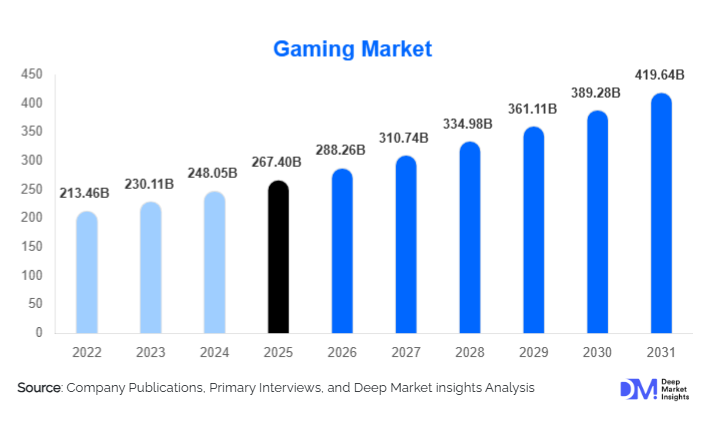
According to Deep Market Insights, the global gaming market size was valued at USD 267.40 billion in 2025 and is projected to grow from USD 288.26 billion in 2026 to reach USD 419.64 billion by 2031, expanding at a CAGR of 7.8% during the forecast period (2026–2031). The gaming market growth is primarily driven by increasing smartphone penetration, expanding cloud gaming infrastructure, rising esports participation, AI-enabled game development, and growing consumer spending on digital entertainment. Continuous innovation in gaming hardware, subscription-based services, and cross-platform ecosystems is further strengthening industry expansion worldwide.
Key Market Insights
- Mobile gaming remains the largest revenue-generating segment, accounting for more than half of global gaming revenue through widespread smartphone adoption and in-app monetization.
- Cloud gaming and subscription platforms are rapidly transforming the industry, enabling instant access to premium game libraries without high-end hardware requirements.
- Asia-Pacific dominates the global market, supported by massive gamer populations in China, Japan, South Korea, and India.
- Middle East & Africa is projected to be the fastest-growing regional market, driven by improving internet infrastructure, smartphone penetration, and government investments in esports.
- Artificial intelligence is accelerating game development, enabling procedural content generation, intelligent NPC behavior, and personalized player experiences.
- Cross-platform gaming and live-service titles continue to reshape consumer engagement, increasing player retention and recurring digital revenue streams.
Gaming Market Trends
Cloud Gaming and Subscription Ecosystems Expand
Cloud gaming continues to reshape digital entertainment by allowing users to stream high-quality games without investing in expensive gaming hardware. Leading publishers are expanding subscription-based gaming libraries with hundreds of premium titles while investing heavily in cloud infrastructure to improve latency and gameplay quality. The growing adoption of high-speed broadband, 5G connectivity, and edge computing is making cloud gaming increasingly accessible across developed and emerging markets. Subscription ecosystems are also improving customer retention by offering continuous content updates, exclusive releases, and cross-device accessibility.
Artificial Intelligence and Cross-Platform Gaming Gain Momentum
Artificial intelligence is becoming an integral part of modern game development, helping developers automate testing, generate realistic environments, personalize gameplay, and improve NPC interactions. Simultaneously, cross-platform gaming is allowing users across mobile, PC, and consoles to play together, significantly expanding multiplayer communities. Game publishers are increasingly focusing on live-service models, seasonal updates, esports integration, and user-generated content to maintain long-term engagement while maximizing lifetime customer value across multiple gaming ecosystems.
Gaming Market Drivers
Growing Digital Entertainment Consumption
The increasing popularity of digital entertainment across all age groups is significantly boosting demand for video games worldwide. Rising smartphone ownership, affordable internet access, expanding esports audiences, and the growing popularity of multiplayer online games are encouraging higher gaming engagement. Continuous investments in game development, virtual reality, augmented reality, and next-generation gaming consoles are further strengthening industry expansion. Additionally, rising disposable incomes and increasing willingness to spend on digital content continue to support long-term market growth.
Expansion of Mobile Gaming Ecosystem
Mobile gaming has become the primary growth engine of the industry due to widespread smartphone availability, app store accessibility, and free-to-play monetization models. Developers are increasingly optimizing games for mobile platforms while integrating advanced graphics, cloud synchronization, social features, and in-app purchasing systems. The rapid rollout of 5G networks and improved mobile processors is enabling console-quality gaming experiences on smartphones, attracting both casual and competitive gamers worldwide.
Gaming Market Restraints
Rising Development Costs
Modern game development requires significant investments in advanced graphics engines, artificial intelligence, cybersecurity, cloud infrastructure, and large development teams. AAA titles often involve extended production cycles and substantial marketing budgets, increasing financial risks for publishers. Smaller studios frequently face challenges in competing with established developers due to limited financial resources and rising production complexity.
Regulatory and Monetization Challenges
Increasing government regulations concerning data privacy, online safety, digital purchases, loot boxes, and age-appropriate content are creating compliance challenges for gaming companies. Different regional policies require publishers to modify monetization strategies and content distribution approaches, increasing operational complexity while potentially affecting revenue generation across international markets.
Gaming Market Opportunities
Growth of Cloud Gaming Services
Rapid expansion of cloud infrastructure presents substantial opportunities for gaming companies to reach broader consumer segments without hardware limitations. Improvements in streaming technology, reduced latency, and increasing internet speeds are enabling premium gaming experiences across multiple connected devices. Cloud gaming also creates recurring revenue opportunities through subscription models and digital content distribution.
Expansion Across Emerging Markets
Emerging economies present considerable opportunities due to rising internet penetration, expanding smartphone adoption, improving digital payment systems, and increasing youth populations. Countries such as India, Brazil, Indonesia, Saudi Arabia, and Vietnam are witnessing rapid growth in gaming participation, encouraging publishers to localize content, expand regional servers, and invest in esports ecosystems.
Report Scope
| Report Metric | Details |
|---|---|
| Market Size in 2025 | USD 267.4 Billion |
| Market Size in 2026 | USD 288.26 Billion |
| Market Size in 2031 | USD 419.64 Billion |
| CAGR | 7.8% (2026-2031) |
| Base Year for Estimation | 2025 |
| Historical Data | 2022-2024 |
| Forecast Period | 2026-2031 |
| Report Coverage | Revenue Forecast, Competitive Landscape, Supply Chain Disruption, Growth Factors, Environment & Regulatory Landscape and Trends |
| Geographies Covered | North America, Europe, APAC, Middle East and Africa, LATAM |
| Countries Covered | U.S., Canada, U.K., Germany, France, Spain, Italy, Russia, Nordic, Benelux, Rest of Europe, China, Korea, Japan, India, Australia, Singapore, Taiwan, South East Asia, Rest of Asia-Pacific, UAE, Turky, Saudi Arabia, South Africa, Egypt, Nigeria, Rest of MEA, Brazil, Mexico, Argentina, Chile, Colombia, Rest of LATAM |
Explore more data points, trends and opportunities Download Free Sample Report
Platform Insights
Mobile gaming dominates the global gaming market owing to widespread smartphone adoption, affordable internet access, and the popularity of free-to-play monetization models. The segment continues to benefit from advancements in mobile processors, cloud gaming capabilities, and expanding 5G networks that enable high-quality, low-latency gameplay across devices. The rapid growth of digital payment platforms, app store ecosystems, and live-service games has further strengthened consumer spending on in-game purchases, battle passes, and premium content. Additionally, increasing smartphone penetration in emerging economies across Asia-Pacific, Latin America, and the Middle East is expanding the addressable player base, making mobile gaming the primary driver of overall industry revenue.
Console gaming remains a significant contributor to the market, supported by exclusive first-party game franchises, next-generation hardware innovations, and expanding subscription ecosystems. High-performance consoles featuring ray tracing, ultra-fast SSD storage, and immersive haptic technologies continue attracting dedicated gamers seeking premium gaming experiences. The growing popularity of digital game downloads, backward compatibility, cloud saves, and cross-platform multiplayer functionality has strengthened user engagement while extending console life cycles. Strategic investments by major console manufacturers in exclusive content, cloud integration, and gaming subscriptions continue driving sustained revenue growth across this segment.
PC gaming maintains a loyal and highly engaged consumer base driven by competitive esports, superior graphics capabilities, customizable hardware configurations, and access to extensive digital game libraries. The increasing popularity of multiplayer online games, game modification communities, simulation titles, and independent game development continues to support PC gaming demand globally. Continuous advancements in graphics processing units (GPUs), artificial intelligence-assisted rendering, virtual reality compatibility, and high-refresh-rate gaming monitors are further enhancing the overall gaming experience. The growing creator economy, game streaming platforms, and esports tournaments also contribute significantly to the long-term expansion of the PC gaming segment.
Revenue Model Insights
Free-to-play games account for the largest share of global gaming revenue due to their low entry barriers and highly scalable monetization strategies. Revenue generation is primarily supported by in-app purchases, cosmetic items, downloadable content, battle passes, seasonal events, and virtual currencies that encourage long-term player engagement. Developers increasingly utilize artificial intelligence and advanced analytics to personalize content, optimize player retention, and maximize lifetime customer value. The continued success of multiplayer live-service games and mobile-first business models is expected to maintain the leadership of the free-to-play segment throughout the forecast period.
Premium games continue to generate substantial revenue through blockbuster franchise launches, high-production-value storytelling, cinematic gameplay, and immersive single-player experiences. Consumer demand for exclusive titles, collector editions, downloadable expansions, and enhanced graphics continues supporting premium game sales across PC and console platforms. Major publishers are investing heavily in proprietary game engines, photorealistic graphics, artificial intelligence, and virtual production technologies to deliver increasingly sophisticated gaming experiences that justify premium pricing.
Subscription services are emerging as one of the fastest-growing revenue models by providing unlimited access to extensive digital game libraries through recurring monthly memberships. These platforms offer players cost-effective access to hundreds of titles across consoles, PCs, and cloud gaming devices while improving customer retention through continuous content additions and exclusive member benefits. The increasing integration of cloud gaming, cross-device synchronization, and day-one game releases is accelerating subscription adoption among both casual and hardcore gamers. Publishers also benefit from predictable recurring revenues, stronger ecosystem loyalty, and improved long-term customer engagement.
Explore more data points, trends and opportunities Download Free Sample Report
Gaming Market Segmentations
By Platform
- Mobile Gaming
- Console Gaming
- PC Gaming
By Revenue Model
- Free-to-Play
- Premium Games
- Subscription Services
Regional Insights
Asia-Pacific
Asia-Pacific dominates the global gaming market, led by China, Japan, South Korea, and India, which collectively account for the largest share of global gamers and industry revenue. The region benefits from rapid smartphone adoption, affordable mobile internet, mature esports ecosystems, and one of the world's most advanced digital payment infrastructures. Government initiatives supporting digital innovation, expanding 5G deployment, and growing investments in game development studios continue strengthening the regional ecosystem. China remains a major publishing hub, Japan leads in console and mobile game development, South Korea dominates competitive esports, while India's rapidly expanding young population and increasing smartphone penetration are creating substantial growth opportunities. The combination of a large consumer base, technological innovation, and strong digital infrastructure continues to position Asia-Pacific as the largest contributor to global gaming revenue.
North America
North America represents one of the most technologically advanced gaming markets, driven by high disposable incomes, strong consumer spending on digital entertainment, and early adoption of next-generation gaming technologies. The United States accounts for the majority of regional revenue through its concentration of leading game publishers, cloud gaming providers, console manufacturers, and esports organizations. Continuous investments in artificial intelligence, cloud computing, virtual reality, and subscription-based gaming ecosystems are accelerating market expansion. High broadband penetration, widespread ownership of premium gaming hardware, and increasing popularity of game streaming platforms further strengthen regional demand. The presence of established intellectual property franchises and robust digital distribution networks continues to support sustained market growth across North America.
Europe
Europe maintains a well-established gaming ecosystem supported by a strong network of game developers, independent studios, advanced digital infrastructure, and increasing consumer adoption of cloud gaming services. Countries including Germany, the United Kingdom, France, Spain, Poland, and the Nordic nations continue investing in game development, esports competitions, and digital innovation. Government funding programs supporting creative industries, favorable startup ecosystems, and increasing investments in independent developers are contributing to market expansion. Rising popularity of cross-platform gaming, subscription services, and digital game distribution platforms is further driving regional growth. Europe's strong emphasis on technological innovation and a highly engaged gaming community continue reinforcing its position as one of the world's leading gaming markets.
Latin America
Latin America is experiencing steady gaming industry growth due to expanding broadband connectivity, increasing smartphone affordability, improving digital payment adoption, and rising internet penetration across major economies. Brazil and Mexico remain the region's largest gaming markets, while Argentina, Chile, and Colombia are witnessing increasing consumer engagement in mobile and online gaming. The growing popularity of esports tournaments, live game streaming, localized gaming content, and free-to-play business models is expanding the regional player base. Improvements in cloud infrastructure and mobile network coverage are enabling greater accessibility to digital gaming services. Rising youth demographics and increasing investments by international publishers in localized content continue supporting long-term regional expansion.
Middle East & Africa
The Middle East & Africa is expected to register the fastest growth during the forecast period, supported by rapid digital transformation, expanding broadband infrastructure, and increasing government investments in gaming and esports industries. Saudi Arabia and the United Arab Emirates are positioning themselves as global gaming hubs through large-scale investments in game development, esports tournaments, gaming festivals, and digital entertainment infrastructure under national economic diversification initiatives. South Africa and Egypt continue witnessing rising smartphone adoption and growing online gaming participation. Increasing availability of affordable gaming devices, improving cloud infrastructure, expanding 5G deployment, and a young technology-oriented population are creating significant opportunities for global publishers. Continuous investments in gaming ecosystems, digital skills development, and regional content creation are expected to further accelerate market growth across the Middle East and Africa.
Key Players in the Gaming Market
- Tencent Holdings Ltd.
- Sony Group Corporation
- Microsoft Corporation
- Nintendo Co., Ltd.
- Electronic Arts Inc.
- Activision Blizzard Inc.
- Take-Two Interactive Software Inc.
- Ubisoft Entertainment SA
- Epic Games Inc.
- NetEase Inc.
- Bandai Namco Holdings Inc.
- Square Enix Holdings Co., Ltd.
- SEGA Corporation
- Roblox Corporation
- Valve Corporation