Sunglasses Market Size
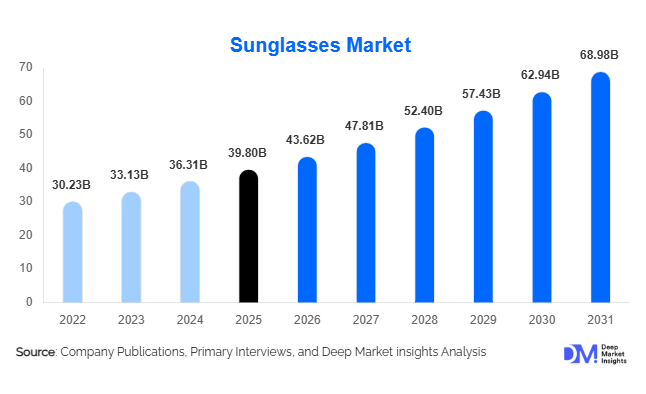
According to Deep Market Insights, the global sunglasses market size was valued at USD 39.8 billion in 2025 and is projected to grow from USD 43.2 billion in 2026 to reach USD 68.9 billion by 2031, expanding at a CAGR of 9.6% during the forecast period (2026–2031). The sunglasses market growth is primarily driven by rising awareness regarding ultraviolet (UV) eye protection, increasing consumer spending on premium fashion accessories, expanding participation in outdoor recreational activities, and the growing adoption of technologically advanced eyewear products. Sunglasses have evolved from being seasonal protective eyewear into essential lifestyle and fashion accessories, supported by strong demand across luxury, sports, and mass-market segments. Premiumization trends, celebrity endorsements, social media influence, and growing disposable incomes in emerging economies continue to create favorable growth conditions. Additionally, innovations in polarized lenses, photochromic technologies, lightweight frame materials, and smart eyewear functionalities are reshaping consumer preferences and creating new revenue streams for manufacturers worldwide.
Key Market Insights
- Non-polarized sunglasses remain the largest product category, accounting for approximately 58% of global market revenue due to affordability and broad consumer appeal.
- Luxury and premium sunglasses continue gaining market share, supported by rising demand for branded fashion accessories and designer collections.
- Europe dominates the global sunglasses market, accounting for nearly 34% of global revenue, owing to strong luxury brand presence and high consumer spending.
- Asia-Pacific is the fastest-growing regional market, driven by rising disposable incomes, urbanization, and increasing fashion consciousness in China, India, and Southeast Asia.
- Smart sunglasses represent one of the fastest-growing innovation segments, integrating audio, artificial intelligence, augmented reality, and connectivity features.
- Sustainability initiatives are becoming a major purchasing factor, encouraging the adoption of recycled plastics, bio-based acetate, and environmentally responsible manufacturing processes.
What are the latest trends in the sunglasses market?
Smart Eyewear Integration Accelerating Market Innovation
The sunglasses industry is experiencing a significant transformation through the integration of wearable technologies. Manufacturers are introducing smart sunglasses equipped with voice assistants, open-ear audio systems, augmented reality interfaces, navigation tools, and health-monitoring capabilities. Technology companies and eyewear brands are increasingly collaborating to develop multifunctional products that merge style with connectivity. Consumers, particularly younger demographics, are showing growing interest in smart eyewear as an alternative to traditional wearable devices. The emergence of AI-powered personal assistants and augmented reality applications is expected to further accelerate adoption across premium market segments over the coming years.
Sustainable Materials and Circular Manufacturing Models
Sustainability has become a major trend across the global sunglasses industry. Manufacturers are increasingly adopting recycled plastics, biodegradable acetate, plant-based polymers, and eco-friendly packaging solutions to address growing consumer demand for environmentally responsible products. European and North American consumers are particularly responsive to sustainability-focused branding initiatives. Companies are also investing in circular economy models that promote product recycling, carbon-neutral production, and responsible sourcing of raw materials. These initiatives not only strengthen brand differentiation but also support compliance with emerging environmental regulations across major consumer markets.
What are the key drivers in the sunglasses market?
Growing Awareness of UV Protection and Eye Health
Increasing awareness regarding the harmful effects of ultraviolet radiation is one of the primary drivers of sunglasses market growth. Healthcare organizations, ophthalmologists, and government agencies continue to educate consumers about the risks associated with prolonged UV exposure, including cataracts, retinal damage, and vision impairment. As a result, consumers are increasingly viewing sunglasses as essential protective products rather than discretionary accessories. The trend is particularly strong among aging populations and health-conscious consumers seeking preventive eye care solutions.
Expansion of Fashion and Luxury Eyewear Consumption
The transformation of sunglasses into fashion statements has significantly expanded market demand. Luxury brands, fashion houses, influencers, and celebrity endorsements continue to stimulate premium product purchases globally. Consumers increasingly own multiple pairs of sunglasses to complement different styles, occasions, and lifestyle activities. The integration of eyewear collections into luxury fashion portfolios has enabled premium brands to command higher margins while strengthening brand loyalty. Emerging markets are also witnessing increasing penetration of designer sunglasses as rising incomes enable greater discretionary spending.
What are the restraints for the global market?
Counterfeit and Imitation Products
The widespread availability of counterfeit sunglasses remains a major challenge for industry participants. Unauthorized replicas undermine brand equity, reduce revenue opportunities for legitimate manufacturers, and create pricing pressure across premium product categories. Counterfeit products are particularly prevalent in developing economies and online marketplaces where enforcement remains inconsistent. The presence of imitation products also raises concerns regarding consumer safety, as many counterfeit sunglasses fail to provide adequate UV protection.
Raw Material Price Volatility and Supply Chain Risks
Manufacturers continue to face challenges related to fluctuating prices of acetate, specialty polymers, metals, and optical-grade lens materials. Supply chain disruptions, geopolitical tensions, and logistics constraints can affect production schedules and increase operating costs. Rising transportation expenses and global inflationary pressures have further complicated procurement strategies. These factors create uncertainty for manufacturers seeking to maintain competitive pricing while preserving profit margins.
What are the key opportunities in the sunglasses industry?
Expansion Across Emerging Consumer Markets
Rapid economic growth in countries such as India, Indonesia, Vietnam, Saudi Arabia, and Brazil presents substantial opportunities for sunglasses manufacturers. Rising middle-class populations, increasing urbanization, and growing fashion awareness are driving higher demand for both premium and affordable eyewear products. Companies that establish localized manufacturing, distribution networks, and marketing strategies can capitalize on these expanding consumer bases. The increasing influence of social media and e-commerce platforms is further accelerating product adoption across emerging economies.
Growth of Smart and Connected Sunglasses
The convergence of eyewear and consumer electronics represents one of the most attractive growth opportunities in the industry. Smart sunglasses equipped with artificial intelligence, audio systems, navigation capabilities, and augmented reality interfaces are creating entirely new product categories. Premium pricing, recurring software ecosystems, and technological differentiation offer manufacturers significant opportunities for revenue expansion. As wearable technology adoption increases globally, connected eyewear is expected to become a major contributor to future market growth.
Report Scope
| Report Metric | Details |
|---|---|
| Market Size in 2025 | USD 39.8 Billion |
| Market Size in 2026 | USD 43.62 Billion |
| Market Size in 2031 | USD 68.98 Billion |
| CAGR | 9.6% (2026-2031) |
| Base Year for Estimation | 2025 |
| Historical Data | 2022-2024 |
| Forecast Period | 2026-2031 |
| Report Coverage | Revenue Forecast, Competitive Landscape, Supply Chain Disruption, Growth Factors, Environment & Regulatory Landscape and Trends |
| Geographies Covered | North America, Europe, APAC, Middle East and Africa, LATAM |
| Countries Covered | U.S., Canada, U.K., Germany, France, Spain, Italy, Russia, Nordic, Benelux, Rest of Europe, China, Korea, Japan, India, Australia, Singapore, Taiwan, South East Asia, Rest of Asia-Pacific, UAE, Turky, Saudi Arabia, South Africa, Egypt, Nigeria, Rest of MEA, Brazil, Mexico, Argentina, Chile, Colombia, Rest of LATAM |
Explore more data points, trends and opportunities Download Free Sample Report
Product Type Insights
Non-polarized sunglasses dominate the global market, accounting for approximately 58% of industry revenue in 2025. Their affordability, wide availability, and versatility across fashion applications support strong demand among mainstream consumers. Polarized sunglasses represent the second-largest segment and continue gaining popularity among drivers, outdoor enthusiasts, and sports participants due to their superior glare reduction capabilities. Photochromic lenses are increasingly adopted by consumers seeking adaptive eyewear solutions that automatically adjust to changing light conditions. Smart sunglasses remain a relatively small but rapidly expanding segment, benefiting from technological innovation and increasing wearable device adoption.
Frame Material Insights
Plastic-based frames, including acetate, TR90, nylon, and polycarbonate materials, account for nearly 47% of global sunglasses sales. These materials offer lightweight construction, design flexibility, durability, and cost advantages compared to metal alternatives. Metal frames, particularly titanium and stainless steel variants, maintain strong demand within premium and luxury categories due to their durability and aesthetic appeal. Sustainable and bio-based materials are emerging as high-growth sub-segments as consumers increasingly prioritize environmentally responsible products. Manufacturers continue investing in advanced material engineering to improve comfort, durability, and sustainability.
Price Range Insights
The mid-range segment, encompassing products priced between USD 50 and USD 150, represents the largest market category with approximately 41% share of global revenue. Consumers increasingly seek products that balance quality, aesthetics, and affordability, making this segment highly attractive. Premium sunglasses priced between USD 150 and USD 300 continue benefiting from strong brand recognition and superior product features. Luxury sunglasses priced above USD 300 generate significant value despite lower sales volumes, supported by affluent consumers and fashion-conscious buyers. Economy-priced products maintain strong demand in emerging markets and price-sensitive consumer segments.
Distribution Channel Insights
Offline retail channels continue to dominate global sunglasses sales, accounting for approximately 68% of market revenue. Optical stores, specialty eyewear retailers, department stores, and brand-owned outlets remain preferred purchasing destinations due to consumers' desire to assess product fit, comfort, and aesthetics before purchase. However, online channels are growing rapidly, supported by virtual try-on technologies, direct-to-consumer business models, and expanding e-commerce infrastructure. Brand websites and online marketplaces are increasingly important sales channels, particularly among younger consumers seeking convenience and broader product selection.
End User Insights
Men represent the largest consumer segment within the sunglasses market, accounting for approximately 38% of global demand. Strong participation in sports, driving, outdoor recreation, and occupational activities supports sustained demand within this category. Women's sunglasses continue to benefit from fashion-driven purchasing behavior and higher product replacement frequency. The unisex segment is expanding rapidly as brands increasingly adopt gender-neutral design strategies. Children's sunglasses represent a growing niche driven by increasing parental awareness regarding UV protection and eye health.
Explore more data points, trends and opportunities Download Free Sample Report
Sunglasses Market Segmentations
By Product Type
- Polarized Sunglasses
- Non-Polarized Sunglasses
- Photochromic Sunglasses
- Mirrored Sunglasses
- Gradient Lens Sunglasses
- Smart/Connected Sunglasses
By End User
- Men
- Women
- Unisex
- Children/Kids
By Distribution Channel
- Optical Stores
- Brand-Owned Stores
- Department Stores
- Hypermarkets/Supermarkets
- Sports Specialty Stores
- Travel Retail/Duty-Free Stores
- Online Brand Websites
- E-Commerce Marketplaces
Regional Insights
Europe
Europe remains the largest regional sunglasses market, accounting for approximately 34% of global revenue in 2025. Italy serves as a global eyewear manufacturing hub and benefits from the presence of leading luxury eyewear brands. France, Germany, Spain, and the United Kingdom collectively contribute substantial demand driven by fashion-conscious consumers and high disposable incomes. Premium and luxury sunglasses enjoy particularly strong penetration across Western European markets. Sustainability-focused products are also gaining significant traction among European consumers.
Asia-Pacific
Asia-Pacific accounts for approximately 29% of global market revenue and is expected to register the highest growth rate through 2031. China represents the largest regional market, supported by rising middle-class consumption and strong domestic manufacturing capabilities. India is among the fastest-growing national markets, driven by increasing urbanization, disposable incomes, and awareness regarding eye protection. Japan and South Korea contribute significant demand for premium and technologically advanced eyewear products. Southeast Asian markets continue experiencing rapid growth as fashion adoption expands across younger populations.
North America
North America represents approximately 26% of global sunglasses demand, led primarily by the United States. High consumer spending, strong outdoor recreation participation, and premium brand adoption contribute to market strength. Demand for polarized sunglasses, sports eyewear, and luxury fashion products remains particularly strong. Canada contributes additional growth through outdoor lifestyle trends and increasing consumer awareness regarding eye protection.
Latin America
Latin America accounts for approximately 6% of global market revenue, with Brazil and Mexico representing the largest consumer markets. Rising urbanization, growing tourism activity, and increasing middle-class purchasing power support market expansion. Demand is strongest within mid-range and fashion-oriented product categories, while premium sunglasses are gradually gaining market share among affluent consumers.
Middle East & Africa
The Middle East and Africa region accounts for approximately 5% of global sunglasses demand. High sunlight exposure, luxury consumption patterns, and expanding tourism industries support market growth across the region. Saudi Arabia and the United Arab Emirates represent key markets for premium eyewear products, while South Africa serves as an important regional demand center. Rising disposable incomes and growing fashion awareness are expected to further strengthen market growth throughout the forecast period.
Key Players in the Sunglasses Market
- EssilorLuxottica
- Kering Eyewear
- Safilo Group
- Marcolin
- De Rigo
- Maui Jim
- Oakley
- Costa Del Mar
- Warby Parker
- Fielmann Group
- Silhouette International
- Charmant Group
- Rodenstock
- Bollé Brands
- Rudy Project