Strawberry Preserves Market Size
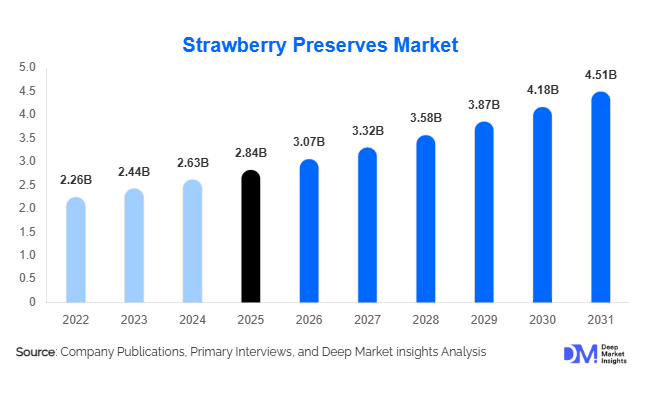
According to Deep Market Insights, the global strawberry preserves market size was valued at USD 2.84 billion in 2025 and is projected to grow from USD 3.07 billion in 2026 to reach USD 4.51 billion by 2031, expanding at a CAGR of 8.0% during the forecast period (2026–2031). The strawberry preserves market growth is primarily driven by rising consumer preference for premium fruit-based breakfast products, increasing demand for clean-label and organic preserves, and expanding applications across household consumption, foodservice, and food processing industries.
Key Market Insights
- Premium and clean-label strawberry preserves continue to gain strong consumer acceptance, supported by increasing demand for natural ingredients, higher fruit content, and preservative-free formulations.
- Organic strawberry preserves represent the fastest-growing product category, driven by growing health awareness and expansion of certified organic strawberry cultivation.
- Europe dominates the global market, accounting for approximately 38.6% of total revenue, supported by mature retail infrastructure and strong consumer preference for fruit spreads.
- Asia-Pacific is the fastest-growing regional market, driven by urbanization, organized retail expansion, rising disposable income, and increasing adoption of premium packaged foods.
- Household consumption remains the leading application segment, while food processing continues to generate growing industrial demand for bakery, dairy, and confectionery products.
- Advanced fruit processing technologies, recyclable packaging, and digital retail channels are improving manufacturing efficiency, product quality, and global market accessibility.
Strawberry Preserves Market Latest Trends
Premiumization and Clean-Label Product Innovation
Manufacturers are increasingly introducing premium strawberry preserves with higher fruit content, organic certification, and reduced sugar formulations to address evolving consumer preferences. Clean-label products made without artificial preservatives or synthetic additives continue gaining shelf space across supermarkets and specialty food retailers. Premium packaging, recyclable glass jars, and sustainably sourced ingredients are becoming important product differentiators. Organic strawberry cultivation continues expanding globally, enabling manufacturers to strengthen premium product portfolios while supporting long-term sustainability objectives.
Technology-Driven Manufacturing and Sustainable Packaging
Food manufacturers are adopting advanced fruit processing technologies that improve fruit retention, texture consistency, and production efficiency while minimizing processing losses. Automation across cooking, filling, and packaging operations enables higher production capacity and consistent product quality. Sustainable packaging innovations, including lightweight recyclable containers and environmentally friendly labels, are becoming increasingly common as retailers and consumers prioritize environmentally responsible food packaging. Digital grocery platforms are also expanding market accessibility by improving direct-to-consumer sales and premium product visibility.
Strawberry Preserves Market Drivers
Growing Consumer Preference for Premium Fruit-Based Foods
Increasing demand for premium breakfast products, healthier food choices, and authentic fruit flavors continues to support market expansion. Consumers increasingly prefer preserves containing higher fruit content, fewer artificial ingredients, and premium quality certifications. Rising consumption of bakery products, breakfast spreads, and dessert ingredients further strengthens demand across both developed and emerging markets. Premium retail channels continue expanding product availability while manufacturers introduce innovative flavor profiles and functional formulations to address changing consumer preferences.
Expansion of Organic and Health-Oriented Food Consumption
Growing awareness regarding nutrition, natural ingredients, and reduced sugar consumption is encouraging manufacturers to expand organic and healthier preserve offerings. Retailers continue increasing shelf space dedicated to organic packaged foods, while consumers actively seek products produced using sustainable agricultural practices. Increasing disposable income, particularly across emerging economies, further supports premium preserve consumption and encourages manufacturers to invest in product innovation and organic production capabilities.
Strawberry Preserves Market Restraints
Raw Material Price Volatility
Seasonal fluctuations in strawberry harvests and changing sugar prices continue creating cost uncertainty for manufacturers. Climatic variability, unfavorable growing conditions, and supply chain disruptions affect fruit availability and production consistency. These cost pressures influence product pricing, profit margins, and inventory planning, particularly for small and medium-sized preserve manufacturers operating within highly competitive retail markets.
Limited Shelf Stability of Premium Natural Formulations
Growing demand for preservative-free products presents formulation challenges for manufacturers seeking to maintain extended shelf life while preserving flavor and texture. Premium clean-label products require advanced processing technologies and specialized packaging solutions to maintain quality during transportation and storage. These additional manufacturing requirements increase production costs and operational complexity across global supply chains.
Strawberry Preserves Industry Key Opportunities
Expansion of Organic Product Portfolios
Organic food consumption continues increasing worldwide, creating significant opportunities for manufacturers to expand certified organic strawberry preserves. Rising investments in sustainable farming, traceable sourcing, and premium food manufacturing are expected to strengthen product differentiation while attracting health-conscious consumers seeking natural fruit spreads and environmentally responsible food products.
Growth Across Food Processing Applications
Industrial demand for strawberry preserves continues expanding within bakery, dairy, confectionery, and snack manufacturing industries. Food manufacturers increasingly utilize preserves as fillings, toppings, and flavoring ingredients to enhance product quality and consumer appeal. Continued innovation in processed foods and convenience products is expected to create additional long-term commercial opportunities across industrial food manufacturing.
Report Scope
| Report Metric | Details |
|---|---|
| Market Size in 2025 | USD 2.84 Billion |
| Market Size in 2026 | USD 3.07 Billion |
| Market Size in 2031 | USD 4.51 Billion |
| CAGR | 8% (2026-2031) |
| Base Year for Estimation | 2025 |
| Historical Data | 2022-2024 |
| Forecast Period | 2026-2031 |
| Report Coverage | Revenue Forecast, Competitive Landscape, Supply Chain Disruption, Growth Factors, Environment & Regulatory Landscape and Trends |
| Geographies Covered | North America, Europe, APAC, Middle East and Africa, LATAM |
| Countries Covered | U.S., Canada, U.K., Germany, France, Spain, Italy, Russia, Nordic, Benelux, Rest of Europe, China, Korea, Japan, India, Australia, Singapore, Taiwan, South East Asia, Rest of Asia-Pacific, UAE, Turky, Saudi Arabia, South Africa, Egypt, Nigeria, Rest of MEA, Brazil, Mexico, Argentina, Chile, Colombia, Rest of LATAM |
Explore more data points, trends and opportunities Download Free Sample Report
Type Insights
Based on type, the global strawberry preserves market is segmented into conventional, organic, and reduced-sugar strawberry preserves. Conventional strawberry preserves accounted for the largest market share in 2025 and continue to dominate the market owing to their widespread retail availability, affordable pricing, extensive product portfolio, and strong consumer familiarity across both developed and emerging economies. Their established presence in supermarkets, hypermarkets, convenience stores, and online retail channels, coupled with consistent demand from households and foodservice operators, continues to reinforce segment leadership. Additionally, long-standing consumer preference for traditional fruit spreads and broad brand availability contribute significantly to sustained demand.Reduced-sugar strawberry preserves continue gaining traction as consumers increasingly seek healthier alternatives without compromising authentic fruit flavor and texture. Rising concerns regarding obesity, diabetes, and excessive sugar intake have encouraged manufacturers to develop formulations containing natural sweeteners, higher fruit content, fruit juice concentrates, and functional ingredients. Continuous product innovation focused on nutritional enhancement, clean ingredient labels, and improved taste profiles is expected to further strengthen growth opportunities across this segment throughout the forecast period.
Application Insights
Based on application, the strawberry preserves market is categorized into household, foodservice, and food processing. Household consumption remained the leading application segment in 2025 and is expected to maintain its dominance throughout the forecast period. The segment is primarily driven by the widespread use of strawberry preserves as breakfast spreads, baking ingredients, dessert toppings, snack accompaniments, and meal preparation ingredients. Growing demand for convenient ready-to-use food products, increasing breakfast consumption at home, expanding availability through organized retail channels, and rising consumer preference for premium fruit-based spreads continue to support segment growth.Food processing is anticipated to witness robust growth during the forecast period as strawberry preserves are increasingly utilized as ingredients in dairy products, yogurt, confectionery, bakery fillings, cereal bars, ice cream, sauces, ready-to-eat packaged foods, and functional snack products. Growing investments in processed food manufacturing, increasing demand for fruit-based ingredients, and continuous product innovation across the packaged food industry are expected to support sustained commercial demand from industrial food manufacturers.
Explore more data points, trends and opportunities Download Free Sample Report
Strawberry Preserves Market Segmentations
By Type
- Conventional
- Organic
- Reduced-Sugar
By Application
- Household Consumption
- Foodservice
- Food Processing
Regional Insights
North America
North America represents one of the leading regional markets for strawberry preserves, supported by high consumption of packaged foods, well-developed retail infrastructure, and strong demand for premium breakfast products. The United States accounts for the largest share of regional production and consumption, while Canada continues witnessing growing demand for organic and reduced-sugar preserves through specialty food retailers and health-focused grocery chains. Regional market growth is further supported by increasing consumer preference for clean-label products, strong purchasing power, widespread adoption of premium fruit spreads, continuous product innovation, expansion of e-commerce grocery platforms, and growing demand for convenient breakfast and snack solutions.
Europe
Europe dominated the global strawberry preserves market in 2025 owing to strong consumer preference for fruit-based breakfast products, a well-established preserve manufacturing industry, and high consumption of premium packaged foods. Germany, France, Italy, Poland, Spain, and the United Kingdom remain major production and consumption hubs supported by extensive retail distribution networks and increasing demand for artisanal and organic fruit preserves. Regional growth is further driven by long-standing breakfast traditions, abundant fruit cultivation, strong export capabilities, increasing demand for clean-label and premium products, growing popularity of locally sourced ingredients, and continuous innovation in gourmet and specialty preserve offerings.
Asia-Pacific
Asia-Pacific is expected to register the fastest growth during the forecast period due to rapid urbanization, rising disposable incomes, organized retail expansion, and increasing consumption of packaged convenience foods. China, Japan, India, South Korea, and Australia continue investing in premium packaged food manufacturing while consumers increasingly adopt western-style breakfast habits and premium fruit spreads. Additional growth drivers include expanding middle-class populations, increasing health awareness, rising demand for premium imported food products, rapid growth of modern retail and e-commerce channels, expanding foodservice industries, and increasing investments by domestic and international food manufacturers across the region.
Latin America
Latin America continues experiencing steady market expansion driven by improving supermarket penetration, growing domestic fruit production, and increasing demand for processed fruit products. Brazil, Argentina, Chile, and Mexico remain important regional contributors supported by expanding food processing industries and rising consumption of premium packaged preserves. Regional market growth is also supported by favorable agricultural conditions for berry cultivation, increasing investments in food manufacturing, growing urban populations, rising disposable incomes, expanding organized retail infrastructure, and increasing consumer preference for value-added fruit products.
Middle East & Africa
The Middle East & Africa strawberry preserves market continues to develop through rising premium food imports, expanding hospitality industries, and increasing consumer awareness of premium packaged foods. The United Arab Emirates, Saudi Arabia, South Africa, and Egypt remain key regional markets where organized retail expansion and tourism continue supporting preserve consumption across both household and foodservice applications. Market growth is further driven by increasing disposable incomes, rapid expansion of supermarkets and hypermarkets, growing expatriate populations, rising demand for premium imported food products, increasing café and bakery establishments, and continued investments in the hospitality and tourism sectors across major economies.
Key Players in the Strawberry Preserves Market
- Andros Group
- Bonne Maman
- The J.M. Smucker Company
- Hero Group
- B&G Foods
- St. Dalfour
- Wilkin & Sons Ltd.
- Darbo AG
- Zentis GmbH
- Mackays
- Agrana Beteiligungs AG
- Crofter's Organic
- Mrs. Bridges
- Rigoni di Asiago
- Orkla Foods