Umeboshi Market Size
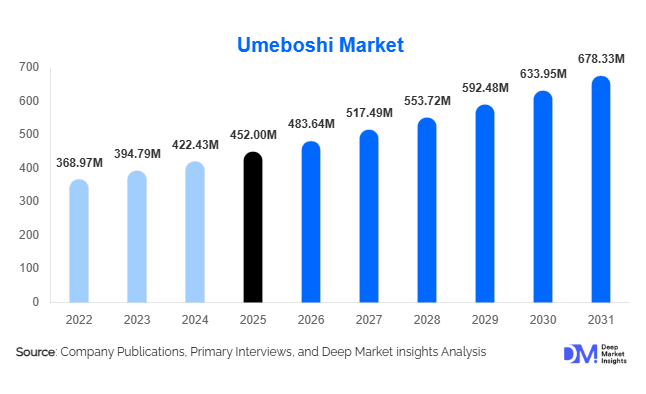
According to Deep Market Insights, the global umeboshi market size was valued at approximately USD 483.64 million in 2026 and is projected to grow to reach USD 678.33 million by 2031, expanding at a CAGR of 7.0% during the forecast period (2026–2031). The umeboshi market growth is primarily driven by rising global demand for fermented foods, increasing adoption of Japanese cuisine worldwide, growing consumer preference for clean-label and functional food products, and expanding international availability through specialty retail and e-commerce channels.
Key Market Insights
- Umeboshi is transitioning from a traditional Japanese preserved food into a global fermented food ingredient, supported by increasing consumer interest in natural preservation, functional foods, and authentic ethnic cuisines.
- Asia-Pacific dominates the global umeboshi market, accounting for approximately 62.7% of the 2025 market value, driven by Japan’s strong cultural consumption base and established production ecosystem.
- North America is emerging as the fastest-growing region, supported by rising demand for Japanese cuisine, fermented foods, premium grocery products, and online specialty food platforms.
- Traditional salted umeboshi remains the largest product segment, accounting for approximately 42.5% of the 2025 market due to its cultural importance, long shelf life, and strong consumer loyalty.
- Household consumption represents the leading end-use segment, contributing nearly 58.6% of total market demand as umeboshi remains widely used in rice dishes, lunch boxes, and traditional meals.
- Product innovation is reshaping consumer preferences, with manufacturers introducing low-sodium, honey-flavored, organic, seedless, and single-serving umeboshi formats to attract international consumers.
umeboshi market latest trends
Global Expansion of Fermented Food Consumption
The growing popularity of fermented foods is one of the most significant trends influencing the global umeboshi market. Consumers across North America, Europe, and emerging Asian markets are increasingly seeking foods associated with natural preservation, digestive wellness, and traditional preparation methods. Umeboshi benefits from this trend due to its fermentation heritage, long shelf stability, and association with Japanese culinary traditions.
Food manufacturers and retailers are increasingly positioning umeboshi alongside other premium fermented products such as kimchi, miso, kombucha, and traditional pickled foods. This shift has expanded umeboshi’s appeal beyond Japanese consumers and created opportunities for adoption among health-conscious consumers looking for unique functional ingredients. Specialty grocery stores and online retailers are increasingly dedicating shelf space to Japanese fermented foods, improving product visibility and consumer accessibility.
Premiumization and Product Innovation
The umeboshi industry is experiencing increasing premiumization as producers move beyond traditional salted products toward differentiated offerings. Manufacturers are introducing reduced-salt formulations, organic umeboshi, honey-infused varieties, seedless products, and gourmet packaging formats to appeal to international consumers with diverse preferences.
Premium products made from high-quality Nanko ume varieties are gaining popularity among consumers willing to pay higher prices for authenticity, regional origin, and traditional production methods. Producers are also investing in modern packaging formats such as single-use portions, resealable pouches, and export-friendly packaging to improve convenience and expand adoption among younger consumers.
Digital Commerce Expanding Global Accessibility
E-commerce is becoming an important growth channel for the umeboshi market by improving access to Japanese specialty foods outside traditional Asian markets. Online platforms allow consumers in North America, Europe, and Australia to purchase authentic umeboshi products directly from Japanese producers and specialty food brands.
Digital retail is also enabling smaller producers to reach international customers without relying entirely on physical distribution networks. Product education, recipe content, customer reviews, and social media marketing are helping introduce umeboshi to consumers unfamiliar with Japanese preserved foods.
umeboshi market drivers
Rising Global Interest in Japanese Cuisine
The international expansion of Japanese cuisine is a major driver supporting umeboshi market growth. Increasing popularity of sushi restaurants, Japanese cafés, ramen outlets, and fusion cuisine has improved consumer familiarity with Japanese ingredients. Umeboshi is increasingly being incorporated into rice dishes, sauces, dressings, beverages, and contemporary culinary applications.
Countries such as the United States, Canada, the United Kingdom, Australia, and Singapore are witnessing growing demand for Japanese specialty foods due to multicultural populations, rising disposable incomes, and consumer willingness to explore international flavors. Restaurants introducing authentic Japanese menus are creating additional demand for commercial umeboshi supplies.
Growing Demand for Functional and Clean-Label Foods
Consumer preference for natural, minimally processed, and functional food products is positively influencing the umeboshi market. Modern consumers increasingly seek ingredients that align with wellness-oriented lifestyles, including fermented foods, plant-based products, and traditional ingredients with perceived health benefits.
Umeboshi manufacturers are benefiting from this trend by highlighting traditional fermentation methods, natural preservation techniques, and simple ingredient profiles. Organic and low-sodium product categories are particularly gaining traction among health-conscious consumers in developed markets.
Expansion of International Retail and E-Commerce Channels
The development of global food distribution networks has significantly improved umeboshi accessibility. Supermarkets, specialty Asian grocery stores, premium food retailers, and online marketplaces are expanding their Japanese food categories, allowing umeboshi products to reach broader consumer groups.
E-commerce platforms are especially important for niche food categories like umeboshi because they allow consumers to discover products that may not be available through conventional retail channels. Direct-to-consumer models are also enabling producers to build stronger international brand recognition.
umeboshi market restraints
Limited Consumer Awareness Outside Asian Markets
Despite growing international interest, umeboshi remains relatively unfamiliar among many consumers outside Japan and East Asia. The product’s strong salty and sour flavor profile can limit adoption among first-time consumers who are accustomed to milder condiments and preserved foods.
Manufacturers need to invest in consumer education, recipe development, and localized product formulations to overcome taste barriers. Unlike globally recognized products such as soy sauce or sushi, umeboshi still requires greater awareness-building efforts in several international markets.
Dependence on Agricultural Supply and Climate Conditions
The umeboshi market faces supply-side challenges due to its dependence on high-quality Japanese plums. Production is influenced by weather conditions, seasonal harvest variations, and limited cultivation regions. Climate change, irregular rainfall patterns, and changing agricultural conditions can affect plum availability and increase raw material costs.
Premium umeboshi producers are particularly vulnerable because high-quality varieties such as Nanko ume require specific cultivation conditions. Maintaining consistent supply while preserving product quality remains a major challenge for manufacturers.
umeboshi market industry key opportunities
Expansion into Functional Food and Wellness Applications
The growing functional food industry presents significant opportunities for umeboshi manufacturers. Consumers are increasingly interested in ingredients associated with traditional wellness practices, fermentation, and digestive health. Umeboshi-based extracts, concentrates, and powdered ingredients could create new applications beyond traditional consumption.
Food companies can develop umeboshi-based wellness products, nutritional blends, functional beverages, and supplements targeting health-conscious consumers. This expansion can help transform umeboshi from a specialty condiment into a broader functional ingredient category.
Growth of Premium Japanese Food Exports
Increasing global demand for authentic Japanese foods creates significant export opportunities for umeboshi producers. Premium Japanese ingredients are gaining popularity among affluent consumers, gourmet retailers, and high-end restaurants worldwide.
Producers can capitalize on this trend by developing export-focused product lines featuring regional authenticity, organic certifications, sustainable sourcing, and premium packaging. Markets such as the United States, Europe, Singapore, and Australia offer strong potential due to rising demand for imported specialty foods.
Integration into Global Food Processing Applications
Umeboshi presents opportunities beyond direct consumption through integration into processed food applications. Manufacturers are increasingly exploring its use as a natural flavor enhancer in sauces, dressings, ready-to-eat meals, snacks, and plant-based products.
The ingredient’s distinctive salty-sour flavor profile provides differentiation opportunities for food companies seeking unique natural flavor solutions. Collaboration between umeboshi producers and global food manufacturers could accelerate adoption across multiple food categories.
Report Scope
| Report Metric | Details |
|---|---|
| Market Size in 2025 | USD 452.00 Million |
| Market Size in 2026 | USD 483.64 Million |
| Market Size in 2031 | USD 678.33 Million |
| CAGR | 7% (2026-2031) |
| Base Year for Estimation | 2025 |
| Historical Data | 2022-2024 |
| Forecast Period | 2026-2031 |
| Report Coverage | Revenue Forecast, Competitive Landscape, Supply Chain Disruption, Growth Factors, Environment & Regulatory Landscape and Trends |
| Geographies Covered | North America, Europe, APAC, Middle East and Africa, LATAM |
| Countries Covered | U.S., Canada, U.K., Germany, France, Spain, Italy, Russia, Nordic, Benelux, Rest of Europe, China, Korea, Japan, India, Australia, Singapore, Taiwan, South East Asia, Rest of Asia-Pacific, UAE, Turky, Saudi Arabia, South Africa, Egypt, Nigeria, Rest of MEA, Brazil, Mexico, Argentina, Chile, Colombia, Rest of LATAM |
Explore more data points, trends and opportunities Download Free Sample Report
Product Type Insights
Traditional salted umeboshi dominates the global umeboshi market, accounting for approximately 42.5% of the 2025 market value. This segment maintains leadership due to its historical importance in Japanese cuisine, widespread household consumption, and strong association with authentic umeboshi preparation methods. Traditional salted varieties are primarily consumed with rice, included in bento meals, used as seasoning ingredients, and incorporated into home-cooked Japanese dishes. The product’s long shelf life and strong consumer loyalty continue to support demand in Japan and among Japanese communities worldwide.Honey-flavored umeboshi is emerging as one of the fastest-growing product categories as manufacturers attempt to reduce the intensity of traditional salty and sour flavors. This variant appeals particularly to international consumers who are new to umeboshi and prefer a sweeter flavor profile. Reduced-sodium umeboshi is also gaining popularity among health-conscious consumers concerned about salt intake, particularly in North America and Europe.Organic umeboshi represents a smaller but rapidly expanding premium segment. Increasing consumer preference for sustainable agriculture, chemical-free farming, and clean-label products is encouraging producers to develop certified organic offerings. Premium organic products command higher pricing and are increasingly available through specialty retailers and online platforms.
Processing Method Insights
Naturally fermented umeboshi remains the leading processing segment, accounting for approximately 68.3% of the 2025 market value. Traditional fermentation methods are preferred due to their cultural authenticity, distinctive flavor development, and consumer perception of higher quality. Japanese consumers and premium international buyers often associate naturally fermented umeboshi with traditional craftsmanship and superior taste.Industrial processing methods are gaining adoption among large-scale manufacturers seeking improved production efficiency, consistency, and export scalability. Modern processing technologies enable manufacturers to maintain quality standards while producing larger volumes for international markets. These methods are particularly relevant for supermarket products, foodservice applications, and processed food ingredients.Hybrid production approaches combining traditional fermentation knowledge with modern quality-control systems are becoming increasingly common. Producers are implementing controlled fermentation environments, automated monitoring systems, and improved hygiene processes to meet international food safety requirements while preserving traditional characteristics.
Packaging Insights
Glass jars represent the leading packaging format in the global umeboshi market, accounting for approximately 36.7% of the 2025 market value. Glass packaging remains popular because it preserves product quality, provides long shelf life, and supports premium brand positioning. Consumers often associate glass jars with traditional Japanese food products and higher-quality preservation methods.Flexible pouches and resealable packaging formats are experiencing faster growth due to their convenience, lower transportation costs, and suitability for international retail channels. These formats appeal to younger consumers and export markets where portability and storage convenience are important purchasing factors.Single-serving packaging is also gaining traction, particularly among foodservice operators, office consumers, and international buyers unfamiliar with umeboshi. Smaller formats allow consumers to try the product with lower commitment while supporting broader market penetration.
Nature Insights
Conventional umeboshi represents the largest nature segment, accounting for approximately 82.4% of the 2025 market value. Conventional products dominate due to established farming systems, wider availability, and lower production costs. They remain the preferred option for traditional household consumption and mainstream retail channels.Organic umeboshi is expected to experience stronger growth during the forecast period due to increasing consumer demand for sustainable and environmentally responsible food products. Organic products are particularly attractive in North America and Europe, where consumers demonstrate higher willingness to pay for certified clean-label products.Although organic production remains limited due to higher cultivation costs and certification requirements, premium pricing opportunities make this segment strategically important for exporters targeting affluent consumers.
Distribution Channel Insights
Supermarkets and hypermarkets represent the largest distribution channel for umeboshi products, accounting for approximately 31.5% of the 2025 market value. These channels dominate in Japan and other Asian markets due to strong consumer familiarity and regular household purchasing patterns. Supermarkets also play an important role internationally by introducing Japanese specialty foods through dedicated Asian food sections.Online retail is the fastest-growing distribution channel due to increasing cross-border e-commerce adoption and consumer demand for convenient access to imported foods. Digital platforms allow smaller umeboshi producers to reach international customers without requiring extensive physical distribution networks.Specialty food stores remain important in premium markets such as the United States and Europe. These retailers attract consumers seeking authentic Japanese ingredients, organic products, and gourmet food experiences.
End-Use Insights
Household consumers represent the largest end-use segment of the global umeboshi market, accounting for approximately 58.6% of the 2025 market value. Household demand remains strong due to umeboshi’s role as a traditional Japanese food ingredient. Japanese households commonly use umeboshi with rice, noodles, vegetables, and packed meals.The foodservice segment is expanding rapidly as Japanese restaurants, sushi chains, and fusion cuisine providers increase their usage of umeboshi in commercial recipes. Restaurants use umeboshi in sushi rolls, sauces, rice dishes, dressings, and specialty menu items.The food processing industry represents another emerging application area. Manufacturers are incorporating umeboshi into ready-to-eat meals, snack products, seasoning blends, and plant-based foods to create differentiated flavor profiles. This segment is expected to experience strong growth as food companies seek natural flavoring ingredients.
Application Insights
Direct consumption remains the leading application segment, accounting for approximately 54.8% of the 2025 market value. Consumers primarily consume umeboshi as a traditional accompaniment to rice, a snack, or a seasoning ingredient. This application continues to dominate due to cultural familiarity in Japan and increasing adoption among Japanese food enthusiasts globally.Culinary applications represent a growing opportunity as chefs and food manufacturers incorporate umeboshi into modern recipes. The ingredient is increasingly used in sauces, dressings, marinades, and fusion dishes due to its unique salty, sour, and umami characteristics.Functional food applications represent the fastest-growing niche segment. Companies are exploring umeboshi extracts and concentrates for wellness-oriented products targeting consumers interested in fermented ingredients and traditional health practices.
Explore more data points, trends and opportunities Download Free Sample Report
Umeboshi Market Segmentations
By Product Type
- Traditional Salted Umeboshi
- Honey-Flavored Umeboshi
- Low-Sodium Umeboshi
- Organic Umeboshi
- Seasoned and Flavored Umeboshi
- Seedless Umeboshi
- Umeboshi Paste and Puree
By Processing Method
- Naturally Fermented Umeboshi
- Industrially Processed Umeboshi
- Sun-Dried Fermented Umeboshi
- Salt-Preserved Umeboshi
By Packaging Type
- Glass Jars
- Plastic Containers
- Flexible Pouches
- Single-Serve Packs
- Bulk Foodservice Packaging
By Nature
- Conventional Umeboshi
- Organic Umeboshi
By Application
- Direct Consumption
- Rice and Traditional Japanese Meals
- Sauces and Seasonings
- Ready-to-Eat Meals
- Snacks and Specialty Foods
- Functional Food Applications
- Beverage and Wellness Applications
Regional Insights
Asia-Pacific
Asia-Pacific is the dominant region in the global umeboshi market, accounting for approximately 62.7% of the 2025 market value. The region’s leadership is primarily supported by Japan’s cultural connection with umeboshi, established production infrastructure, and strong domestic consumption patterns.Japan represents the largest country market, contributing approximately 56.8% of global market demand. Umeboshi remains deeply embedded in Japanese culinary traditions, particularly in rice dishes, lunch boxes, and seasonal food practices. Production centers such as Wakayama Prefecture continue to support premium umeboshi manufacturing through high-quality Nanko ume cultivation.China is emerging as an important production and export market due to expanding plum cultivation, lower manufacturing costs, and increasing demand for Japanese-style foods. Chinese producers primarily participate in processed and cost-competitive product categories.
North America
North America represents approximately 16.5% of the 2025 global umeboshi market and is expected to be the fastest-growing regional market during 2026–2031.The United States is the largest North American market due to rising Japanese restaurant penetration, growing interest in fermented foods, and increasing availability through online grocery platforms. Urban consumers, health-conscious shoppers, and Asian-American communities are major demand contributors.Canada is experiencing steady growth due to multicultural demographics, premium food consumption patterns, and increasing availability of Japanese specialty products.
Europe
Europe accounts for approximately 12.4% of the 2025 market value. Demand is supported by increasing interest in Japanese cuisine, organic foods, and fermented products.The United Kingdom represents the largest European market due to its developed Japanese restaurant sector and specialty food retail infrastructure. Germany and France are also experiencing rising demand through gourmet stores, organic retailers, and premium food channels.
Latin America
Latin America represents a smaller share of the global umeboshi market but offers emerging opportunities. Brazil and Argentina show increasing adoption due to Japanese communities, sushi restaurant expansion, and rising interest in international cuisines.
Middle East & Africa
The Middle East and Africa remain emerging markets for umeboshi. Demand is concentrated in premium hospitality, Japanese restaurants, and affluent urban markets. The UAE represents the leading regional opportunity due to strong international food consumption patterns and luxury retail development.
Key Players in the Umeboshi Market
- Nakata Foods Co., Ltd.
- Choya Umeshu Co., Ltd.
- Yamaki Jozo Co., Ltd.
- Kawashima Foods Co., Ltd.
- S&B Foods Inc.
- House Foods Group Inc.
- Hikari Miso Co., Ltd.
- Momoya Co., Ltd.
- Kikkoman Corporation
- Marukome Co., Ltd.
- Asahi Group Holdings Ltd.
- Yutaka Foods Co., Ltd.
- Clearspring Ltd.
- Eden Foods Inc.
- Regional Umeboshi Producers and Agricultural Cooperatives