Caramelized Nut Market Size
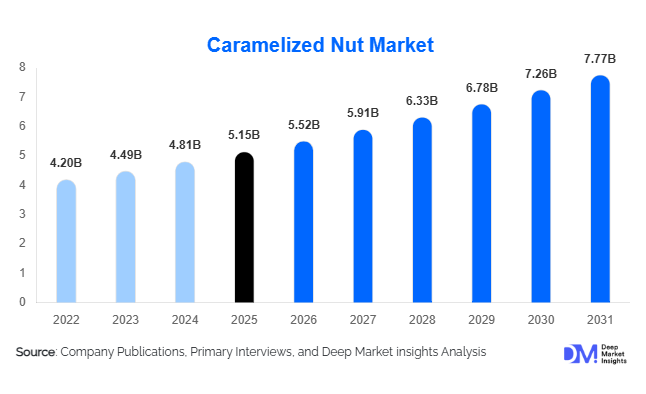
According to Deep Market Insights, the global caramelized nut market size was valued at USD 5.15 billion in 2026 and is projected to grow from USD 5.52 billion in 2026 to reach USD 7.77 billion by 2031, expanding at a CAGR of 7.1% during the forecast period (2026–2031). The caramelized nut market growth is primarily driven by rising consumer demand for premium and indulgent snacks, increasing adoption of nuts as protein-rich food options, expansion of bakery and confectionery applications, and growing preference for value-added nut products across global markets.
Key Market Insights
- Premiumization is reshaping the caramelized nut market, with consumers increasingly preferring gourmet flavors, luxury packaging, and specialty nut varieties such as almonds, pistachios, and pecans.
- North America and Asia-Pacific represent the largest demand centers, supported by strong premium snack consumption, expanding organized retail, and growing e-commerce penetration.
- Ready-to-eat snack applications dominate global demand, while bakery, confectionery, and frozen dessert manufacturers are emerging as high-growth industrial users.
- Clean-label and reduced-sugar formulations are gaining momentum, as consumers seek healthier alternatives without compromising indulgence.
- E-commerce is becoming a critical growth channel, enabling specialty caramelized nut brands to reach international consumers through direct-to-consumer platforms.
- Sustainable sourcing and environmentally responsible packaging are becoming key competitive differentiators as consumers increasingly evaluate food products based on ethical production practices.
caramelized nut market latest trends
Premium and Gourmet Snack Demand Increasing
The caramelized nut market is experiencing strong growth due to increasing consumer preference for premium snack experiences. Consumers are moving beyond traditional snacks and seeking products that combine indulgence, convenience, and nutritional benefits. Caramelized nuts provide a unique value proposition by combining the natural protein, healthy fats, and minerals of nuts with appealing sweet flavors and premium textures. Manufacturers are responding by introducing gourmet combinations such as chocolate caramel almonds, sea salt caramel cashews, cinnamon pecans, and seasonal limited-edition varieties. Luxury packaging, gift boxes, and artisanal positioning are further supporting higher price realization, particularly in developed markets where consumers are willing to pay premiums for differentiated food experiences.
Clean Label and Health-Oriented Product Innovation
Health-conscious consumption is influencing product development within the caramelized nut industry. While traditional caramelized nuts rely heavily on sugar-based coatings, manufacturers are increasingly introducing reduced-sugar, organic, and natural sweetener-based alternatives. Products using honey, maple syrup, coconut sugar, and plant-based sweeteners are gaining popularity among consumers seeking healthier indulgence. Companies are also emphasizing transparent ingredient labeling, non-GMO certification, and preservative-free formulations to appeal to consumers who prioritize clean-label foods. This shift is encouraging innovation in caramelization technologies that maintain taste and texture while reducing sugar content.
Expansion Across Bakery, Confectionery, and Dessert Applications
Caramelized nuts are increasingly being used as premium ingredients across food manufacturing industries. Bakery producers incorporate caramelized almonds, walnuts, and pecans into cakes, cookies, pastries, and specialty breads to enhance flavor and texture. Chocolate manufacturers use caramelized nuts to create premium confectionery products, while ice cream and frozen dessert producers utilize them as inclusions for differentiated flavors. This industrial demand is creating opportunities for suppliers to move beyond retail snack categories and establish long-term partnerships with food manufacturers. Customized caramelized nut ingredients designed for specific industrial applications are becoming increasingly important for market expansion.
E-commerce Transforming Distribution Strategies
Digital commerce has become a major growth driver for caramelized nut brands by improving accessibility and enabling direct consumer relationships. Online grocery platforms, specialty snack websites, and subscription snack services allow emerging brands to compete with established companies by reaching targeted consumer groups. Social media marketing, influencer partnerships, and personalized product recommendations are helping premium snack brands build awareness among younger consumers. E-commerce also supports international expansion by allowing manufacturers to sell specialty products across borders without requiring extensive physical retail networks.
caramelized nut market drivers
Rising Demand for Premium and Healthy Snacking
The increasing popularity of premium snacking is one of the strongest growth drivers for the caramelized nut market. Consumers are seeking convenient food options that provide both indulgence and nutritional value, creating strong demand for nut-based snacks. Caramelized nuts benefit from the growing perception of nuts as sources of plant-based protein, healthy fats, and essential nutrients. Rising disposable incomes, particularly in emerging economies, are allowing consumers to upgrade from traditional snacks toward premium packaged products. This trend is especially visible among urban consumers who prioritize convenience, quality ingredients, and unique flavor experiences.
Growth of Bakery and Confectionery Industries
The expansion of global bakery, chocolate, and dessert industries is significantly increasing demand for caramelized nuts as functional ingredients. Manufacturers use caramelized nuts to improve product appearance, add texture, and create premium product differentiation. Growth in artisanal bakeries, luxury chocolates, gourmet desserts, and specialty ice cream categories is creating new opportunities for caramelized nut suppliers. Food manufacturers increasingly prefer customized ingredients that help them launch innovative products, supporting long-term industrial demand growth.
Expansion of Organized Retail and Online Food Channels
The rapid expansion of supermarkets, specialty food stores, and online grocery platforms is improving global access to caramelized nut products. Organized retail provides greater shelf visibility, premium product placement, and consumer trust, while digital channels enable smaller brands to compete internationally. Online platforms are particularly beneficial for niche caramelized nut companies offering unique flavors, organic products, and premium gift packs. The combination of physical and digital distribution networks is expanding the overall consumer base.
caramelized nut market restraints
Raw Material Price Volatility
Fluctuations in nut and sugar prices remain a major challenge for caramelized nut manufacturers. Almonds, cashews, pistachios, walnuts, and pecans are affected by agricultural cycles, weather conditions, water availability, transportation costs, and geopolitical factors. Supply disruptions in major nut-producing regions can significantly increase production costs and impact profitability. Smaller manufacturers are particularly vulnerable due to limited purchasing power compared with multinational food companies. Maintaining stable margins requires efficient sourcing strategies, long-term supplier agreements, and improved inventory management.
Health Concerns Related to Sugar Content
Growing awareness regarding sugar consumption is creating pressure on caramelized nut manufacturers to reformulate products. Consumers and regulatory bodies are increasingly focused on reducing added sugars in packaged foods. Sugar taxation initiatives, nutritional labeling requirements, and changing dietary preferences may limit demand for traditional caramelized products. Manufacturers are responding by developing reduced-sugar formulations, natural sweetener alternatives, and portion-controlled packaging. However, maintaining the traditional taste, crunch, and consumer appeal while reducing sugar content remains a significant product development challenge.
caramelized nut industry key opportunities
Functional and Better-for-You Snack Development
The growing functional food industry presents significant opportunities for caramelized nut manufacturers. Companies can expand beyond traditional indulgent snacks by incorporating functional ingredients such as plant proteins, fiber, probiotics, vitamins, and natural energy-enhancing components. Positioning caramelized nuts as premium functional snacks can attract health-conscious consumers while maintaining the indulgent characteristics that drive category demand. Products targeting athletes, office workers, and wellness-focused consumers represent attractive growth opportunities.
Expansion in Emerging Markets
Emerging economies across Asia-Pacific, Latin America, and the Middle East offer substantial growth potential due to rising disposable incomes, urbanization, and increasing exposure to international food trends. Countries such as India, China, Indonesia, Brazil, and the UAE are experiencing growing demand for premium packaged snacks and imported gourmet foods. Manufacturers that develop localized flavors, culturally relevant packaging, and affordable premium formats can capture new consumer segments in these markets.
Innovation Through Sustainable Packaging and Sourcing
Sustainability is becoming an important purchasing factor in premium food categories. Caramelized nut producers have opportunities to differentiate through recyclable packaging, ethical nut sourcing, transparent supply chains, and environmentally responsible production methods. Consumers increasingly prefer brands that demonstrate commitment to sustainability, creating opportunities for companies to build stronger brand loyalty and premium positioning through responsible business practices.
Report Scope
| Report Metric | Details |
|---|---|
| Market Size in 2025 | USD 5.15 Billion |
| Market Size in 2026 | USD 5.52 Billion |
| Market Size in 2031 | USD 7.77 Billion |
| CAGR | 7.1% (2026-2031) |
| Base Year for Estimation | 2025 |
| Historical Data | 2022-2024 |
| Forecast Period | 2026-2031 |
| Report Coverage | Revenue Forecast, Competitive Landscape, Supply Chain Disruption, Growth Factors, Environment & Regulatory Landscape and Trends |
| Geographies Covered | North America, Europe, APAC, Middle East and Africa, LATAM |
| Countries Covered | U.S., Canada, U.K., Germany, France, Spain, Italy, Russia, Nordic, Benelux, Rest of Europe, China, Korea, Japan, India, Australia, Singapore, Taiwan, South East Asia, Rest of Asia-Pacific, UAE, Turky, Saudi Arabia, South Africa, Egypt, Nigeria, Rest of MEA, Brazil, Mexico, Argentina, Chile, Colombia, Rest of LATAM |
Explore more data points, trends and opportunities Download Free Sample Report
Product Type Insights
Whole caramelized nuts dominate the product type segment, accounting for approximately 42% of global market revenue in 2025, due to their premium appearance, stronger texture, and higher perceived consumer value. Whole almonds, cashews, pecans, and pistachios are particularly popular in retail snack packs, festive gift boxes, and gourmet food collections. These products benefit from premium positioning because consumers associate whole nuts with better quality compared with processed formats. Chopped, diced, and crushed caramelized nuts represent a growing segment due to increasing demand from industrial food manufacturers. Bakery producers, chocolate companies, and ice cream manufacturers increasingly use processed caramelized nut formats as ingredients for cakes, cookies, pralines, cereals, and frozen desserts. Caramelized nut clusters are also gaining traction as convenient snack options, particularly among younger consumers seeking portable and indulgent food products. Future growth is expected to be strongest in value-added formats that combine premium ingredients, innovative flavors, and convenient packaging.
Application Insights
Ready-to-eat snacks represent the largest application segment of the caramelized nut market, accounting for approximately 39% of global demand in 2025. Consumer preference for convenient snacking, protein-rich foods, and premium indulgence is driving strong retail demand for caramelized nut packs. Supermarkets, specialty food stores, and online retailers are expanding their premium snack categories, creating additional opportunities for manufacturers. Bakery and confectionery applications are among the fastest-growing areas, as food producers increasingly use caramelized nuts to enhance flavor, texture, and product differentiation. Premium chocolates, cookies, pastries, and desserts frequently incorporate caramelized almonds, hazelnuts, and pecans to create luxury product experiences. Ice cream and frozen dessert manufacturers are also increasing adoption of caramelized nut inclusions, particularly in premium product lines. Breakfast cereals, granola, and nutrition bars represent emerging applications as consumers seek convenient breakfast solutions combining taste and nutritional benefits. The expansion of gourmet food culture and premium dining is further supporting the use of caramelized nuts in culinary applications, including salads, desserts, and specialty dishes.
Distribution Channel Insights
Supermarkets and hypermarkets remain the leading distribution channel for caramelized nuts, representing approximately 36% of global sales in 2025. These channels provide strong consumer accessibility, extensive product visibility, and opportunities for premium product placement. Large retailers increasingly dedicate shelf space to gourmet snacks, organic products, and healthier indulgence categories, benefiting caramelized nut brands. Online retail is the fastest-growing distribution channel due to increasing digital grocery adoption and consumer preference for convenient purchasing options. E-commerce platforms allow specialty brands to reach international customers and introduce niche products such as organic caramelized nuts, seasonal flavors, and luxury gift packs. Direct-to-consumer models are also gaining momentum as manufacturers build online communities and use digital marketing to establish stronger consumer relationships. Foodservice distribution is another important channel, supplying hotels, restaurants, cafés, and bakeries with bulk caramelized nut ingredients. Premium hospitality businesses increasingly use caramelized nuts in desserts, beverages, and gourmet menus, supporting demand from commercial buyers.
End-use Insights
Household consumers represent the largest end-use segment of the caramelized nut market, supported by increasing demand for convenient snacks, festive gifting products, and premium food experiences. Consumers are increasingly purchasing caramelized nuts for daily snacking, celebrations, and seasonal occasions such as Christmas, Lunar New Year, Diwali, and Ramadan. The household segment benefits from rising disposable incomes and expanding availability through supermarkets and online platforms. Food manufacturers represent the fastest-growing commercial end-use segment, particularly bakery, confectionery, and frozen dessert producers. These industries are increasingly incorporating caramelized nuts as premium ingredients to improve product differentiation and justify higher retail pricing. Hotels, restaurants, and cafés are also expanding usage as premium dining concepts continue to grow globally. Gourmet restaurants and cafés frequently use caramelized nuts in desserts, pastries, and specialty beverages. Corporate gifting is another important application, particularly in Asia-Pacific and the Middle East, where premium food products are commonly exchanged during business occasions and festivals. Export-driven demand is increasing as manufacturers in nut-producing countries move from raw nut exports toward higher-value processed products, improving margins and strengthening global supply chains.
Explore more data points, trends and opportunities Download Free Sample Report
Caramelized Nut Market Segmentations
By Nut Type
- Almonds
- Cashews
- Peanuts
- Pistachios
- Walnuts
- Pecans
- Hazelnuts
- Mixed Nuts
By Product Form
- Whole Caramelized Nuts
- Chopped/Diced Caramelized Nuts
- Caramelized Nut Clusters
- Caramelized Nut Pieces and Inclusions
By Sweetening Ingredient
- Sugar-Based Caramelized Nuts
- Honey-Based Caramelized Nuts
- Maple Syrup-Based Caramelized Nuts
- Other Natural Sweetener-Based Caramelized Nuts
By Flavor Profile
- Classic Sweet
- Chocolate-Flavored
- Salted Caramel
- Spiced and Cinnamon Flavored
- Fruit and Specialty Flavors
By Application
- Ready-to-Eat Snacks
- Bakery Products
- Confectionery and Chocolate Products
- Ice Cream and Frozen Desserts
- Breakfast Cereals and Granola
- Foodservice and Hospitality Applications
Regional Insights
North America
North America represents one of the largest caramelized nut markets globally, accounting for approximately 30% of market revenue in 2025. The United States is the dominant country market, supported by strong demand for premium snacks, healthy indulgence products, and value-added nut offerings. American consumers increasingly prefer snacks that combine nutritional benefits with convenience, supporting demand for caramelized almonds, pecans, cashews, and mixed nut products. The growth of specialty grocery stores, premium supermarkets, and online food retailers has improved product accessibility. The United States also benefits from a mature confectionery and bakery industry, creating strong industrial demand for caramelized nuts as ingredients. Canada represents a smaller but growing market, driven by increasing interest in clean-label foods, imported gourmet snacks, and premium gift products. North American consumers are also showing increasing preference for organic, reduced-sugar, and sustainably sourced caramelized nuts, encouraging manufacturers to innovate around healthier formulations.
Europe
Europe contributes approximately 22% of global caramelized nut market share in 2025, supported by strong premium food culture and established confectionery industries. Germany represents the largest European market due to high consumption of premium snacks, bakery products, and organic foods. The country’s strong retail infrastructure and consumer preference for high-quality packaged foods support market expansion. The United Kingdom is another important market, with growing demand for gourmet snacks, luxury gifting products, and online specialty food brands. France and Italy demonstrate strong demand through premium chocolates, artisanal bakeries, and dessert applications. European consumers are particularly receptive to sustainable packaging, organic certifications, and natural ingredient claims, encouraging manufacturers to focus on ethical sourcing and clean-label innovation. The region’s mature food industry also creates opportunities for industrial caramelized nut suppliers serving confectionery and bakery manufacturers.
Asia-Pacific
Asia-Pacific is the largest and fastest-growing regional market, accounting for approximately 38% of global caramelized nut demand in 2025. China represents the largest country market within the region, contributing nearly 18% of global market demand. Rising disposable incomes, urbanization, expanding e-commerce penetration, and strong festive gifting traditions are supporting growth. Caramelized nuts are increasingly consumed during Lunar New Year celebrations and corporate gifting occasions. India represents one of the fastest-growing markets due to increasing premium snack consumption, growing urban middle-class populations, and strong cultural demand for nuts during festivals. Australia, Japan, and South Korea are mature markets with consistent demand for premium snacks, healthy food products, and imported gourmet offerings. Southeast Asian countries are also emerging as attractive markets due to increasing modern retail penetration and exposure to international food trends.
Latin America
Latin America represents approximately 4% of global caramelized nut market revenue in 2025, with Brazil and Mexico leading regional demand. Growth is supported by expanding urban populations, increasing premium food consumption, and rising interest in international snack categories. Brazil’s large consumer base provides opportunities for domestic and imported caramelized nut brands, particularly through supermarkets and online retail channels. Mexico is benefiting from increasing adoption of premium packaged foods and growing demand from hospitality businesses. While the region remains smaller compared with North America, Europe, and Asia-Pacific, long-term growth potential exists as organized retail expands and consumer preferences shift toward premium snack options.
Middle East & Africa
The Middle East and Africa region accounts for approximately 6% of global caramelized nut market share in 2025. The UAE and Saudi Arabia are key markets due to high disposable incomes, luxury food consumption, tourism activity, and strong gifting culture. Premium caramelized nuts are widely used in hospitality, corporate gifting, and festive occasions across Gulf countries. Luxury hotels, restaurants, and airlines represent important commercial buyers. South Africa is the leading African market, supported by established retail networks and growing demand for premium snacks. Increasing imports of processed nut products and expansion of modern grocery channels are expected to support regional growth. The Middle East is also emerging as an important re-export hub for premium food products due to its strategic location and developed logistics infrastructure.
Key Players in the Caramelized Nut Market
- The Hershey Company
- Mars, Incorporated
- Mondelez International
- Nestlé S.A.
- Ferrero Group
- Olam Group
- John B. Sanfilippo & Son, Inc.
- Blue Diamond Growers
- Borges International Group
- Wonderful Pistachios & Almonds
- Barry Callebaut
- Hormel Foods Corporation
- TreeHouse Foods
- Lubeca Lebensmitteltechnik
- Mount Franklin Foods