Pasta Sauce Market Size
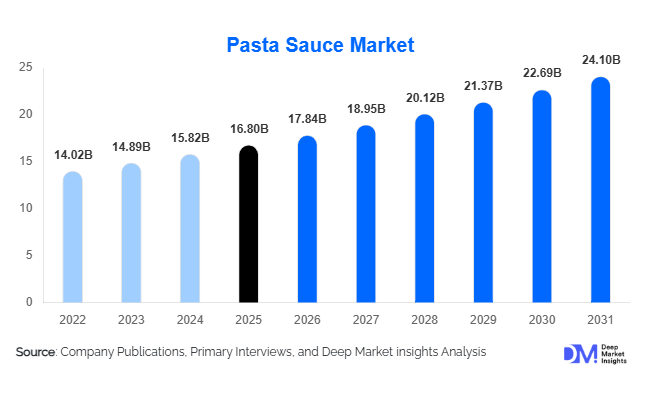
According to Deep Market Insights, the global pasta sauce market size was valued at USD 17.84 billion in 2026 and is projected to grow to reach USD 24.10 billion by 2031, expanding at a CAGR of 6.2% during the forecast period (2026–2031). The pasta sauce market growth is primarily driven by increasing demand for convenience foods, rising global consumption of pasta-based meals, expansion of premium and clean-label sauces, and growing adoption of plant-based and specialty food products across developed and emerging markets.
Key Market Insights
- Tomato-based pasta sauces dominate the global market, accounting for more than half of total market revenue due to widespread consumer acceptance, affordability, and strong association with traditional Italian cuisine.
- Premiumization is reshaping the pasta sauce industry, with consumers increasingly preferring organic, clean-label, low-sodium, vegan, and preservative-free formulations.
- Europe remains the largest regional market, supported by strong pasta consumption culture, established food processing industries, and high demand for authentic Italian sauces.
- North America represents a major consumption hub, driven by household demand, supermarket penetration, and increasing interest in premium and specialty pasta sauces.
- Asia-Pacific is emerging as the fastest-growing region, supported by rising disposable incomes, urbanization, increasing adoption of Western cuisines, and expansion of modern grocery retail channels.
- E-commerce and direct-to-consumer food brands are transforming distribution, allowing specialty pasta sauce manufacturers to reach consumers beyond traditional supermarket channels.
- Plant-based and functional pasta sauces are gaining momentum, with manufacturers introducing vegetable-based, protein-enriched, organic, and low-sugar alternatives to meet evolving consumer preferences.
pasta sauce market latest trends
Premium and Clean-Label Pasta Sauces Gaining Market Share
The pasta sauce market is witnessing a significant shift toward premium and clean-label products as consumers become increasingly focused on ingredient transparency, health, and food quality. Traditional sauces containing artificial preservatives and additives are gradually losing preference among health-conscious consumers, while products made with organic tomatoes, natural herbs, extra virgin olive oil, and minimally processed ingredients are gaining popularity.
Manufacturers are responding by expanding portfolios of organic marinara sauces, vegan pesto variants, low-sodium tomato sauces, and specialty regional recipes. Premium sauces command higher price points and stronger margins, encouraging companies to invest in product differentiation. This trend is particularly strong across North America and Europe, where consumers demonstrate higher willingness to pay for healthier and sustainably produced food products.
Growth of Plant-Based and Functional Pasta Sauces
The increasing adoption of vegetarian, vegan, and flexitarian diets is accelerating innovation within the pasta sauce industry. Consumers are seeking alternatives that align with health and sustainability goals, creating demand for plant-based sauces made from vegetables, legumes, nuts, and alternative protein ingredients.
Manufacturers are introducing functional pasta sauces enriched with vegetables, protein, fiber, vitamins, and reduced sodium content. These products are attracting younger consumers who prioritize nutritional benefits alongside taste. The expansion of plant-based food categories globally is expected to create new growth opportunities for pasta sauce producers, particularly in developed markets where consumers actively seek healthier meal options.
E-Commerce Expansion Transforming Pasta Sauce Distribution
Digital grocery platforms and direct-to-consumer channels are becoming increasingly important distribution routes for pasta sauce brands. Online retail enables manufacturers to offer a wider variety of products, including premium, imported, organic, and specialty sauces that may have limited availability in physical stores.
Subscription-based food models, online grocery marketplaces, and social media-driven product discovery are helping emerging brands compete with established companies. Consumers benefit from greater product variety, customer reviews, and convenient home delivery. This trend is particularly important for niche brands targeting health-conscious and premium consumer segments.
pasta sauce market drivers
Increasing Demand for Convenience Foods
Changing lifestyles, urbanization, and increasing numbers of working households are significantly driving demand for convenient meal preparation products. Pasta sauces offer consumers a quick solution for preparing flavorful meals without requiring extensive cooking time, making them highly attractive among urban populations.
The expansion of ready-to-cook and ready-to-eat food categories is supporting increased consumption of pasta sauces globally. Consumers increasingly prefer products that combine convenience, affordability, and restaurant-style taste. Supermarkets and online grocery platforms are expanding their convenience food categories, improving accessibility and encouraging repeat purchases.
Rising Global Consumption of Italian Cuisine
The worldwide popularity of Italian cuisine is one of the strongest growth drivers for the pasta sauce market. Pasta has become a mainstream food category across regions beyond Europe, supported by international restaurants, food delivery platforms, tourism, and cultural exchange.
Emerging economies in Asia-Pacific, Latin America, and the Middle East are experiencing increased demand for pasta dishes as consumers gain exposure to international cuisines. Restaurants, cafés, and home cooks are increasingly adopting pasta sauces as essential ingredients, expanding consumption beyond traditional markets.
Expansion of Premium and Health-Oriented Food Products
Consumer preference for healthier food choices is accelerating innovation in the pasta sauce industry. Demand for organic, vegan, gluten-free, low-sugar, and clean-label products is increasing as consumers become more aware of nutrition and ingredient quality.
Manufacturers are leveraging this trend by launching differentiated products with functional benefits, sustainable sourcing, and premium positioning. Health-focused consumers, particularly millennials and Generation Z, are driving demand for sauces that combine convenience with improved nutritional profiles.
pasta sauce market restraints
Raw Material Price Volatility
The pasta sauce industry faces challenges from fluctuations in raw material costs, particularly tomatoes, olive oil, dairy ingredients, herbs, spices, and packaging materials. Tomato production is highly dependent on weather conditions, agricultural cycles, and water availability, making supply consistency a major concern for manufacturers.
Unexpected changes in agricultural output can increase production expenses and reduce profit margins. Rising energy costs, transportation expenses, and packaging inflation have further increased operational pressures. Manufacturers are addressing these challenges through supplier diversification, contract farming arrangements, and improved inventory management strategies.
Increasing Competition from Private Labels
Private-label pasta sauces from supermarket chains are becoming increasingly competitive due to their attractive pricing and improving product quality. Large retailers are expanding their own branded food portfolios, creating pricing pressure on established manufacturers.
Branded companies must continuously invest in marketing, innovation, and premium product development to maintain customer loyalty. Competition is particularly intense in mature markets such as North America and Europe, where consumers have access to numerous product alternatives across different price categories.
pasta sauce industry key opportunities
Expansion into Emerging Markets
Emerging markets represent a significant growth opportunity for pasta sauce manufacturers due to rising disposable incomes, urbanization, and increasing exposure to global cuisines. Countries across Asia-Pacific, including China, India, Indonesia, and South Korea, are witnessing growing acceptance of pasta-based meals through restaurants, cafés, and household cooking.
Manufacturers can capture these opportunities by developing localized flavors, affordable packaging formats, and region-specific marketing strategies. Establishing local production facilities and partnerships with regional distributors can help companies improve market penetration while reducing supply chain costs.
Growth of Foodservice and Industrial Applications
The expansion of restaurants, cloud kitchens, frozen meal manufacturers, and prepared food companies is creating additional demand for pasta sauces beyond household consumption. Foodservice operators increasingly rely on standardized sauces to reduce preparation time, maintain consistency, and improve operational efficiency.
Industrial applications represent an attractive opportunity as pasta sauces are increasingly used in frozen meals, pizzas, ready-to-eat products, and food ingredient applications. Manufacturers offering customized formulations and bulk packaging solutions can capture additional revenue streams from commercial buyers.
Innovation in Sustainable and Functional Products
Sustainability and health-focused innovation are creating new opportunities within the pasta sauce market. Consumers are increasingly interested in environmentally responsible packaging, organic ingredients, plant-based formulations, and products with added nutritional benefits.
Companies investing in recyclable packaging, sustainable tomato sourcing, carbon-efficient production, and functional ingredients are likely to gain competitive advantages. The combination of health benefits and environmental responsibility is becoming an important purchasing factor, particularly among younger consumers.
Report Scope
| Report Metric | Details |
|---|---|
| Market Size in 2025 | USD 16.80 Billion |
| Market Size in 2026 | USD 17.84 Billion |
| Market Size in 2031 | USD 24.10 Billion |
| CAGR | 6.2% (2026-2031) |
| Base Year for Estimation | 2025 |
| Historical Data | 2022-2024 |
| Forecast Period | 2026-2031 |
| Report Coverage | Revenue Forecast, Competitive Landscape, Supply Chain Disruption, Growth Factors, Environment & Regulatory Landscape and Trends |
| Geographies Covered | North America, Europe, APAC, Middle East and Africa, LATAM |
| Countries Covered | U.S., Canada, U.K., Germany, France, Spain, Italy, Russia, Nordic, Benelux, Rest of Europe, China, Korea, Japan, India, Australia, Singapore, Taiwan, South East Asia, Rest of Asia-Pacific, UAE, Turky, Saudi Arabia, South Africa, Egypt, Nigeria, Rest of MEA, Brazil, Mexico, Argentina, Chile, Colombia, Rest of LATAM |
Explore more data points, trends and opportunities Download Free Sample Report
Product Type Insights
Tomato-based pasta sauces dominate the global pasta sauce market, accounting for approximately 54.2% of global market revenue in 2025. The segment maintains leadership due to strong consumer familiarity, affordability, wide availability, and its association with traditional Italian cuisine. Products such as marinara, tomato basil, arrabbiata, and bolognese sauces remain household staples across North America and Europe, where pasta consumption is deeply establishedTomato-based sauces also benefit from their versatility across multiple applications, including pasta dishes, pizzas, casseroles, ready meals, and foodservice preparations. Manufacturers continue improving this segment through premium tomato varieties, organic ingredients, reduced-sodium formulations, and clean-label positioning.Cream-based sauces represent a significant premium category, particularly in developed markets where consumers seek indulgent meal experiences. Alfredo and cheese-based sauces are popular in restaurants and household cooking, while pesto-based sauces are witnessing above-average growth due to increasing demand for authentic Mediterranean flavors and premium ingredients.Plant-based and specialty pasta sauces are among the fastest-growing categories, supported by vegan diets, health-conscious consumers, and demand for functional foods. Manufacturers are increasingly introducing vegetable-based, nut-based, and protein-enhanced sauces to capture emerging consumer preferences.
Ingredient Base Insights
Tomato-based ingredients represent the largest ingredient category, accounting for approximately 55.8% of global pasta sauce demand in 2025. Tomatoes remain the preferred ingredient base due to their traditional association with pasta dishes, strong supply chains, and compatibility with global cuisines.Large-scale tomato cultivation and processing capabilities in countries such as Italy, the United States, Spain, and China provide manufacturers with reliable raw material availability. Tomato-based sauces are also preferred because they offer flexibility across price segments, ranging from economy products to premium organic offerings.Dairy-based ingredients hold an important position in cream and cheese sauces, particularly in North America and Europe. However, dairy-based sauces face increasing competition from plant-based alternatives due to changing dietary preferences.Alternative plant-based ingredients, including cashew, soy, legumes, and vegetable blends, are expanding rapidly. These ingredients allow manufacturers to develop vegan and allergen-friendly products targeting younger consumers and health-focused demographics.
Packaging Type Insights
Glass bottles and jars represent the leading packaging format, accounting for approximately 46.5% of global pasta sauce sales in 2025. Glass packaging remains popular because consumers associate it with premium quality, product visibility, and better preservation characteristics.Premium and organic pasta sauce brands frequently use glass packaging to strengthen brand positioning and communicate product quality. The ability to visually inspect the sauce before purchase also improves consumer confidence, especially for specialty products.Flexible pouches are emerging as the fastest-growing packaging format due to convenience, lightweight design, lower transportation costs, and reduced material usage. Pouches are increasingly used for family-size packs, foodservice applications, and environmentally conscious product lines.Metal cans continue serving institutional and industrial buyers due to their long shelf life, while plastic containers remain relevant in cost-sensitive markets because of affordability and durability.
Distribution Channel Insights
Supermarkets and hypermarkets dominate pasta sauce distribution, accounting for approximately 48.7% of global market revenue in 2025. Large retail chains remain the primary purchasing channel due to extensive product availability, promotional activities, and consumer convenience.Supermarkets provide manufacturers with strong visibility through dedicated pasta aisles, seasonal promotions, and private-label opportunities. Developed markets such as the United States, Germany, Italy, France, and the United Kingdom have highly established retail networks supporting strong sales volumes.Online retail is the fastest-growing distribution channel, supported by increasing digital grocery adoption and changing consumer shopping behavior. E-commerce enables consumers to access premium imported sauces, organic products, and specialty brands that may not be widely available through traditional stores.Foodservice distribution channels are also expanding due to increasing demand from restaurants, hotels, catering companies, and cloud kitchens. Bulk packaging formats and customized sauce formulations are creating opportunities for industrial suppliers.
End-User Insights
Household consumers represent the largest end-user segment, accounting for approximately 62.3% of global pasta sauce consumption in 2025. Household demand continues to grow due to increasing preference for convenient cooking solutions, rising home meal preparation, and wider availability through retail and online channels.Consumers increasingly use pasta sauces as versatile kitchen ingredients beyond traditional pasta dishes, including pizza preparation, dips, casseroles, sandwiches, and meal kits. This expanded usage is increasing purchase frequency among households.Restaurants and foodservice operators represent another major demand segment. Restaurants, cafés, hotels, and catering companies rely on pasta sauces for consistent flavor, reduced preparation time, and operational efficiency. Growth in food delivery platforms and cloud kitchens is further increasing commercial demand.Food manufacturers are among the fastest-growing end users as pasta sauces become important ingredients in frozen meals, ready-to-eat products, pizza manufacturing, and prepared food categories.
Application Insights
Pasta and noodle dishes represent the largest application segment, accounting for approximately 58.6% of global pasta sauce consumption in 2025. Pasta sauces remain primarily purchased for traditional pasta preparation due to strong consumer familiarity and the global popularity of Italian cuisine.Beyond traditional pasta applications, manufacturers are expanding usage opportunities through ready meals, frozen foods, pizzas, and snack applications. The increasing popularity of convenience foods is encouraging food companies to incorporate pasta sauces into multiple product categories.Ready-to-eat meals and frozen pasta products are among the fastest-growing applications. Consumers increasingly prefer convenient meal solutions that require minimal preparation, creating additional demand for industrial pasta sauce suppliers.Foodservice applications, including restaurant meals and catering solutions, continue expanding as global restaurant chains and hospitality businesses increase their reliance on standardized sauce products.
Price Category Insights
Mid-range pasta sauces dominate the market, accounting for approximately 49.2% of global revenue in 2025. These products provide a balance between affordability and quality, making them attractive to mainstream consumers across developed and developing markets.Economy products maintain strong demand in price-sensitive markets, particularly in emerging economies where affordability remains a key purchase factor. Retailers frequently use economy pasta sauces as high-volume products to attract customers.Premium and super-premium sauces are growing faster than conventional categories. Consumers are increasingly willing to pay higher prices for organic ingredients, authentic Italian recipes, artisanal production methods, and sustainable packaging.Premium products typically achieve higher profit margins due to stronger pricing power and differentiation. This trend is encouraging manufacturers to expand specialty product portfolios.
Consumer Preference Insights
Traditional flavors remain the largest consumer preference category, accounting for approximately 56.7% of market demand in 2025. Classic tomato, marinara, basil, garlic, and cheese-based sauces continue dominating due to strong consumer familiarity and established culinary traditions.However, consumer preferences are rapidly evolving toward healthier and more diverse products. Younger consumers are increasingly interested in vegan sauces, ethnic-inspired flavors, functional ingredients, and sustainable food products.Health-oriented preferences are becoming increasingly influential, with demand rising for low-sodium, organic, gluten-free, and preservative-free pasta sauces. Consumers are also paying greater attention to ingredient sourcing, environmental impact, and nutritional benefits.Manufacturers are responding by introducing innovative formulations that combine convenience, taste, health benefits, and sustainability to attract a broader consumer base.
Explore more data points, trends and opportunities Download Free Sample Report
Pasta Sauce Market Segmentations
By Product Type
- Tomato-Based Pasta Sauces
- Cream-Based Pasta Sauces
- Pesto-Based Pasta Sauces
- Meat-Based Pasta Sauces
- Plant-Based & Specialty Pasta Sauces
By Ingredient Base
- Tomato-Based Ingredients
- Dairy-Based Ingredients
- Vegetable-Based Ingredients
- Plant Protein-Based Ingredients
- Herbs, Spices & Functional Ingredients
By Packaging Type
- Glass Bottles & Jars
- Flexible Pouches
- Metal Cans
- Plastic Containers
- Bulk Foodservice Packaging
By Distribution Channel
- Supermarkets & Hypermarkets
- Online Retail & E-Commerce
- Convenience Stores
- Specialty Food Stores
- Foodservice Distributors
By End User
- Household Consumers
- Restaurants & Foodservice Operators
- Food Manufacturers
- Catering & Hospitality Companies
- Institutional Buyers
Regional Insights
North America
North America represents the largest regional market for pasta sauce, accounting for approximately 38.6% of global market revenue in 2025. The United States dominates regional demand, contributing nearly 32% of global pasta sauce consumption due to high pasta consumption, strong retail penetration, and widespread acceptance of convenience cooking products. Pasta sauces are considered essential pantry products among American households, supported by established brands, supermarket availability, and extensive foodservice usage.Canada represents another important market, contributing approximately 4.5% of global demand. Canadian consumers show strong preference for imported Italian sauces, organic products, and premium brands. Mexico is emerging as a growing market due to increasing urbanization, modern retail expansion, and rising adoption of Western-style convenience foods.
Europe
Europe accounted for approximately 31.4% of global pasta sauce market share in 2025, making it the second-largest regional market. Italy remains the center of pasta sauce consumption due to its culinary heritage, large domestic pasta industry, and strong preference for traditional recipes. Italian manufacturers benefit from global exports of authentic tomato sauces, pesto, and premium specialty products.European consumers are among the most environmentally conscious globally, creating demand for recyclable packaging, sustainable sourcing, and organic-certified products. Regulatory emphasis on food transparency and clean-label ingredients is encouraging manufacturers to reformulate products.
Asia-Pacific
Asia-Pacific accounted for approximately 19.2% of global pasta sauce revenue in 2025 and is expected to be the fastest-growing region during 2026–2031. The region is benefiting from urbanization, rising disposable incomes, expanding modern retail, and increasing exposure to Western cuisines.India is expected to record one of the fastest growth rates in the region. Increasing urban lifestyles, growth of supermarkets, expanding food delivery services, and rising interest in Italian cuisine are driving demand. Pasta sauce consumption remains relatively low compared with Western markets, creating significant long-term growth potential.Australia and Southeast Asian countries, including Indonesia, Thailand, Singapore, and Malaysia, are also witnessing increasing demand due to tourism growth, international food chains, and changing dietary patterns.
Latin America
Latin America accounted for approximately 6.8% of global pasta sauce market share in 2025. Brazil and Argentina are the leading markets due to strong agricultural capabilities, tomato production, and increasing demand for convenience foods.Brazil represents the largest regional consumer, supported by expanding supermarkets, rising urbanization, and increasing popularity of Italian-inspired dishes. Local manufacturers are competing with international brands by offering affordable products tailored to regional tastes.Argentina has strong cultural connections with Italian cuisine, creating stable demand for pasta sauces. Mexico is also emerging as a significant market due to growing processed food consumption, modern retail development, and increasing demand for imported premium sauces.
Middle East & Africa
The Middle East & Africa region accounted for approximately 4% of global pasta sauce demand in 2025 but represents an emerging growth opportunity. Demand is increasing due to urbanization, tourism expansion, expatriate populations, and rising consumption of international cuisines.South Africa dominates African demand due to developed retail infrastructure and Western food adoption. Other markets, including Egypt, Morocco, and Nigeria, are showing gradual growth as processed food consumption expands.Asia-Pacific is expected to remain the fastest-growing region, with an estimated CAGR above 7% between 2026 and 2031, while India and China are projected to be among the fastest-growing country markets.
Key Players in the Pasta Sauce Market
- Nestlé S.A.
- The Kraft Heinz Company
- Conagra Brands Inc.
- Unilever PLC
- Barilla Group
- Mizkan Holdings
- Del Monte Foods Inc.
- F.lli De Cecco di Filippo Fara San Martino S.p.A.
- Ragú (Mizkan brand)
- Rao’s Homemade
- Newman’s Own
- Mutti S.p.A.
- Casa Visco Foods
- Leggo’s
- Premier Foods Group