Smart Locker System Market Size
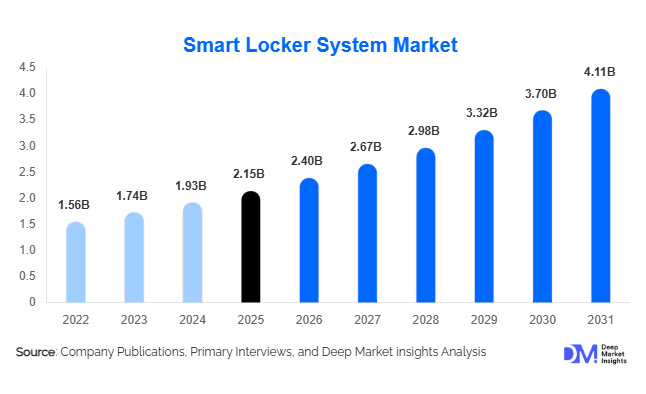
According to Deep Market Insights, the global Smart Locker System market size was valued at USD 2.15 billion in 2025 and is projected to grow from USD 2.40 billion in 2026 to reach USD 4.11 billion by 2031, expanding at a CAGR of 11.4% during the forecast period (2026–2031). The smart locker system market growth is primarily driven by the rapid expansion of e-commerce logistics, increasing adoption of contactless delivery solutions, rising demand for secure asset management across enterprises, and growing investments in smart city infrastructure worldwide. Organizations across retail, logistics, healthcare, education, transportation, and commercial real estate sectors are increasingly deploying smart lockers to improve operational efficiency, reduce labor costs, enhance customer convenience, and support digital transformation initiatives.
Key Market Insights
- Parcel lockers account for approximately 38% of the global market, driven by growing e-commerce deliveries and last-mile fulfillment requirements.
- Cloud-based locker management platforms are becoming the preferred deployment model, enabling centralized monitoring, predictive maintenance, and scalable operations.
- North America dominates the global market with nearly 36% share, supported by mature logistics networks and advanced retail infrastructure.
- Asia-Pacific is the fastest-growing regional market, driven by expanding e-commerce penetration, smart city investments, and urbanization.
- Retail click-and-collect and BOPIS (Buy Online Pick Up In Store) models are significantly accelerating smart locker deployments globally.
- Biometric authentication, AI-enabled analytics, and IoT integration are transforming smart lockers into intelligent asset management platforms.
Smart Locker System Market Trends
Rapid Expansion of Parcel Locker Networks
Global parcel volumes continue to rise as online retail becomes an increasingly dominant purchasing channel. Logistics providers, retailers, and residential property developers are expanding smart locker networks to address growing demand for secure and contactless parcel delivery. Large-scale locker deployments are increasingly being integrated into apartment complexes, office buildings, transportation hubs, universities, and retail centers. Parcel lockers reduce failed delivery attempts, improve courier productivity, and provide consumers with greater flexibility in package collection. The emergence of same-day and next-day delivery services is further increasing the importance of automated pickup infrastructure. Many logistics companies are also integrating lockers into urban micro-fulfillment networks to improve last-mile delivery efficiency while reducing delivery costs.
Growing Adoption of IoT and AI-Powered Locker Platforms
Smart locker solutions are increasingly incorporating IoT sensors, cloud analytics, artificial intelligence, and predictive maintenance capabilities. Advanced platforms now provide real-time occupancy monitoring, user behavior analytics, inventory tracking, energy management, and remote diagnostics. AI-driven software is helping operators optimize locker placement, capacity utilization, and maintenance schedules. Biometric authentication technologies, mobile applications, QR-code access, and RFID-based tracking systems are improving security and user experience. As enterprises prioritize workplace automation and digital asset management, intelligent locker platforms are evolving beyond storage infrastructure into connected operational ecosystems.
Smart Locker System Market Drivers
E-Commerce Growth and Last-Mile Delivery Optimization
The continued expansion of global e-commerce is one of the strongest growth drivers for the smart locker system market. Online retailers and logistics providers face increasing pressure to improve delivery efficiency while minimizing operational costs. Smart lockers offer a scalable solution for reducing failed deliveries, improving parcel security, and enabling 24/7 package access. Major retailers and courier companies are investing heavily in locker networks to support omnichannel fulfillment strategies and improve customer satisfaction.
Increasing Enterprise Demand for Asset Management Automation
Organizations across manufacturing, healthcare, education, and commercial office environments are adopting smart lockers to manage valuable equipment, employee assets, IT devices, tools, and inventory. Automated access control, audit trails, and inventory visibility help organizations improve accountability, reduce asset losses, and streamline operational workflows. The growing emphasis on workplace automation and digital transformation continues to support strong adoption across enterprise environments.
Smart Locker System Market Restraints
High Initial Installation and Infrastructure Costs
Despite their long-term operational benefits, smart locker systems require substantial upfront investment in hardware, software integration, connectivity infrastructure, and site preparation. Small businesses and institutions often face budget constraints that delay deployment decisions. Outdoor installations may also require additional investments in weatherproofing, power supply systems, and network connectivity, increasing total ownership costs.
Cybersecurity and Data Privacy Concerns
As locker systems become increasingly connected through cloud platforms and mobile applications, cybersecurity risks continue to emerge. Unauthorized access, data breaches, system outages, and privacy concerns represent significant challenges for operators. Compliance with regional data protection regulations and implementation of robust security frameworks are becoming critical requirements for market participants seeking to scale deployments globally.
Smart Locker System Market Opportunities
Smart City Infrastructure Development
Governments worldwide are investing heavily in smart city projects focused on digital infrastructure, urban mobility, and connected public services. Smart lockers are increasingly being integrated into transportation hubs, public spaces, municipal facilities, and residential developments. These initiatives create substantial opportunities for manufacturers, software providers, and infrastructure integrators to expand deployments while supporting urban digitalization goals.
Healthcare and Pharmaceutical Applications
The healthcare sector presents significant growth opportunities for smart locker providers. Hospitals, pharmacies, clinics, and healthcare networks are adopting automated lockers for prescription dispensing, medical equipment management, specimen collection, and secure medication distribution. Temperature-controlled lockers are gaining particular attention due to increasing demand for cold-chain pharmaceutical logistics and telehealth-enabled prescription fulfillment.
Report Scope
| Report Metric | Details |
|---|---|
| Market Size in 2025 | USD 2.15 Billion |
| Market Size in 2026 | USD 2.40 Billion |
| Market Size in 2031 | USD 4.11 Billion |
| CAGR | 11.4% (2026-2031) |
| Base Year for Estimation | 2025 |
| Historical Data | 2022-2024 |
| Forecast Period | 2026-2031 |
| Report Coverage | Revenue Forecast, Competitive Landscape, Supply Chain Disruption, Growth Factors, Environment & Regulatory Landscape and Trends |
| Geographies Covered | North America, Europe, APAC, Middle East and Africa, LATAM |
| Countries Covered | U.S., Canada, U.K., Germany, France, Spain, Italy, Russia, Nordic, Benelux, Rest of Europe, China, Korea, Japan, India, Australia, Singapore, Taiwan, South East Asia, Rest of Asia-Pacific, UAE, Turky, Saudi Arabia, South Africa, Egypt, Nigeria, Rest of MEA, Brazil, Mexico, Argentina, Chile, Colombia, Rest of LATAM |
Explore more data points, trends and opportunities Download Free Sample Report
Locker Type Insights
Parcel lockers dominate the global smart locker system market, accounting for approximately 38% of total market revenue in 2025. Growth is largely driven by increasing e-commerce parcel volumes and retailer investments in omnichannel fulfillment strategies. Click-and-collect lockers represent one of the fastest-growing subsegments as retailers seek to improve customer convenience while reducing in-store operational costs. Refrigerated smart lockers are emerging rapidly within grocery and pharmaceutical applications due to rising demand for temperature-controlled delivery infrastructure. Asset management lockers are gaining adoption across industrial facilities, healthcare institutions, and corporate offices, where organizations require secure tracking of equipment, tools, and IT assets.
Component Insights
Hardware remains the largest component segment, representing approximately 52% of the overall market, due to substantial investments in locker cabinets, electronic locking systems, displays, and sensor technologies. However, software is the fastest-growing segment as operators increasingly adopt cloud-based locker management platforms. Software-driven recurring revenue models are improving profitability across the industry. Managed services and maintenance contracts are also expanding as enterprises seek outsourced operational support and lifecycle management solutions.
Authentication Technology Insights
Mobile app-based authentication leads adoption globally, accounting for nearly 31% of installations, driven by smartphone penetration and consumer preference for contactless access. QR code authentication is growing rapidly in retail and logistics applications due to ease of implementation and low deployment costs. Biometric authentication technologies, including facial recognition and fingerprint scanning, are gaining traction in high-security environments such as healthcare, government facilities, and enterprise asset management applications.
Deployment Mode Insights
Cloud-based deployment dominates the market with approximately 61% share in 2025. Organizations increasingly prefer cloud solutions due to centralized management capabilities, lower infrastructure requirements, remote monitoring functionality, and scalable software updates. Hybrid deployments are gaining popularity among enterprises requiring both cloud flexibility and localized data control. On-premise solutions continue to maintain demand within government and highly regulated industries where data sovereignty remains a critical concern.
End-Use Industry Insights
Logistics and e-commerce companies represent the largest end-user segment, contributing approximately 34% of global market revenue. The segment continues to benefit from expanding online retail activity and increasing parcel delivery volumes. Healthcare represents the fastest-growing end-use segment, supported by automated prescription dispensing, medical device management, and pharmaceutical distribution requirements. Educational institutions, commercial offices, transportation hubs, and manufacturing facilities are also increasingly adopting smart locker systems to improve operational efficiency and security.
Explore more data points, trends and opportunities Download Free Sample Report
Smart Locker System Market Segmentations
By Locker Type
- Parcel Lockers
- Asset Management Lockers
- Employee Storage Lockers
- Click-and-Collect Retail Lockers
- Refrigerated Smart Lockers
- Laundry Smart Lockers
- Library Smart Lockers
- Pharmacy & Healthcare Lockers
- University & Campus Lockers
By Component
- Hardware
- Software
- Services
By Authentication Technology
- PIN-Based Access
- RFID/NFC-Based Access
- QR Code Access
- Mobile App-Based Access
- Biometric Authentication
By Deployment Mode
- Cloud-Based
- On-Premise
- Hybrid Deployment
By End User
- Logistics & Courier Companies
- E-commerce Retailers
- Commercial Offices
- Residential Housing Communities
- Educational Institutions
- Healthcare Facilities
- Government & Public Infrastructure
- Manufacturing & Industrial Facilities
- Transportation Hubs
- Hospitality Sector
Regional Insights
North America
North America accounted for approximately 36% of global market revenue in 2025, making it the largest regional market. The United States dominates regional demand, supported by extensive e-commerce activity, mature logistics infrastructure, and strong adoption of workplace automation technologies. Canada is also witnessing increasing deployment of parcel lockers in residential communities and commercial properties. The region benefits from significant investments by retailers, courier companies, and commercial real estate developers seeking to enhance delivery efficiency and customer convenience.
Europe
Europe represents approximately 28% of global market demand, with Germany, the United Kingdom, France, Poland, and the Nordic countries leading adoption. Parcel locker networks are particularly advanced across Poland and Germany, where consumers have embraced automated parcel collection services. Sustainability initiatives, labor cost optimization, and urban delivery challenges continue to support regional growth. Retailers and logistics providers are increasingly investing in automated locker infrastructure to improve last-mile delivery efficiency.
Asia-Pacific
Asia-Pacific is the fastest-growing regional market, expected to expand at a CAGR exceeding 14% through 2031. China, Japan, South Korea, India, Singapore, and Australia are key contributors. China represents the largest market within the region due to its extensive e-commerce ecosystem and smart city investments. India is emerging as a major growth market supported by rapid urbanization, expanding online retail activity, and increasing investment in digital infrastructure. Smart locker deployments across transportation hubs, educational institutions, and residential communities continue to accelerate across the region.
Latin America
Latin America is witnessing growing demand from Brazil, Mexico, Chile, and Colombia. E-commerce growth, increasing urban population density, and rising logistics modernization efforts are supporting market expansion. Parcel locker adoption remains at an early stage but is expected to accelerate as retailers and courier companies seek more efficient last-mile delivery solutions.
Middle East & Africa
The Middle East and Africa market is expanding steadily, led by the UAE, Saudi Arabia, South Africa, and Israel. Government-led smart city initiatives, growing e-commerce activity, and infrastructure modernization programs are creating new deployment opportunities. Countries such as the UAE and Saudi Arabia are investing heavily in automated delivery systems, smart buildings, and connected urban infrastructure, making the region increasingly attractive for smart locker solution providers.
Key Players in the Smart Locker System Market
- Quadient
- KEBA Group
- InPost
- Pitney Bowes
- Ricoh
- Cleveron
- American Locker
- TZ Limited
- Hollman
- Luxer One
- Kern
- Zhilai Technology
- Smiota
- Florence Corporation
- ParcelPort