Guitar Market Size
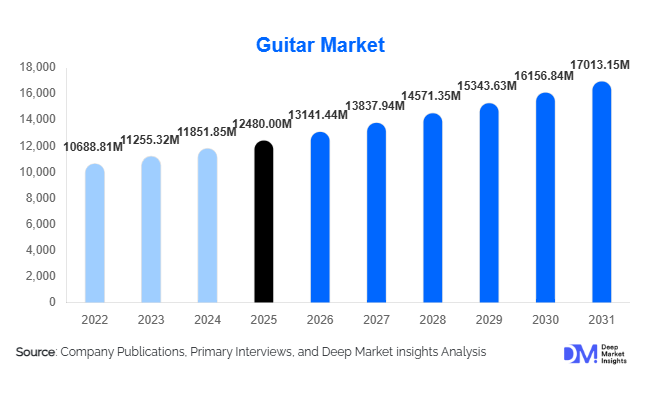
According to Deep Market Insights, the global guitar market size was valued at USD 12,480 million in 2025 and is projected to grow from USD 13,141.44 million in 2026 to reach USD 17,013.15 million by 2031, expanding at a CAGR of 5.3% during the forecast period (2026–2031). Market growth is primarily supported by increasing participation in music education, growing popularity of independent music production, rising disposable incomes across emerging economies, and continued expansion of digital learning platforms. Demand remains strong across both beginner and professional musicians, while technological advancements in smart guitars, sustainable manufacturing practices, and direct-to-consumer sales channels are reshaping competitive dynamics. Premium handcrafted instruments continue to command higher margins, whereas entry-level guitars benefit from expanding first-time buyer populations in Asia-Pacific and Latin America.
Key Market Insights
- Acoustic guitars remain the largest product segment, accounting for the highest share of global sales owing to widespread adoption among beginners, educational institutions, and recreational musicians.
- Asia-Pacific is the fastest-growing regional market, driven by expanding middle-class populations, increasing disposable income, and rapid growth of music education across China, India, Indonesia, and Vietnam.
- Offline specialty music retailers continue to dominate distribution, although online direct-to-consumer sales are expanding rapidly through digital commerce platforms.
- Smart guitars featuring Bluetooth connectivity, MIDI compatibility, and integrated learning software are creating new premium revenue opportunities for manufacturers.
- Sustainability has become an important competitive differentiator, with manufacturers increasingly adopting certified tonewoods, recycled materials, and environmentally responsible production processes.
- Growth in live entertainment, social media content creation, and home recording studios continues to stimulate replacement purchases of professional-grade electric and acoustic guitars worldwide.
Guitar Market Trends
Smart and Connected Guitars Transforming Consumer Experience
The integration of digital technologies into traditional guitars is becoming one of the industry's most significant developments. Manufacturers are increasingly introducing instruments equipped with Bluetooth connectivity, USB recording interfaces, MIDI compatibility, onboard digital effects, automatic tuning systems, and mobile application integration. These innovations allow musicians to record, learn, practice, and perform using a single connected ecosystem. Artificial intelligence-assisted learning platforms now provide real-time feedback on finger positioning, rhythm accuracy, and chord progression, significantly improving the learning experience for beginners. Professional musicians also benefit from integrated digital processing capabilities that simplify studio recording and live performances. As younger consumers increasingly expect connected devices across all product categories, smart guitars are expected to become a major growth area throughout the forecast period.
Sustainable Manufacturing and Alternative Tonewoods Becoming Industry Priorities
Environmental sustainability has emerged as a defining trend across the global guitar industry. Regulatory restrictions on protected hardwood species, growing consumer awareness of responsible sourcing, and increasing corporate sustainability commitments are encouraging manufacturers to diversify material selection. Companies are investing in FSC-certified timber, engineered wood products, carbon-fiber construction, recycled composite materials, and environmentally friendly finishing processes. Several premium brands have introduced guitars manufactured using alternative tonewoods without compromising acoustic performance. Simultaneously, manufacturing facilities are adopting energy-efficient production systems, water-based coatings, waste reduction technologies, and renewable energy sources to lower environmental impact. Sustainability has evolved from regulatory compliance into a key purchasing consideration, particularly among younger musicians and environmentally conscious consumers.
Guitar Market Drivers
Growing Participation in Music Education and Recreational Learning
Increasing enrollment in music schools, universities, private academies, and online instructional platforms continues to strengthen global demand for guitars. Governments and educational institutions across developed and emerging economies are expanding arts education programs that encourage musical participation among children and young adults. At the same time, digital learning platforms have democratized guitar education by providing affordable lessons, interactive tutorials, and personalized practice tools. Adult learners and hobbyists also represent an expanding customer base, particularly among individuals seeking creative recreational activities. This broadening participation across multiple age groups has generated sustained demand for entry-level acoustic guitars while simultaneously creating future demand for intermediate and premium instruments as musicians advance their skills.
Expansion of Live Entertainment and Independent Music Production
The continued recovery of concerts, festivals, live entertainment venues, and touring activities has significantly strengthened demand for professional guitars. Simultaneously, the rapid expansion of digital content creation has enabled independent musicians to distribute music globally through streaming platforms and social media. Home recording studios have become increasingly affordable, encouraging musicians to invest in higher-quality electric and acoustic guitars capable of professional recording performance. Artist collaborations, influencer marketing, and online performances have further increased product visibility, contributing to stronger replacement purchases among experienced musicians and creating sustained growth opportunities for premium manufacturers.
Guitar Market Restraints
Raw Material Supply Constraints and Increasing Manufacturing Costs
The guitar industry remains highly dependent on specialty hardwoods including rosewood, mahogany, ebony, spruce, and maple. Environmental regulations, international trade restrictions, certification requirements, and supply limitations have reduced the availability of several premium tonewoods while increasing procurement costs. Manufacturers must also manage inflationary pressures related to transportation, labor, energy, and finishing materials. These cost increases have particularly affected premium instruments, forcing manufacturers to adjust pricing strategies while investing in alternative materials that maintain product quality without compromising regulatory compliance.
Competition from Digital Music Production Technologies
The growing accessibility of digital audio workstations, software-based virtual instruments, MIDI controllers, and AI-assisted music production platforms presents a long-term competitive challenge for traditional musical instruments. Many aspiring musicians begin producing music digitally before purchasing physical instruments, particularly in electronic music genres. Although guitars remain highly relevant across numerous musical styles, manufacturers must continuously innovate to maintain engagement among younger consumers whose creative workflows increasingly integrate software, mobile applications, and digital recording technologies.
Guitar Market Opportunities
Expansion of Smart Learning Ecosystems
Manufacturers have significant opportunities to expand beyond traditional hardware sales by integrating digital learning platforms, subscription-based educational content, cloud-connected practice tools, and artificial intelligence-powered instruction. Smart guitars capable of synchronizing with mobile applications provide recurring software revenue while improving customer retention. Partnerships with online music schools, educational institutions, streaming platforms, and digital creators can further strengthen ecosystem development, allowing manufacturers to differentiate their offerings in an increasingly competitive marketplace.
Rising Demand Across Emerging Economies
Rapid urbanization, expanding disposable incomes, and increasing investment in music education throughout Asia-Pacific, Latin America, and parts of the Middle East continue to create substantial long-term growth opportunities. Countries including China, India, Indonesia, Vietnam, Brazil, and Mexico are experiencing rising demand from first-time buyers, supported by growing middle-class populations and increasing cultural acceptance of contemporary music. Manufacturers that establish localized production, strengthen regional dealer networks, and develop affordable product portfolios specifically designed for emerging markets are expected to capture significant incremental revenue over the coming decade.
Report Scope
| Report Metric | Details |
|---|---|
| Market Size in 2025 | USD 12480 Million |
| Market Size in 2026 | USD 13141.44 Million |
| Market Size in 2031 | USD 17013.15 Million |
| CAGR | 5.3% (2026-2031) |
| Base Year for Estimation | 2025 |
| Historical Data | 2022-2024 |
| Forecast Period | 2026-2031 |
| Report Coverage | Revenue Forecast, Competitive Landscape, Supply Chain Disruption, Growth Factors, Environment & Regulatory Landscape and Trends |
| Geographies Covered | North America, Europe, APAC, Middle East and Africa, LATAM |
| Countries Covered | U.S., Canada, U.K., Germany, France, Spain, Italy, Russia, Nordic, Benelux, Rest of Europe, China, Korea, Japan, India, Australia, Singapore, Taiwan, South East Asia, Rest of Asia-Pacific, UAE, Turky, Saudi Arabia, South Africa, Egypt, Nigeria, Rest of MEA, Brazil, Mexico, Argentina, Chile, Colombia, Rest of LATAM |
Explore more data points, trends and opportunities Download Free Sample Report
Product Type Insights
The global guitar market is primarily segmented into acoustic guitars, electric guitars, bass guitars, and hybrid/smart guitars, each serving distinct consumer needs and performance requirements. Among these, acoustic guitars dominate global demand due to their affordability, portability, and ease of learning, making them the preferred choice for beginners and educational institutions. Electric guitars hold a strong position in professional and performance-driven segments, particularly within rock, metal, jazz, and contemporary music genres. Bass guitars contribute a steady niche demand across bands, recording studios, and live performances, while hybrid and smart guitars represent an emerging innovation-driven category integrating digital technologies with traditional instrument design.
Acoustic guitars accounted for the largest share of the global market at approximately 44% in 2025, driven by their widespread use in music education and recreational learning. Steel-string acoustic guitars remain the most popular sub-category due to their versatility across genres. Electric guitars represented nearly 32% of global market revenue, supported by strong demand from professional musicians and increasing adoption in home recording setups. Bass guitars held around 12% share, while hybrid and smart guitars collectively accounted for nearly 12%, reflecting their early-stage but rapidly growing adoption among tech-savvy musicians.
Price Range Insights
The guitar market is segmented into entry-level, mid-range, premium, and professional instruments, each catering to different consumer profiles and purchasing capacities. Entry-level guitars dominate the market in terms of volume, driven by first-time buyers, students, and hobbyists. Mid-range guitars represent a balance between affordability and performance quality, often preferred by intermediate musicians. Premium and professional guitars cater to experienced artists and collectors who prioritize craftsmanship, tone quality, and brand reputation.
Entry-level guitars accounted for approximately 39% of global revenue in 2025, making them the largest price segment due to strong demand from emerging markets and educational institutions. Mid-range guitars held around 33%, supported by upgrading consumers transitioning from beginner instruments. Premium guitars represented nearly 18%, while professional-grade instruments accounted for about 10% of total market revenue. Despite lower volume, premium and professional segments generate disproportionately high margins, often exceeding 45–55% due to craftsmanship, customization, and brand value.
Distribution Channel Insights
Distribution in the global guitar market is divided into offline retail and online channels. Offline retail continues to dominate due to the tactile nature of guitar purchasing, where customers prefer to physically test sound quality, build, and playability before making a decision. Specialty music stores, brand-exclusive outlets, and independent dealers play a critical role in guiding purchasing decisions, particularly for premium instruments.
Offline retail accounted for approximately 58% of global sales in 2025, maintaining its dominance despite the rapid growth of e-commerce. Online channels, including brand websites, e-commerce marketplaces, and digital music retail platforms, represented around 42% of total sales. The online segment is expanding faster due to convenience, wider product availability, competitive pricing, and increasing adoption of direct-to-consumer models by leading manufacturers. Digital retail growth is particularly strong in entry-level and mid-range categories.
End-Use Insights
The guitar market serves multiple end-use segments, including personal learning, professional performance, music education, recording studios, live entertainment, and commercial rental services. Personal learning remains the largest end-use segment, driven by increasing participation in online learning platforms and self-taught musicians. Music education institutions also represent a stable demand base supported by curriculum-based instrument adoption.
Personal learning accounted for approximately 42% of total global demand in 2025, making it the leading end-use segment. Professional performance contributed around 24%, driven by touring musicians, studio artists, and live performers. Music education institutions represented approximately 15%, while recording studios and content creators collectively accounted for nearly 12%. Commercial rental and institutional usage made up the remaining 7%, primarily supported by event organizers and cultural programs.
Customer Type Insights
Customer segmentation in the guitar market includes individual consumers, educational institutions, professional musicians, music studios, rental companies, and cultural or religious organizations. Individual consumers dominate the market due to widespread adoption of guitars as a hobby instrument across all age groups. Professional musicians, although smaller in number, contribute significantly to revenue due to higher average selling prices.
Individual consumers accounted for approximately 67% of global market revenue in 2025, making them the largest customer segment. Educational institutions contributed around 12%, driven by structured music programs in schools and universities. Professional musicians represented nearly 10%, while music studios accounted for about 6%. Rental companies and institutional buyers collectively contributed the remaining 5%, mainly through event-based and short-term usage demand.
Explore more data points, trends and opportunities Download Free Sample Report
Guitar Market Segmentations
By Product Type
- Acoustic Guitars
- Electric Guitars
- Bass Guitars
- Hybrid & Smart Guitars
By Price Range
- Entry-Level (Below USD 300)
- Mid-Range (USD 300–1,000)
- Premium (USD 1,000–3,000)
- Professional (Above USD 3,000)
By Distribution Channel
- Offline Retail
- Online Retail
By End Use
- Personal Learning
- Professional Performance
- Music Education Institutions
- Recording Studios & Content Creation
- Live Entertainment & Events
- Commercial Rental & Institutional Use
By Customer Type
- Individual Consumers
- Educational Institutions
- Professional Musicians
- Music Studios
- Rental Companies & Institutions
Regional Insights
North America
North America is the largest regional market, accounting for approximately 34% of global guitar demand in 2025. The United States dominates regional consumption, supported by a strong culture of live music, high disposable income, and the presence of major manufacturers. Canada also contributes steady demand through educational programs and recreational music participation. The region shows strong preference for premium and professional guitars, particularly among established musicians and collectors.
Europe
Europe accounted for nearly 26% of the global market in 2025, with strong demand from countries such as Germany, the United Kingdom, France, Italy, and Spain. Germany remains the largest European market due to its strong manufacturing base and vibrant music culture. The region demonstrates increasing demand for sustainable and ethically sourced instruments, with consumers showing preference for premium handcrafted guitars and eco-certified products.
Asia-Pacific
Asia-Pacific held approximately 27% share of global revenue in 2025 and is the fastest-growing region, with a projected CAGR of 6.8% through 2031. China leads regional consumption and also serves as a global manufacturing hub. India is witnessing rapid growth driven by expanding music education and rising disposable income. Japan and South Korea maintain strong premium segments, while Southeast Asian countries such as Indonesia and Vietnam are emerging as both manufacturing and consumption hubs.
Latin America
Latin America represented around 7% of global demand in 2025, with Brazil being the dominant market due to its strong music culture and growing middle class. Mexico also plays a key role as both a consumer and manufacturing hub. The region is characterized by strong demand for affordable acoustic guitars and increasing participation in music education and live entertainment.
Middle East & Africa
The Middle East & Africa region accounted for approximately 6% of global market share in 2025. South Africa leads regional demand, supported by a well-established music culture and growing educational initiatives. The Middle East, particularly the UAE and Saudi Arabia, is emerging as a high-growth market due to rising investments in entertainment, tourism, and cultural sectors. Increasing youth population and government support for arts and music education are expected to drive future growth.
Key Players in the Global Guitar Market
- Fender Musical Instruments Corporation
- Yamaha Corporation
- Gibson Brands
- C.F. Martin & Co.
- Hoshino Gakki (Ibanez)
- PRS Guitars
- Taylor Guitars
- ESP Guitars
- Cort Guitars
- Godin Guitars
- Takamine Guitars
- Schecter Guitar Research
- Washburn Guitars
- Breedlove Guitars
- Höfner