Global Offline Recipe Box Delivery Market Size
According to Deep Market Insights, the global offline recipe box delivery market size was valued at USD 16.2 billion in 2026 and is projected to grow from USD 18.44 billion in 2027 to reach USD 35.19 billion by 2031, expanding at a CAGR of 13.8% during the forecast period (2026–2031). The market growth is primarily driven by rising demand for convenient home-cooking solutions, increasing penetration of organized retail channels, growing preference for portion-controlled healthy meals, and the expansion of supermarket-based meal kit offerings across developed and emerging economies.
Key Market Insights
- Offline grocery retail dominates distribution, with supermarkets and hypermarkets accounting for the largest share of recipe box sales globally.
- Fresh ingredient recipe boxes lead demand due to strong consumer preference for minimally processed, healthy meals.
- Subscription-based purchasing models remain dominant, but one-time purchase boxes are growing rapidly among casual consumers.
- Millennials represent the largest consumer segment, driven by convenience-oriented lifestyles and health-conscious food choices.
- North America leads the global market, while Asia-Pacific is emerging as the fastest-growing region.
- Sustainability and food waste reduction trends are significantly influencing product innovation and packaging strategies.
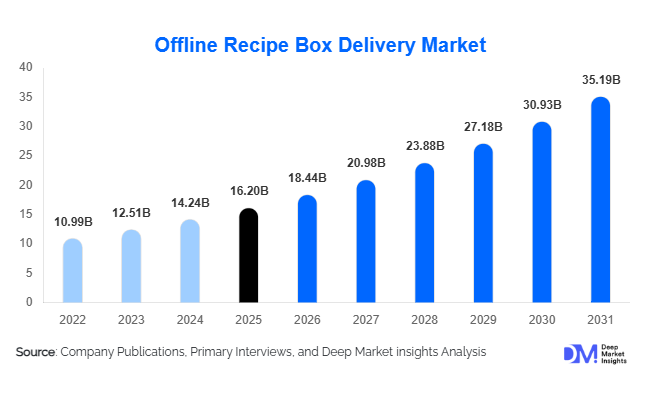
Global offline recipe box delivery market latest trends
Retail-Led Meal Kit Expansion
Supermarkets and hypermarkets are increasingly integrating recipe box solutions into their fresh food aisles to drive higher basket sizes and customer retention. Private-label meal kits are gaining strong traction as retailers seek to build differentiated offerings against online meal kit providers. This trend is especially strong in Europe and North America, where established grocery chains are leveraging in-store visibility and cold-chain infrastructure to scale recipe box adoption. Retailers are also experimenting with seasonal recipe boxes and chef-curated limited editions to increase repeat purchases and in-store engagement.
Personalized Nutrition and Dietary-Specific Boxes
Consumers are increasingly demanding recipe boxes tailored to specific dietary needs such as keto, vegan, gluten-free, and high-protein diets. This personalization trend is enabling manufacturers to command premium pricing and improve customer retention. Advanced data analytics and consumer preference tracking are being used by retailers to design localized and demographic-specific meal kits. Health-driven consumption trends, particularly among urban professionals and aging populations, are accelerating demand for functional nutrition-based recipe boxes across global markets.
Global offline recipe box delivery market drivers
Rising Demand for Convenient Home Cooking Solutions
Modern consumers are increasingly seeking convenient yet healthy alternatives to traditional fast food and takeout. Offline recipe boxes provide pre-portioned ingredients with easy-to-follow instructions, reducing meal preparation time while maintaining the appeal of home cooking. This hybrid convenience-health model is a major driver across urban households, particularly among dual-income families and working professionals.
Expansion of Organized Retail Infrastructure
The rapid growth of supermarkets, hypermarkets, and warehouse club stores has significantly boosted the visibility and accessibility of recipe box products. Retailers benefit from higher margins and increased foot traffic, while manufacturers gain broad consumer exposure. The integration of chilled storage systems and improved supply chain logistics has further supported large-scale offline distribution of meal kits.
Growing Focus on Food Waste Reduction
Recipe boxes provide pre-measured ingredients, helping consumers reduce household food waste. Sustainability concerns and rising food costs are encouraging adoption, especially in developed markets. This aligns with broader environmental goals and strengthens demand for eco-friendly packaging and responsibly sourced ingredients within the market.
Global offline recipe box delivery market restraints
High Operational and Cold Chain Costs
The requirement for refrigeration, temperature-controlled logistics, and fresh ingredient sourcing increases operational complexity and cost. These challenges are more pronounced in emerging markets where cold-chain infrastructure is still developing. As a result, profitability can be constrained, particularly for smaller players.
Price Sensitivity Compared to Traditional Grocery Shopping
Offline recipe boxes are typically priced higher than conventional grocery shopping due to packaging, convenience, and logistics costs. During periods of inflation or economic slowdown, consumers may shift back to traditional cooking methods, limiting market penetration among price-sensitive segments.
Global offline recipe box delivery industry key opportunities
Expansion in Emerging Markets
Rapid urbanization and rising middle-class income levels in Asia-Pacific, Latin America, and the Middle East are creating strong growth opportunities. Countries such as India, China, Indonesia, UAE, and Brazil are witnessing increasing demand for convenient food solutions. Expansion of modern retail infrastructure and rising acceptance of packaged fresh food products will further support market entry and scaling opportunities.
Private Label and Retailer-Driven Ecosystems
Supermarkets are increasingly launching private-label recipe box brands to strengthen customer loyalty and differentiate themselves from competitors. This creates opportunities for manufacturers to act as contract producers. Retail-led ecosystems are expected to become a dominant growth channel, especially in Europe and North America, where grocery consolidation is strong.
Report Scope
| Report Metric | Details |
|---|---|
| Market Size in 2025 | USD 16.20 Billion |
| Market Size in 2026 | USD 18.44 Billion |
| Market Size in 2031 | USD 35.19 Billion |
| CAGR | 13.8% (2026-2031) |
| Base Year for Estimation | 2025 |
| Historical Data | 2022-2024 |
| Forecast Period | 2026-2031 |
| Report Coverage | Revenue Forecast, Competitive Landscape, Supply Chain Disruption, Growth Factors, Environment & Regulatory Landscape and Trends |
| Geographies Covered | North America, Europe, APAC, Middle East and Africa, LATAM |
| Countries Covered | U.S., Canada, U.K., Germany, France, Spain, Italy, Russia, Nordic, Benelux, Rest of Europe, China, Korea, Japan, India, Australia, Singapore, Taiwan, South East Asia, Rest of Asia-Pacific, UAE, Turky, Saudi Arabia, South Africa, Egypt, Nigeria, Rest of MEA, Brazil, Mexico, Argentina, Chile, Colombia, Rest of LATAM |
Explore more data points, trends and opportunities Download Free Sample Report
Product Type Insights
Fresh ingredient recipe boxes continue to dominate the global market, holding the largest share due to their strong alignment with modern consumer preferences for healthy eating, freshness, and minimally processed food solutions. The leading driver for this segment is the rising global focus on nutritional transparency combined with the convenience of pre-portioned ingredients that reduce food waste and simplify home cooking without compromising quality. The expansion of organized retail and cold-chain logistics has further strengthened availability, making fresh ingredient boxes the default choice for many urban households seeking balance between convenience and home-prepared meals. Semi-prepared and ready-to-cook boxes are experiencing accelerated adoption, primarily driven by time-constrained consumers and dual-income households who seek to reduce meal preparation time while still maintaining control over cooking outcomes. Premium gourmet recipe boxes are expanding steadily in affluent urban markets, supported by rising experiential consumption trends where consumers value chef-curated meals, exotic ingredients, and restaurant-like dining experiences at home. Family meal boxes remain a structurally important segment due to their cost efficiency, scalability for larger households, and strong value proposition in portion control and weekly meal planning. Specialty dietary boxes, including vegan, keto, gluten-free, and high-protein variants, are emerging as the fastest-growing sub-segment, driven by increasing prevalence of lifestyle-based diets, health consciousness, and rising awareness of food sensitivities, positioning them as a key innovation frontier in the overall market.
Application Insights
Residential consumers represent the dominant application segment, driven by the widespread shift toward home-based cooking solutions that combine convenience with healthier eating habits. The primary growth driver in this segment is the increasing preference for time-saving meal preparation solutions that still allow consumers to engage in cooking without extensive planning or grocery shopping. Corporate meal programs are emerging as a rapidly growing application, supported by organizations integrating wellness-focused food solutions into employee benefit structures, productivity enhancement initiatives, and workplace satisfaction strategies. Hospitality and tourism applications are also gaining momentum, particularly in serviced apartments, boutique hotels, and short-term rental accommodations, where recipe boxes enhance guest experience by offering interactive and localized dining options. Healthcare adoption is expanding steadily, supported by the growing need for controlled nutrition programs in hospitals, rehabilitation centers, and elderly care facilities where diet precision and ingredient traceability are essential. Additionally, gifting and seasonal demand is becoming an increasingly important application, especially during festive periods and corporate gifting cycles, where curated recipe boxes are positioned as premium experiential gifts that combine utility with personalization.
Distribution Channel Insights
Supermarkets and hypermarkets continue to dominate distribution due to their extensive cold storage infrastructure, strong consumer trust, and high footfall, making them the most influential offline channel for recipe box penetration. The key driver behind their leadership is the ability to offer immediate product visibility and impulse-driven purchases combined with established supply chain efficiencies. Specialty food stores play a critical role in the premium segment, driven by consumer demand for curated, high-quality, and artisanal meal kits that emphasize organic sourcing and gourmet positioning. Club stores and warehouse retailers are expanding their presence in bulk family meal kit distribution, supported by value-conscious consumers seeking cost efficiency and larger portion packaging. Convenience stores are increasingly contributing to urban demand by catering to impulse purchases and last-minute meal solutions, particularly in densely populated metropolitan areas. Pop-up retail formats and seasonal experiential events are also emerging as important experimental channels, driven by brand engagement strategies that aim to introduce consumers to recipe box concepts, encourage trial adoption, and enhance product discovery through experiential marketing.
Consumer Segment Insights
Millennials remain the dominant consumer group in the market, driven by their strong inclination toward convenience-oriented, health-conscious, and experience-driven food consumption patterns. The primary growth driver within this segment is their preference for digitally enabled lifestyle solutions that simplify meal planning while aligning with wellness goals. Working professionals represent a significant demand base, particularly in urban environments where time constraints and demanding schedules increase reliance on structured meal solutions that reduce daily cooking effort. Families with children form a stable and high-volume segment, supported by demand for predictable meal planning, cost efficiency, and balanced nutrition for household members. Generation Z consumers are emerging as a highly influential growth segment, particularly driven by their openness to experimentation, sustainability preferences, and strong adoption of specialty dietary options such as plant-based and environmentally conscious meal kits. Senior consumers are gradually increasing adoption, supported by the need for easy-to-prepare meals, portion-controlled diets, and nutrition-focused solutions that assist in managing age-related dietary requirements and health conditions.
Explore more data points, trends and opportunities Download Free Sample Report
Offline Recipe Box Delivery Market Segmentations
By Product Format
- Fresh Ingredient Recipe Boxes
- Semi-Prepared Recipe Boxes
- Ready-to-Cook Recipe Boxes
- Premium Gourmet Recipe Boxes
- Family Meal Recipe Boxes
- Specialty Dietary Recipe Boxes
By Purchase Model
- Subscription-Based Boxes
- One-Time Purchase Boxes
By Distribution Channel
- Supermarkets & Hypermarkets
- Specialty Food Stores
- Club Stores & Warehouse Retailers
- Convenience Stores
- Pop-Up & Seasonal Retail Formats
By Price Tier
- Economy
- Mid-Priced
- Premium
- Luxury / Gourmet
By Serving Size
- Single-Person Boxes
- Two-Person Boxes
- Family Boxes
- Large Household Boxes
Regional Insights
North America
North America remains the largest market for offline recipe box delivery, led primarily by the United States and Canada. The key growth drivers in this region include high disposable income levels, mature retail infrastructure, and strong consumer awareness regarding health and nutrition. A significant driver is the widespread adoption of convenience-oriented lifestyles supported by subscription-based meal delivery ecosystems and strong brand loyalty. Supermarket chains actively promote private-label meal kits, further reinforcing mainstream acceptance. Additionally, the region benefits from advanced cold-chain logistics and high penetration of organized retail formats, which together support consistent product availability and premiumization of fresh ingredient boxes.
Europe
Europe holds a substantial share of the global market, with strong performance across the United Kingdom, Germany, France, and the Netherlands. The primary growth driver in this region is the strong cultural emphasis on sustainability, food waste reduction, and environmentally responsible consumption. Consumers increasingly prefer eco-friendly packaging, locally sourced ingredients, and organic recipe box offerings, which has encouraged retailers to innovate across sustainable supply chains. Regulatory support for food traceability and growing awareness of clean-label food consumption further strengthen market expansion. The region also benefits from high culinary awareness and openness to diverse cuisines, which supports steady demand for premium and specialty recipe box formats.
Asia-Pacific
Asia-Pacific is the fastest-growing regional market, driven by rapid urbanization, expanding middle-class populations, and increasing penetration of modern retail infrastructure. The major growth driver is the rising demand for convenient cooking solutions among urban households experiencing time scarcity and lifestyle changes associated with dual-income families. Countries such as China, India, Japan, South Korea, and Australia are leading adoption due to increasing exposure to global food trends and digital retail ecosystems. The influence of Western dining culture through media, food delivery platforms, and retail partnerships is further accelerating awareness and acceptance of recipe box solutions. Expanding e-commerce infrastructure and improving cold-chain logistics are also enabling broader accessibility across tier-one and tier-two cities.
Latin America
Latin America is an emerging market where growth is primarily driven by expanding middle-class populations and gradual modernization of retail infrastructure. Brazil, Mexico, and Argentina are leading demand centers, supported by increasing urbanization and evolving consumer preferences toward convenience-based food solutions. The key driver in this region is the rising penetration of organized supermarkets and improved access to packaged fresh food offerings in urban areas. As disposable incomes increase, consumers are gradually shifting toward time-saving meal preparation options, particularly in metropolitan regions where lifestyle changes are accelerating demand for structured meal solutions.
Middle East & Africa
The Middle East and Africa region is witnessing steady expansion, driven primarily by high-income consumer bases in countries such as the UAE, Saudi Arabia, and Qatar. A major growth driver is the strong demand for premium imported food products supported by a well-developed retail sector and a high concentration of expatriate populations with diverse culinary preferences. In addition, tourism growth and the expansion of luxury hospitality sectors are contributing to increased adoption of curated meal solutions. In Africa, adoption is gradually increasing in urban centers such as South Africa and Kenya, where improving organized retail infrastructure and rising urban incomes are enabling greater access to convenient meal solutions, particularly among younger urban consumers.
Key Players in the Global Offline Recipe Box Delivery Market
- HelloFresh
- Home Chef
- Blue Apron
- Gousto
- Marley Spoon
- Sunbasket
- EveryPlate
- Green Chef
- Mindful Chef
- Dinnerly
- Chefmarket
- Cookit
- SimplyCook
- Purple Carrot
- Factor Meals