Retail and Wholesale Market Size
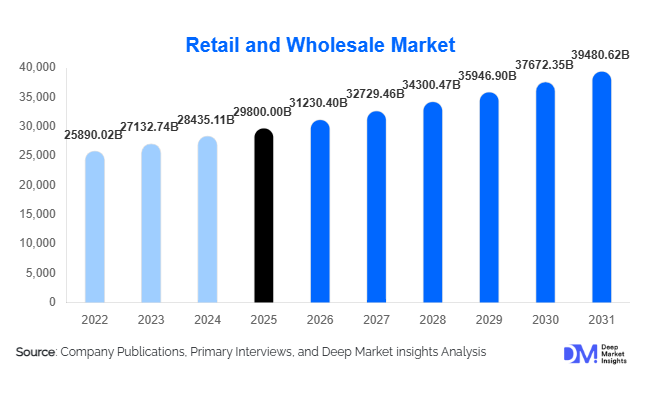
According to Deep Market Insights, the global retail and wholesale market size was valued at USD 29,800 billion in 2025 and is projected to grow from USD 31,230.40 billion in 2026 to reach USD 39,480.62 billion by 2031, expanding at a CAGR of 4.8% during the forecast period (2026–2031). The retail and wholesale market growth is primarily driven by the rapid expansion of e-commerce, increasing consumer spending across emerging economies, and the integration of digital technologies such as AI, automation, and omnichannel platforms into retail operations.
Key Market Insights
- E-commerce and omnichannel retail are reshaping the industry, enabling seamless customer experiences across online and offline platforms.
- Asia-Pacific dominates the global market, driven by strong consumption growth in China and India.
- Food & beverages remain the largest product category, accounting for over 30% of total market demand.
- Organized retail chains are gaining share globally, supported by economies of scale and strong brand presence.
- Digital wholesale platforms are transforming B2B trade, improving transparency, pricing efficiency, and inventory management.
- Sustainability and private label expansion are emerging as key differentiators for retailers globally.
What are the latest trends in the retail and wholesale market?
Rise of Omnichannel Retail Ecosystems
Retailers are increasingly adopting omnichannel strategies to provide a unified shopping experience across physical stores, websites, and mobile applications. Consumers expect flexibility in purchasing options, including buy-online-pickup-in-store (BOPIS), same-day delivery, and easy returns. This trend is particularly strong in developed markets such as North America and Europe, where digital infrastructure is highly advanced. Retailers are investing in data analytics, customer relationship management (CRM) systems, and AI-powered personalization tools to enhance customer engagement. The integration of inventory systems across channels ensures real-time product availability, reducing stockouts and improving customer satisfaction. As competition intensifies, omnichannel capabilities are becoming a critical differentiator for both large retail chains and emerging direct-to-consumer brands.
Digital Transformation in Wholesale Trade
The wholesale segment is undergoing significant digital transformation, with the emergence of B2B e-commerce platforms and digital marketplaces. These platforms enable wholesalers to streamline procurement processes, optimize pricing, and expand their customer base globally. Technologies such as blockchain are being explored for supply chain transparency, while automation in warehouses is improving efficiency and reducing operational costs. Digital wholesale platforms are particularly gaining traction in emerging markets, where traditional distribution networks are fragmented. By leveraging digital tools, wholesalers can improve demand forecasting, reduce inventory holding costs, and enhance supplier-buyer relationships, making the sector more resilient and scalable.
What are the key drivers in the retail and wholesale market?
Growth of E-commerce and Digital Payments
The rapid adoption of e-commerce and digital payment systems has significantly accelerated market growth. Consumers increasingly prefer online shopping due to convenience, wider product selection, and competitive pricing. The proliferation of smartphones and internet penetration has further expanded the reach of digital retail platforms, particularly in emerging economies. Payment innovations such as digital wallets and buy-now-pay-later (BNPL) solutions are enhancing purchasing power and driving higher transaction volumes.
Rising Disposable Income and Urbanization
Increasing disposable incomes, especially in Asia-Pacific and Latin America, are driving higher consumer spending on both essential and discretionary goods. Urbanization is contributing to the growth of organized retail formats such as supermarkets, hypermarkets, and shopping malls. As consumers shift toward branded and premium products, retailers are expanding their offerings to cater to evolving preferences, thereby boosting overall market growth.
What are the restraints for the global market?
Supply Chain Disruptions and Cost Pressures
Global supply chain disruptions, including logistics bottlenecks and rising transportation costs, have impacted product availability and pricing. Inflationary pressures are increasing input costs, which are often passed on to consumers, potentially reducing demand. These challenges are particularly pronounced in sectors such as food, apparel, and electronics, where supply chain dependencies are complex and global.
Regulatory and Compliance Complexities
The retail and wholesale market operates under diverse regulatory frameworks across different regions. Compliance with taxation policies, import-export regulations, labor laws, and environmental standards can increase operational complexity and costs. Companies expanding into new markets must navigate these regulatory challenges, which can act as barriers to entry and limit scalability.
What are the key opportunities in the retail and wholesale industry?
Expansion in Emerging Markets
Emerging economies in Asia-Pacific, Africa, and Latin America present significant growth opportunities due to rising middle-class populations and increasing consumer spending. Organized retail penetration remains relatively low in these regions, creating opportunities for international retailers and wholesalers to expand their presence. Government initiatives supporting infrastructure development and foreign direct investment are further facilitating market entry and growth.
Sustainability and Private Label Growth
Sustainability is becoming a key focus area for retailers, with consumers increasingly demanding eco-friendly products and ethical sourcing practices. Retailers are expanding private label offerings with sustainable attributes, which not only meet consumer expectations but also offer higher profit margins. Wholesale distributors are also adapting by sourcing environmentally compliant products and supporting corporate sustainability goals.
Report Scope
| Report Metric | Details |
|---|---|
| Market Size in 2025 | USD 29800 Billion |
| Market Size in 2026 | USD 31230.40 Billion |
| Market Size in 2031 | USD 39480.62 Billion |
| CAGR | 4.8% (2026-2031) |
| Base Year for Estimation | 2025 |
| Historical Data | 2022-2024 |
| Forecast Period | 2026-2031 |
| Report Coverage | Revenue Forecast, Competitive Landscape, Supply Chain Disruption, Growth Factors, Environment & Regulatory Landscape and Trends |
| Geographies Covered | North America, Europe, APAC, Middle East and Africa, LATAM |
| Countries Covered | U.S., Canada, U.K., Germany, France, Spain, Italy, Russia, Nordic, Benelux, Rest of Europe, China, Korea, Japan, India, Australia, Singapore, Taiwan, South East Asia, Rest of Asia-Pacific, UAE, Turky, Saudi Arabia, South Africa, Egypt, Nigeria, Rest of MEA, Brazil, Mexico, Argentina, Chile, Colombia, Rest of LATAM |
Explore more data points, trends and opportunities Download Free Sample Report
Retail Format Insights
E-commerce and online retail continue to dominate as the fastest-growing retail format, accounting for approximately 28% of the global market share in 2025. The segment’s leadership is primarily driven by increasing internet penetration, widespread smartphone usage, and evolving consumer preference for convenience and doorstep delivery. Competitive pricing enabled by reduced overhead costs, coupled with the availability of a wide assortment of products, further strengthens this segment’s growth trajectory. Additionally, advancements in last-mile delivery, digital payments, and AI-driven personalization have significantly enhanced the online shopping experience.
Hypermarkets and supermarkets remain a cornerstone of the retail ecosystem, particularly in emerging markets, due to their ability to provide a diverse range of products under one roof at competitive prices. These formats benefit from strong supply chain networks and economies of scale, making them highly resilient even amid economic fluctuations. Meanwhile, discount stores are gaining increasing traction globally, especially in inflationary environments, as consumers shift toward value-based purchasing. The growth of private labels and bulk-buying options in these stores is further reinforcing their position in price-sensitive markets.
Wholesale Format Insights
Merchant wholesalers lead the wholesale segment, capturing nearly 35% of the market share in 2025. Their dominance is driven by their integral role in facilitating bulk distribution across key industries such as manufacturing, retail, and food services. These wholesalers provide essential services, including inventory management, logistics support, and credit facilities, making them indispensable within the supply chain. Their ability to bridge the gap between producers and retailers at scale continues to drive their global leadership.
Digital wholesale platforms are emerging as a transformative force within the segment, enabling seamless B2B transactions, real-time pricing, and enhanced supply chain visibility. These platforms are particularly impactful in fragmented markets, where they help streamline procurement and reduce inefficiencies. Cash-and-carry wholesalers remain highly relevant in developing economies, where small and medium enterprises rely on them for flexible purchasing and immediate product availability. Their growth is supported by expanding SME sectors and increasing urbanization.
Product Category Insights
Food and beverages represent the largest product category, contributing approximately 32% of the global market in 2025, driven by the essential and recurring nature of demand. This segment benefits from stable consumption patterns across all economic cycles, making it a foundational pillar of the retail and wholesale market. The expansion of organized grocery retail and online food delivery services has further strengthened its dominance.
Apparel and consumer electronics are also significant contributors, with growth driven by rapid product innovation, changing fashion trends, and shorter replacement cycles. The consumer electronics segment, in particular, is benefiting from increasing digitalization and demand for smart devices. Meanwhile, the health and personal care segment is witnessing robust growth due to rising health awareness, aging populations, and increased spending on wellness and hygiene products, especially in the post-pandemic landscape.
Distribution Channel Insights
Offline or brick-and-mortar channels continue to dominate the market, accounting for approximately 60% of the global share in 2025. Their leadership is supported by strong consumer trust, the ability to physically evaluate products, and immediate product availability. This channel remains particularly dominant in developing regions where digital infrastructure is still evolving.
However, online distribution channels are rapidly gaining momentum, driven by improvements in logistics networks, digital payment systems, and user-friendly e-commerce platforms. The emergence of omnichannel retail is reshaping the competitive landscape, as retailers integrate online and offline operations to provide seamless customer experiences. Features such as click-and-collect, same-day delivery, and unified inventory systems are becoming standard, enabling retailers to enhance customer satisfaction and operational efficiency simultaneously.
End-Use Insights
The retail and wholesale market caters to a diverse range of end-use industries, including consumer goods, food services, manufacturing, and healthcare. Among these, the food service (HoReCa) segment is one of the fastest-growing, with growth exceeding 6% CAGR, driven by urbanization, changing dietary habits, and the proliferation of online food delivery platforms. Increasing demand for convenience foods and dining-out experiences is further fueling this segment.
The consumer electronics industry also represents a high-growth end-use segment, supported by continuous technological advancements and rising consumer demand for connected devices. Additionally, healthcare and pharmaceutical distribution are emerging as critical growth areas, driven by increasing global health awareness, expanding healthcare infrastructure, and rising demand for medical supplies and over-the-counter products. These end-use industries collectively contribute to sustained demand across both retail and wholesale channels.
Explore more data points, trends and opportunities Download Free Sample Report
Retail and Wholesale Market Segmentations
By Retail Format
- Hypermarkets & Supermarkets
- Convenience Stores
- Specialty Stores
- Department Stores
- Discount Stores
- E-commerce / Online Retail
- Direct-to-Consumer (D2C)
- Warehouse Clubs
By Wholesale Format
- Merchant Wholesalers
- Cash-and-Carry Wholesalers
- Industrial Distributors
- Agricultural Product Wholesalers
- Import/Export Wholesalers
- Digital Wholesale Platforms
By Product Category
- Food & Beverages
- Apparel & Footwear
- Consumer Electronics
- Home & Furniture
- Health & Personal Care
- Automotive Products
- Industrial & Construction Supplies
- Luxury Goods
By Distribution Channel
- Offline / Brick-and-Mortar
- Online / Digital Platforms
- Omnichannel Retail
End-Use Industry
- Consumer Goods
- Food Services (HoReCa)
- Manufacturing
- Healthcare & Pharmaceuticals
Regional Insights
Asia-Pacific
Asia-Pacific dominates the global retail and wholesale market with approximately 38% share in 2025. China is the largest contributor, accounting for nearly 20% of global demand, supported by its expansive consumer base, highly developed e-commerce ecosystem, and strong domestic manufacturing sector. India is the fastest-growing market in the region, with a CAGR of around 7%, driven by rising disposable incomes, rapid urbanization, and increasing digital penetration. Southeast Asian countries such as Indonesia and Vietnam are also witnessing strong growth due to expanding middle-class populations and improving retail infrastructure. Government initiatives promoting digital economies and foreign direct investment further act as key growth drivers in the region.
North America
North America holds around 25% of the global market share, led by the United States, which remains a global leader in retail innovation. The region’s growth is driven by high consumer spending, advanced logistics networks, and strong adoption of e-commerce and omnichannel retail strategies. Technological advancements, including AI-driven analytics, automated warehouses, and personalized marketing, are key drivers enhancing operational efficiency. Canada also contributes significantly, supported by a stable economy and growing online retail penetration. The presence of major global retailers further strengthens the region’s competitive landscape.
Europe
Europe accounts for approximately 20% of the market, with Germany, the UK, and France as major contributors. The region is characterized by well-established retail chains, high private label penetration, and strong regulatory frameworks. Growth is driven by increasing consumer preference for sustainable and ethically sourced products, prompting retailers to adopt eco-friendly practices. The expansion of discount retail chains and the rising popularity of online grocery shopping are additional growth drivers. Digital transformation and cross-border e-commerce within the European Union further enhance market expansion.
Middle East & Africa
The Middle East and Africa region is experiencing steady growth, driven by rapid urbanization, increasing retail infrastructure development, and rising disposable incomes. Countries such as the UAE and Saudi Arabia are leading the region, supported by government initiatives aimed at economic diversification and retail sector expansion. The development of large shopping malls, tourism growth, and increasing adoption of e-commerce platforms are key drivers. In Africa, improving internet penetration and mobile payment adoption are enabling the growth of digital retail, particularly in countries such as South Africa and Nigeria.
Latin America
Latin America is gradually expanding, with Brazil and Mexico as key markets. The region’s growth is driven by increasing penetration of organized retail, rising urban populations, and growing adoption of e-commerce platforms. Improvements in digital payment infrastructure and logistics networks are supporting online retail expansion. Additionally, economic recovery in key countries and the expansion of international retail chains are contributing to market growth. Price-sensitive consumers are also driving the popularity of discount stores and private label products across the region.
Key Players in the Retail and Wholesale Market
- Walmart Inc.
- Amazon.com Inc.
- Costco Wholesale Corporation
- Schwarz Group
- Alibaba Group
- Carrefour
- Tesco PLC
- The Home Depot
- JD.com
- Target Corporation
- Metro AG
- Aeon Co. Ltd.
- Seven & I Holdings
- Aldi Group
- Best Buy Co. Inc.