Natural Cat Litter Market Size
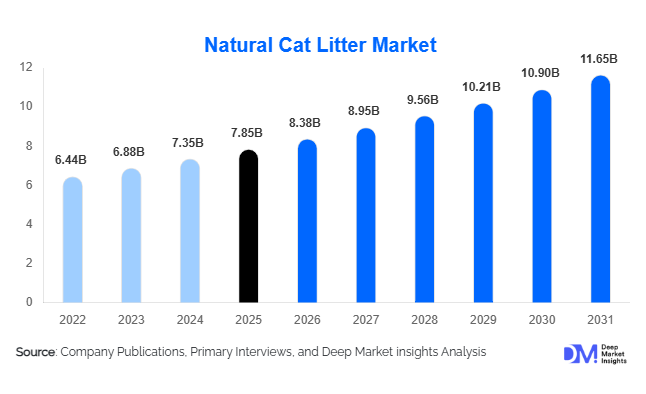
According to Deep Market Insights, the global natural cat litter market size was valued at USD 7.85 billion in 2025 and is projected to grow from USD 8.38 billion in 2026 to reach USD 11.65 billion by 2031, expanding at a CAGR of 6.8% during the forecast period (2026–2031). The natural cat litter market is experiencing growth primarily driven by increasing pet humanization, rising awareness of sustainable pet care products, growing environmental concerns associated with conventional clay-based litter, and expanding demand for biodegradable and renewable pet hygiene solutions. Consumers are increasingly opting for litter products derived from natural materials such as corn, wheat, pine, walnut shells, tofu, recycled paper, and coconut fiber due to their superior sustainability profile and lower environmental impact. The market is also benefiting from premiumization trends within the global pet care industry, where pet owners are willing to spend more on products that improve pet health, indoor hygiene, and environmental sustainability.
Key Market Insights
- Natural cat litter is increasingly replacing traditional clay-based litter products, driven by growing environmental awareness and consumer preference for biodegradable alternatives.
- Premium and super-premium litter products account for nearly half of total market revenue, supported by higher spending on pet wellness and hygiene.
- North America dominates the market, accounting for approximately 38% of global demand, led by high pet ownership rates and strong sustainability adoption.
- Asia-Pacific is the fastest-growing region, supported by rising cat ownership, urbanization, and increasing disposable income in China, India, and Southeast Asia.
- E-commerce channels are rapidly expanding, enabling manufacturers to directly engage consumers through subscription-based purchasing models.
- Technology integration in odor control, antimicrobial formulations, and smart litter box compatibility is reshaping product innovation across the industry.
Natural Cat Litter Market Trends
Sustainable and Biodegradable Products Becoming Mainstream
Sustainability has become one of the strongest purchasing criteria among pet owners globally. Natural cat litter products manufactured from renewable agricultural materials such as corn, wheat, walnut shells, tofu, and recycled paper are gaining widespread adoption as consumers seek environmentally responsible alternatives to traditional bentonite clay litter. Manufacturers are increasingly investing in compostable packaging, carbon footprint reduction initiatives, and circular economy production models. Growing landfill concerns and stricter environmental regulations are encouraging retailers and consumers to favor biodegradable litter solutions. Premium natural litter products that combine sustainability with high-performance odor control and clumping capabilities are witnessing particularly strong demand across North America and Europe.
Growth of Smart Pet Care and Automated Litter Systems
The emergence of smart pet care technologies is creating new growth opportunities within the natural cat litter market. Automated litter boxes, app-connected pet monitoring systems, and self-cleaning litter solutions are gaining popularity among urban consumers. Manufacturers are developing lightweight, dust-free, and clumping natural litter formulations specifically optimized for automated litter box systems. Enhanced odor-control technologies, antimicrobial ingredients, and moisture-absorption innovations are also being incorporated into premium product offerings. As pet owners increasingly seek convenience and hygiene improvements, technology-compatible natural litter products are expected to capture a growing share of the global market.
Natural Cat Litter Market Drivers
Rising Global Cat Ownership and Pet Humanization
The growing global cat population remains a primary driver of market expansion. Urbanization, smaller living spaces, and changing lifestyles have increased the popularity of cats as companion animals. Consumers increasingly view pets as family members and are willing to invest in premium hygiene products that support pet health and household cleanliness. This trend has significantly increased spending on high-quality litter products, particularly within developed economies.
Increasing Consumer Preference for Sustainable Pet Care Products
Environmental awareness is significantly influencing purchasing decisions across the pet care industry. Conventional clay-based litter products are often criticized for their environmental footprint due to mining activities and landfill waste generation. Natural litter products offer renewable sourcing, biodegradability, compostability, and lower environmental impact, making them highly attractive to eco-conscious consumers. Sustainability certifications and environmentally responsible packaging are becoming increasingly important competitive differentiators for manufacturers.
Natural Cat Litter Market Restraints
Higher Product Pricing Compared to Conventional Alternatives
Natural cat litter products typically command premium prices due to higher raw material costs, specialized processing requirements, and lower manufacturing scale efficiencies. Price-sensitive consumers, particularly in developing markets, may continue to favor traditional clay-based products, limiting broader market penetration.
Raw Material Supply Volatility
The industry relies heavily on agricultural raw materials such as corn, wheat, soybeans, walnut shells, and coconut fiber. Seasonal variations, climate conditions, crop yields, and commodity price fluctuations can significantly affect production costs and profit margins. Maintaining stable supply chains while controlling costs remains a critical challenge for market participants.
Natural Cat Litter Market Opportunities
Expansion Across Emerging Asia-Pacific Markets
Asia-Pacific represents one of the largest growth opportunities for natural cat litter manufacturers. Rising disposable incomes, increasing pet ownership rates, and expanding premium pet care spending are creating substantial demand across China, India, Indonesia, Thailand, Vietnam, and the Philippines. Market penetration for natural litter remains significantly lower than in North America and Europe, providing considerable room for future expansion. Localized production and regional distribution networks are expected to play a critical role in capturing emerging demand.
Development of Circular Economy and Sustainable Product Platforms
Manufacturers have significant opportunities to leverage agricultural waste streams and renewable feedstocks to produce environmentally sustainable litter products. Corn residues, wheat by-products, coconut fiber, and soybean derivatives can be transformed into high-performance litter products while supporting circular economy objectives. Companies that successfully integrate sustainable sourcing, compostable packaging, and carbon reduction strategies are likely to gain competitive advantages and strengthen brand loyalty among environmentally conscious consumers.
Report Scope
| Report Metric | Details |
|---|---|
| Market Size in 2025 | USD 7.85 Billion |
| Market Size in 2026 | USD 8.38 Billion |
| Market Size in 2031 | USD 11.65 Billion |
| CAGR | 6.8% (2026-2031) |
| Base Year for Estimation | 2025 |
| Historical Data | 2022-2024 |
| Forecast Period | 2026-2031 |
| Report Coverage | Revenue Forecast, Competitive Landscape, Supply Chain Disruption, Growth Factors, Environment & Regulatory Landscape and Trends |
| Geographies Covered | North America, Europe, APAC, Middle East and Africa, LATAM |
| Countries Covered | U.S., Canada, U.K., Germany, France, Spain, Italy, Russia, Nordic, Benelux, Rest of Europe, China, Korea, Japan, India, Australia, Singapore, Taiwan, South East Asia, Rest of Asia-Pacific, UAE, Turky, Saudi Arabia, South Africa, Egypt, Nigeria, Rest of MEA, Brazil, Mexico, Argentina, Chile, Colombia, Rest of LATAM |
Explore more data points, trends and opportunities Download Free Sample Report
Raw Material Type Insights
Corn-based natural cat litter dominates the global market, accounting for approximately 28% of total market revenue in 2025. Corn litter offers superior clumping performance, excellent odor control, biodegradability, and flushability, making it the preferred choice among consumers seeking environmentally friendly alternatives. Pine- and wood-based litter products continue to maintain strong market positions due to their natural deodorizing capabilities and renewable sourcing. Recycled paper litter remains popular among pet owners seeking dust-free and hypoallergenic solutions, particularly for kittens and cats with respiratory sensitivities. Emerging materials such as tofu, cassava, and coconut fiber are experiencing strong growth, supported by premiumization trends and innovation in sustainable pet care products.
Product Functionality Insights
Clumping natural litter represents the largest product category, accounting for approximately 64% of global market demand. Consumers prefer clumping products because they simplify cleaning, reduce overall litter consumption, and provide enhanced odor management. Odor-control formulations are witnessing strong adoption among multi-cat households, while lightweight and flushable products are becoming increasingly popular among urban consumers seeking convenience. Dust-free and hypoallergenic formulations continue to gain traction among pet owners concerned about indoor air quality and pet health.
Distribution Channel Insights
Pet specialty stores remain the leading distribution channel, representing approximately 34% of global market revenue. These outlets provide consumers with access to premium brands, expert recommendations, and specialized product selections. Online marketplaces have become the fastest-growing sales channel as consumers increasingly prefer home delivery, subscription services, and direct-to-consumer purchasing options. Supermarkets and hypermarkets continue to play an important role in driving volume sales through broad consumer accessibility and competitive pricing strategies. Brand-owned e-commerce platforms are also expanding rapidly, enabling manufacturers to strengthen customer relationships and improve profit margins.
End User Insights
Single-cat households account for approximately 52% of total market demand, reflecting global pet ownership demographics and urban living trends. Multi-cat households represent a significant growth segment due to their higher litter consumption volumes and preference for premium odor-control formulations. Veterinary clinics, animal shelters, and pet boarding facilities are increasingly adopting natural litter products because of their dust-free properties, improved hygiene performance, and environmental benefits. Commercial pet facilities are expected to generate growing demand as sustainability initiatives become more prominent throughout the pet services industry.
Explore more data points, trends and opportunities Download Free Sample Report
Natural Cat Litter Market Segmentations
By Raw Material Type
- Corn-Based Natural Cat Litter
- Wheat-Based Natural Cat Litter
- Pine/Wood-Based Natural Cat Litter
- Recycled Paper-Based Natural Cat Litter
- Walnut Shell-Based Natural Cat Litter
- Tofu/Soy-Based Natural Cat Litter
- Coconut Husk & Other Plant-Based Litters
By Product Functionality
- Clumping Natural Cat Litter
- Non-Clumping Natural Cat Litter
- Odor-Control Formulations
- Multi-Cat Formulations
- Lightweight Formulations
- Flushable Formulations
- Dust-Free & Hypoallergenic Formulations
By Distribution Channel
- Pet Specialty Stores
- Supermarkets & Hypermarkets
- Veterinary Clinics
- Online Marketplaces
- Brand-Owned E-Commerce Platforms
- Subscription-Based Deliveries
By End User
- Single-Cat Households
- Multi-Cat Households
- Cat Breeders
- Animal Shelters & Rescue Centers
- Veterinary Hospitals & Clinics
- Pet Boarding Facilities
Regional Insights
North America
North America accounted for approximately 38% of the global natural cat litter market revenue in 2025, making it the largest regional market. The United States alone contributes nearly 31% of worldwide demand and remains the primary revenue generator for manufacturers operating in the natural pet care industry. Market growth is strongly supported by one of the world's highest pet ownership rates, a well-established pet humanization trend, and premium consumer spending on pet wellness products. American consumers increasingly view pets as family members, resulting in higher expenditure on sustainable, health-conscious, and environmentally friendly pet products.
The region also benefits from a highly developed retail ecosystem consisting of pet specialty stores, veterinary channels, mass retailers, and rapidly expanding e-commerce platforms. Subscription-based pet product deliveries have significantly increased product accessibility and repeat purchases. Furthermore, growing consumer awareness regarding the environmental impact of clay-based litter mining has accelerated adoption of biodegradable alternatives manufactured from corn, wheat, pine, recycled paper, and walnut shells. Canada represents an important secondary market, supported by strong sustainability initiatives, environmentally conscious purchasing behavior, and increasing demand for premium pet hygiene products. Continued innovation in odor-control technologies, lightweight formulations, and smart litter box-compatible products is expected to further strengthen North America's market leadership through the forecast period.
Europe
Europe accounted for approximately 29% of the global natural cat litter market demand in 2025 and remains one of the most sustainability-driven markets worldwide. Germany represents the largest regional market, followed by the United Kingdom, France, Italy, and the Netherlands. The region's growth is heavily influenced by stringent environmental regulations, circular economy initiatives, and increasing consumer preference for biodegradable consumer products. European consumers are among the most environmentally conscious globally, creating favorable conditions for natural litter products manufactured from renewable raw materials.
The European Green Deal, waste reduction programs, and increasing emphasis on sustainable sourcing continue to encourage the adoption of eco-friendly pet care products. Germany leads regional demand due to its large pet population, strong premium pet care spending, and high penetration of specialty pet retail chains. The United Kingdom and France are witnessing increasing demand for compostable and low-carbon pet products as consumers actively seek environmentally responsible purchasing options. Additionally, growth in private-label natural litter offerings through major retail chains is improving affordability and expanding consumer adoption. The region's mature e-commerce infrastructure and strong focus on product certifications and sustainability labeling continue to support long-term market growth.
Asia-Pacific
Asia-Pacific is the fastest-growing regional market and is expected to register a CAGR exceeding 9% through 2031. The region is experiencing a structural transformation in pet ownership patterns, particularly in urban areas where cats are increasingly preferred due to apartment living and changing lifestyles. China dominates regional demand and represents the largest growth opportunity globally due to rapidly increasing pet ownership, expanding middle-class income levels, and significant growth in premium pet care spending.
The growing influence of social media, pet-focused digital communities, and online retail channels has accelerated awareness and adoption of premium natural litter products across the region. Japan and South Korea remain mature markets characterized by strong consumer preference for high-quality, low-dust, odor-control, and technologically advanced pet hygiene solutions. Meanwhile, India, Indonesia, Thailand, Vietnam, Malaysia, and the Philippines are emerging as high-potential growth markets due to rising disposable incomes, increasing urbanization, and growing acceptance of companion animals. The expansion of organized pet retail chains, local manufacturing capabilities, and e-commerce platforms is further improving product availability and affordability. As sustainability awareness continues to rise across the Asia-Pacific region, demand for biodegradable and plant-based litter products is expected to accelerate significantly.
Latin America
Latin America accounts for approximately 5% of the global natural cat litter market demand, with Brazil emerging as the region's largest consumer market. The region is benefiting from rising urbanization, growing pet ownership rates, and increasing awareness regarding premium pet care products. Brazil's large pet population, expanding middle class, and improving access to specialized pet retail channels continue to support demand growth. Mexico represents another important market, driven by increasing household expenditure on companion animals and expanding availability of imported premium pet products.
Growing penetration of international pet care brands and increasing adoption of e-commerce channels are making natural cat litter products more accessible throughout the region. Additionally, younger consumers are demonstrating greater willingness to purchase environmentally sustainable pet products compared to previous generations. Although natural litter penetration remains relatively low compared with North America and Europe, improving consumer education regarding environmental benefits and pet health advantages is expected to create significant long-term growth opportunities across Latin America.
Middle East & Africa
The Middle East & Africa region accounts for approximately 4% of the global natural cat litter market demand, but it is emerging as an increasingly attractive growth market. Demand is concentrated primarily in GCC countries, South Africa, and Turkey, where rising disposable incomes and growing pet ownership rates are supporting market development. Urbanization and changing lifestyle preferences have contributed to increased adoption of companion animals, particularly among younger consumers and expatriate populations.
The GCC countries, including the United Arab Emirates and Saudi Arabia, are witnessing strong growth in premium pet care spending, supported by expanding pet retail infrastructure and growing availability of imported pet products. South Africa remains the largest market in Sub-Saharan Africa due to relatively mature pet ownership trends and an established pet care industry. The region is also benefiting from increasing awareness regarding pet hygiene, environmental sustainability, and premium pet wellness products. Although the market remains at an earlier stage of development compared to North America and Europe, expanding retail networks, growth in online pet product sales, and rising consumer awareness are expected to support above-average long-term growth across the Middle East & Africa.
Key Players in the Natural Cat Litter Market
- World's Best Cat Litter
- ökocat
- Dr. Elsey's
- Church & Dwight
- Purina
- Kent Pet Group
- Intersand
- Pioneer Pet
- Healthy Pet
- Petfive Brands
- Almo Nature
- Green Pet Care
- Cat's Best
- Next Gen Pet
- SmartCat