Preschool App Market Size
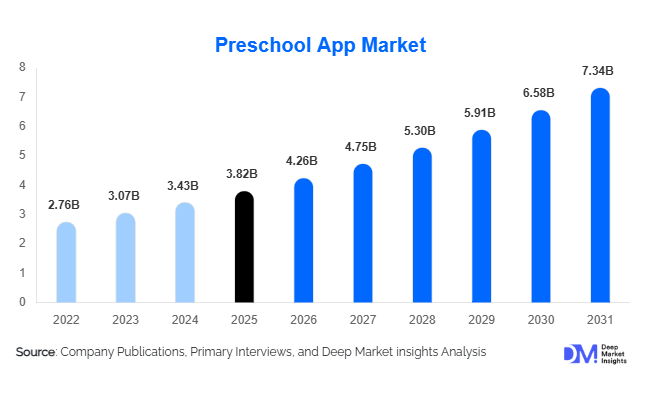
According to Deep Market Insights, the global Preschool App Market was valued at USD 3.82 billion in 2025 and is anticipated to increase from USD 4.26 billion in 2026 to USD 9.94 billion by 2031, registering a CAGR of 11.5% during the forecast period (2026–2031). Market expansion is supported by rising smartphone ownership, increasing internet accessibility, growing investments in educational technology, and greater parental emphasis on interactive early childhood learning. Artificial intelligence, cloud-based content delivery, adaptive learning systems, and multilingual educational modules are enabling application developers to deliver highly personalized learning experiences for preschool children across home and institutional environments.
Key Market Insights
- Artificial intelligence and adaptive learning technologies are improving personalized educational experiences for children aged 2–6 years.
- Subscription-based preschool learning platforms continue gaining popularity through recurring content updates and parental engagement features.
- North America accounted for the largest revenue share in 2025 owing to advanced digital infrastructure and high educational technology adoption.
- Asia-Pacific is projected to witness the fastest expansion supported by rising smartphone penetration and increasing preschool enrollment.
- Home learning remains the leading application segment as parents increasingly adopt digital educational solutions for children.
- Gamification, multilingual content, and cloud synchronization continue transforming the global preschool application ecosystem.
Preschool App Market Trends
Artificial Intelligence Reshaping Early Childhood Learning
Artificial intelligence has become one of the most influential technologies within preschool educational applications. Developers are integrating adaptive learning engines, speech recognition, automated assessments, and personalized lesson recommendations to improve learning efficiency. Interactive storytelling, voice-guided activities, and intelligent progress tracking help children learn at their own pace while enabling parents to monitor development through real-time dashboards. Educational institutions are also incorporating AI-powered applications into classroom learning, increasing engagement and supporting individualized education plans.
Growing Adoption of Gamified Educational Platforms
Gamification continues to improve user engagement by combining educational content with rewards, animations, quizzes, puzzles, and interactive games. Mobile-first learning experiences are encouraging higher daily usage among preschool learners while increasing lesson completion rates. Cloud-based synchronization enables seamless learning across smartphones, tablets, and computers, whereas multilingual educational content allows developers to expand into international markets. These innovations continue strengthening long-term user retention and subscription growth.
Preschool App Market Drivers
Increasing Digital Learning Adoption Among Young Children
Growing access to smartphones, affordable internet connectivity, and digital education initiatives are accelerating preschool application adoption worldwide. Parents increasingly prefer interactive educational applications that support literacy, numeracy, language learning, creativity, and cognitive development before formal schooling begins. Government investments in digital education, expanding preschool enrollment, and rising awareness regarding early childhood development continue creating favorable conditions for market expansion. Educational institutions are also integrating digital learning tools into classroom instruction, further supporting demand.
Growing Investment in Educational Technology
Public and private investments in educational technology continue supporting innovation across preschool applications. Application developers are expanding cloud infrastructure, introducing AI-powered personalization, and developing curriculum-aligned educational content for multiple regions. Collaboration between educational institutions, technology providers, and content developers is resulting in increasingly comprehensive digital learning ecosystems that improve accessibility and learning outcomes.
Preschool App Market Restraints
Privacy Regulations and Screen-Time Concerns
Growing concerns regarding children's online privacy, digital safety, and excessive screen exposure remain significant challenges for preschool application providers. Compliance with child protection regulations requires continuous investment in cybersecurity, parental controls, secure cloud storage, and data governance. Additionally, many parents continue limiting daily screen time, encouraging developers to create balanced learning experiences that prioritize educational quality over prolonged usage.
Highly Competitive Application Marketplace
The educational application ecosystem contains thousands of competing products across major mobile platforms. Continuous content development, frequent software updates, multilingual localization, and curriculum alignment increase operational costs for developers. Smaller companies often face challenges in achieving user acquisition, maintaining subscription retention, and differentiating their applications within increasingly competitive digital marketplaces.
Preschool App Market Opportunities
Expansion Across Emerging Digital Education Markets
Rapid smartphone adoption and expanding broadband infrastructure across Asia-Pacific, Latin America, and parts of the Middle East create significant opportunities for preschool application providers. Affordable subscription pricing, regional language support, and curriculum localization enable companies to serve previously underserved markets while increasing digital learning accessibility among young children.
Integration of Augmented Reality and Interactive Learning
Emerging technologies such as augmented reality, voice interaction, and immersive learning environments are creating new opportunities for application developers. Interactive educational experiences improve engagement while supporting visual learning, creativity, and problem-solving skills. These innovations are expected to strengthen premium subscription offerings and improve long-term customer retention.
Report Scope
| Report Metric | Details |
|---|---|
| Market Size in 2025 | USD 3.82 Billion |
| Market Size in 2026 | USD 4.26 Billion |
| Market Size in 2031 | USD 7.34 Billion |
| CAGR | 11.5% (2026-2031) |
| Base Year for Estimation | 2025 |
| Historical Data | 2022-2024 |
| Forecast Period | 2026-2031 |
| Report Coverage | Revenue Forecast, Competitive Landscape, Supply Chain Disruption, Growth Factors, Environment & Regulatory Landscape and Trends |
| Geographies Covered | North America, Europe, APAC, Middle East and Africa, LATAM |
| Countries Covered | U.S., Canada, U.K., Germany, France, Spain, Italy, Russia, Nordic, Benelux, Rest of Europe, China, Korea, Japan, India, Australia, Singapore, Taiwan, South East Asia, Rest of Asia-Pacific, UAE, Turky, Saudi Arabia, South Africa, Egypt, Nigeria, Rest of MEA, Brazil, Mexico, Argentina, Chile, Colombia, Rest of LATAM |
Explore more data points, trends and opportunities Download Free Sample Report
Type Insights
Learning Apps represent the largest segment of the preschool app market, driven by increasing parental demand for curriculum-aligned digital learning solutions that support early literacy, numeracy, language development, science, and cognitive skill enhancement. The growing emphasis on school readiness, personalized learning experiences, and continuous progress monitoring has encouraged widespread adoption of these applications across both home learning and educational institutions. Many learning apps integrate artificial intelligence, adaptive assessments, cloud synchronization, speech recognition, and interactive multimedia content to deliver customized educational pathways based on individual learning pace. In addition, partnerships between educational technology providers and schools are expanding the availability of curriculum-based digital resources, further strengthening the leadership of this segment.
Gaming Apps are witnessing strong growth as gamification becomes an increasingly effective approach to improving children's engagement and knowledge retention. These applications combine educational objectives with puzzles, storytelling, quizzes, animated characters, reward systems, and interactive challenges that make learning enjoyable while encouraging consistent participation. Developers are continuously introducing augmented reality features, voice-enabled interactions, and adaptive gaming experiences that enhance creativity, memory development, logical thinking, and problem-solving skills. Growing acceptance of game-based learning among parents and educators, coupled with higher smartphone penetration and affordable mobile internet access, continues to support the expansion of this segment.
Creativity Apps continue gaining popularity as parents and educators increasingly recognize the importance of creative development during early childhood education. These applications offer digital drawing, coloring, painting, music creation, storytelling, animation, and craft-based learning activities that encourage imagination, artistic expression, communication, and fine motor skill development. The integration of interactive design tools, collaborative creative activities, and personalized project portfolios further enhances user engagement. Rising awareness regarding holistic child development and the inclusion of creativity-based learning within preschool curricula are expected to drive steady demand for creativity-focused preschool applications over the forecast period.
Application Insights
Home Learning accounted for the largest share of the preschool app market owing to increasing parental involvement in early childhood education and the growing preference for flexible digital learning environments. Parents are increasingly utilizing preschool applications to supplement classroom education through personalized lesson plans, interactive educational games, progress tracking dashboards, offline accessibility, multilingual content, and AI-driven recommendations. The widespread availability of smartphones, tablets, and affordable internet connectivity has significantly improved accessibility, while subscription-based educational platforms continue providing regularly updated learning materials. The growing emphasis on individualized learning and digital education at home remains the primary driver supporting this segment's market leadership.
Preschools & Daycare Centers represent one of the fastest-growing application segments as educational institutions continue integrating digital learning technologies into classroom instruction. Preschool applications are increasingly used for attendance management, classroom engagement, curriculum delivery, student performance assessment, communication with parents, and collaborative learning activities. The adoption of smart classrooms, interactive digital boards, and cloud-based educational platforms is enabling teachers to deliver personalized instruction while improving administrative efficiency. Government initiatives promoting digital education and institutional investments in educational technology continue accelerating adoption across public and private preschool facilities.
Homeschooling continues to experience steady growth as families increasingly adopt flexible and personalized education models. Preschool applications designed for homeschooling provide structured lesson plans, curriculum-based educational content, interactive assessments, live progress monitoring, and teacher collaboration tools that support independent learning. Cloud-based learning platforms allow parents to access educational resources across multiple devices while maintaining learning continuity. The growing availability of high-quality digital educational content, together with increasing acceptance of alternative learning approaches, is expected to create favorable growth opportunities for this application segment.
Explore more data points, trends and opportunities Download Free Sample Report
Preschool App Market Segmentations
By Type
- Learning Apps
- Gaming Apps
- Creativity Apps
By Application
- Home Learning
- Preschools & Daycare Centers
- Homeschooling
Regional Insights
North America
North America continues to dominate the global preschool app market due to its highly developed digital ecosystem, widespread smartphone and tablet ownership, advanced internet infrastructure, and strong consumer spending on educational technology. The United States accounts for the largest regional revenue share, supported by the presence of leading educational technology companies, well-established subscription-based learning platforms, and continuous innovation in artificial intelligence-powered educational applications. High awareness among parents regarding early childhood development, increasing adoption of blended learning models, and extensive integration of digital learning tools across preschools and childcare centers continue driving regional market expansion. Government support for digital education initiatives and growing investments in personalized learning technologies further strengthen North America's leadership position.
Europe
Europe maintains a significant share of the preschool app market owing to strong government support for digital education, widespread implementation of multilingual learning programs, and increasing investments in classroom digitalization. Countries including Germany, the United Kingdom, France, the Netherlands, and the Nordic nations continue expanding the use of educational applications within preschool environments to improve learning outcomes and digital literacy from an early age. Regional growth is further supported by stringent educational standards, high internet penetration, increasing demand for curriculum-aligned educational content, and growing adoption of child-safe digital platforms. Continuous collaboration between educational institutions, technology providers, and government organizations is expected to sustain long-term market growth across the region.
Asia-Pacific
Asia-Pacific is projected to register the fastest growth throughout the forecast period, driven by rapid urbanization, rising disposable incomes, expanding smartphone penetration, and increasing government investments in digital education infrastructure. China and India represent the largest regional markets due to their substantial preschool-age populations, while Japan, South Korea, Singapore, and Australia continue adopting advanced educational technologies and AI-powered learning platforms. Rising internet accessibility, increasing parental expenditure on educational applications, growing awareness of early childhood education, and the expansion of affordable subscription-based learning services are creating significant growth opportunities. Continuous improvements in regional digital infrastructure and multilingual educational content are expected to further accelerate adoption across both urban and rural markets.
Latin America
Latin America is gradually emerging as a promising market for preschool applications as smartphone ownership, broadband connectivity, and digital literacy continue improving across the region. Countries such as Brazil, Mexico, Argentina, Chile, and Colombia are witnessing increasing adoption of educational applications supported by expanding investments in educational technology and government-led digital learning initiatives. Regional developers are introducing localized educational content, affordable subscription pricing, and multilingual learning platforms to improve accessibility for families. Growing parental awareness regarding early childhood education, increasing preschool enrollment, and continuous improvements in digital infrastructure are expected to support sustained market expansion across Latin America.
Middle East & Africa
The Middle East & Africa preschool app market is experiencing steady growth supported by ongoing digital transformation initiatives, expanding internet penetration, and increasing government investments in education technology. Gulf Cooperation Council countries, including the United Arab Emirates and Saudi Arabia, continue leading regional adoption through smart education strategies, high smartphone penetration, and significant investments in artificial intelligence and cloud computing infrastructure. Across Africa, improving mobile connectivity, expanding access to affordable smartphones, public-private partnerships promoting digital learning, and international investments in educational technology are gradually improving access to preschool educational applications. Increasing emphasis on digital literacy, educational accessibility, and modern learning methodologies is expected to support long-term regional market development.
Key Players in the Preschool App Market
- Lingokids
- Khan Academy Kids
- ABCmouse
- Duolingo
- Homer Learning
- Sago Mini
- Toca Boca
- Originator Inc.
- Epic Creations Inc.
- PBS KIDS
- Bimi Boo Kids
- RV AppStudios
- Papumba
- StudyPad Inc.
- IDZ Digital Pvt. Ltd.