Card And Board Games Market Size
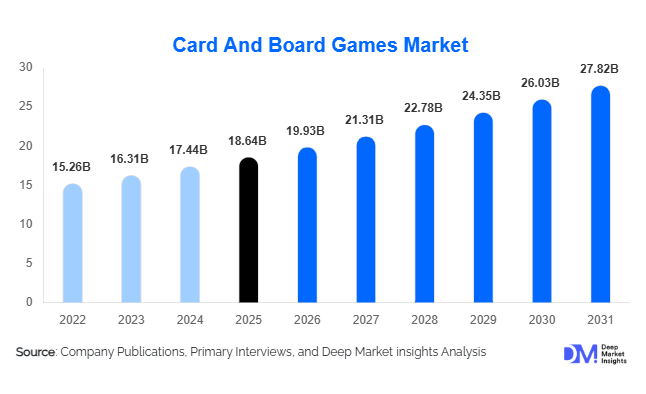
According to Deep Market Insights, the global card and board games market size was valued at USD 18.64 billion in 2025 and is projected to grow from USD 19.93 billion in 2026 to reach USD 27.82 billion by 2031, expanding at a CAGR of 6.9% during the forecast period (2026–2031). The card and board games market growth is driven by the increasing popularity of tabletop entertainment, rising consumer preference for family-oriented recreational activities, expanding collectible card game communities, and growing adoption of educational board games across schools and corporate training programs. The rapid expansion of online retail platforms, premium game editions, and technology-enabled tabletop gaming experiences is further strengthening global market expansion.
Key Market Insights
- Board games account for the largest market share, supported by strong household adoption, family entertainment, and premium strategy game demand.
- Collectible card games represent the fastest-growing product category, fueled by organized tournaments, licensed franchises, and growing global gaming communities.
- North America dominates the global market, driven by high consumer spending, established gaming culture, and a mature specialty retail ecosystem.
- Asia-Pacific is the fastest-growing regional market, supported by rising disposable income, expanding youth populations, and increasing tabletop gaming adoption across China, India, Japan, and South Korea.
- Educational applications continue expanding rapidly, as schools increasingly integrate board games into STEM education, problem-solving, and collaborative learning environments.
- Digital integration is reshaping the industry, with companion mobile applications, augmented reality features, NFC-enabled cards, and online multiplayer support enhancing traditional tabletop gaming experiences.
Card And Board Games Market Trends
Technology-Integrated Tabletop Gaming Experiences
Manufacturers are increasingly combining physical gameplay with digital technologies to create more immersive consumer experiences. Companion mobile applications, augmented reality gameplay, artificial intelligence-assisted tutorials, and NFC-enabled cards are becoming common across premium product portfolios. Digital scoring systems, online campaign synchronization, and virtual multiplayer support allow players to extend traditional tabletop experiences beyond physical gameplay. These innovations are particularly appealing to younger consumers who expect connected entertainment experiences while maintaining the social interaction that distinguishes tabletop gaming from digital-only alternatives.
Growing Demand for Premium and Sustainable Games
Consumer demand for premium-quality board games featuring wooden components, deluxe miniatures, metal coins, and collector's editions continues to accelerate worldwide. At the same time, manufacturers are increasing investments in sustainable production by utilizing recycled paperboard, FSC-certified packaging, soy-based inks, and environmentally responsible manufacturing processes. Premium game collections, limited-edition releases, and licensed entertainment franchises are driving higher average selling prices while strengthening customer loyalty among enthusiasts and collectors across both developed and emerging markets.
Card And Board Games Market Drivers
Growing Popularity of Social and Family Entertainment
Increasing consumer preference for screen-free recreational activities continues to support market expansion. Families are spending more on interactive entertainment that encourages communication, strategic thinking, and collaborative gameplay. The rapid growth of tabletop gaming cafés, organized tournaments, hobby communities, and social gaming events has significantly increased participation among both casual and competitive players. Educational institutions and corporate organizations are also adopting board games for leadership development, team building, and cognitive skill enhancement, creating sustained long-term demand across multiple end-user segments.
Expansion of Licensed and Collectible Gaming Franchises
The success of licensed entertainment properties has created substantial opportunities for publishers to introduce collectible card games and premium board games based on popular movies, television series, anime, comics, and video games. Limited-edition releases, expansion packs, and tournament-supported collectible ecosystems encourage repeat purchases while increasing customer engagement. Strategic partnerships between entertainment companies and tabletop game publishers continue to expand product portfolios and strengthen global consumer interest.
Card And Board Games Market Restraints
Competition from Digital Gaming Platforms
The rapid expansion of mobile gaming, console gaming, and online multiplayer entertainment presents significant competition for traditional tabletop games. Younger consumers increasingly allocate discretionary spending toward digital subscriptions and downloadable content rather than physical gaming products. In addition, rising raw material costs, higher transportation expenses, and fluctuations in paperboard and printing prices continue to pressure manufacturing margins, particularly for small and medium-sized publishers operating in highly competitive markets.
Counterfeit Products and Supply Chain Challenges
The increasing circulation of counterfeit board games and unauthorized trading cards affects brand reputation and reduces revenue for established manufacturers. Supply chain disruptions, shipping delays, semiconductor shortages affecting electronic game accessories, and rising international freight costs also create inventory management challenges. Maintaining consistent product quality while protecting intellectual property remains a major operational priority across the global tabletop gaming industry.
Card And Board Games Market Opportunities
Expansion Across Educational and Corporate Learning
Educational institutions are increasingly incorporating board games into classroom learning to improve problem-solving, teamwork, mathematics, language development, and critical thinking. Corporate organizations are also adopting strategy-based tabletop games for leadership development, communication training, and employee engagement programs. These expanding applications diversify revenue opportunities beyond traditional consumer entertainment while creating recurring institutional demand.
Growth of Direct-to-Consumer Sales Channels
The rapid expansion of e-commerce platforms, crowdfunding campaigns, subscription boxes, and direct-to-consumer online stores enables publishers to launch new products with lower distribution costs while reaching global audiences. Crowdfunding platforms have become particularly important for independent designers, allowing innovative game concepts to secure funding before production while building highly engaged consumer communities that support long-term brand growth.
Report Scope
| Report Metric | Details |
|---|---|
| Market Size in 2025 | USD 18.64 Billion |
| Market Size in 2026 | USD 19.93 Billion |
| Market Size in 2031 | USD 27.82 Billion |
| CAGR | 6.9% (2026-2031) |
| Base Year for Estimation | 2025 |
| Historical Data | 2022-2024 |
| Forecast Period | 2026-2031 |
| Report Coverage | Revenue Forecast, Competitive Landscape, Supply Chain Disruption, Growth Factors, Environment & Regulatory Landscape and Trends |
| Geographies Covered | North America, Europe, APAC, Middle East and Africa, LATAM |
| Countries Covered | U.S., Canada, U.K., Germany, France, Spain, Italy, Russia, Nordic, Benelux, Rest of Europe, China, Korea, Japan, India, Australia, Singapore, Taiwan, South East Asia, Rest of Asia-Pacific, UAE, Turky, Saudi Arabia, South Africa, Egypt, Nigeria, Rest of MEA, Brazil, Mexico, Argentina, Chile, Colombia, Rest of LATAM |
Explore more data points, trends and opportunities Download Free Sample Report
Product Type Insights
Board games represent the largest product segment, driven by increasing demand for family entertainment, cooperative gameplay, and premium strategy titles across households worldwide. Traditional board games continue to dominate retail sales, while modern eurogames, miniature games, and cooperative campaigns are expanding rapidly among hobby gamers. Card games maintain strong consumer demand through classic playing cards, educational games, and party games that offer affordability and portability. Collectible card games represent the fastest-growing category, supported by organized tournaments, expansion packs, licensed intellectual properties, and active secondary trading markets that encourage continuous consumer engagement and repeat purchasing behavior.
Application Insights
Household applications account for the largest share of global demand, supported by family recreation, holiday gifting, and increasing interest in offline social entertainment. Commercial applications continue expanding through gaming cafés, hotels, libraries, entertainment centers, and hobby stores that organize tournaments and community events. Educational institutions increasingly utilize board games for classroom learning, cognitive development, STEM education, language instruction, and collaborative problem-solving. Corporate organizations also represent an emerging application segment by incorporating tabletop games into employee training, leadership workshops, and team-building activities.
Distribution Channel Insights
Online retail platforms dominate global distribution as consumers increasingly purchase games through e-commerce marketplaces, publisher websites, and crowdfunding platforms. Specialty hobby stores remain important for premium board games, collectible card games, and tournament-supported products by providing demonstrations, organized events, and expert recommendations. Mass merchandise retailers continue generating substantial sales through family games, educational products, and seasonal gift purchases. Direct-to-consumer channels are expanding rapidly as publishers strengthen digital marketing, subscription services, and exclusive online product launches.
End User Insights
Families remain the largest consumer group, driven by increasing demand for interactive entertainment that promotes communication and collaborative gameplay. Hobby gamers represent a rapidly growing segment characterized by premium purchases, expansion pack collections, and participation in organized tournaments. Educational users continue expanding through classroom learning and institutional procurement, while corporate organizations increasingly adopt strategy games for professional development and employee engagement initiatives. Collectors also contribute significantly to premium product demand through limited editions and licensed franchise products.
Age Group Insights
Consumers aged 18–35 years account for the largest share of organized tabletop gaming participation, supported by hobby communities, strategy gaming, and collectible card tournaments. Children remain a major consumer base for educational and family-oriented games that support cognitive development and social interaction. Adults aged 36–55 years continue driving household purchases through family entertainment and premium board game collections, while senior consumers increasingly adopt tabletop games for cognitive stimulation, recreational engagement, and social interaction within community groups.
Explore more data points, trends and opportunities Download Free Sample Report
Card And Board Games Market Segmentations
By Product Type
- Card Games
- Board Games
- Collectible Card Games
By Application
- Household
- Commercial
- Educational
By Distribution Channel
- Online Retail
- Specialty Hobby Stores
- Mass Merchandise Retailers
- Direct-to-Consumer
Regional Insights
North America
North America represents the largest regional market for card and board games, supported by strong consumer spending, well-established tabletop gaming culture, and an extensive network of specialty hobby retailers. The United States accounts for the majority of regional demand, driven by organized gaming conventions, collectible card tournaments, crowdfunding success, and premium board game adoption. Canada also contributes significantly through expanding educational applications and family-oriented entertainment spending.
Europe
Europe remains a mature and innovation-driven market led by Germany, the United Kingdom, France, Italy, and Spain. Germany continues to serve as a global hub for board game development and publishing, supported by internationally recognized gaming exhibitions and award programs. Consumer preference for strategic gameplay, educational products, and environmentally sustainable manufacturing practices continues strengthening regional market performance.
Asia-Pacific
Asia-Pacific is the fastest-growing regional market due to expanding middle-class populations, rising disposable incomes, and increasing popularity of tabletop gaming communities across China, Japan, India, South Korea, and Australia. Licensed anime and entertainment franchises continue driving collectible card game sales, while online retail expansion improves product accessibility throughout emerging markets. Educational gaming adoption is also increasing rapidly across schools and learning centers.
Latin America
Latin America continues to experience steady market expansion supported by improving retail infrastructure, increasing youth participation in tabletop gaming, and growing demand for affordable family entertainment. Brazil, Mexico, Argentina, and Chile remain the leading regional markets, with publishers expanding localized product offerings and strengthening online distribution networks to improve accessibility.
Middle East & Africa
The Middle East & Africa market is gradually expanding as disposable incomes increase and organized gaming communities continue developing across the UAE, Saudi Arabia, South Africa, and Egypt. Premium imports, educational gaming initiatives, and growing consumer awareness of tabletop entertainment support regional demand. The expansion of specialty retailers and international gaming events is expected to further strengthen long-term market development.
Key Players in the Card And Board Games Market
- Hasbro Inc.
- Mattel Inc.
- Ravensburger AG
- Asmodee Group
- Spin Master Corp.
- The Pokémon Company
- Konami Group Corporation
- Bandai Co., Ltd.
- CMON Limited
- Goliath Games
- Cartamundi Group
- Buffalo Games LLC
- University Games Corporation
- Exploding Kittens Inc.
- Winning Moves Games