Plastic Model Kits Market Size
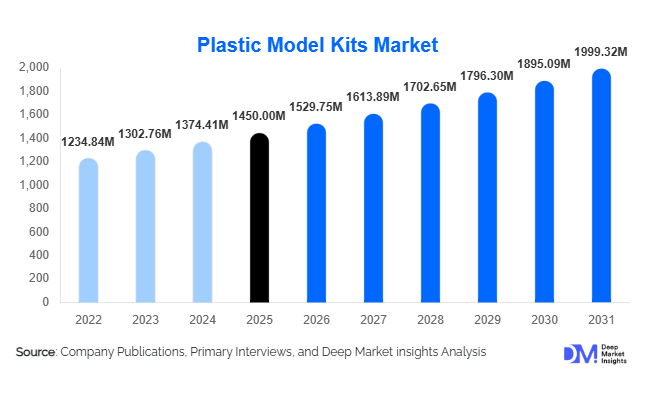
According to Deep Market Insights, the global plastic model kits market was valued at approximately USD 1,450 million in 2025 and is projected to grow from around USD 1,529.75 million in 2026 to reach nearly USD 1,999.32 million by 2031, expanding at a CAGR of 5.5% during the forecast period (2026–2031). The market growth is driven by the rising popularity of hobby-based leisure activities, the increasing influence of pop culture franchises such as anime, films, and gaming, and the growing penetration of e-commerce platforms that have made niche collectible products globally accessible. Additionally, advancements in snap-fit technologies, precision molding, and pre-colored kits are lowering entry barriers for beginners while expanding the premium collector segment. The resurgence of analog hobbies among adults seeking stress-relief and creative engagement is also significantly contributing to demand across developed economies, while Asia-Pacific continues to emerge as both a manufacturing and consumption hub.
Key Market Insights
- Pop culture licensing is a major growth engine, with anime, sci-fi, and military franchises driving premium collectible demand globally.
- Asia-Pacific dominates production and consumption, supported by strong manufacturing ecosystems in Japan, China, and South Korea.
- E-commerce channels account for the largest distribution share, enabling global access to niche hobby products.
- Beginner-friendly snap-fit kits are expanding the consumer base, attracting younger and first-time hobbyists.
- Collector-grade and premium kits are driving profitability, with strong demand from enthusiasts and adult hobbyists.
- Educational adoption is rising, with model kits increasingly used in STEM learning and engineering visualization.
Plastic Model Kits Market Trends
Pop Culture and Licensed Model Ecosystems Expanding
One of the most influential trends shaping the market is the rapid expansion of licensed model kit ecosystems tied to entertainment franchises. Anime-based models, military IP collaborations, and film-inspired collectibles are becoming central to product development strategies. These licensed kits allow manufacturers to command higher price points while building long-term brand loyalty. Companies are increasingly investing in exclusive rights agreements, limited-edition releases, and character-driven product lines that generate repeat purchases among collectors. The integration of storytelling with physical model building is strengthening emotional engagement and driving sustained demand.
Digital Integration and Smart Hobby Experiences
The market is also witnessing growing adoption of digital tools that enhance the model-building experience. Augmented reality assembly guides, mobile-based instruction apps, and 3D visualization tools are helping reduce complexity for beginners. Some manufacturers are experimenting with digital customization platforms where users can modify designs before production. E-commerce platforms are also integrating recommendation engines and community review systems, improving purchase confidence. This blend of physical craftsmanship and digital support is making model kits more accessible to younger, tech-savvy consumers.
Plastic Model Kits Market Drivers
Rising Global Hobby and Collector Culture
The growing global shift toward hobby-based leisure activities is a major driver of the plastic model kits market. Adults aged 25–45 are increasingly engaging in model building as a stress-relief and creative activity. The rise of collector culture, particularly in North America, Europe, and Japan, has strengthened demand for high-detail and premium kits. This demographic is also willing to spend on advanced kits, tools, and customization accessories, significantly boosting overall market value.
Expansion of Pop Culture Influence
Global popularity of anime, gaming franchises, and cinematic universes is fueling sustained demand for character-based and themed model kits. These franchises create continuous product cycles, with new releases tied to seasonal content and media launches. This ensures recurring demand and strong consumer engagement across different age groups.
Growth of E-Commerce Distribution Channels
The expansion of online retail platforms has significantly improved global accessibility to niche hobby products. Consumers can now access international brands, limited editions, and specialty kits without geographical restrictions. Direct-to-consumer models are also improving manufacturer margins while strengthening brand loyalty.
Plastic Model Kits Market Restraints
High Skill Requirement and Entry Barriers
Advanced model kits often require technical skills such as painting, gluing, and assembly precision, which can discourage new entrants. Although snap-fit kits are reducing this barrier, the complexity of premium kits still limits mass-market adoption among casual users.
Raw Material Price Volatility
The market is highly dependent on petrochemical-based materials such as polystyrene and ABS plastics. Fluctuations in raw material prices directly impact production costs and retail pricing, creating margin pressure for manufacturers and reducing affordability in price-sensitive markets.
Plastic Model Kits Market Opportunities
Expansion in Emerging Markets
Rising disposable incomes in countries such as India, Brazil, and Southeast Asian nations are opening new consumer bases for hobby products. Increasing exposure to global pop culture through streaming platforms and social media is further accelerating demand in these regions.
STEM Education and Institutional Adoption
Educational institutions are increasingly adopting model kits for teaching engineering, architecture, and physics concepts. This creates a stable institutional demand stream beyond traditional hobbyist markets and strengthens long-term growth potential.
Premiumization and Customization Trends
Manufacturers are increasingly focusing on premium collector editions, modular kits, and customizable components. These innovations allow higher pricing flexibility and improved consumer engagement, especially among advanced hobbyists seeking unique builds.
Report Scope
| Report Metric | Details |
|---|---|
| Market Size in 2025 | USD 1450 Million |
| Market Size in 2026 | USD 1529.75 Million |
| Market Size in 2031 | USD 1999.32 Million |
| CAGR | 5.5% (2026-2031) |
| Base Year for Estimation | 2025 |
| Historical Data | 2022-2024 |
| Forecast Period | 2026-2031 |
| Report Coverage | Revenue Forecast, Competitive Landscape, Supply Chain Disruption, Growth Factors, Environment & Regulatory Landscape and Trends |
| Geographies Covered | North America, Europe, APAC, Middle East and Africa, LATAM |
| Countries Covered | U.S., Canada, U.K., Germany, France, Spain, Italy, Russia, Nordic, Benelux, Rest of Europe, China, Korea, Japan, India, Australia, Singapore, Taiwan, South East Asia, Rest of Asia-Pacific, UAE, Turky, Saudi Arabia, South Africa, Egypt, Nigeria, Rest of MEA, Brazil, Mexico, Argentina, Chile, Colombia, Rest of LATAM |
Explore more data points, trends and opportunities Download Free Sample Report
Product Type Insights
Aircraft model kits remain one of the dominant product categories, accounting for approximately 22% of the global market in 2025. This leadership is driven by a strong base of military modeling enthusiasts, aviation history collectors, and museum-quality diorama builders. The segment benefits from long-standing global interest in WWII and modern aviation replicas, as well as continuous product innovation in high-detail scaling and authentic design accuracy. Rising disposable income among hobbyists and increasing availability of licensed military and aviation IPs further reinforce demand for premium aircraft kits.
Military vehicle kits also hold a significant market share, supported by strong collector communities and demand for highly detailed armored vehicle replicas. Automotive model kits are witnessing accelerating growth, driven by global car culture, motorsports fandom, and collaborations with automotive brands producing licensed replicas of iconic vehicles. Figure and character kits, particularly anime and sci-fi-based models, represent the fastest-growing product category, fueled by the global expansion of pop culture ecosystems, streaming platforms, and fandom-driven collectibles markets. Ship and naval kits continue to maintain steady demand among traditional hobbyists, while architectural and building kits are gaining relevance in educational institutions and professional visualization applications.
The expansion of licensed intellectual property (IP)-driven product ecosystems is the primary driver for this segment. Increasing collaboration between model manufacturers and entertainment franchises (anime, film, automotive, and gaming) is enabling premium pricing, repeat purchases, and strong collector retention. Additionally, technological improvements in snap-fit engineering and pre-colored components are significantly lowering entry barriers, expanding the consumer base beyond advanced hobbyists to beginners and younger users globally.
Application Insights
Individual hobbyists and collectors dominate global demand, accounting for the majority share of the plastic model kits market. This dominance is driven by strong consumer enthusiasm for hands-on creative hobbies, rising adult participation in model building, and increasing disposable income allocated toward leisure and collectible investments. The segment benefits significantly from community engagement, online forums, and social media platforms that encourage sharing of completed models and customization techniques.
Educational applications are steadily expanding as schools, universities, and technical institutes integrate model kits into STEM-focused learning programs. These kits are widely used to demonstrate engineering concepts, structural mechanics, aerodynamics, and architectural design principles, making them a valuable experiential learning tool. Commercial applications, including film studios, museums, and industrial prototyping firms, represent a niche but high-value segment. These users rely on model kits for concept visualization, set design prototyping, and large-scale diorama development, contributing to premium demand within the market.
The rising adoption of experiential and skill-based learning methodologies is a major growth driver. Increasing integration of model kits in STEM education systems globally is expanding institutional demand. Simultaneously, the growth of digital fatigue among consumers is pushing adults toward tactile, screen-free creative activities, significantly boosting hobbyist participation across all age groups.
Distribution Channel Insights
Online e-commerce platforms dominate the distribution landscape, accounting for the largest share of global sales due to unmatched accessibility, wide product availability, and competitive pricing structures. Global marketplaces and niche hobby platforms have significantly reduced geographical barriers, allowing consumers to access specialized and imported model kits easily. This has particularly benefited niche and premium brands that previously relied on limited regional distribution networks.
Specialty hobby stores continue to maintain relevance, especially for premium product sales, expert guidance, and community engagement activities such as workshops and model-building events. Direct-to-consumer (DTC) brand websites are rapidly gaining traction as manufacturers focus on margin optimization, brand control, and exclusive product launches. Additionally, social media platforms and influencer-driven marketing strategies are becoming increasingly important discovery channels, particularly among younger demographics entering the hobby ecosystem for the first time.
The rapid globalization of e-commerce infrastructure is the primary driver of distribution growth. Improved cross-border logistics, digital payment adoption, and algorithm-driven product recommendations are significantly enhancing product visibility and conversion rates. The rise of niche hobby communities online is also strengthening repeat purchases and brand loyalty, particularly for collectible and limited-edition kits.
Explore more data points, trends and opportunities Download Free Sample Report
Plastic Model Kits Market Segmentations
By Product Type
- Aircraft Model Kits
- Military Vehicle Model Kits
- Automotive Model Kits
- Ship & Naval Model Kits
- Figure & Character Kits
- Architectural & Building Model Kits
- Diorama & Accessory Kits
By Material Type
- Polystyrene Plastic Kits
- Resin-Based Premium Kits
- ABS Plastic Kits
- PVC Hybrid Kits
- Composite / Multi-Material Kits
By Skill Level
- Beginner / Snap-Fit Kits
- Intermediate Kits
- Advanced / Collector-Grade Kits
By Application
- Individual Hobbyists & Collectors
- Educational Institutions
- Commercial Use
By Distribution Channel
- Online E-commerce Platforms
- Specialty Hobby Stores
- Direct-to-Consumer Brand Websites
- Licensed Pop Culture Retail Outlets
Regional Insights
Asia-Pacific
Asia-Pacific is the leading region in the global plastic model kits market, supported by strong manufacturing ecosystems and high consumer demand in Japan, China, and South Korea. Japan remains the global innovation hub, particularly for anime-based and high-precision model kits, while China serves as both a dominant manufacturing base and a rapidly expanding consumer market. South Korea is experiencing strong growth driven by pop culture exports and rising collector communities.
Regional Growth Drivers: The dominance of anime and pop culture franchises, combined with strong domestic manufacturing capabilities and rising disposable incomes, is fueling sustained market expansion. Increasing influence of gaming culture, digital entertainment, and collectible-based consumer behavior is further accelerating demand. Government support for advanced manufacturing and export-oriented industries also strengthens the regional supply chain.
North America
North America, led by the United States, represents a major consumption-driven market supported by strong hobbyist culture, high disposable income, and well-established collector communities. Military modeling, automotive replicas, and pop culture character kits are particularly popular in this region. The market is also supported by strong retail infrastructure and advanced e-commerce penetration.
Regional Growth Drivers: Rising interest in nostalgia-driven hobbies, increasing engagement in DIY creative activities, and strong influence of entertainment franchises (movies, comics, gaming) are key growth factors. The expansion of online hobby communities and subscription-based collectible models is also contributing to sustained market growth.
Europe
Europe demonstrates stable and mature demand, led by Germany, the United Kingdom, and France. Germany dominates technical and automotive modeling segments, while the UK benefits from a strong legacy hobby culture supported by established brands and specialty retail networks. France contributes significantly through historical and military modeling interest.
Regional Growth Drivers: Strong preference for historically accurate and premium-quality models is a major driver in Europe. Increasing adoption of sustainable and eco-friendly materials in manufacturing is also influencing purchasing decisions. Additionally, rising interest in heritage preservation and museum-grade modeling is supporting long-term market stability.
Latin America
Latin America is an emerging market with growing interest in hobby-based and collectible activities, particularly in Brazil, Argentina, and Mexico. Demand is primarily driven by younger consumers influenced by global entertainment content, anime culture, and online communities. Import-based availability remains a key factor in market development.
Regional Growth Drivers: Increasing exposure to global pop culture through streaming platforms, rising middle-class income levels, and expanding e-commerce penetration are driving growth. Growing youth engagement in creative hobbies and collectible culture is also contributing to market expansion.
Middle East & Africa
The Middle East & Africa region is in the early stages of adoption but shows strong potential, particularly in affluent markets such as the UAE, Saudi Arabia, and South Africa. Demand is primarily supported by rising luxury consumption patterns and increasing availability of imported hobby products through global distribution networks.
Regional Growth Drivers: Growing interest in premium collectibles among high-income consumers, expansion of retail diversification strategies, and rising tourism-driven retail exposure are key drivers. Additionally, increasing youth population and digital engagement are gradually supporting awareness and adoption of hobby-based products in the region.
Key Players in the Plastic Model Kits Market
- Bandai Namco
- Tamiya
- Revell
- Airfix
- Hasegawa
- Hobby Boss
- Trumpeter
- Zvezda
- Academy Plastic Model
- Dragon Models
- Italeri