Comic Book Market Size
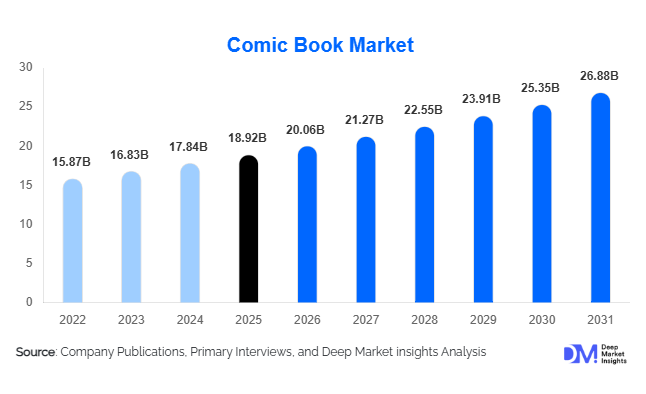
According to Deep Market Insights, the global comic book market was valued at USD 18.92 billion in 2025 and is projected to grow from USD 20.06 billion in 2026 to reach USD 26.88 billion by 2031, expanding at a CAGR of 6.03% during the forecast period (2026–2031). The comic book market growth is driven by the increasing popularity of superhero franchises, expanding global demand for manga and graphic novels, rapid digital comic adoption, growing collector interest in premium editions, and continuous investments by publishers in licensed intellectual properties. The integration of comic books with streaming platforms, gaming ecosystems, and merchandising businesses continues to strengthen long-term industry expansion.
Key Market Insights
- Physical comic books continue to dominate global revenue, supported by strong collector demand, retail distribution, and premium special editions.
- Digital comic books represent the fastest-growing segment, driven by subscription platforms, smartphone penetration, and multilingual digital publishing.
- North America dominates the global market, led by the United States through strong superhero franchises, established publishers, and extensive retail networks.
- Asia-Pacific is the fastest-growing regional market, fueled by expanding manga readership, mobile-first digital consumption, and increasing entertainment spending.
- Licensed intellectual properties account for a majority of global comic sales, with superhero, anime, gaming, and movie franchises driving consumer purchases worldwide.
- Technological advancements, including AI-powered translation, cloud-based digital publishing, interactive reading platforms, and subscription ecosystems, are transforming consumer engagement across the industry.
Comic Book Market Trends
Digital Comics Continue Transforming Consumer Reading Habits
Digital publishing has become one of the strongest growth drivers within the comic book industry. Consumers increasingly prefer reading comics through smartphones, tablets, and cloud-based subscription services that provide instant access to thousands of titles. Publishers are investing heavily in digital-first releases, simultaneous multilingual launches, AI-assisted translation, and subscription-based business models to expand international readership. Digital platforms also enable independent creators to reach global audiences without relying on traditional print distribution, significantly lowering publishing costs while increasing accessibility. Interactive reading experiences, cloud synchronization, offline downloads, and personalized recommendations are further improving customer engagement, particularly among younger demographics that increasingly consume entertainment through digital ecosystems.
Premium Collectibles and Licensed Franchises Continue Expanding
Collectible comic books remain one of the highest-value segments of the publishing industry. Limited editions, anniversary releases, variant covers, graded collectibles, signed issues, and premium hardcover collections continue attracting dedicated collectors and investors. Entertainment franchises from superhero universes, anime series, movies, streaming platforms, and gaming publishers are creating sustained demand for licensed comic books worldwide. Publishers are increasingly launching exclusive retailer editions, convention-exclusive releases, foil covers, and premium collector boxes to maximize consumer spending. The growing secondary resale market, supported by grading services and online auction platforms, further strengthens demand for high-value collectible comic books.
Comic Book Market Drivers
Growing Popularity of Entertainment Franchises
Global expansion of cinematic universes, streaming adaptations, anime productions, and gaming franchises continues driving comic book sales across both physical and digital formats. Every successful film or television adaptation significantly increases demand for original comic storylines, graphic novels, and collector editions. Publishers are strengthening partnerships with entertainment companies to develop cross-platform intellectual properties that generate revenue through publishing, licensing, merchandising, gaming, and digital subscriptions. Younger consumers are increasingly discovering comic books through movies and streaming services before transitioning into long-term readers, creating sustained commercial opportunities for publishers worldwide.
Growing Consumer Interest in Graphic Storytelling
Readers increasingly prefer visually engaging storytelling that combines literature with high-quality artwork. Graphic novels have become popular among both adults and younger readers due to their accessibility, educational value, and diverse storytelling formats. Educational institutions and libraries are expanding graphic novel collections to encourage literacy among younger audiences. Independent creators are also introducing original content covering history, science fiction, fantasy, romance, and social issues, broadening comic readership beyond traditional superhero genres and attracting entirely new consumer demographics.
Comic Book Market Restraints
Increasing Printing and Distribution Costs
Rising paper prices, printing expenses, labor costs, and international logistics continue challenging profit margins for publishers. Smaller independent publishers are particularly affected by higher production costs, making it difficult to compete with established global publishing houses. Inflation has also increased retail pricing, reducing affordability for price-sensitive consumers. Supply chain disruptions occasionally delay product launches, affecting retailer inventories and limiting sales opportunities during peak demand periods.
Digital Piracy and Unauthorized Content Distribution
Illegal digital distribution remains a major challenge for comic book publishers. Unauthorized scanning, file sharing, and piracy websites reduce legitimate sales while impacting revenue generated from premium digital subscriptions. Publishers continue investing in digital rights management technologies, copyright enforcement, watermarking systems, and subscription-based distribution models to minimize unauthorized content circulation. Despite these efforts, piracy continues affecting monetization, particularly in emerging digital markets where enforcement remains inconsistent.
Comic Book Market Opportunities
Expansion of Subscription-Based Digital Platforms
Subscription services present significant long-term growth opportunities by providing consumers with affordable access to extensive digital comic libraries. Monthly subscription models improve customer retention while generating recurring revenue for publishers. Cloud-based reading platforms also enable publishers to analyze consumer preferences using data analytics, allowing personalized recommendations and targeted content development. As smartphone penetration continues increasing worldwide, subscription-based digital ecosystems are expected to become a major revenue contributor throughout the forecast period.
Growing Demand Across Emerging Markets
Emerging economies throughout Asia-Pacific, Latin America, the Middle East, and Africa present attractive expansion opportunities due to rising internet penetration, increasing disposable incomes, expanding youth populations, and growing demand for digital entertainment. Local-language publishing, regional creators, educational graphic novels, and affordable digital subscriptions are helping publishers establish stronger positions within these high-growth markets. Government initiatives promoting reading culture and educational publishing further support future comic book industry expansion.
Report Scope
| Report Metric | Details |
|---|---|
| Market Size in 2025 | USD 18.92 Billion |
| Market Size in 2026 | USD 20.06 Billion |
| Market Size in 2031 | USD 26.88 Billion |
| CAGR | 6.03% (2026-2031) |
| Base Year for Estimation | 2025 |
| Historical Data | 2022-2024 |
| Forecast Period | 2026-2031 |
| Report Coverage | Revenue Forecast, Competitive Landscape, Supply Chain Disruption, Growth Factors, Environment & Regulatory Landscape and Trends |
| Geographies Covered | North America, Europe, APAC, Middle East and Africa, LATAM |
| Countries Covered | U.S., Canada, U.K., Germany, France, Spain, Italy, Russia, Nordic, Benelux, Rest of Europe, China, Korea, Japan, India, Australia, Singapore, Taiwan, South East Asia, Rest of Asia-Pacific, UAE, Turky, Saudi Arabia, South Africa, Egypt, Nigeria, Rest of MEA, Brazil, Mexico, Argentina, Chile, Colombia, Rest of LATAM |
Explore more data points, trends and opportunities Download Free Sample Report
Product Type Insights
Physical comic books accounted for the largest share of the global comic book market in 2025, supported by strong demand from collectors, hobbyists, comic specialty stores, bookstores, and libraries. Traditional single-issue comics continue to generate substantial revenue through monthly releases, while trade paperbacks, hardcover collections, omnibus editions, and deluxe collector versions have expanded publisher profitability. Premium variant covers, limited-edition print runs, signed copies, and professionally graded comics are attracting both enthusiasts and investment-focused buyers. Comic conventions and exclusive retailer editions further stimulate demand for physical publications, particularly among established franchises such as superhero, fantasy, horror, science fiction, and manga series.
Digital comic books represent the fastest-growing product category as readers increasingly consume content through smartphones, tablets, e-readers, and subscription-based applications. Publishers are investing heavily in cloud libraries, AI-powered recommendations, multilingual localization, offline reading capabilities, and simultaneous global releases. Subscription platforms provide readers with access to thousands of titles through affordable monthly plans while reducing publishing and distribution costs. Independent creators are also benefiting from digital-first publishing models that eliminate printing expenses and provide direct access to international audiences.
Collectible and Special Editions continue to generate premium revenue despite relatively lower sales volumes. Anniversary editions, foil covers, retailer-exclusive variants, convention-exclusive releases, artist signature editions, numbered print runs, and professionally graded collectibles command significantly higher average selling prices than standard issues. Increasing participation from investors and collectors, combined with the growth of online auction platforms and grading services, continues strengthening this premium segment.
Application Insights
Retail and Bookstores remain the largest application segment due to widespread availability through comic specialty stores, bookstores, supermarkets, and entertainment retailers. Specialty comic shops continue serving dedicated collectors by offering subscription pull lists, exclusive merchandise, limited editions, and community events. Large bookstore chains increasingly dedicate shelf space to graphic novels, manga, and young adult comics, expanding mainstream readership across multiple age groups.
Online Platforms have become one of the fastest-growing application areas owing to increasing consumer preference for digital content. Subscription-based reading platforms, publisher-owned applications, mobile marketplaces, and digital bookstores provide instant access to thousands of comic titles. AI-powered recommendation engines, personalized reading libraries, multilingual content, and synchronized cloud storage improve user experience while increasing customer retention. Online platforms have also enabled independent creators to commercialize original content through direct-to-consumer business models.
Libraries and Educational Institutions continue expanding their adoption of graphic novels and educational comics to improve literacy, visual learning, and student engagement. Schools increasingly integrate graphic literature into reading programs, while universities use comics for subjects including history, literature, science, psychology, and social studies. Educational publishers are also producing curriculum-focused graphic content designed specifically for classroom learning.
Distribution Channel Insights
Offline retail channels continue to dominate overall physical comic sales through comic specialty stores, bookstores, department stores, supermarkets, and entertainment retailers. Comic conventions and exclusive retailer launches remain important sales channels for premium editions, signed copies, and limited collector releases. Many publishers continue supporting brick-and-mortar retailers through exclusive cover variants and promotional campaigns that encourage in-store purchases.
Online distribution channels continue experiencing rapid expansion through publisher websites, subscription services, digital marketplaces, mobile applications, and e-commerce platforms. Consumers benefit from immediate purchases, digital downloads, subscription bundles, automatic updates, and personalized recommendations. Publishers increasingly utilize online channels to improve global accessibility while reducing inventory and logistics costs.
Reader Type Insights
Adult readers account for the largest proportion of comic book revenue owing to higher disposable incomes, collector purchasing behavior, and growing interest in graphic novels, mature storytelling, horror, science fiction, crime, and fantasy genres. Many adult consumers also participate actively in collectible comic investments, convention attendance, and premium merchandise purchases, contributing significantly to overall market revenue.
Teen readers represent one of the fastest-growing consumer groups due to expanding popularity of manga, superhero universes, anime adaptations, gaming franchises, and webcomics. Digital reading applications and social media communities have significantly increased engagement among younger readers, while publishers continue introducing youth-oriented titles with diverse storytelling themes. Children remain an important consumer segment supported by educational comics, illustrated storytelling, licensed cartoon characters, and age-appropriate graphic novels. Parents and educational institutions increasingly recognize comics as valuable educational tools that encourage reading habits while improving comprehension through visual storytelling.
Format Insights
Single-Issue Comics continue representing the foundation of the publishing industry by delivering regular monthly content that maintains reader engagement and supports franchise continuity. Publishers utilize ongoing issue releases to introduce new characters, storylines, and crossover events that later expand into collected editions and multimedia adaptations. Graphic Novels and Trade Paperbacks have experienced substantial commercial growth as consumers increasingly prefer complete story arcs in a single volume. Bookstores, educational institutions, and libraries continue driving demand for graphic novels because they offer improved durability, easier cataloging, and broader literary appeal. This format has significantly expanded comic readership beyond traditional collectors by attracting mainstream consumers interested in complete narratives.
Explore more data points, trends and opportunities Download Free Sample Report
Comic Book Market Segmentations
By Product Type
- Physical Comic Books
- Digital Comic Books
- Collectible & Special Editions
By Application
- Retail & Bookstores
- Online Platforms
- Libraries & Educational Institutions
By Distribution Channel
- Comic Specialty Stores
- Bookstores
- Online Retail
- Digital Subscription Platforms
- Direct Publisher Sales
Regional Insights
North America
North America remains the dominant regional market for comic books, supported by globally recognized publishers, strong intellectual property portfolios, extensive retail infrastructure, and high consumer spending on entertainment. The United States generates the majority of regional revenue through superhero comics, graphic novels, collectible editions, and digital subscriptions. Canada also contributes steadily through expanding graphic novel readership and educational adoption. The continued success of cinematic universes, streaming adaptations, gaming franchises, and merchandising businesses strengthens comic book sales throughout the region. Comic conventions, specialty retailers, grading companies, and collector communities further reinforce North America's leadership position.
Europe
Europe represents a mature comic book market characterized by strong demand for graphic novels, Franco-Belgian comics, manga, and independent publications. France, Germany, Italy, Spain, and the United Kingdom remain the largest contributors to regional revenue. Government support for publishing industries, well-established bookstore networks, literary festivals, and educational adoption continue supporting market growth. European consumers increasingly purchase premium hardcover collections, translated manga, and independent graphic literature covering diverse genres beyond traditional superhero content.
Asia-Pacific
Asia-Pacific is projected to register the fastest market growth throughout the forecast period, primarily driven by Japan, China, South Korea, India, and Southeast Asia. Manga dominates regional consumption, while digital comic platforms continue expanding rapidly due to widespread smartphone adoption and affordable internet access. Regional publishers increasingly export localized content internationally, while anime adaptations continue driving comic sales worldwide. Growing middle-class populations, expanding youth demographics, and rising digital entertainment spending position Asia-Pacific as the fastest-growing regional market.
Latin America
Latin America continues experiencing gradual market expansion supported by increasing digital adoption, improving internet connectivity, and rising demand for superhero comics, manga, and locally produced graphic novels. Brazil and Mexico remain the largest regional markets, while independent publishers continue introducing culturally relevant content for domestic audiences. Online marketplaces and subscription platforms are improving accessibility across countries with historically limited physical distribution networks.
Middle East & Africa
The Middle East & Africa represents an emerging comic book market supported by rising youth populations, expanding literacy initiatives, improving digital infrastructure, and growing interest in global entertainment franchises. Countries including the UAE, Saudi Arabia, South Africa, and Egypt continue witnessing increasing demand for translated manga, superhero comics, educational graphic novels, and digital reading platforms. Regional publishers are also investing in locally developed comic content inspired by regional history, folklore, and cultural narratives, supporting long-term market development.
Key Players in the Comic Book Market
- Marvel Entertainment
- DC Comics
- Shueisha Inc.
- Kodansha Ltd.
- Shogakukan Inc.
- Dark Horse Comics
- Image Comics
- IDW Publishing
- BOOM! Studios
- VIZ Media LLC
- Dynamite Entertainment
- Archie Comics
- Titan Comics
- Humanoids Publishing
- Fantagraphics Books