Meditation Market Size
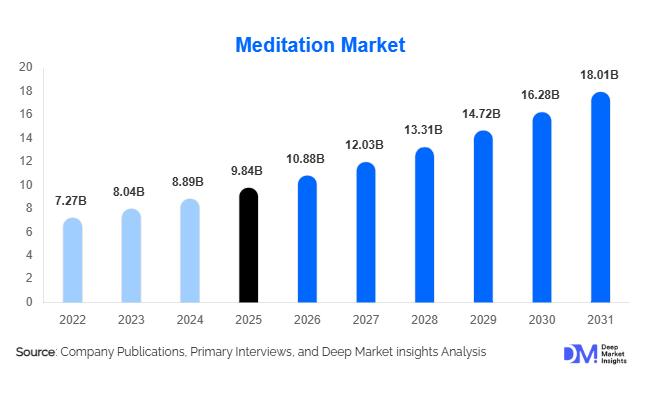
According to Deep Market Insights, the global meditation market size was valued at USD 9.84 billion in 2025 and is projected to grow from USD 10.88 billion in 2026 to reach USD 18.01 billion by 2031, expanding at a CAGR of 10.6% during the forecast period (2026–2031). The meditation market growth is primarily driven by increasing awareness of mental health, rising adoption of digital wellness platforms, growing integration of meditation into healthcare and corporate wellness programs, and continuous advancements in AI-enabled mindfulness applications and wearable biofeedback technologies.
Key Market Insights
- Digital meditation platforms continue to dominate the industry, accounting for over 58% of global revenue as consumers increasingly prefer app-based mindfulness solutions.
- Artificial intelligence and wearable biofeedback technologies are transforming meditation experiences, delivering personalized sessions based on stress levels, heart rate variability, and sleep quality.
- North America dominates the global market, supported by strong digital health adoption, corporate wellness investments, and high consumer spending on mental wellness solutions.
- Asia-Pacific is projected to be the fastest-growing regional market, fueled by rising smartphone penetration, expanding wellness awareness, and increasing healthcare digitization across China, India, and Southeast Asia.
- Corporate wellness and healthcare applications are rapidly expanding, with employers and healthcare providers integrating meditation into employee assistance and behavioral health programs.
- Subscription-based wellness ecosystems and multilingual content libraries are improving accessibility while increasing long-term user engagement across developed and emerging markets.
Meditation Market Trends
AI-Powered Personalized Meditation Experiences
The meditation industry is witnessing rapid adoption of artificial intelligence, machine learning, and biometric analytics to personalize mindfulness experiences. Meditation platforms are increasingly integrating heart rate monitoring, breathing analysis, sleep tracking, and emotional wellness assessments to deliver customized meditation sessions that improve user engagement and long-term retention. AI-powered recommendation engines continuously adapt meditation content based on individual stress patterns, mood changes, and daily routines, making digital wellness solutions significantly more effective. Integration with smartwatches, fitness trackers, and wearable biofeedback devices is further enhancing real-time meditation guidance while supporting preventive mental healthcare across global consumer markets.
Growing Enterprise and Healthcare Adoption
Organizations worldwide are increasingly incorporating meditation into employee wellness initiatives to reduce workplace stress, improve productivity, and enhance overall employee well-being. Healthcare providers are also expanding the use of mindfulness-based therapies alongside conventional treatments for anxiety, depression, chronic pain, and sleep disorders. Hospitals, behavioral health centers, and rehabilitation facilities continue introducing evidence-based meditation programs supported by digital applications and remote patient monitoring. The growing acceptance of meditation as a complementary therapeutic solution is expanding commercial opportunities across healthcare institutions, insurance-supported wellness programs, and employer-sponsored mental health initiatives.
Meditation Market Drivers
Increasing Global Focus on Mental Health and Preventive Wellness
The growing prevalence of stress, anxiety, burnout, and sleep-related disorders has significantly increased global demand for meditation services. Governments, employers, educational institutions, and healthcare organizations are investing heavily in preventive mental wellness initiatives that incorporate guided meditation, mindfulness training, and emotional resilience programs. Digital accessibility through smartphones and connected devices has enabled millions of users to adopt meditation as part of their daily wellness routines. Continuous scientific validation of meditation's effectiveness in reducing stress and improving cognitive performance further strengthens long-term market expansion.
Expansion of Digital Health Ecosystems
The rapid growth of digital healthcare infrastructure continues to accelerate meditation platform adoption worldwide. Mobile applications, cloud-based wellness platforms, wearable technologies, and virtual coaching solutions are creating highly scalable meditation ecosystems that provide users with convenient, personalized, and affordable mindfulness experiences. Integration with telehealth services, behavioral health platforms, and AI-enabled wellness assistants is further increasing the accessibility of meditation across both developed and emerging healthcare markets.
Meditation Market Restraints
Subscription Fatigue and High Market Competition
The increasing number of meditation applications available across digital marketplaces has intensified market competition while creating subscription fatigue among consumers. Many users continue relying on free meditation content available through social media platforms, video streaming services, and public wellness resources, reducing premium subscription conversion rates. High customer acquisition costs, intense pricing competition, and user retention challenges continue to limit profitability for several digital meditation service providers.
Limited Clinical Standardization
Despite growing scientific support for meditation, variations in instructional quality, therapeutic methodologies, and certification standards remain significant challenges across global markets. Limited regulatory standardization for digital wellness applications creates uncertainty among healthcare providers and insurers regarding reimbursement and clinical integration. Maintaining evidence-based content while ensuring consistent user outcomes remains an important challenge for meditation platform developers.
Meditation Market Opportunities
Expansion Across Clinical Healthcare and Insurance Programs
The increasing recognition of meditation as a complementary therapy presents substantial opportunities for integration into hospitals, behavioral healthcare facilities, rehabilitation centers, and insurance-supported wellness programs. Healthcare providers are expanding mindfulness-based interventions for chronic disease management, pain therapy, oncology support, and mental health treatment. As reimbursement policies evolve, meditation platforms are expected to experience growing institutional adoption across global healthcare systems.
Corporate Wellness and Educational Institutions
Businesses and educational institutions continue expanding investments in mental wellness programs to improve productivity, reduce absenteeism, and enhance emotional well-being. Meditation applications designed specifically for employees and students provide guided stress management, mindfulness coaching, sleep improvement, and resilience training. Increasing awareness regarding workplace mental health is expected to generate long-term commercial opportunities for enterprise-focused meditation solution providers.
Report Scope
| Report Metric | Details |
|---|---|
| Market Size in 2025 | USD 9.84 Billion |
| Market Size in 2026 | USD 10.88 Billion |
| Market Size in 2031 | USD 18.01 Billion |
| CAGR | 10.6% (2026-2031) |
| Base Year for Estimation | 2025 |
| Historical Data | 2022-2024 |
| Forecast Period | 2026-2031 |
| Report Coverage | Revenue Forecast, Competitive Landscape, Supply Chain Disruption, Growth Factors, Environment & Regulatory Landscape and Trends |
| Geographies Covered | North America, Europe, APAC, Middle East and Africa, LATAM |
| Countries Covered | U.S., Canada, U.K., Germany, France, Spain, Italy, Russia, Nordic, Benelux, Rest of Europe, China, Korea, Japan, India, Australia, Singapore, Taiwan, South East Asia, Rest of Asia-Pacific, UAE, Turky, Saudi Arabia, South Africa, Egypt, Nigeria, Rest of MEA, Brazil, Mexico, Argentina, Chile, Colombia, Rest of LATAM |
Explore more data points, trends and opportunities Download Free Sample Report
Type Insights
Apps and digital meditation platforms dominate the market owing to widespread smartphone adoption, affordable subscription models, multilingual guided sessions, and continuous AI-powered personalization. These platforms provide flexible access to mindfulness exercises, breathing techniques, sleep stories, relaxation music, and cognitive wellness programs that appeal to both beginners and experienced practitioners. Meditation centers and wellness retreats continue attracting consumers seeking immersive mindfulness experiences through instructor-led programs, yoga retreats, and holistic wellness therapies. Meanwhile, wearable and biofeedback solutions are emerging as one of the fastest-growing categories by enabling real-time physiological monitoring, stress detection, breathing optimization, and personalized meditation guidance through smart devices.
Application Insights
Personal wellness remains the largest application segment as consumers increasingly adopt meditation to improve emotional health, stress management, sleep quality, and overall well-being. Corporate wellness programs are expanding rapidly as employers prioritize employee mental health, burnout reduction, and workplace productivity through mindfulness initiatives. Healthcare and therapeutic applications continue gaining momentum as hospitals, behavioral health centers, rehabilitation facilities, and mental health professionals integrate meditation into evidence-based treatment protocols for anxiety, depression, chronic pain, and post-traumatic stress management.
Distribution Channel Insights
Mobile application stores and direct-to-consumer digital platforms represent the primary distribution channels for meditation services, supported by subscription-based business models, freemium offerings, and cloud-based content delivery. Corporate licensing agreements continue expanding among enterprise wellness providers, while healthcare partnerships enable institutional deployment of meditation solutions across hospitals and clinics. Wellness centers, yoga studios, retreat operators, and educational organizations also contribute significantly by delivering instructor-led meditation programs through both physical and hybrid learning environments.
End User Insights
Individual consumers account for the largest share of meditation platform adoption due to increasing awareness regarding mental wellness and preventive healthcare. Corporate organizations represent a rapidly expanding end-user segment as employee assistance programs increasingly incorporate guided meditation and mindfulness training. Healthcare providers, educational institutions, military organizations, and rehabilitation centers are also adopting meditation solutions to support emotional resilience, stress reduction, and behavioral health improvement across diverse population groups.
Explore more data points, trends and opportunities Download Free Sample Report
Meditation Market Segmentations
By Type
- Apps & Digital Platforms
- Meditation Centers & Retreats
- Wearable & Biofeedback Solutions
By Application
- Personal Wellness
- Corporate Wellness
- Healthcare & Therapy
By Distribution Channel
- Mobile Application Stores
- Direct-to-Consumer Platforms
- Corporate Wellness Providers
- Healthcare Institutions
- Wellness Centers & Yoga Studios
Regional Insights
North America
North America holds the largest share of the global meditation market due to widespread adoption of digital health technologies, advanced healthcare infrastructure, strong corporate wellness investments, and high consumer spending on mental wellness services. The United States remains the primary contributor, supported by growing awareness of behavioral health, increasing insurance coverage for mental healthcare, and continuous innovation among leading meditation platform providers. High smartphone penetration and wearable technology adoption further accelerate regional market growth.
Europe
Europe represents a mature meditation market characterized by increasing healthcare integration, government support for mental wellness initiatives, and growing consumer preference for holistic healthcare approaches. Countries including Germany, the United Kingdom, France, Italy, and the Netherlands are witnessing rising adoption of meditation across healthcare, educational institutions, and workplace wellness programs. Digital mindfulness platforms continue expanding through multilingual content and evidence-based therapeutic partnerships.
Asia-Pacific
Asia-Pacific is expected to register the fastest market growth throughout the forecast period. Rapid urbanization, increasing mental health awareness, expanding smartphone penetration, and rising disposable income continue driving regional demand. China, India, Japan, South Korea, and Australia remain key contributors, supported by growing investments in digital healthcare, wellness tourism, and preventive healthcare initiatives. Traditional mindfulness practices combined with modern digital delivery platforms create significant opportunities for regional expansion.
Latin America
Latin America is experiencing steady growth in meditation adoption, supported by expanding digital connectivity, increasing awareness regarding stress management, and rising investments in wellness applications. Brazil, Mexico, Argentina, Chile, and Colombia are leading regional demand through growing smartphone usage and increasing availability of affordable digital wellness platforms. Corporate wellness initiatives and healthcare modernization continue supporting long-term market development.
Middle East & Africa
The Middle East & Africa region is gradually emerging as a promising meditation market due to increasing investments in healthcare modernization, employee wellness initiatives, and digital transformation. Countries including the UAE, Saudi Arabia, South Africa, and Israel are witnessing growing adoption of mindfulness applications across healthcare institutions, educational organizations, and corporate workplaces. Rising awareness regarding mental health and expanding access to digital wellness technologies are expected to sustain regional market growth over the coming years.
Key Players in the Meditation Market
- Headspace Health
- Calm.com Inc.
- Insight Timer
- Breethe
- Simple Habit
- Ten Percent Happier
- Aura Health
- Mindvalley
- Balance
- Meditopia