Body Lotion Market Size
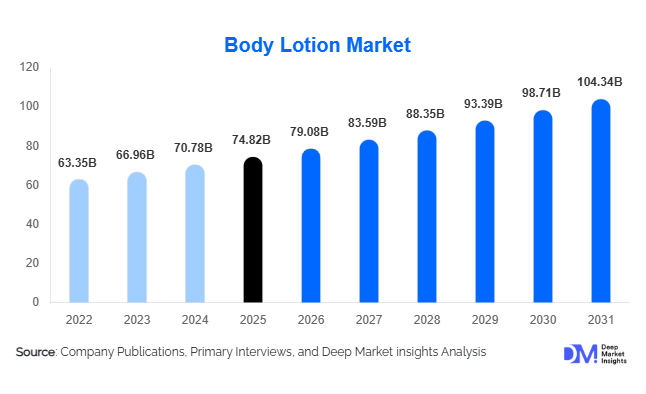
According to Deep Market Insights, the global body lotion market size was valued at USD 74.82 billion in 2025 and is projected to grow from USD 79.08 billion in 2026 to reach USD 104.34 billion by 2031, expanding at a CAGR of 5.7% during the forecast period (2026–2031). The body lotion market growth is primarily driven by rising consumer awareness regarding skincare routines, increasing demand for hydration-focused personal care products, growing adoption of premium and organic formulations, and expansion of digital beauty retail channels. The market report provides detailed insights into market segmentation, competitive landscape, regional performance, technological advancements, and evolving consumer preferences shaping the global body lotion industry.
Key Market Insights
- North America dominates the global body lotion market, accounting for approximately 35.6% market share in 2025, supported by high skincare awareness, premium product adoption, and strong retail penetration.
- Asia-Pacific is the fastest-growing region, projected to expand at a CAGR of 6.8% during 2026–2031 due to rising disposable income, urbanization, and increasing beauty product consumption.
- Mass body lotion dominates the product category, holding nearly 54.3% revenue share, while medicated body lotion is expected to witness faster growth with a 6.6% CAGR.
- Adult consumers represent the largest application segment, contributing approximately 68.4% market share due to increased daily skincare adoption and moisturizing routines.
- India is emerging as a high-growth country market, projected to reach approximately USD 11.4 billion by 2031, growing at a CAGR of around 7.3%.
- Sustainable packaging, clean-label ingredients, and digital beauty platforms are becoming major trends influencing body lotion purchasing decisions worldwide.
Body Lotion Market Trends
Growing Demand for Natural and Functional Skincare Formulations
The body lotion industry is witnessing a significant shift toward multifunctional and ingredient-focused skincare products. Consumers are increasingly preferring formulations containing ceramides, hyaluronic acid, niacinamide, aloe vera, shea butter, and botanical extracts that provide hydration along with skin barrier protection. In 2025, more than 38% of newly launched body lotion products included natural or plant-based ingredients, while premium skincare formulations contributed nearly 28.7% of total market revenue. Manufacturers are investing in advanced formulation technologies to develop products targeting anti-aging, sensitive skin, eczema-prone skin, and pollution-related skin concerns. Global production exceeded 9.2 billion body lotion units annually, reflecting strong consumer penetration across developed and emerging economies. This increasing focus on effective ingredients and personalized skincare solutions is strengthening the long-term growth of the body lotion market.
Digital Commerce and Sustainable Packaging Transformation
Online beauty retail and sustainability-focused product innovation are reshaping the body lotion market landscape. E-commerce channels accounted for nearly 29% of global body lotion sales in 2025, compared with approximately 18% in 2021, driven by convenience, product comparison tools, and influencer-based marketing. Leading skincare companies are adopting recyclable plastics, refill packaging, and environmentally responsible manufacturing processes, with sustainable packaging adoption exceeding 31% among major brands. Smart manufacturing technologies have improved production efficiency by nearly 15%, enabling manufacturers to increase output while reducing operational costs. Younger consumers, particularly millennials and Gen Z, are showing higher preference for ethical, sustainable, and digitally accessible skincare products, further accelerating body lotion market expansion.
Body Lotion Market Drivers
Rising Consumer Awareness Regarding Skin Health
Increasing awareness about skin hydration, preventive skincare, and personal wellness is one of the strongest drivers of the body lotion market. Approximately 72% of global consumers now include moisturizing products in their regular skincare routines, supported by rising social media influence and dermatologist recommendations. Annual global consumption has exceeded 4.6 billion liters of body lotion products, with premium skincare spending growing by nearly 9% annually. Consumers are increasingly seeking products that provide long-lasting hydration, UV protection, anti-aging benefits, and improved skin texture. Expansion of beauty education content, skincare influencers, and digital product reviews has increased product awareness among younger demographics, strengthening demand across mass-market and premium categories.
Expansion of Premium and Personalized Skincare Products
The growing preference for customized and premium skincare solutions is accelerating market growth. Premium body lotions containing advanced ingredients such as peptides, collagen, probiotics, and ceramides are gaining traction among high-income consumers. The premium segment accounted for approximately 28.7% of global revenue in 2025, supported by increasing willingness to spend on specialized skincare products. Personalized skincare platforms and AI-based recommendations are improving product discovery, while luxury beauty brands are expanding targeted body care portfolios. Emerging markets are also experiencing double-digit growth in premium skincare adoption, with countries such as India and China witnessing annual beauty expenditure increases above 12%. These trends continue to create favorable conditions for body lotion market expansion.
Body Lotion Market Restraints
High Raw Material Price Volatility
Fluctuating prices of key ingredients including natural oils, botanical extracts, glycerin, and specialty emulsifiers remain a major challenge for manufacturers. Raw material costs experienced variations between 8% and 18% during recent years due to supply chain disruptions and changing agricultural conditions. Packaging and transportation expenses increased by approximately 11%, affecting overall production costs. Although global manufacturing capacity exceeds 9 billion units annually, smaller manufacturers face difficulty maintaining competitive pricing while meeting quality and regulatory standards. These cost pressures may impact profit margins and slow expansion opportunities, particularly in price-sensitive developing markets.
Regulatory Compliance and Ingredient Restrictions
Increasing regulatory scrutiny regarding cosmetic ingredients, labeling requirements, and sustainability standards is creating operational challenges for manufacturers. Compliance expenses have increased by nearly 7% across several markets due to stricter safety testing and environmental regulations. Companies investing in new formulations must conduct extensive testing for allergens, preservatives, and ingredient safety before commercialization. Additionally, growing consumer concerns regarding synthetic chemicals have increased demand for transparent ingredient disclosure. While these regulations improve product safety, they also increase development timelines and manufacturing costs across the global body lotion market.
Body Lotion Market Opportunities
Growth of Organic and Clean Label Products
The increasing demand for clean beauty products presents significant opportunities for body lotion manufacturers. Organic and naturally derived formulations are gaining popularity, with clean-label products representing approximately 36% of premium product launches. Consumers are increasingly avoiding artificial additives and selecting products containing sustainable ingredients, plant-based oils, and environmentally friendly packaging. Emerging economies are witnessing rapid adoption of organic skincare due to rising middle-class spending and increasing awareness of wellness products. Companies developing transparent formulations, sustainable sourcing strategies, and eco-friendly packaging solutions are positioned to capture growing consumer interest in clean skincare categories.
Expansion Through Online Beauty Platforms
The rapid growth of digital commerce provides new opportunities for body lotion brands to reach wider consumer segments. Online platforms enable direct consumer engagement, personalized recommendations, subscription-based purchases, and targeted marketing campaigns. Digital beauty sales have expanded significantly, contributing nearly 29% of market revenue in 2025. Social media platforms, influencer marketing, and virtual skincare consultations are improving brand visibility among younger consumers. Emerging markets with increasing smartphone penetration and internet accessibility are expected to contribute significantly to future demand, creating new growth opportunities for the body lotion market.
Body Lotion Market Challenges
Intense Competition and Brand Differentiation
The body lotion industry faces intense competition with more than 3,500 active skincare brands competing globally. Manufacturers launch thousands of new personal care products annually, increasing pressure on companies to differentiate through innovation, pricing, branding, and sustainability initiatives. Marketing expenditure often represents more than 14% of annual revenues for major beauty companies. Private-label brands and regional manufacturers are gaining market presence by offering affordable alternatives, creating pricing pressure for established players. Maintaining consumer loyalty while continuously introducing innovative formulations remains a critical challenge for market participants.
Changing Consumer Preferences
Rapid changes in consumer expectations regarding ingredients, sustainability, and product effectiveness create continuous challenges for manufacturers. Modern consumers increasingly demand cruelty-free, vegan, environmentally responsible, and clinically tested products. Companies must invest heavily in research and development to meet evolving preferences while maintaining affordability. Approximately 42% of consumers consider ingredient transparency an important purchasing factor, increasing pressure on brands to provide detailed product information. Adapting quickly to these changing preferences remains essential for sustaining competitiveness in the body lotion market.
Report Scope
| Report Metric | Details |
|---|---|
| Market Size in 2025 | USD 74.82 Billion |
| Market Size in 2026 | USD 79.08 Billion |
| Market Size in 2031 | USD 104.34 Billion |
| CAGR | 5.7% (2026-2031) |
| Base Year for Estimation | 2025 |
| Historical Data | 2022-2024 |
| Forecast Period | 2026-2031 |
| Report Coverage | Revenue Forecast, Competitive Landscape, Supply Chain Disruption, Growth Factors, Environment & Regulatory Landscape and Trends |
| Geographies Covered | North America, Europe, APAC, Middle East and Africa, LATAM |
| Countries Covered | U.S., Canada, U.K., Germany, France, Spain, Italy, Russia, Nordic, Benelux, Rest of Europe, China, Korea, Japan, India, Australia, Singapore, Taiwan, South East Asia, Rest of Asia-Pacific, UAE, Turky, Saudi Arabia, South Africa, Egypt, Nigeria, Rest of MEA, Brazil, Mexico, Argentina, Chile, Colombia, Rest of LATAM |
Explore more data points, trends and opportunities Download Free Sample Report
Product Type Insights
Body lotion products are primarily segmented into mass body lotion, premium body lotion, and medicated body lotion categories, with mass products accounting for the largest market share due to affordability and widespread retail availability. Mass body lotion contributed approximately 54.3% of global revenue in 2025, supported by production exceeding 5 billion units annually across supermarkets, pharmacies, convenience stores, and online platforms. These products primarily contain moisturizing ingredients such as glycerin, aloe vera, vitamin E, and mineral oils, targeting daily hydration requirements among broad consumer groups.
Premium body lotion represents a rapidly expanding segment, accounting for nearly 28.7% market share in 2025. This segment is driven by consumer preference for advanced skincare benefits, including anti-aging properties, deep hydration, skin barrier repair, and dermatological benefits. Premium formulations increasingly incorporate ingredients such as hyaluronic acid, ceramides, peptides, botanical extracts, and probiotics. Production volumes exceeded 2.8 billion units globally, supported by strong demand from luxury beauty retailers, specialty stores, and direct-to-consumer digital channels.
Medicated body lotion accounted for approximately 17% of global market revenue and is expected to register one of the fastest growth rates during the forecast period. These products are designed for consumers experiencing eczema, psoriasis, extremely dry skin, and sensitive skin conditions. Annual production exceeded 1.4 billion units, with increased adoption through dermatology clinics, pharmacies, and healthcare-supported skincare recommendations. Rising awareness regarding therapeutic skincare solutions is expected to strengthen demand for medicated body lotion products.
Application Insights
Adult consumers represent the largest application segment in the body lotion market, contributing approximately 68.4% of global revenue in 2025. Growing awareness regarding daily skincare routines, anti-aging solutions, skin hydration, and pollution protection has increased adult adoption worldwide. More than 6.1 billion units of adult-focused body lotion products are consumed annually, with demand particularly strong among working professionals, urban populations, and premium skincare users. Manufacturers are introducing specialized formulations targeting different skin types, climates, and lifestyle requirements.
Children’s body lotion products accounted for approximately 18.5% market share, supported by increasing parental preference for gentle, hypoallergenic, and dermatologist-tested formulations. Production exceeded 1.7 billion units annually, with rising adoption across urban households. Products designed for children typically include mild moisturizing agents, fragrance-free formulations, and sensitive-skin protection technologies. Increasing awareness regarding child skincare safety is encouraging parents to invest in specialized body care products.
Baby care applications contributed nearly 13.1% of global body lotion demand, supported by increasing healthcare awareness and demand for clinically tested baby skincare products. Global baby lotion production exceeded 1.2 billion units, with strong penetration through hospitals, pharmacies, and baby specialty retailers. Manufacturers are focusing on natural ingredients, dermatologist-approved formulations, and chemical-free solutions to address the sensitive skin requirements of infants.
Distribution Channel Insights
Online retail channels are becoming one of the fastest-growing distribution platforms in the body lotion market, accounting for approximately 29% of global sales in 2025. E-commerce platforms enable consumers to compare products, access reviews, receive personalized recommendations, and purchase premium skincare products conveniently. Direct-to-consumer brand websites are expanding rapidly through subscription models, influencer marketing, and digital campaigns. Increasing smartphone penetration and internet accessibility across emerging economies are expected to further accelerate online body lotion sales.
Supermarkets and hypermarkets remain dominant offline distribution channels due to their wide consumer reach and product accessibility. These channels contribute significant sales volume, particularly for mass body lotion products, with thousands of retail outlets supporting global distribution. Pharmacies and specialty beauty stores continue to gain importance for premium and medicated body lotion categories, as consumers increasingly seek expert recommendations and clinically supported skincare solutions.
Explore more data points, trends and opportunities Download Free Sample Report
Body Lotion Market Segmentations
By Product Type
- Mass Body Lotion
- Premium Body Lotion
- Medicated Body Lotion
By Application
- Adults
- Children
- Baby Care
By Distribution Channel
- Online Retail
- Supermarkets and Hypermarkets
- Pharmacies and Drugstores
- Specialty Beauty Stores
- Direct-to-Consumer Channels
Regional Insights
North America
North America dominates the global body lotion market with approximately 35.6% revenue share in 2025, supported by high skincare awareness, premium product adoption, and strong retail infrastructure. The United States represents nearly 82% of regional demand, followed by Canada and Mexico. The region produces more than 2.8 billion body lotion units annually, with premium and medicated formulations showing strong growth. Consumers increasingly prefer products containing clean ingredients, anti-aging benefits, and sustainable packaging. Online beauty retail penetration exceeds 40% among younger consumers, strengthening digital sales channels across the region.
Europe
Europe accounted for approximately 28.2% of global body lotion revenue, driven by strong demand for natural skincare, organic formulations, and sustainable beauty products. Germany, France, the United Kingdom, Italy, and Spain are major contributors, collectively representing a significant portion of regional consumption. European manufacturers produce more than 2.2 billion units annually, supported by advanced cosmetic manufacturing capabilities. Clean-label products represent nearly 39% of premium launches, reflecting consumer preference for environmentally responsible and ingredient-transparent skincare solutions.
Asia-Pacific
Asia-Pacific represents the fastest-growing regional market, accounting for approximately 25.4% share in 2025 and projected to expand at a CAGR of 6.8% through 2031. China, India, Japan, South Korea, and Australia contribute more than 86% of regional revenue. Regional production exceeded 2.9 billion units annually, supported by increasing disposable income, urbanization, and expanding beauty e-commerce platforms. India is expected to become a major growth market, reaching approximately USD 11.4 billion by 2031 due to rising skincare awareness and premium product adoption.
Latin America
Latin America contributed approximately 6.3% of global body lotion revenue, with Brazil, Mexico, and Argentina representing key markets. Regional production exceeded 620 million units annually, supported by growing beauty product consumption and increasing demand for moisturizing skincare products. Brazil accounts for nearly 49% of regional demand, driven by strong personal care culture and expanding retail networks. Premium and natural skincare products are gaining traction among urban consumers.
Middle East & Africa
The Middle East & Africa region accounted for approximately 4.5% of global market revenue, supported by rising urbanization, increasing beauty expenditure, and premium skincare adoption. Countries including the UAE, Saudi Arabia, South Africa, and Egypt contribute significantly to regional demand. Production exceeded 410 million units annually, with luxury skincare and dermatological products showing strong growth. Expanding pharmacy networks, international beauty brands, and rising consumer awareness are expected to support regional market development.
Key Players in the Body Lotion Market
- Beiersdorf AG
- Unilever PLC
- L'Oréal S.A.
- Johnson & Johnson
- Procter & Gamble Co.
- Kao Corporation
- Shiseido Company Limited
- Natura &Co.
- The Estée Lauder Companies Inc.
- Coty Inc.
- Edgewell Personal Care Company
- Revlon Inc.
- Avon Products Inc.
- Himalaya Wellness Company
- Amorepacific Corporation