Tattoo Market Size
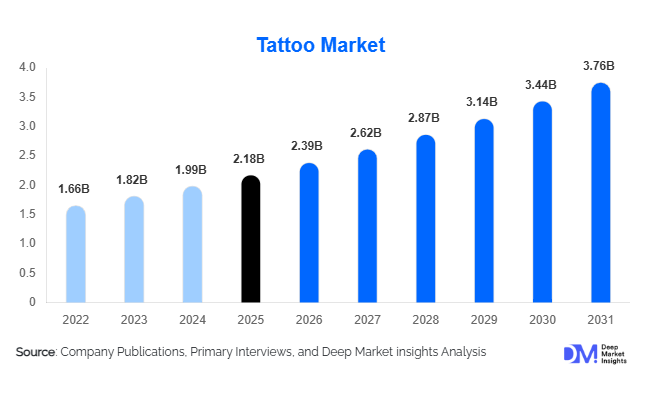
According to Deep Market Insights, the global tattoo market size was valued at USD 2.18 billion in 2025 and is projected to grow from USD 2.39 billion in 2026 to reach USD 3.76 billion by 2031, expanding at a CAGR of 9.5% during the forecast period (2026–2031). The tattoo market growth is primarily driven by rising consumer acceptance of body art, increasing popularity of cosmetic tattooing, expanding professional tattoo studios, and continuous advancements in tattoo equipment, pigments, and sterilization technologies. Growing demand for personalized self-expression, premium tattoo experiences, and permanent cosmetic procedures continues to support long-term industry expansion worldwide.
Key Market Insights
- Permanent tattoos remain the dominant segment, accounting for the majority of professional tattoo procedures worldwide due to strong consumer preference for long-lasting body art.
- Cosmetic tattoo services are witnessing rapid adoption, supported by increasing demand for permanent makeup, scalp micropigmentation, and eyebrow enhancement procedures.
- North America dominates the global market, driven by high consumer spending, established professional studios, and favorable industry regulations.
- Asia-Pacific is the fastest-growing regional market, supported by rising disposable incomes, urbanization, and growing acceptance of tattoo culture among younger consumers.
- Digital tattoo visualization technologies and wireless tattoo equipment are transforming studio operations while improving customer experience and artist productivity.
- Demand for vegan tattoo inks, sustainable aftercare products, and premium hygiene standards continues to reshape purchasing preferences across professional tattoo studios.
Tattoo Market Trends
Growing Popularity of Personalized and Artistic Tattoos
Consumers are increasingly seeking customized tattoo designs that reflect personal identity, culture, memories, and artistic expression. Professional tattoo studios are expanding their portfolios with exclusive artwork, digital tattoo design consultations, and personalized body art experiences. Social media platforms have significantly increased artist visibility, enabling consumers to connect directly with experienced professionals worldwide. The popularity of fine-line tattoos, minimalist artwork, geometric designs, realism, and watercolor tattoos continues to expand among younger demographics. As consumer awareness grows, studios are investing in advanced equipment, premium pigments, and enhanced sterilization systems to improve both safety and artistic precision.
Expansion of Cosmetic Tattoo and Digital Technologies
Cosmetic tattoo procedures such as microblading, permanent eyeliner, lip pigmentation, and scalp micropigmentation continue gaining popularity among consumers seeking long-lasting beauty solutions. At the same time, tattoo studios are adopting wireless tattoo machines, AI-assisted tattoo visualization software, digital booking systems, and electronic client management platforms to improve operational efficiency. Manufacturers are also introducing vegan pigments, hypoallergenic inks, disposable cartridge needles, and eco-friendly aftercare products to meet evolving consumer preferences. These technological advancements are enhancing treatment quality while creating new revenue opportunities for tattoo professionals worldwide.
Tattoo Market Drivers
Increasing Consumer Acceptance of Body Art
The growing acceptance of tattoos across different age groups, professions, and cultures continues to drive market expansion. Younger consumers increasingly view tattoos as a form of self-expression rather than social stigma, while celebrities, athletes, musicians, and influencers continue to normalize tattoo culture globally. Rising disposable income, increasing urbanization, and expanding premium tattoo studio networks are further supporting demand for customized tattoo services and high-quality artistic experiences.
Rising Demand for Cosmetic Tattoo Procedures
Growing consumer interest in permanent cosmetic enhancement is creating strong demand for cosmetic tattoo procedures worldwide. Permanent eyebrow shaping, eyeliner enhancement, lip blush treatments, and scalp micropigmentation offer long-lasting aesthetic solutions while reducing daily cosmetic routines. The expansion of certified cosmetic tattoo professionals and beauty clinics continues to accelerate adoption across developed and emerging markets.
Tattoo Market Restraints
Strict Health Regulations and Safety Concerns
Government regulations regarding tattoo pigments, sterilization protocols, artist certification, and infection control continue to present operational challenges for industry participants. Concerns regarding allergic reactions, skin infections, and unlicensed practitioners influence consumer confidence in certain regions. Compliance with evolving health standards requires continuous investment in certified equipment, disposable supplies, and professional training, increasing operational costs for tattoo studios.
Social and Cultural Limitations
Although tattoos have gained widespread acceptance in many countries, cultural and religious perceptions continue to limit adoption in several regions. Workplace restrictions, conservative social attitudes, and regulatory limitations reduce demand among specific consumer groups. These factors continue to create regional differences in tattoo industry penetration despite increasing global awareness.
Tattoo Market Opportunities
Growth of Premium Tattoo Studios
Consumers increasingly prefer premium tattoo studios that provide personalized consultation, advanced sterilization practices, luxury interiors, and internationally recognized artists. High-end studios offering customized artwork, digital design previews, and exclusive tattoo experiences are attracting affluent customers willing to invest in premium body art. This trend continues creating new opportunities for studio expansion and service differentiation.
Expansion of Medical and Reconstructive Tattooing
Medical tattooing is emerging as an important growth opportunity across reconstructive healthcare. Tattoo procedures are increasingly utilized for scar camouflage, burn recovery, vitiligo pigmentation correction, breast reconstruction, and post-surgical cosmetic restoration. Collaboration between healthcare providers and certified tattoo specialists is expected to further strengthen this specialized segment during the forecast period.
Report Scope
| Report Metric | Details |
|---|---|
| Market Size in 2025 | USD 2.18 Billion |
| Market Size in 2026 | USD 2.39 Billion |
| Market Size in 2031 | USD 3.76 Billion |
| CAGR | 9.5% (2026-2031) |
| Base Year for Estimation | 2025 |
| Historical Data | 2022-2024 |
| Forecast Period | 2026-2031 |
| Report Coverage | Revenue Forecast, Competitive Landscape, Supply Chain Disruption, Growth Factors, Environment & Regulatory Landscape and Trends |
| Geographies Covered | North America, Europe, APAC, Middle East and Africa, LATAM |
| Countries Covered | U.S., Canada, U.K., Germany, France, Spain, Italy, Russia, Nordic, Benelux, Rest of Europe, China, Korea, Japan, India, Australia, Singapore, Taiwan, South East Asia, Rest of Asia-Pacific, UAE, Turky, Saudi Arabia, South Africa, Egypt, Nigeria, Rest of MEA, Brazil, Mexico, Argentina, Chile, Colombia, Rest of LATAM |
Explore more data points, trends and opportunities Download Free Sample Report
Type Insights
Permanent tattoos accounted for the largest share of the global tattoo market, primarily driven by increasing consumer preference for long-lasting body art, rising acceptance of tattoos across professional and social environments, and growing demand for customized artistic expression. This segment benefits from continuous innovation in tattoo machines, precision needles, premium-quality pigments, and advanced sterilization practices that improve safety and artwork quality. Traditional black-and-grey tattoos, realism, Japanese, geometric, tribal, watercolor, and portrait styles remain highly sought after across North America and Europe, while personalized custom artwork continues to attract younger consumers globally. The expansion of licensed tattoo studios, increasing availability of internationally certified artists, and rising disposable incomes further strengthen the dominance of permanent tattoos throughout the forecast period.
Cosmetic tattoos are projected to witness the fastest growth owing to increasing consumer demand for minimally invasive aesthetic enhancement procedures. Permanent makeup applications including microblading, permanent eyebrows, eyeliner, lip blush, scalp micropigmentation, and areola reconstruction are becoming increasingly popular among both women and men seeking long-lasting cosmetic solutions. Growing awareness of beauty treatments, expanding medical aesthetic clinics, technological improvements in cosmetic pigmentation equipment, and increasing acceptance of semi-permanent aesthetic procedures continue supporting rapid segment expansion. The growing aging population and rising preference for time-saving beauty routines are expected to further accelerate demand.
Temporary tattoos continue to maintain stable demand across fashion, entertainment, promotional marketing, festivals, sporting events, and children's products. Brands increasingly utilize temporary tattoos for product promotions, experiential marketing campaigns, and event branding, while celebrity collaborations and social media trends continue encouraging adoption among younger consumers. The availability of skin-safe materials, biodegradable inks, metallic tattoos, glow-in-the-dark designs, and customized event-specific products further supports steady market expansion.
Application Insights
Personal use remains the leading application segment, supported by growing consumer interest in self-expression, individuality, fashion trends, and cultural identity. Rising social acceptance across multiple age groups, increasing influence of celebrities, musicians, athletes, and digital creators, and the widespread popularity of tattoo-focused content across social media platforms continue driving consumer demand. Improvements in tattoo safety standards, personalized consultation services, digital tattoo visualization software, and premium studio experiences have further encouraged first-time consumers to undergo tattoo procedures. The increasing number of licensed tattoo studios worldwide continues to reinforce the leadership of this segment.
Cosmetic enhancement applications are experiencing robust growth as permanent cosmetic procedures become an integral part of the beauty and personal care industry. Permanent eyebrows, eyeliner, lip pigmentation, scalp micropigmentation, and beauty correction procedures are increasingly performed in specialized aesthetic clinics and dermatology centers. Rising consumer preference for long-lasting cosmetic solutions, growing disposable income, expanding beauty awareness, and technological advancements in pigment formulations continue driving demand across developed and emerging markets.
Medical and reconstructive tattooing is steadily expanding with increasing adoption in healthcare settings. Medical tattoo procedures are widely used for scar camouflage, burn rehabilitation, vitiligo pigmentation correction, breast reconstruction, post-operative cosmetic restoration, and skin discoloration treatment. Growing collaboration between hospitals, plastic surgeons, dermatologists, and certified medical tattoo practitioners is creating new growth opportunities. Increasing awareness regarding restorative pigmentation therapies and improvements in medical tattoo pigments are expected to support long-term expansion of this application segment.
Explore more data points, trends and opportunities Download Free Sample Report
Tattoo Market Segmentations
By Type
- Permanent Tattoos
- Temporary Tattoos
- Cosmetic Tattoos
By Application
- Personal Use
- Medical & Reconstructive
- Cosmetic Enhancement
Regional Insights
North America
North America accounted for the largest share of the global tattoo market and continues to maintain its leadership owing to widespread cultural acceptance of tattoos, high disposable income, well-established professional tattoo studios, and stringent health and safety regulations. The United States remains the primary revenue contributor due to strong consumer spending on premium tattoo services, cosmetic tattoo procedures, and technologically advanced tattoo equipment, while Canada continues witnessing increasing demand through expanding professional certification programs and growing acceptance among working professionals.
The region's growth is primarily driven by rising demand for customized tattoos, increasing popularity of cosmetic tattooing, rapid adoption of wireless tattoo equipment, expanding premium tattoo studios, and strong consumer preference for experienced licensed artists. The presence of leading tattoo equipment manufacturers, continuous technological innovation, and growing expenditure on aesthetic services continue supporting long-term regional market expansion.
Europe
Europe represents one of the most mature tattoo markets globally, characterized by highly skilled artists, advanced hygiene standards, strict pigment regulations, and increasing consumer demand for premium tattoo experiences. Germany, the United Kingdom, France, Italy, Spain, and the Netherlands continue leading regional demand through well-developed studio networks, expanding tattoo conventions, and increasing appreciation for artistic body modification. Cosmetic tattoo procedures are also witnessing growing adoption across beauty clinics throughout Western Europe.
Regional growth is supported by increasing popularity of customized artistic tattoos, rising beauty consciousness, growing demand for permanent makeup procedures, expansion of certified tattoo academies, and continuous innovation in vegan tattoo inks and environmentally sustainable tattoo products. Strong regulatory oversight has further strengthened consumer confidence in professional tattoo services across Europe.
Asia-Pacific
Asia-Pacific is expected to register the fastest growth throughout the forecast period, driven by rapid urbanization, rising disposable income, increasing influence of global fashion trends, and changing cultural perceptions toward body art. China, Japan, South Korea, India, Australia, and Southeast Asian countries continue witnessing growing numbers of tattoo studios, cosmetic clinics, and internationally trained tattoo professionals. Social media platforms and celebrity influence have significantly accelerated tattoo adoption among millennials and Generation Z consumers.
The region's growth is further supported by expanding middle-class populations, increasing beauty and wellness expenditure, growing acceptance of cosmetic tattoo procedures, rising medical tourism, and continuous investment in premium tattoo equipment by professional studios. The rapid expansion of digital appointment platforms and customized tattoo consultation services is also improving customer accessibility across major metropolitan areas.
Latin America
Latin America continues experiencing steady growth led by Brazil, Mexico, Argentina, Colombia, and Chile, where tattoo culture has become increasingly mainstream among younger consumers. Professional tattoo studios continue expanding across major urban centers, supported by growing demand for artistic tattoos, customized body art, and cosmetic pigmentation services. Tattoo conventions, cultural festivals, and international artist collaborations continue strengthening regional industry visibility.
Regional market growth is primarily driven by increasing urban populations, improving disposable income, expanding tourism activities, rising social acceptance of tattoos, and greater availability of professionally certified artists. Continuous investment in modern tattoo studios and increasing consumer awareness regarding hygiene and safety standards are expected to support sustained regional expansion.
Middle East & Africa
The Middle East & Africa tattoo market remains comparatively smaller but is gradually expanding due to rising consumer awareness, increasing adoption of cosmetic tattoo procedures, and growth in premium beauty clinics. Countries including the United Arab Emirates, South Africa, Saudi Arabia, and selected North African nations are witnessing increasing demand for permanent makeup, scalp micropigmentation, eyebrow enhancement, and medically supervised tattoo procedures. Medical aesthetic clinics continue driving demand for reconstructive tattoo applications across the region.
Growth across the region is supported by expanding beauty and wellness industries, rising medical tourism, increasing investment in aesthetic healthcare infrastructure, growing availability of certified cosmetic tattoo professionals, and improving regulatory frameworks governing tattoo procedures. The increasing influence of international beauty trends and higher spending on personal appearance are expected to further strengthen regional market development during the forecast period.
Key Players in the Tattoo Market
- World Famous Tattoo Ink
- Intenze Products Inc.
- Eternal Ink
- Kuro Sumi Inc.
- Dynamic Color Co.
- Cheyenne Professional Tattoo Equipment
- Bishop Rotary
- FK Irons Inc.
- Dragonhawk Tattoo Supply
- EZ Tattoo Supply
- Critical Tattoo
- H2Ocean LLC
- Hustle Butter Deluxe
- Perma Blend
- Tattooed Now! Ltd.