Shampoo Bar Market Size
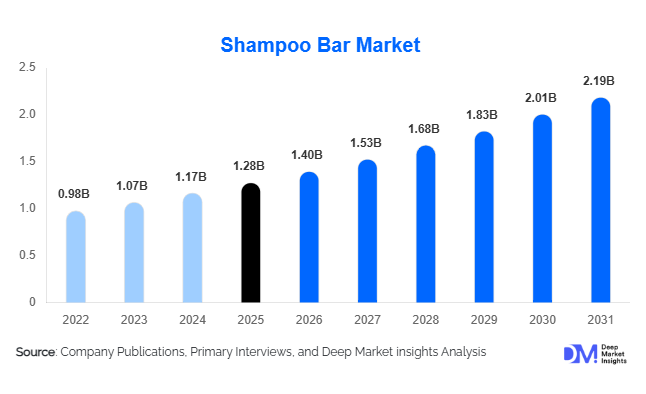
According to Deep Market Insights, the global shampoo bar market was valued at USD 1.28 billion in 2025 and is projected to grow from USD 1.40 billion in 2026 to reach USD 2.86 billion by 2031, expanding at a CAGR of 9.4% during the forecast period (2026–2031). The market is witnessing robust expansion owing to the increasing adoption of sustainable personal care products, growing consumer preference for plastic-free packaging, and rising awareness regarding environmentally responsible beauty products. Rapid product innovation, premiumization of hair care formulations, and the introduction of sulfate-free, silicone-free, and vegan shampoo bars are further strengthening market growth across developed and emerging economies. Increasing retail availability through supermarkets, specialty beauty stores, and e-commerce platforms is also improving consumer accessibility. Furthermore, stringent regulations regarding single-use plastic packaging and increasing investments by cosmetic manufacturers in sustainable product portfolios continue to support long-term market expansion.
Key Market Insights
- Natural and organic shampoo bars account for the largest market share, supported by increasing consumer preference for clean-label, sulfate-free, and biodegradable personal care products.
- Online retail has emerged as the leading distribution channel, driven by rapid expansion of direct-to-consumer brands, subscription models, and digital marketing strategies.
- Europe dominates the global market, supported by strong environmental regulations, high consumer awareness regarding sustainable cosmetics, and widespread adoption of plastic-free beauty products.
- Asia-Pacific is expected to register the fastest growth, led by increasing disposable income, rising penetration of premium beauty products, expanding e-commerce infrastructure, and growing environmental awareness.
- Product innovation remains one of the strongest competitive strategies, with manufacturers introducing scalp-specific formulations, botanical ingredients, probiotic haircare, solid conditioner combinations, and zero-waste packaging solutions.
- Growing consumer interest in vegan, cruelty-free, and naturally derived formulations continues to accelerate product launches across premium and mass-market personal care brands.
Shampoo Bar Market Trends
Sustainable Beauty Products Continue to Transform Haircare
Sustainability has become one of the strongest purchasing factors influencing the global haircare industry, significantly accelerating demand for shampoo bars. Consumers are increasingly replacing bottled shampoos with concentrated solid formulations that reduce plastic waste, lower transportation emissions, and utilize biodegradable ingredients. Manufacturers are introducing packaging-free products, recyclable paper cartons, compostable wrappers, and refill-based retail concepts to further strengthen their sustainability initiatives. Botanical oils including argan oil, coconut oil, jojoba oil, tea tree oil, rosemary oil, and shea butter are becoming standard ingredients within premium shampoo bars. In addition, sulfate-free, paraben-free, silicone-free, and palm-oil-free formulations continue gaining popularity among environmentally conscious consumers. Beauty companies are also investing heavily in carbon-neutral manufacturing facilities and responsibly sourced raw materials, positioning shampoo bars as a central component of sustainable personal care portfolios.
Premium Formulations and Personalized Haircare Solutions Gain Momentum
The premiumization of solid haircare products has emerged as another significant trend shaping the shampoo bar industry. Companies are developing specialized shampoo bars targeting curly hair, chemically treated hair, dandruff control, color protection, sensitive scalp care, volumizing treatments, anti-hair fall solutions, and moisturizing formulations. Artificial intelligence-powered scalp analysis, personalized product recommendations, and digital beauty consultations are increasingly influencing purchasing decisions through online platforms. Direct-to-consumer brands continue introducing subscription services that allow customers to receive customized shampoo bars based on hair type and seasonal requirements. Furthermore, dermatologically tested formulations enriched with probiotics, peptides, vitamins, proteins, botanical extracts, and fermented ingredients are expanding the premium consumer segment while improving overall product differentiation.
Shampoo Bar Market Drivers
Growing Consumer Preference for Sustainable Personal Care Products
Increasing awareness regarding environmental sustainability remains the primary growth driver for the shampoo bar market. Governments, retailers, and cosmetic manufacturers are collectively promoting alternatives to single-use plastic packaging, encouraging consumers to transition toward solid personal care products. Growing concerns regarding marine plastic pollution, landfill accumulation, and carbon emissions have significantly increased the adoption of packaging-free cosmetics across Europe and North America. Major beauty brands continue expanding their sustainable product portfolios by introducing biodegradable formulations manufactured using renewable raw materials and ethical sourcing practices. Rising investments in green manufacturing technologies and environmentally responsible supply chains further strengthen consumer confidence while supporting continuous market expansion.
Rapid Expansion of Premium Haircare Industry
The global premium beauty industry continues experiencing steady expansion, creating favorable conditions for shampoo bar manufacturers. Consumers increasingly seek salon-quality haircare products containing naturally derived active ingredients, botanical oils, proteins, vitamins, and customized treatment solutions. Premium shampoo bars provide concentrated formulations with longer product life, reduced packaging waste, and higher ingredient quality compared to conventional liquid shampoos. Continuous product innovation, celebrity brand endorsements, influencer marketing campaigns, and premium retail positioning further contribute to increasing consumer acceptance across multiple income groups.
Shampoo Bar Market Restraints
Higher Product Prices Compared to Conventional Liquid Shampoos
Despite growing popularity, shampoo bars continue facing pricing challenges across price-sensitive markets. Premium formulations often contain certified organic ingredients, plant-derived surfactants, essential oils, biodegradable conditioning agents, and sustainable packaging materials, resulting in higher manufacturing costs than conventional bottled shampoos. Consequently, retail prices remain comparatively higher, particularly across emerging economies where affordability significantly influences purchasing decisions. Limited promotional discounts, lower production volumes, and higher raw material procurement costs continue restricting broader consumer adoption.
Consumer Familiarity and Usage Barriers
Many consumers remain unfamiliar with proper shampoo bar usage, storage methods, and expected performance characteristics. Some first-time users perceive reduced foaming, difficulty during application, or shorter product lifespan despite evidence demonstrating the opposite under proper usage conditions. Inadequate product education, inconsistent retail merchandising, and limited product demonstrations further reduce conversion rates among conventional shampoo users. Additionally, climatic conditions including high humidity may influence storage requirements, encouraging manufacturers to develop improved packaging and storage solutions.
Shampoo Bar Market Opportunities
Emerging Economies Present Significant Long-Term Growth Potential
Developing countries across Asia-Pacific, Latin America, and the Middle East present substantial opportunities for shampoo bar manufacturers due to increasing urbanization, expanding middle-class populations, rising disposable incomes, and improving retail infrastructure. Growing environmental awareness among younger consumers, combined with increasing penetration of organized retail and e-commerce platforms, is accelerating product visibility. Local manufacturing investments, affordable product variants, and region-specific botanical formulations are expected to further improve adoption rates throughout these high-growth markets.
Innovation in Functional and Scalp-Specific Haircare Products
Future market opportunities are increasingly centered around advanced product innovation. Manufacturers are investing in multifunctional shampoo bars offering cleansing, conditioning, scalp treatment, anti-dandruff protection, color preservation, UV protection, hydration, and strengthening benefits within a single product. Research into microbiome-friendly formulations, probiotic ingredients, fermented botanical extracts, and dermatologist-developed haircare products is creating new premium categories. Simultaneously, refillable packaging systems, waterless cosmetics, personalized beauty subscriptions, and AI-driven product recommendations are expected to generate significant commercial opportunities throughout the forecast period.
Report Scope
| Report Metric | Details |
|---|---|
| Market Size in 2025 | USD 1.28 Billion |
| Market Size in 2026 | USD 1.40 Billion |
| Market Size in 2031 | USD 2.19 Billion |
| CAGR | 9.40% (2026-2031) |
| Base Year for Estimation | 2025 |
| Historical Data | 2022-2024 |
| Forecast Period | 2026-2031 |
| Report Coverage | Revenue Forecast, Competitive Landscape, Supply Chain Disruption, Growth Factors, Environment & Regulatory Landscape and Trends |
| Geographies Covered | North America, Europe, APAC, Middle East and Africa, LATAM |
| Countries Covered | U.S., Canada, U.K., Germany, France, Spain, Italy, Russia, Nordic, Benelux, Rest of Europe, China, Korea, Japan, India, Australia, Singapore, Taiwan, South East Asia, Rest of Asia-Pacific, UAE, Turky, Saudi Arabia, South Africa, Egypt, Nigeria, Rest of MEA, Brazil, Mexico, Argentina, Chile, Colombia, Rest of LATAM |
Explore more data points, trends and opportunities Download Free Sample Report
Product Type Insights
The shampoo bar market is primarily segmented into natural & organic, medicated, and moisturizing product categories, with natural and organic shampoo bars accounting for the largest market share due to increasing consumer demand for clean-label and environmentally sustainable haircare products. Natural & organic shampoo bars contributed approximately 51.4% of global revenue in 2025, supported by rising adoption of plant-based ingredients, biodegradable formulations, and cruelty-free certifications. These products contain botanical extracts, essential oils, naturally derived surfactants, and renewable ingredients that appeal strongly to environmentally conscious consumers. Production of natural & organic shampoo bars exceeded 206 million units in 2025, with demand increasing across Europe and North America due to strict sustainability standards and growing preference for chemical-free beauty products.
Medicated shampoo bars represent a rapidly expanding segment, accounting for approximately 24.6% market share in 2025. These formulations are designed to address specific scalp concerns including dandruff, excessive oil production, scalp irritation, fungal conditions, and hair weakening. The segment produced more than 99 million units globally in 2025, driven by increasing consumer interest in functional haircare solutions. Manufacturers are incorporating active ingredients such as tea tree oil, salicylic acid, zinc compounds, herbal extracts, and dermatologically tested components to improve treatment effectiveness. Rising awareness regarding scalp health and preventive haircare is expected to support strong growth of medicated shampoo bars during the forecast period.
Moisturizing shampoo bars accounted for nearly 24.0% of the global market in 2025, supported by demand from consumers seeking hydration, smoothness, and damage-repair benefits. These products generated sales exceeding 97 million units and are widely adopted among consumers with dry, damaged, curly, or chemically treated hair. Moisturizing shampoo bars commonly include ingredients such as shea butter, coconut oil, argan oil, cocoa butter, aloe vera, and plant-based conditioning agents. Increasing demand for multifunctional haircare products combining cleansing and conditioning properties is encouraging manufacturers to develop advanced moisturizing formulations with improved performance and longer-lasting benefits.
Application Insights
The household application segment dominates the shampoo bar market, driven by increasing consumer adoption of sustainable daily-use personal care products. Household users accounted for the majority of global consumption in 2025, supported by rising awareness regarding plastic reduction, cost efficiency, and longer product lifespan compared with traditional liquid shampoos. More than 70% of shampoo bar consumption originates from individual household users, particularly among millennials and Gen Z consumers. Online education, influencer marketing, and social media campaigns have significantly improved awareness regarding proper application methods, storage techniques, and environmental benefits.
Personal care and beauty enthusiasts represent another important application segment, contributing significantly to premium shampoo bar sales. This segment focuses on high-quality formulations featuring organic ingredients, luxury fragrances, specialized treatments, and sustainable packaging concepts. Premium consumers are increasingly adopting shampoo bars as part of broader zero-waste beauty routines, with sustainable cosmetics accounting for a growing share of personal care spending. Brands targeting this segment are introducing limited-edition collections, customized formulations, and ingredient-focused product lines to attract environmentally conscious buyers.
Salon and professional haircare applications are emerging as a promising segment within the shampoo bar market. Professional users are increasingly exploring solid haircare products due to growing demand for sustainable salon practices and eco-friendly service models. Sustainable salons are adopting shampoo bars to reduce packaging waste and demonstrate environmental responsibility to customers. Professional-grade formulations containing advanced conditioning agents, proteins, botanical extracts, and scalp-treatment ingredients are gaining traction among premium salons. This segment is expected to experience increased adoption as more beauty professionals integrate sustainable practices into their operations.
Travel and hospitality applications are also contributing to market expansion, particularly due to the compact size, lightweight design, and long shelf life of shampoo bars. Hotels, resorts, airlines, and travel companies are increasingly adopting solid toiletries as alternatives to traditional miniature plastic bottles. The hospitality sector is using shampoo bars as part of sustainability initiatives aimed at reducing plastic consumption and improving environmental credentials. Growing demand for eco-friendly accommodations is expected to increase commercial adoption of shampoo bars across global tourism markets.
Distribution Channel Insights
Online retail has become the leading distribution channel for the shampoo bar market, accounting for approximately 39.7% of global revenue in 2025. E-commerce platforms, direct-to-consumer websites, subscription services, and digital marketplaces have significantly improved product accessibility while enabling smaller sustainable beauty brands to reach global consumers. Online channels generated sales exceeding 160 million units during 2025, supported by consumer reviews, influencer marketing, digital advertisements, and personalized product recommendations. Subscription-based models are gaining popularity as consumers seek convenient recurring deliveries of sustainable personal care products.
Supermarkets and hypermarkets represented around 34.2% market share in 2025, supported by increasing shelf availability of sustainable beauty products across major retail chains. Large-format retailers provide consumers with physical product access, brand comparisons, and immediate purchasing convenience. More than 138 million shampoo bar units were distributed through supermarkets and hypermarkets during 2025. Retailers are expanding dedicated eco-friendly beauty sections to meet rising consumer demand for sustainable alternatives, particularly across developed markets.
Specialty stores accounted for nearly 26.1% of market revenue in 2025, driven by premium beauty retailers, organic stores, zero-waste shops, and professional cosmetic outlets. Specialty channels provide consumers with expert guidance, ingredient information, and personalized recommendations, making them important for premium and niche shampoo bar brands. These stores are particularly influential among consumers seeking organic, vegan, cruelty-free, and dermatologically tested products. Expansion of specialty beauty retail networks is expected to support continued market penetration.
Explore more data points, trends and opportunities Download Free Sample Report
Shampoo Bar Market Segmentations
By Product Type
- Natural & Organic Shampoo Bars
- Medicated Shampoo Bars
- Moisturizing Shampoo Bars
- Specialized Treatment Shampoo Bars
By Application
- Household Use
- Personal Care & Beauty Enthusiasts
- Salon & Professional Haircare
- Travel & Hospitality
By Distribution Channel
- Online Retail
- Supermarkets & Hypermarkets
- Specialty Stores
- Organic & Zero-Waste Stores
Regional Insights
North America
North America represents one of the largest markets for shampoo bars, accounting for approximately 28.6% of global revenue in 2025. The region generated more than 102 million units in production volume, supported by strong consumer awareness regarding sustainability, increasing demand for clean beauty products, and high adoption of premium personal care solutions. The United States contributed nearly 82% of regional revenue, while Canada accounted for approximately 14%. Consumers across North America increasingly prefer sulfate-free, vegan, cruelty-free, and plastic-free haircare products, encouraging manufacturers to expand sustainable product portfolios.
The region's market growth is further supported by strong e-commerce penetration, direct-to-consumer brands, and influencer-driven beauty trends. Online channels account for more than 42% of shampoo bar sales across North America, reflecting consumer preference for digital purchasing platforms. Premium shampoo bars targeting scalp health, hydration, hair repair, and specialized treatments are gaining popularity among millennials and Gen Z consumers. Growing adoption among eco-conscious households, boutique salons, and sustainable hospitality businesses continues strengthening regional demand.
Europe
Europe dominates the global shampoo bar market with approximately 36.8% revenue share in 2025, supported by strong environmental regulations, consumer awareness regarding plastic pollution, and widespread adoption of sustainable cosmetics. Regional production exceeded 145 million units, making Europe the largest manufacturing and consumption hub for shampoo bars. Countries including Germany, the United Kingdom, France, Italy, and Spain collectively contribute more than 74% of regional market revenue. The region has witnessed rapid growth in zero-waste beauty stores, organic cosmetic retailers, and sustainable personal care brands.
European consumers demonstrate strong preference for natural ingredients, vegan certifications, ethical sourcing, and environmentally responsible packaging. Organic shampoo bars represent nearly 59% of premium product sales across the region. Government initiatives promoting circular economy practices and reducing single-use plastics are further supporting market development. Increasing adoption among hotels, salons, and environmentally conscious households continues creating significant growth opportunities for manufacturers operating in European markets.
Asia-Pacific
Asia-Pacific is projected to be the fastest-growing regional market for shampoo bars, expanding at a CAGR of 10.9% during 2026–2031. The region accounted for approximately 22.1% of global revenue in 2025, generating more than 118 million units in production volume. Growth is primarily supported by increasing environmental awareness, rising disposable incomes, expanding middle-class populations, and rapid growth of online beauty retail platforms. Countries including China, India, Japan, South Korea, and Australia are emerging as major contributors to regional demand, with China accounting for nearly 39% of Asia-Pacific revenue.
India represents one of the most promising markets within the region, supported by increasing demand for natural personal care products, rising digital commerce adoption, and growing consumer interest in Ayurvedic and plant-based haircare formulations. The country is projected to reach approximately USD 327 million by 2031, expanding at a CAGR of 11.8%. Japanese and South Korean consumers are increasingly adopting premium scalp-care and functional shampoo bars containing botanical extracts, probiotics, and advanced conditioning ingredients. Additionally, Australian consumers demonstrate strong preference for sustainable and plastic-free beauty products, contributing to regional market expansion.
Latin America
Latin America accounted for approximately 8.1% of the global shampoo bar market revenue in 2025, supported by increasing awareness regarding sustainable beauty products and expanding premium personal care consumption. The region produced more than 21 million shampoo bar units during 2025, with Brazil, Mexico, and Argentina representing the largest contributors. Brazil accounted for nearly 46% of regional demand, driven by its strong beauty and cosmetics industry and increasing consumer preference for natural ingredient-based haircare products.
The market in Latin America is benefiting from the expansion of online retail platforms, social media-driven beauty trends, and increasing availability of eco-friendly cosmetic brands. Consumers are showing growing interest in botanical formulations containing coconut oil, aloe vera, argan oil, and herbal extracts due to regional preference for naturally derived beauty products. Sustainable packaging initiatives and increasing retailer investments in environmentally friendly product categories are expected to accelerate adoption. However, limited awareness outside major urban centers and comparatively lower purchasing power continue influencing market penetration across smaller economies.
Middle East & Africa
The Middle East & Africa region represented approximately 6.2% of global shampoo bar market revenue in 2025, supported by increasing premium beauty consumption, expanding tourism infrastructure, and growing interest in sustainable personal care solutions. The region generated more than 18 million units in production and consumption volume, with the United Arab Emirates, Saudi Arabia, and South Africa emerging as key markets. Urban consumers, particularly in major metropolitan areas, are increasingly adopting premium shampoo bars featuring natural ingredients, luxury fragrances, and specialized haircare benefits.
South Africa remains one of the leading African markets due to increasing environmental awareness, expanding organic beauty retail, and demand for sustainable lifestyle products. The Middle East market is being supported by high-income consumers seeking premium personal care solutions and luxury wellness products. Hotels and resorts across the region are also adopting solid toiletries to reduce plastic waste and strengthen sustainability initiatives. Increasing investment in e-commerce infrastructure and international beauty brand expansion is expected to improve accessibility and support future market growth.
Key Players in the Shampoo Bar Market
- Lush Cosmetics
- Ethique
- Unilever PLC
- Procter & Gamble Co.
- HiBAR LLC
- J.R. Liggett Ltd.
- The Earthling Co.
- Friendly Soap Ltd.
- Beauty and the Bees
- The Body Shop International
- Dr. Bronner’s
- Kitsch LLC
- Lamazuna
- Basin White
- Wildland Organics