Soap Market Size
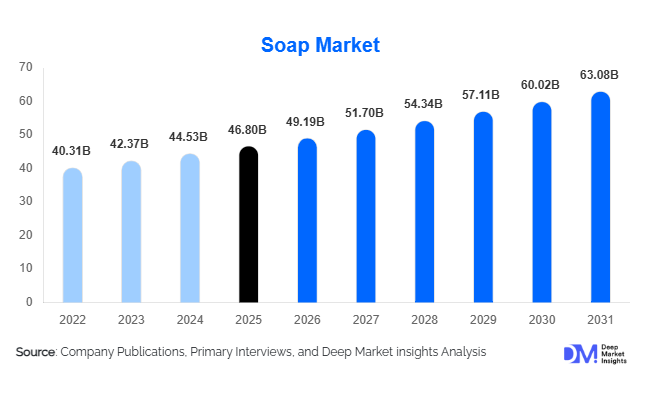
According to Deep Market Insights, the global soap market size was valued at USD 46.8 billion in 2025 and is projected to grow from USD 49.19 billion in 2026 to reach USD 63.08 billion by 2031, expanding at a CAGR of 5.1% during the forecast period (2026–2031). The soap market growth is primarily driven by rising consumer awareness regarding personal hygiene, increasing demand for premium and skin-friendly cleansing products, and growing adoption of natural and sustainable soap formulations across residential and institutional applications. Continuous product innovation, expanding e-commerce penetration, and the increasing popularity of herbal, organic, and dermatologically tested soaps are further supporting long-term market expansion worldwide.
Key Market Insights
- Bar soap continues to dominate the global market, accounting for over 40% of total revenue due to its affordability, widespread availability, and strong consumer preference across emerging economies.
- Natural, organic, and herbal soaps are the fastest-growing product categories, supported by increasing consumer preference for clean-label ingredients, plant-based formulations, and sustainable personal care products.
- Asia-Pacific remains the largest regional market, led by China, India, Indonesia, and Japan, owing to high population density, expanding middle-class spending, and extensive retail penetration.
- Premiumization is reshaping mature markets, with consumers in North America and Europe increasingly purchasing moisturizing, fragrance-rich, vegan, and specialty soaps offering additional skincare benefits.
- Institutional demand from healthcare, hospitality, foodservice, and commercial facilities continues to increase, driving sales of antibacterial liquid soaps, refill systems, and dispenser-based hygiene solutions.
- Digital commerce and direct-to-consumer channels are transforming product distribution, allowing premium, artisanal, and niche soap manufacturers to expand globally while improving customer engagement through personalized marketing.
Soap Market Trends
Premium, Natural, and Sustainable Soap Products Continue to Gain Momentum
Consumers are increasingly replacing conventional cleansing products with soaps formulated using naturally derived ingredients, essential oils, botanical extracts, and biodegradable materials. Growing awareness regarding skin sensitivity, environmental sustainability, and chemical-free personal care has accelerated demand for herbal, vegan, sulfate-free, paraben-free, and organic soaps across both developed and emerging markets. Manufacturers are expanding premium product portfolios featuring activated charcoal, goat milk, shea butter, aloe vera, turmeric, neem, lavender, and other functional ingredients that provide skincare benefits beyond cleansing. Sustainable packaging innovations, including recyclable paper cartons, refillable liquid soap systems, and plastic-free packaging, are becoming key competitive differentiators as environmental consciousness continues to influence purchasing decisions. Companies are also investing in responsibly sourced palm oil, carbon-neutral manufacturing, and cruelty-free certifications to strengthen brand positioning among environmentally conscious consumers.
Digital Retail and Personalized Consumer Engagement are Reshaping the Industry
E-commerce has become one of the fastest-growing sales channels within the global soap market. Consumers increasingly purchase soaps through online marketplaces, brand-owned websites, and subscription-based platforms that provide convenience, broader product selection, and customized recommendations. Artificial intelligence-powered product suggestions, digital skin assessments, subscription refill programs, and social media marketing are improving customer acquisition and retention rates. Premium artisanal soap manufacturers have particularly benefited from direct-to-consumer business models, allowing smaller brands to compete effectively alongside multinational FMCG companies. Influencer marketing, limited-edition product launches, personalized fragrance selections, and gift-oriented packaging have further strengthened online demand, particularly among younger demographics seeking differentiated personal care experiences.
Soap Market Drivers
Growing Global Awareness of Personal Hygiene
Personal hygiene remains the most significant long-term growth driver for the global soap market. Increased awareness regarding handwashing, disease prevention, and overall personal cleanliness continues to support strong consumption across residential, healthcare, educational, hospitality, and commercial sectors. Governments, healthcare organizations, and educational institutions continue promoting regular hand hygiene through awareness campaigns, encouraging consistent soap usage across both developed and developing economies. Population growth, urbanization, and rising household disposable incomes further contribute to increasing per-capita soap consumption. Institutional procurement from hospitals, hotels, airports, offices, and foodservice establishments has also expanded considerably as organizations strengthen hygiene protocols and workplace health standards.
Premiumization Across Personal Care Products
Consumers are increasingly viewing soap as an extension of skincare rather than merely a cleansing product. This shift has significantly increased demand for premium beauty soaps, moisturizing formulations, aromatherapy soaps, and dermatologically tested products offering multiple skincare benefits. Manufacturers continue investing in research and development to introduce multifunctional soaps incorporating anti-aging ingredients, probiotics, vitamins, antioxidants, essential oils, and naturally derived moisturizers. Premium products generate substantially higher profit margins while strengthening customer loyalty through differentiated product positioning. The premiumization trend is particularly pronounced across North America, Western Europe, Japan, South Korea, Australia, and affluent urban populations throughout Asia-Pacific.
Soap Market Restraints
Volatility in Raw Material and Packaging Costs
Soap manufacturers remain highly exposed to fluctuations in raw material prices, particularly vegetable oils such as palm oil, coconut oil, olive oil, and other natural fats used during soap manufacturing. Price volatility resulting from climatic conditions, geopolitical disruptions, supply chain constraints, and agricultural production variability directly impacts manufacturing costs and operating margins. In addition, increasing prices of fragrances, specialty chemicals, paper packaging, recycled plastics, transportation, and energy continue creating cost pressures throughout the value chain. Smaller regional manufacturers often face greater financial challenges in absorbing these cost increases compared to multinational companies with diversified sourcing capabilities.
Intense Competition and Product Commoditization
The global soap market remains highly competitive, with numerous multinational FMCG companies competing alongside regional manufacturers, private-label producers, and artisanal brands. While competition encourages product innovation, it also intensifies pricing pressure and limits margin expansion in mass-market categories. Consumer loyalty remains relatively low within economy soap segments, making promotional pricing and retail discounting common strategies across supermarkets and hypermarkets. New market entrants also face significant challenges in establishing brand recognition, securing retail shelf space, and differentiating products within an increasingly crowded marketplace. Maintaining long-term profitability therefore requires continuous investment in innovation, branding, sustainability, and digital consumer engagement.
Soap Market Opportunities
Expansion of Natural, Herbal, and Functional Soap Categories
The strongest growth opportunity within the global soap market lies in expanding natural, herbal, Ayurvedic, organic, and functional soap portfolios. Consumers increasingly seek products formulated with botanical ingredients offering skincare benefits such as hydration, acne prevention, anti-inflammatory properties, and sensitive skin protection. Premium herbal soaps featuring neem, turmeric, tea tree oil, activated charcoal, aloe vera, sandalwood, lavender, and shea butter continue recording above-average growth rates across developed and emerging markets. Manufacturers that successfully combine natural ingredients with clinically validated skincare performance are expected to capture significant market share while achieving higher operating margins than conventional soap categories.
Institutional Hygiene Solutions and Smart Dispensing Systems
Healthcare facilities, hospitality providers, educational institutions, airports, restaurants, manufacturing facilities, and commercial offices continue increasing investments in workplace hygiene infrastructure. This trend presents substantial opportunities for manufacturers supplying liquid soaps, antibacterial formulations, automated dispensers, refill cartridges, and touchless hygiene systems. Demand for institutional hygiene products is expected to remain structurally strong as organizations continue prioritizing employee health, regulatory compliance, and public sanitation standards. Companies capable of providing integrated hygiene management solutions alongside long-term supply contracts are likely to benefit from stable recurring revenues and higher customer retention.
Report Scope
| Report Metric | Details |
|---|---|
| Market Size in 2025 | USD 46.8 Billion |
| Market Size in 2026 | USD 49.19 Billion |
| Market Size in 2031 | USD 63.08 Billion |
| CAGR | 5.1% (2026-2031) |
| Base Year for Estimation | 2025 |
| Historical Data | 2022-2024 |
| Forecast Period | 2026-2031 |
| Report Coverage | Revenue Forecast, Competitive Landscape, Supply Chain Disruption, Growth Factors, Environment & Regulatory Landscape and Trends |
| Geographies Covered | North America, Europe, APAC, Middle East and Africa, LATAM |
| Countries Covered | U.S., Canada, U.K., Germany, France, Spain, Italy, Russia, Nordic, Benelux, Rest of Europe, China, Korea, Japan, India, Australia, Singapore, Taiwan, South East Asia, Rest of Asia-Pacific, UAE, Turky, Saudi Arabia, South Africa, Egypt, Nigeria, Rest of MEA, Brazil, Mexico, Argentina, Chile, Colombia, Rest of LATAM |
Explore more data points, trends and opportunities Download Free Sample Report
Product Type Insights
Bar soap remains the largest product segment in the global soap market, accounting for approximately 41% of the total market revenue in 2025. The segment continues to dominate due to its affordability, longer shelf life, ease of transportation, and widespread availability across both developed and emerging economies. Bar soaps remain the preferred choice in Asia-Pacific, Africa, and Latin America, where household penetration is exceptionally high and consumers prioritize value-oriented products. Manufacturers continue introducing moisturizing, antibacterial, herbal, and beauty-oriented bar soaps to maintain consumer interest while improving product differentiation.
Liquid hand soap represents the fastest-growing product category, driven by increasing adoption across residential, healthcare, hospitality, and commercial environments. Growing installation of dispenser-based hygiene systems in offices, hospitals, airports, educational institutions, restaurants, and shopping malls has accelerated demand for liquid formulations. Body wash and shower gel products are also experiencing robust growth, particularly among younger consumers seeking premium skincare experiences. Specialty soaps, including activated charcoal, sulfur, glycerin, baby soap, medicated, and exfoliating variants, continue expanding their market presence as consumers increasingly seek products targeting specific skin concerns.
Ingredient Type Insights
Conventional soaps continue to dominate the global soap market, representing nearly 63% of total revenue in 2025, supported by their affordability, extensive distribution networks, and strong consumer familiarity. These products remain particularly popular across price-sensitive markets where purchasing decisions are primarily influenced by cost and brand recognition. Large multinational manufacturers continue investing in fragrance innovation and improved formulations to sustain demand within this mature category.
Natural and organic soaps are projected to record the highest growth throughout the forecast period. Consumers are increasingly preferring formulations containing plant-derived oils, essential oils, herbal extracts, naturally sourced fragrances, and biodegradable ingredients while avoiding sulfates, parabens, synthetic dyes, and harsh preservatives. Ayurvedic and herbal soap categories continue gaining strong momentum across India, Southeast Asia, Europe, and North America, driven by increasing awareness regarding wellness and clean-label personal care products. Vegan soaps certified as cruelty-free and sustainably manufactured are also attracting environmentally conscious consumers, creating opportunities for premium pricing and stronger brand differentiation.
Distribution Channel Insights
Supermarkets and hypermarkets remain the leading distribution channel, contributing approximately 38% of the global soap market revenue in 2025. Consumers continue preferring these retail formats because they offer extensive product variety, promotional pricing, attractive product displays, and convenient one-stop shopping experiences. Large retail chains also provide manufacturers with significant opportunities for product launches, promotional campaigns, and premium shelf positioning.
Online retail is the fastest-growing distribution channel as consumers increasingly purchase personal care products through e-commerce platforms and direct-to-consumer websites. Digital platforms enable consumers to compare products, review ingredients, access subscription services, and purchase premium or specialty soaps unavailable through traditional retail stores. Pharmacies and drug stores remain important channels for medicated, antibacterial, dermatologist-recommended, and sensitive-skin products, while specialty beauty retailers continue supporting premium skincare-focused soap brands. Institutional sales through wholesalers also continue expanding as hospitals, hotels, educational institutions, manufacturing facilities, and corporate offices increasingly procure soaps through long-term supply agreements.
End-User Insights
The residential and household segment accounted for nearly 72% of the global soap market in 2025, making it the largest end-user category. Daily personal hygiene routines, population growth, urbanization, and rising disposable incomes continue supporting strong household consumption worldwide. Manufacturers continue introducing family-sized packaging, refill packs, premium beauty soaps, and multifunctional products designed to address diverse consumer preferences across various income groups.
Healthcare facilities represent one of the fastest-growing institutional end-use segments. Hospitals, clinics, diagnostic laboratories, nursing homes, and healthcare centers continue strengthening infection prevention measures through increased procurement of antibacterial liquid soaps and automated dispensing systems. The hospitality industry, including hotels, resorts, cruise operators, and serviced apartments, also remains a significant consumer of premium soap products as tourism activity continues recovering globally. Demand from foodservice establishments, educational institutions, commercial offices, industrial manufacturing facilities, and public infrastructure projects continues expanding as organizations prioritize workplace hygiene and employee health.
Price Tier Insights
Mid-range soap products continue leading the global market with approximately 46% revenue share in 2025. This segment successfully balances affordability, product quality, fragrance variety, and skincare functionality, making it attractive to middle-income households worldwide. Manufacturers increasingly position mid-priced products with added moisturizing ingredients, improved fragrances, herbal extracts, and dermatological benefits while maintaining competitive pricing.
Premium soaps represent the fastest-growing price segment due to increasing consumer willingness to invest in high-quality personal care products. Premium formulations featuring essential oils, natural botanicals, luxury fragrances, organic certifications, and sustainable packaging continue generating above-average revenue growth across developed economies. Luxury artisanal soaps are also expanding steadily through online retail channels, gift packaging, and boutique personal care stores. Economy soaps continue maintaining strong demand across emerging economies due to affordability and high-volume household consumption.
Explore more data points, trends and opportunities Download Free Sample Report
Soap Market Segmentations
By Product Type
- Bar Soap
- Liquid Hand Soap
- Body Wash / Shower Gel
- Foaming Soap
- Medicated / Antibacterial Soap
- Beauty Soap
- Laundry Soap Bars
- Specialty Soaps
By Ingredient Type
- Conventional Soap
- Natural & Organic Soap
- Herbal / Ayurvedic Soap
- Vegan Soap
- Glycerin-Based Soap
- Hypoallergenic / Sensitive Skin Soap
By Distribution Channel
- Supermarkets & Hypermarkets
- Convenience Stores
- Pharmacies & Drug Stores
- Online Retail / E-commerce
- Direct-to-Consumer (D2C)
- Specialty Beauty Stores
- Wholesale / Institutional Sales
By End User
- Residential / Household
- Hotels & Hospitality
- Healthcare Facilities
- Foodservice & Restaurants
- Commercial Offices
- Educational Institutions
- Industrial & Manufacturing Facilities
By Price Tier
- Economy
- Mid-Range
- Premium
- Luxury / Artisanal
Regional Insights
Asia-Pacific
Asia-Pacific dominated the global soap market in 2025, accounting for approximately 41% of total market revenue. The region's leadership is supported by its large population base, rising urbanization, expanding middle-class income, and well-established FMCG distribution networks. China represents the largest regional market due to its enormous consumer base, increasing demand for premium personal care products, and continuous product innovation by domestic and multinational manufacturers. India is the second-largest market and also the fastest-growing major country, supported by increasing hygiene awareness, strong rural market penetration, expanding organized retail, and growing consumer preference for herbal and Ayurvedic soaps. Japan and South Korea continue driving premiumization through skincare-focused cleansing products, while Indonesia, Vietnam, Thailand, and the Philippines remain high-growth Southeast Asian markets benefiting from rising disposable incomes and improving retail infrastructure.
North America
North America accounted for nearly 24% of the global soap market in 2025, with the United States contributing the overwhelming majority of regional demand. Consumers increasingly prefer premium, moisturizing, dermatologist-tested, organic, vegan, and fragrance-enhanced soap products. Liquid hand soaps and body washes continue gaining market share owing to widespread adoption in residential households and institutional settings. Canada also demonstrates strong demand for sustainable personal care products, refillable soap systems, and environmentally friendly packaging. Continued product innovation, strong retail penetration, and advanced digital commerce platforms support long-term regional growth.
Europe
Europe represented approximately 22% of the global soap market in 2025. Germany, the United Kingdom, France, Italy, and Spain remain the region's largest markets, supported by high consumer awareness regarding personal care, premium skincare, and sustainable products. European consumers increasingly prefer soaps formulated with natural ingredients, essential oils, biodegradable formulations, and certified organic components. Regulatory emphasis on ingredient transparency, environmental sustainability, and responsible sourcing continues encouraging manufacturers to develop innovative premium products. Western Europe remains particularly attractive for luxury and artisanal soap manufacturers targeting affluent consumers seeking skincare-focused cleansing solutions.
Latin America
Latin America accounted for nearly 8% of global soap market revenue in 2025, led by Brazil, Mexico, and Argentina. Brazil remains the largest regional consumer owing to its sizeable cosmetics and personal care industry, high frequency of soap usage, and strong preference for fragranced beauty soaps. Mexico continues experiencing steady demand growth supported by urbanization, expanding retail distribution, and increasing household purchasing power. Regional manufacturers are also introducing herbal and moisturizing soap formulations to capture growing premium demand while maintaining affordability across mass-market consumer segments.
Middle East & Africa
The Middle East & Africa accounted for approximately 5% of the global market in 2025, with Saudi Arabia, the United Arab Emirates, South Africa, Egypt, and Nigeria serving as the primary demand centers. Rising urban populations, improving healthcare infrastructure, expanding hospitality industries, and increasing hygiene awareness continue supporting regional market growth. Premium soap products are gaining popularity across Gulf Cooperation Council countries due to higher disposable incomes and growing demand for luxury personal care products. Meanwhile, African markets continue witnessing increasing consumption of economy and mid-range soap products driven by population growth, improving retail accessibility, and government-led public hygiene initiatives. The Middle East & Africa region is expected to register one of the fastest growth rates globally during the forecast period, supported by expanding institutional demand and rising investments in FMCG manufacturing facilities.
Key Players in the Soap Market
- Unilever PLC
- Procter & Gamble
- Colgate-Palmolive Company
- Henkel AG & Co. KGaA
- Kao Corporation
- Lion Corporation
- Godrej Consumer Products Limited
- Reckitt plc
- Beiersdorf AG
- Johnson & Johnson
- PZ Cussons plc
- Wipro Consumer Care & Lighting
- L'Oréal Group
- Yunnan Baiyao Group
- The Body Shop International Limited