Hotel Toiletries Market Size
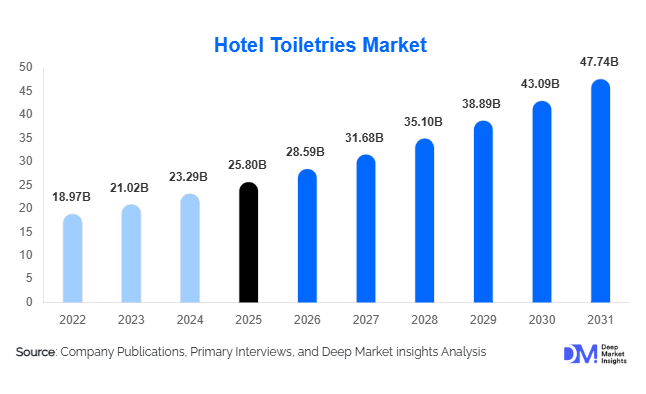
According to Deep Market Insights, the global hotel toiletries market size was valued at USD 25.8 billion in 2025 and is projected to grow from USD 28.59 billion in 2026 to reach USD 47.74 billion by 2031, expanding at a CAGR of 10.8% during the forecast period (2026–2031). Market growth is primarily driven by the expansion of global hospitality infrastructure, increasing hotel occupancy rates, rising demand for premium guest amenities, and the accelerating transition toward sustainable and refillable toiletry solutions. Hotels are increasingly using branded and wellness-oriented amenities as a competitive differentiator, while regulatory pressure to reduce single-use plastic waste is encouraging investment in eco-friendly packaging and dispenser systems.
Key Market Insights
- Sustainability initiatives are reshaping hotel amenity programs, with refillable dispensers and biodegradable packaging rapidly replacing traditional single-use bottles.
- Luxury and upscale hotels remain the largest consumers of premium toiletries, accounting for the highest per-room spending on guest amenities globally.
- North America dominates the global hotel toiletries market, supported by a mature hospitality industry and strong adoption of premium branded amenities.
- Asia-Pacific is the fastest-growing regional market, driven by hotel construction activity, tourism growth, and rising disposable incomes.
- Natural, organic, and vegan formulations are gaining market share as travelers increasingly seek wellness-oriented and environmentally responsible products.
- Strategic partnerships between hotels and premium personal care brands are becoming a major differentiator in enhancing guest experience and brand loyalty.
Hotel Toiletries Market Trends
Transition Toward Sustainable and Refillable Amenities
One of the most significant trends in the hotel toiletries market is the widespread transition toward refillable dispenser systems and environmentally responsible packaging. Governments across North America and Europe have introduced regulations limiting the use of small single-use plastic bottles in hotels, prompting operators to redesign their amenity programs. Large hotel chains are implementing wall-mounted dispensers, refillable containers, biodegradable packaging, and recycled plastic solutions to reduce waste generation. Beyond regulatory compliance, sustainability initiatives are increasingly influencing booking decisions, particularly among younger and environmentally conscious travelers. Hotels adopting sustainable amenity programs benefit from improved brand perception, reduced operating costs, and stronger ESG performance metrics.
Premiumization and Wellness-Oriented Guest Experiences
Hotel toiletries are evolving from basic guest necessities into premium hospitality touchpoints. Luxury hotels, resorts, and boutique properties are introducing high-end skincare, aromatherapy products, organic formulations, and spa-inspired amenities designed to enhance guest satisfaction. Wellness tourism trends are influencing procurement strategies, with hotels increasingly partnering with luxury cosmetic and personal care brands. Products containing botanical extracts, essential oils, sulfate-free ingredients, and dermatologically tested formulations are gaining popularity. This trend is helping hotels differentiate their offerings while allowing manufacturers to command premium pricing and improve profit margins.
Hotel Toiletries Market Drivers
Growth in Global Tourism and Hotel Occupancy
Increasing international and domestic travel activity continues to drive demand for hotel toiletries. Rising occupancy rates across hotels, resorts, serviced apartments, and vacation properties directly increase amenity consumption volumes. The recovery of business travel, expansion of leisure tourism, and growth in emerging hospitality markets such as India, Vietnam, Saudi Arabia, and Indonesia are contributing significantly to market expansion. New hotel developments and room inventory additions create long-term procurement opportunities for toiletries suppliers.
Rising Demand for Premium Hospitality Experiences
Hotels are increasingly competing through guest experience differentiation rather than pricing alone. Premium toiletries have become a key component of customer satisfaction strategies, online review performance, and brand positioning. Luxury and upscale hotels are investing in branded amenities featuring exclusive fragrances, organic ingredients, and customized packaging. Travelers increasingly associate high-quality toiletries with overall service standards, encouraging hotels to allocate larger budgets toward amenity programs and premium partnerships.
Hotel Toiletries Market Restraints
Volatility in Raw Material and Packaging Costs
Manufacturers face ongoing challenges associated with fluctuations in the prices of surfactants, fragrances, specialty chemicals, packaging materials, and transportation. Rising costs of sustainable packaging solutions can place additional pressure on margins, particularly for suppliers operating under fixed-price hospitality contracts. Smaller manufacturers are especially vulnerable to cost inflation due to limited purchasing power and lower economies of scale.
Intense Competition and Pricing Pressure
The hotel toiletries market remains highly competitive, with numerous regional and international suppliers competing for hospitality contracts. Midscale and economy hotel operators often prioritize cost efficiency over premium features, resulting in significant pricing pressure across large-volume procurement contracts. Market participants must continuously balance innovation, sustainability, and product quality while maintaining competitive pricing structures to secure long-term agreements with hotel chains.
Hotel Toiletries Market Opportunities
Expansion of Sustainable Hospitality Programs
The increasing adoption of environmental sustainability programs across global hotel chains presents substantial growth opportunities for toiletries manufacturers. Suppliers offering biodegradable products, plastic-free packaging, refillable systems, and carbon-neutral production processes are well-positioned to secure long-term contracts. Hotels seeking to improve ESG performance and comply with evolving environmental regulations are expected to accelerate investments in sustainable amenities throughout the forecast period.
Growth of Wellness and Luxury Tourism
The rapid expansion of wellness tourism is creating demand for premium and therapeutic personal care products within hospitality environments. Hotels are increasingly introducing spa-inspired toiletries featuring aromatherapy oils, botanical ingredients, and wellness-focused formulations. Manufacturers capable of developing customized luxury product lines for hospitality brands can benefit from higher margins and stronger customer loyalty. Wellness-oriented amenities are becoming a key differentiator among luxury resorts, wellness retreats, and boutique properties.
Report Scope
| Report Metric | Details |
|---|---|
| Market Size in 2025 | USD 25.8 Billion |
| Market Size in 2026 | USD 28.59 Billion |
| Market Size in 2031 | USD 47.74 Billion |
| CAGR | 10.8% (2026-2031) |
| Base Year for Estimation | 2025 |
| Historical Data | 2022-2024 |
| Forecast Period | 2026-2031 |
| Report Coverage | Revenue Forecast, Competitive Landscape, Supply Chain Disruption, Growth Factors, Environment & Regulatory Landscape and Trends |
| Geographies Covered | North America, Europe, APAC, Middle East and Africa, LATAM |
| Countries Covered | U.S., Canada, U.K., Germany, France, Spain, Italy, Russia, Nordic, Benelux, Rest of Europe, China, Korea, Japan, India, Australia, Singapore, Taiwan, South East Asia, Rest of Asia-Pacific, UAE, Turky, Saudi Arabia, South Africa, Egypt, Nigeria, Rest of MEA, Brazil, Mexico, Argentina, Chile, Colombia, Rest of LATAM |
Explore more data points, trends and opportunities Download Free Sample Report
Product Type Insights
Shampoo and conditioner products dominate the global hotel toiletries market, accounting for approximately 22.5% of total market revenue in 2025. Their leadership position is primarily driven by universal guest usage, mandatory inclusion across virtually all hotel categories, and high replenishment frequency. Unlike discretionary amenities, shampoo and conditioner are considered essential guest consumables, resulting in stable recurring demand regardless of hotel positioning. Growth within this segment is increasingly supported by the introduction of sulfate-free, paraben-free, organic, and botanical formulations that align with rising consumer preference for wellness-oriented personal care products. Luxury and upscale hotels are increasingly partnering with premium cosmetic brands to offer exclusive haircare collections, further strengthening segment value growth.
Body wash and liquid soap products represent the second-largest product category and continue to gain market share due to the ongoing transition away from traditional bar soaps. Hotels increasingly favor liquid formulations because they improve hygiene standards, support refillable dispenser systems, and reduce product wastage. Premium body lotions and skincare products are among the fastest-growing categories, particularly within luxury hotels, resorts, and wellness-focused properties where personalized guest experiences are a key competitive differentiator. Demand for oral care kits, shaving amenities, vanity kits, and specialty wellness products is also expanding as hotels seek to enhance guest satisfaction scores and strengthen brand loyalty through comprehensive amenity offerings.
Packaging Format Insights
Refillable dispenser systems lead the packaging segment, accounting for nearly 34% of global market revenues. The segment's dominance is largely driven by increasing sustainability regulations, rising environmental awareness among travelers, and the significant operational cost savings achieved by hotel operators. Many international hotel chains have established corporate sustainability targets focused on reducing single-use plastic consumption, accelerating the deployment of wall-mounted dispensers across thousands of properties worldwide. In addition to lowering packaging waste, refillable systems reduce housekeeping replenishment costs and improve inventory efficiency.
While refillable solutions are becoming the industry standard, single-use bottles continue to maintain demand within luxury, boutique, and premium hospitality segments where individualized presentation remains an important component of guest experience. Eco-refill cartridges and premium glass packaging solutions are also witnessing increased adoption among high-end properties seeking to combine sustainability objectives with luxury aesthetics. Looking forward, regulatory restrictions on single-use plastics across North America, Europe, and parts of Asia-Pacific are expected to further accelerate the transition toward reusable packaging systems.
Hotel Category Insights
Luxury hotels account for approximately 28% of total hotel toiletries consumption globally, making them the leading hotel category within the market. The segment's leadership is driven by significantly higher per-room spending on guest amenities compared to midscale or economy properties. Luxury operators increasingly view toiletries as an extension of their brand identity and guest experience strategy, resulting in greater investment in premium formulations, designer packaging, and partnerships with internationally recognized personal care brands. The growth of luxury tourism, wellness travel, and experiential hospitality continues to strengthen demand for high-value amenity programs.
Upscale hotels and resort properties also represent major demand centers due to their focus on guest satisfaction and premium service delivery. Resort destinations frequently provide expanded amenity portfolios that include body lotions, spa products, aromatherapy items, and wellness-oriented toiletries. Boutique and lifestyle hotels are increasingly adopting customized and co-branded amenity programs to create unique customer experiences and differentiate themselves within competitive hospitality markets. Meanwhile, midscale and economy hotels continue to prioritize cost-efficient procurement strategies while maintaining adequate quality standards to support customer retention.
Procurement Model Insights
Third-party branded toiletries represent approximately 42% of global market revenues, making them the dominant procurement model worldwide. The segment's leadership is driven by hotels' increasing preference for partnering with established personal care brands that already possess strong consumer recognition and product credibility. Premium amenity brands enable hotels to enhance guest perception while reducing the costs associated with developing proprietary formulations. International hotel chains particularly favor branded products because they support standardized guest experiences across geographically diverse property portfolios.
Private-label and hotel-branded toiletries continue to gain traction among large hospitality groups seeking greater control over branding, customer engagement, and procurement costs. Co-branded amenity programs are emerging as a notable trend within luxury hospitality, combining the reputation of leading cosmetic brands with the unique identity of hotel operators. These collaborations create differentiation opportunities while delivering premium guest experiences that can positively influence customer reviews and repeat visitation rates.
Distribution Channel Insights
Hospitality procurement contracts dominate the distribution landscape, accounting for approximately 46% of total market revenues. Their leadership stems from the highly structured purchasing practices employed by major hotel chains, which typically negotiate long-term agreements to secure product consistency, quality assurance, and pricing stability across multiple properties. Contract-based procurement also allows hotel operators to optimize inventory management, improve supply chain visibility, and maintain compliance with corporate sustainability standards.
Hotel supply distributors continue to play a critical role in serving independent hotels, boutique properties, and regional hospitality operators that may lack centralized procurement capabilities. Direct manufacturer sales are expanding as suppliers increasingly pursue strategic partnerships with global hotel brands. Meanwhile, digital procurement platforms are transforming purchasing processes by improving transparency, streamlining vendor selection, and enabling real-time inventory management. The growing adoption of hospitality-focused e-procurement solutions is expected to further improve procurement efficiency throughout the forecast period.
Explore more data points, trends and opportunities Download Free Sample Report
Hotel Toiletries Market Segmentations
By Product Type
- Shampoo
- Conditioner
- Combined Shampoo & Conditioner
- Body Wash/Shower Gel
- Bar Soap
- Liquid Hand Soap
- Body Lotion/Moisturizer
- Facial Cleanser
- Oral Care Products
- Shaving Amenities
- Vanity Kits
- Hair Care Accessories
- Specialty Wellness Toiletries
By Packaging Format
- Single-Use Bottles & Sachets
- Refillable Dispenser Systems
- Wall-Mounted Bulk Dispensers
- Eco-Pack Refill Cartridges
- Premium Glass Containers
By Ingredient Category
- Conventional Formulations
- Natural Formulations
- Organic Formulations
- Vegan Formulations
- Hypoallergenic Formulations
- Medicated/Functional Formulations
By Hotel Category
- Luxury Hotels
- Upscale Hotels
- Midscale Hotels
- Economy Hotels
- Boutique Hotels
- Lifestyle Hotels
- Extended-Stay Hotels
- Resort Hotels
By Distribution Channel
- Direct Manufacturer Sales
- Hospitality Procurement Contracts
- Hotel Supply Distributors
- E-Procurement Platforms
- Hospitality Wholesalers
Regional Insights
North America
North America accounted for approximately 34% of the global hotel toiletries market in 2025, making it the largest regional market. The United States alone contributes nearly 28% of global demand, supported by one of the world's largest hotel infrastructures, strong occupancy rates, and widespread adoption of premium guest amenities. The region's market leadership is further driven by high consumer expectations regarding hospitality experiences, encouraging hotels to invest in branded, sustainable, and wellness-oriented toiletry programs. Regulatory initiatives aimed at reducing single-use plastic waste are accelerating the transition toward refillable dispenser systems, particularly among large hotel chains. Canada continues to support regional growth through expanding luxury resort developments, eco-tourism investments, and increasing demand for wellness-focused hospitality experiences.
Europe
Europe represents approximately 29% of global market revenues, making it the second-largest regional market. Germany, the United Kingdom, France, Italy, and Spain collectively account for the majority of regional demand due to their large tourism sectors and extensive hotel networks. Growth across Europe is strongly supported by stringent environmental regulations that encourage adoption of biodegradable products, recyclable packaging, and refillable amenity systems. European consumers also demonstrate a strong preference for organic, natural, and ethically sourced personal care products, prompting hotels to upgrade their amenity portfolios. The region's mature hospitality industry, combined with strong inbound tourism flows and increasing luxury travel activity, continues to drive premium toiletries demand.
Asia-Pacific
Asia-Pacific accounts for approximately 24% of global market revenues and remains the fastest-growing regional market, with forecast growth exceeding 12% annually. China, India, Japan, Thailand, Indonesia, Vietnam, and Australia are major contributors to regional demand. The primary growth driver is unprecedented hotel construction activity across emerging tourism destinations, supported by government investments in tourism infrastructure and rising international visitor arrivals. Expanding middle-class populations, growing disposable incomes, and increasing domestic tourism are generating substantial demand for hotel amenities across both premium and midscale hospitality segments.
India is among the fastest-growing national markets globally, benefiting from rapid expansion of branded hotel chains, strong domestic travel demand, government tourism promotion programs, and increasing foreign investment in hospitality infrastructure. China continues to drive significant volume demand through its extensive hotel development pipeline, while Southeast Asian tourism destinations are witnessing rising demand for premium and sustainable amenity solutions.
Latin America
Latin America accounts for approximately 6% of global hotel toiletries demand, led by Brazil, Mexico, Argentina, Chile, and Colombia. Regional growth is primarily driven by tourism recovery, increasing international hotel investments, and the expansion of resort-focused hospitality developments. Mexico benefits from strong inbound tourism, particularly across beach destinations and luxury resorts, while Brazil continues to attract investment in both business and leisure hospitality infrastructure. The growing presence of international hotel chains is increasing demand for standardized branded amenities and sustainable toiletry solutions. Rising consumer spending on travel and hospitality services is expected to support steady long-term market expansion across the region.
Middle East & Africa
The Middle East & Africa region represents approximately 7% of global market revenues and is emerging as one of the most attractive long-term growth markets. Saudi Arabia and the United Arab Emirates are the primary growth engines, supported by large-scale tourism diversification initiatives, luxury hospitality developments, and government-backed infrastructure projects. Programs such as Saudi Vision 2031 are accelerating hotel construction, resort development, and international tourism promotion, creating substantial demand for premium hotel amenities.
Within Africa, South Africa remains the largest demand center due to its established hospitality industry and strong tourism sector. Additional growth opportunities are emerging across Morocco, Egypt, Kenya, and Tanzania as international tourism rebounds and hotel investments increase. The region's expanding luxury hospitality sector, combined with rising visitor arrivals and growing adoption of international hotel standards, is expected to significantly increase demand for premium, branded, and sustainable toiletries over the forecast period.
Key Players in the Hotel Toiletries Market
- Unilever PLC
- La Bottega S.p.A.
- Vanity Group
- Guest Supply
- Kimirica Hunter International
- Gilchrist & Soames
- ADA Cosmetics
- Accent Amenities
- Essential Amenities Inc.
- Hunter Amenities
- Molton Brown
- HD Fragrances
- LATHER
- Hotel Emporium
- Pineapple Hospitality