Walk-in Refrigerators Market Size
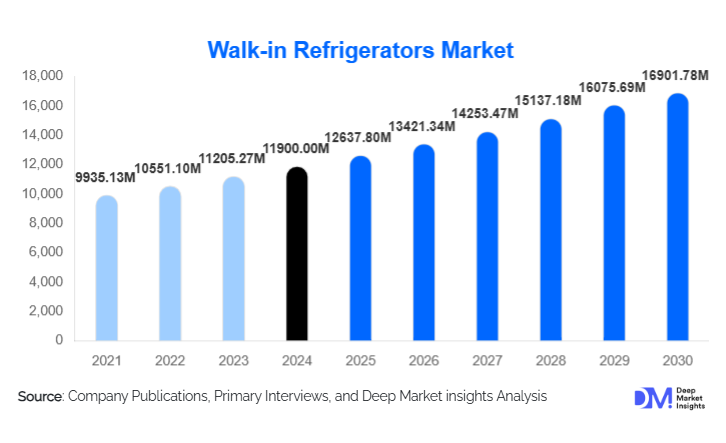
According to Deep Market Insights, the global walk-in refrigerators market size was valued at USD 11,900.00 million in 2025 and is projected to grow from USD 12,637.80 million in 2026 to reach USD 16,901.78 million by 2031, expanding at a CAGR of 6.2% during the forecast period (2026–2031). The walk-in refrigerators market growth is primarily driven by the rapid expansion of cold-chain infrastructure, rising demand from foodservice and pharmaceutical industries, and increasing adoption of energy-efficient and smart refrigeration systems across both developed and emerging economies.
Key Market Insights
- Foodservice and hospitality remain the largest demand drivers, supported by the global expansion of quick-service restaurants, hotels, and catering services.
- Energy-efficient and low-GWP refrigeration systems are gaining prominence as governments tighten environmental and energy regulations.
- North America dominates the global market, driven by replacement demand, pharmaceutical cold-chain investments, and strict food safety standards.
- Asia-Pacific is the fastest-growing region, supported by cold storage capacity additions in China, India, and Southeast Asia.
- Medium-temperature walk-in units account for the largest share, reflecting strong demand for chilled food and pharmaceutical storage.
- IoT-enabled and modular walk-in refrigeration systems are reshaping procurement decisions by offering predictive maintenance and operational efficiency.
Walk-in Refrigerators Market Trends
Shift Toward Energy-Efficient and Sustainable Refrigeration
Energy efficiency has become a central focus in the walk-in refrigerators market as operators seek to reduce operating costs and comply with increasingly stringent regulations. Manufacturers are investing in high-performance insulation materials such as PIR and advanced PUF panels, along with inverter-driven compressors and natural refrigerants like CO₂ and ammonia. Sustainability-driven procurement is particularly strong in Europe and North America, where eco-design and energy labeling regulations influence purchasing decisions. This trend is also accelerating retrofit and replacement demand, as older systems are phased out in favor of compliant, lower-energy alternatives.
Technology-Enabled Smart Walk-in Refrigeration Systems
Digitalization is transforming walk-in refrigerators into intelligent cold-storage assets. IoT-enabled temperature monitoring, cloud-based compliance reporting, and predictive maintenance systems are increasingly integrated into new installations. These features are especially critical for pharmaceutical, healthcare, and food processing applications where temperature deviations can lead to significant losses. Smart walk-in systems improve uptime, reduce energy waste, and enable remote asset management, making them highly attractive to large retail chains and logistics operators managing multiple locations.
Walk-in Refrigerators Market Drivers
Expansion of Foodservice and Organized Retail
The rapid growth of organized retail formats, including supermarkets, hypermarkets, and convenience stores, is a key driver of walk-in refrigerator demand. Foodservice operators require reliable, high-capacity refrigeration for perishable goods, while retail chains increasingly rely on centralized and back-of-store cold storage. The rise of cloud kitchens and dark stores has further increased demand for compact, modular walk-in refrigeration systems in urban areas.
Growth of Pharmaceutical and Healthcare Cold Chains
Pharmaceutical products such as vaccines, biologics, and specialty drugs require strict temperature control throughout storage and distribution. Increased healthcare spending, expanded immunization programs, and growth in biologics manufacturing have significantly boosted demand for walk-in refrigerators in hospitals, laboratories, and pharmaceutical warehouses. This segment benefits from high compliance requirements, making it a high-value and resilient demand driver.
Walk-in Refrigerators Market Restraints
High Initial Capital Investment
Walk-in refrigeration systems require substantial upfront investment, including insulated panels, refrigeration units, installation, and electrical infrastructure. This high capital requirement can deter small foodservice operators and independent retailers, particularly in developing markets. Although long-term energy savings can offset costs, initial affordability remains a challenge.
Volatility in Raw Material Prices
Fluctuations in the prices of steel, aluminum, insulation foams, and refrigerants directly impact manufacturing costs and profit margins. Sudden increases in raw material prices can delay projects, increase end-user pricing, and create uncertainty for manufacturers operating on long-term contracts.
Walk-in Refrigerators Market Opportunities
Cold-Chain Infrastructure Development in Emerging Markets
Emerging economies in Asia-Pacific, Latin America, and Africa are investing heavily in cold-chain infrastructure to reduce food wastage and support agricultural exports. Government-backed cold storage programs, food parks, and logistics hubs present significant opportunities for walk-in refrigerator manufacturers, particularly for medium- and large-capacity systems.
Integration of Smart and Value-Added Services
Manufacturers that bundle hardware with digital services such as monitoring, maintenance contracts, and energy optimization tools can unlock recurring revenue streams. This service-oriented model improves customer retention and differentiates suppliers in an increasingly competitive market.
Report Scope
| Report Metric | Details |
|---|---|
| Market Size in 2025 | USD 11900 Million |
| Market Size in 2026 | USD 12637.80 Million |
| Market Size in 2031 | USD 16901.78 Million |
| CAGR | 6.2% (2026-2031) |
| Base Year for Estimation | 2025 |
| Historical Data | 2022-2024 |
| Forecast Period | 2026-2031 |
| Report Coverage | Revenue Forecast, Competitive Landscape, Supply Chain Disruption, Growth Factors, Environment & Regulatory Landscape and Trends |
| Geographies Covered | North America, Europe, APAC, Middle East and Africa, LATAM |
| Countries Covered | U.S., Canada, U.K., Germany, France, Spain, Italy, Russia, Nordic, Benelux, Rest of Europe, China, Korea, Japan, India, Australia, Singapore, Taiwan, South East Asia, Rest of Asia-Pacific, UAE, Turky, Saudi Arabia, South Africa, Egypt, Nigeria, Rest of MEA, Brazil, Mexico, Argentina, Chile, Colombia, Rest of LATAM |
Explore more data points, trends and opportunities Download Free Sample Report
Product Type Insights
Walk-in coolers dominate the market, accounting for approximately 52% of global revenue in 2025, driven by widespread use in foodservice, retail, and pharmaceutical storage. Walk-in freezers represent a significant share due to rising demand for frozen food and long-term storage applications. Combination walk-in units are gaining traction in facilities requiring both chilled and frozen storage within limited footprints, particularly in supermarkets and food processing plants.
Installation Type Insights
Indoor walk-in refrigerators lead the market with around 61% share, as they are extensively deployed in supermarkets, hotels, hospitals, and industrial kitchens. Outdoor walk-in units are gaining momentum in logistics hubs, cold storage facilities, and large food processing plants where space constraints and operational flexibility are critical. Modular and mobile units are emerging as niche solutions for temporary storage and rapid deployment needs.
End-Use Industry Insights
The foodservice and hospitality sector accounts for nearly 36% of total market demand, supported by global restaurant expansion and catering services. Food processing and cold storage represent the fastest-growing end-use segment, driven by frozen food consumption and export-oriented agriculture. Pharmaceuticals and healthcare contribute a smaller but high-value share, characterized by strict compliance requirements and stable long-term demand.
Explore more data points, trends and opportunities Download Free Sample Report
Walk-in Refrigerators Market Segmentations
By Product Type
- Walk-in Coolers
- Walk-in Freezers
- Combination Walk-in Units
By Installation Type
- Indoor Walk-in Refrigerators
- Outdoor Walk-in Refrigerators
- Mobile / Modular Units
By Panel Construction
- PUF Panels
- PIR Panels
- EPS Panels
By End-Use Industry
- Foodservice & Hospitality
- Food Processing & Cold Storage
- Retail & Supermarkets
- Pharmaceuticals & Healthcare
- Chemicals & Biotechnology
- Logistics & Warehousing
- Others
By Distribution Channel
- Direct OEM Sales
- System Integrators & EPC Contractors
- Aftermarket & Retrofit Providers
Regional Insights
North America
North America holds approximately 32% of the global walk-in refrigerators market, led by the United States. Strong food safety regulations, replacement demand, and robust pharmaceutical cold-chain infrastructure support market growth. Canada also contributes steadily through retail modernization and healthcare investments.
Europe
Europe accounts for about 24% of the market, with Germany, the U.K., France, and Italy as key contributors. Demand is heavily influenced by energy efficiency standards and sustainability regulations, driving the adoption of advanced and eco-friendly walk-in refrigeration systems.
Asia-Pacific
Asia-Pacific represents roughly 29% of global demand and is the fastest-growing region, with a CAGR exceeding 9%. China and India lead growth due to rapid cold storage expansion, food processing investments, and pharmaceutical manufacturing growth. Southeast Asia is emerging as a strong secondary growth hub.
Latin America
Latin America accounts for about 7% of the market, led by Brazil and Mexico. Growth is driven by retail expansion, food exports, and the gradual modernization of cold-chain infrastructure.
Middle East & Africa
The Middle East & Africa region holds around 8% of the global market share. Demand is driven by food imports, hospitality growth, and government investments in cold storage, particularly in the UAE, Saudi Arabia, and South Africa.
Key Players in the Walk-in Refrigerators Market
- Carrier Global Corporation
- Daikin Industries
- Trane Technologies
- Johnson Controls
- Danfoss
- Panasonic Corporation
- Mitsubishi Electric
- Hussmann Corporation
- Bitzer SE
- Heatcraft Worldwide Refrigeration
- GEA Group
- LU-VE Group
- Zanotti S.p.A.
- Blue Star Limited
- Emerson Electric Co.