Commercial Bedding Market Size
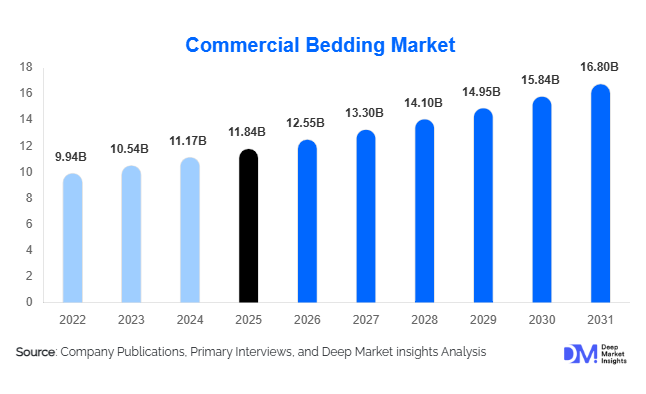
According to Deep Market Insights, the global commercial bedding market size was valued at USD 11.84 billion in 2025 and is projected to grow from USD 12.55 billion in 2026 to reach USD 16.80 billion by 2031, expanding at a CAGR of 6.0% during the forecast period (2026–2031). The commercial bedding market growth is primarily driven by the rapid expansion of the hospitality industry, increasing investments in healthcare infrastructure, rising demand for premium sleep solutions across commercial establishments, and growing replacement demand for durable mattresses, pillows, and bed linen. Continuous improvements in textile technology, antimicrobial fabrics, and sustainable bedding materials are further supporting long-term market expansion while enabling manufacturers to address evolving institutional procurement requirements.
Key Market Insights
- Hotels remain the largest end-user segment, accounting for more than 51% of global commercial bedding demand owing to increasing hotel construction, renovation projects, and frequent bedding replacement cycles.
- Mattresses dominate product demand, representing approximately 46.5% of industry revenue due to high replacement value and growing preference for premium comfort solutions across hospitality and healthcare sectors.
- North America dominates the global market, supported by a mature hospitality industry, advanced healthcare infrastructure, and high institutional spending on premium bedding products.
- Asia-Pacific is the fastest-growing regional market, driven by expanding tourism, rising healthcare investments, increasing student accommodation projects, and rapid urbanization across China, India, and Southeast Asia.
- Sustainable and antimicrobial bedding products are gaining strong momentum, with commercial facilities increasingly adopting organic cotton, recycled polyester fibers, and antimicrobial textile technologies to improve hygiene and environmental performance.
- Digital procurement platforms and smart bedding technologies are transforming institutional purchasing by improving inventory management, procurement efficiency, and guest comfort across hotels, hospitals, and serviced apartments.
Commercial Bedding Market Trends
Sustainable and Eco-Friendly Bedding Solutions Witness Strong Adoption
Sustainability has become one of the most influential trends shaping the commercial bedding industry. Hotels, hospitals, and institutional accommodation providers are increasingly adopting bedding products manufactured using organic cotton, recycled polyester, bamboo fibers, and environmentally responsible production methods. Hospitality chains are integrating sustainability targets into procurement policies, encouraging suppliers to obtain certifications such as OEKO-TEX and Global Organic Textile Standard (GOTS). Manufacturers are simultaneously reducing water consumption, energy usage, and carbon emissions throughout textile production processes while introducing biodegradable packaging solutions. Eco-friendly commercial bedding not only supports corporate sustainability initiatives but also enhances brand reputation among environmentally conscious travelers and institutional buyers. The increasing emphasis on circular economy practices and recyclable bedding materials is expected to remain a defining trend across the commercial bedding market throughout the forecast period.
Smart Bedding and Advanced Textile Technologies Transform Institutional Procurement
Commercial bedding manufacturers are increasingly incorporating advanced textile technologies to improve durability, hygiene, and occupant comfort. Antimicrobial fabrics, moisture-management materials, temperature-regulating textiles, and memory foam innovations are becoming standard features across premium commercial bedding products. Hotels are investing in luxury sleep experiences by adopting smart mattresses capable of monitoring pressure distribution and improving guest comfort, while hospitals continue prioritizing infection-resistant bedding materials designed for repeated sterilization cycles. Digital procurement systems, AI-based inventory management, and automated manufacturing facilities are further improving operational efficiency and reducing supply chain complexities. These technological advancements are enabling commercial buyers to optimize replacement cycles, lower maintenance costs, and deliver higher-quality sleeping environments, reinforcing long-term commercial bedding market expansion.
Commercial Bedding Market Drivers
Rapid Expansion of Hospitality Infrastructure Worldwide
The continuous expansion of hotels, resorts, serviced apartments, and short-term accommodation facilities remains one of the strongest growth drivers for the commercial bedding market. Rising international tourism, business travel, and domestic leisure travel have encouraged significant investments in new hospitality projects across both developed and emerging economies. Premium hotels increasingly differentiate themselves through superior guest comfort, driving demand for luxury mattresses, premium pillows, high-thread-count linens, and customized bedding collections. Frequent replacement cycles within hotels further generate recurring procurement opportunities for manufacturers. In addition, large hotel renovation projects, franchise expansion, and the modernization of accommodation facilities continue to stimulate consistent demand for high-quality commercial bedding products worldwide.
Growing Investments in Healthcare and Institutional Facilities
Healthcare infrastructure development continues to create substantial opportunities for commercial bedding manufacturers. Governments and private healthcare providers are expanding hospitals, rehabilitation centers, nursing homes, and long-term care facilities to address rising patient volumes and aging populations. These institutions require highly durable, antimicrobial, fire-resistant, and easily washable bedding products capable of meeting stringent infection control standards. Beyond healthcare, increasing investments in student housing, military accommodations, correctional facilities, worker housing, and senior living communities are further strengthening institutional demand. The growing emphasis on patient comfort, hygiene, and operational efficiency continues to accelerate procurement of technologically advanced commercial bedding solutions across multiple institutional sectors.
Commercial Bedding Market Restraints
Volatility in Raw Material Prices and Manufacturing Costs
Fluctuating prices of cotton, polyurethane foam, synthetic fibers, latex, and textile chemicals remain significant challenges for commercial bedding manufacturers. Global supply chain disruptions, transportation cost inflation, labor shortages, and energy price volatility continue to increase manufacturing expenses and compress profit margins. Since commercial procurement contracts often involve fixed pricing agreements and long-term supply commitments, manufacturers frequently face limited flexibility to pass increased production costs directly to institutional buyers. Small and regional suppliers are particularly vulnerable to these cost pressures, reducing investment capacity for product innovation and manufacturing expansion.
Intense Competitive Pricing Across Institutional Procurement Markets
The commercial bedding industry remains highly competitive due to the presence of numerous global, regional, and local manufacturers competing for large institutional contracts. Hotels, hospitals, universities, and government organizations frequently prioritize cost-effective procurement, resulting in aggressive price competition and lower average selling prices. Public tenders and bulk purchasing contracts often emphasize pricing over premium product differentiation, placing additional pressure on manufacturers seeking to maintain profitability while meeting strict quality standards. This competitive environment continues to challenge smaller companies attempting to expand market presence despite increasing overall demand.
Commercial Bedding Market Opportunities
Increasing Demand for Premium Hospitality Bedding Solutions
The growing popularity of luxury hospitality experiences is creating substantial opportunities for manufacturers specializing in premium commercial bedding. High-end hotels, boutique resorts, wellness retreats, and luxury serviced apartments increasingly invest in customized mattresses, premium pillows, organic linens, and temperature-regulating bedding systems to enhance guest satisfaction and strengthen brand positioning. Consumers increasingly associate sleep quality with overall travel experience, encouraging hospitality providers to differentiate themselves through superior bedding comfort. This premiumization trend is expected to support higher-value procurement contracts and improved profit margins for manufacturers offering technologically advanced and sustainable commercial bedding products.
Expansion of Sustainable Institutional Procurement Programs
Governments, multinational hotel groups, healthcare organizations, and educational institutions are increasingly implementing sustainable procurement policies that prioritize environmentally responsible suppliers. This transition creates significant opportunities for manufacturers offering recyclable materials, biodegradable packaging, certified organic textiles, low-emission manufacturing processes, and circular economy initiatives. Companies investing in sustainable product innovation, transparent supply chains, and internationally recognized environmental certifications are expected to strengthen long-term customer relationships while gaining competitive advantages across institutional procurement markets. Growing regulatory support for sustainable manufacturing is likely to accelerate adoption of eco-friendly commercial bedding solutions during the forecast period.
Report Scope
| Report Metric | Details |
|---|---|
| Market Size in 2025 | USD 11.84 Billion |
| Market Size in 2026 | USD 12.55 Billion |
| Market Size in 2031 | USD 16.80 Billion |
| CAGR | 6.0% (2026-2031) |
| Base Year for Estimation | 2025 |
| Historical Data | 2022-2024 |
| Forecast Period | 2026-2031 |
| Report Coverage | Revenue Forecast, Competitive Landscape, Supply Chain Disruption, Growth Factors, Environment & Regulatory Landscape and Trends |
| Geographies Covered | North America, Europe, APAC, Middle East and Africa, LATAM |
| Countries Covered | U.S., Canada, U.K., Germany, France, Spain, Italy, Russia, Nordic, Benelux, Rest of Europe, China, Korea, Japan, India, Australia, Singapore, Taiwan, South East Asia, Rest of Asia-Pacific, UAE, Turky, Saudi Arabia, South Africa, Egypt, Nigeria, Rest of MEA, Brazil, Mexico, Argentina, Chile, Colombia, Rest of LATAM |
Explore more data points, trends and opportunities Download Free Sample Report
Product Type Insights
Mattresses account for the largest share of the commercial bedding market, contributing approximately 46.5% of global revenue in 2025. Their dominance is driven by widespread adoption across hotels, hospitals, serviced apartments, student accommodations, and other institutional facilities where comfort, durability, and hygiene are critical purchasing factors. Commercial mattresses are engineered using innerspring, memory foam, latex, hybrid, and high-density polyurethane foam technologies to withstand continuous usage while maintaining structural integrity. Hospitality operators are increasingly investing in luxury-grade mattresses featuring pressure-relief technology, temperature regulation, antimicrobial protection, and enhanced edge support to improve guest satisfaction. Healthcare facilities continue prioritizing medical-grade mattresses designed to reduce pressure ulcers, improve patient comfort, and support infection prevention protocols. Replacement cycles averaging three to seven years ensure recurring procurement opportunities, making mattresses the highest-value product category within the commercial bedding market.
Pillows represent the second-largest product category, supported by consistent replacement requirements across hospitality and healthcare facilities. Commercial establishments increasingly utilize microfiber, memory foam, polyester fiberfill, feather, and latex pillows designed for high durability, shape retention, and hypoallergenic performance. Hotels frequently offer multiple pillow options to enhance guest comfort, while hospitals emphasize antimicrobial, fluid-resistant, and washable pillow designs that meet strict infection control requirements. Growing consumer expectations regarding sleep quality have encouraged institutional buyers to procure premium pillow collections that complement luxury bedding programs. Increasing awareness of ergonomic sleep support and neck alignment is also encouraging adoption of advanced pillow technologies throughout commercial accommodation facilities.
Bed linen continues to experience strong demand owing to rising occupancy rates across hotels and expanding institutional infrastructure worldwide. The segment includes bed sheets, duvet covers, comforters, blankets, mattress protectors, and pillowcases manufactured using cotton, cotton blends, microfiber, bamboo fibers, polyester blends, and sustainable textiles. Premium hospitality providers increasingly prefer high-thread-count fabrics, wrinkle-resistant materials, and moisture-management technologies that improve customer experience while reducing maintenance costs. Healthcare organizations continue investing in antimicrobial linens capable of withstanding repeated industrial laundering without compromising softness or durability. Growing demand for environmentally sustainable textiles is further accelerating adoption of organic cotton and recycled fiber bed linen across commercial facilities.
Application Insights
Hotels remain the largest application segment within the commercial bedding market, accounting for more than half of total industry demand. Continuous growth in international tourism, business travel, and luxury hospitality investments has significantly increased procurement of mattresses, pillows, blankets, and premium bed linen. Hotel operators increasingly differentiate themselves through superior sleep experiences, encouraging investments in customized bedding collections, premium comfort technologies, and sustainable textile solutions. Frequent room renovations, brand standardization programs, and relatively short replacement cycles generate stable recurring demand for bedding manufacturers. Boutique hotels, luxury resorts, serviced apartments, and international hotel chains continue upgrading bedding specifications to improve guest satisfaction, online ratings, and customer retention, making hospitality the industry's primary revenue contributor.
Hospitals represent the second-largest application segment, driven by ongoing investments in healthcare infrastructure, patient safety, and infection prevention. Healthcare facilities require specialized commercial bedding products capable of supporting intensive daily usage, repeated sterilization, and strict hygiene standards. Medical mattresses featuring pressure redistribution, waterproof barriers, antimicrobial coatings, and fire-retardant materials continue experiencing increasing demand across acute care hospitals, rehabilitation centers, long-term care facilities, and nursing homes. Similarly, antimicrobial pillows, fluid-resistant mattress protectors, and high-performance hospital linens contribute to improved patient outcomes while supporting operational efficiency. Rising healthcare expenditure and aging populations worldwide continue strengthening institutional procurement of advanced commercial bedding solutions.
Student accommodation has emerged as one of the fastest-growing application areas, supported by expanding university enrollment, international student mobility, and increasing private investment in purpose-built student housing. Universities, colleges, hostels, training institutes, and residential campuses require durable, standardized bedding products capable of withstanding continuous occupancy while minimizing maintenance costs. Institutional buyers emphasize affordability, durability, stain resistance, and ease of laundering when selecting commercial bedding products for student residences. Growing development of private student housing across Asia-Pacific, Europe, and North America continues creating long-term procurement opportunities for manufacturers supplying mattresses, pillows, blankets, and bed linen specifically designed for institutional accommodation.
Explore more data points, trends and opportunities Download Free Sample Report
Commercial Bedding Market Segmentations
By Product Type
- Mattresses
- Pillows
- Bed Linen
By Application
- Hotels
- Hospitals
- Student Accommodation
Regional Insights
North America
North America dominates the global commercial bedding market, accounting for approximately 36.8% of total revenue in 2025. The United States represents the largest contributor owing to its highly developed hospitality industry, extensive healthcare infrastructure, and significant institutional procurement spending. Premium hotels, luxury resorts, hospitals, nursing homes, universities, and serviced apartment operators consistently invest in high-quality bedding products to improve customer satisfaction and operational efficiency. Growing demand for sustainable bedding materials, antimicrobial textiles, and smart mattress technologies continues supporting product innovation throughout the region. Manufacturers also benefit from well-established distribution networks, advanced textile manufacturing capabilities, and strong replacement demand generated by mature commercial facilities.
Europe
Europe remains a mature and innovation-driven commercial bedding market supported by strict product quality regulations, advanced textile manufacturing, and a highly developed hospitality sector. Germany, the United Kingdom, France, Italy, and Spain account for the majority of regional demand due to their large hotel industries and expanding healthcare investments. Sustainability remains a defining purchasing criterion across European institutions, encouraging adoption of organic cotton, recycled fibers, environmentally certified manufacturing processes, and circular economy initiatives. Luxury hotels continue investing in premium bedding collections to strengthen customer loyalty while hospitals increasingly procure antimicrobial and reusable textile solutions capable of meeting stringent healthcare regulations.
Asia-Pacific
Asia-Pacific is projected to register the fastest growth throughout the forecast period due to rapid urbanization, increasing tourism, expanding healthcare infrastructure, and rising investments in institutional accommodation. China remains the region's largest manufacturing hub for commercial bedding products, while India, Japan, South Korea, Australia, and Southeast Asian countries continue recording strong procurement growth. Rapid hotel construction, increasing international tourist arrivals, expanding private hospital networks, and growing student accommodation developments are significantly strengthening regional demand. Rising disposable income and greater emphasis on premium hospitality experiences are also encouraging wider adoption of technologically advanced and sustainable commercial bedding products across the region.
Latin America
Latin America is witnessing steady expansion driven by improving tourism infrastructure, increasing healthcare investments, and modernization of institutional accommodation facilities. Brazil and Mexico represent the largest regional markets, supported by expanding hotel chains, private healthcare providers, and educational institutions. International hospitality brands entering the region continue investing in premium bedding products to align with global service standards. Manufacturers are increasingly introducing affordable yet durable bedding solutions designed to meet institutional procurement budgets while maintaining product quality and longevity.
Middle East & Africa
The Middle East & Africa commercial bedding market continues to benefit from substantial investments in luxury hospitality, healthcare modernization, and tourism diversification initiatives. Countries including the United Arab Emirates, Saudi Arabia, South Africa, Qatar, and Egypt continue expanding hotel capacity through large-scale tourism development projects. Premium hospitality brands increasingly demand customized luxury bedding collections that enhance guest comfort and support premium positioning. Simultaneously, expanding healthcare infrastructure and government investments in hospitals and specialized medical facilities continue strengthening demand for antimicrobial mattresses, medical pillows, and healthcare-grade bed linen. The region is expected to witness steady long-term growth as tourism, healthcare, and institutional infrastructure continue expanding.
Key Players in the Commercial Bedding Market
- Tempur Sealy International, Inc.
- Serta Simmons Bedding LLC
- Sleep Number Corporation
- King Koil
- Leggett & Platt, Incorporated
- Hilding Anders International AB
- Kingsdown Inc.
- Standard Textile Co., Inc.
- Welspun Living Limited
- American Textile Company
- Pacific Coast Feather Company
- The Fine Bedding Company
- Hollander Sleep Products
- Global Textile Alliance
- Bedgear LLC