Formal Wear Market Size
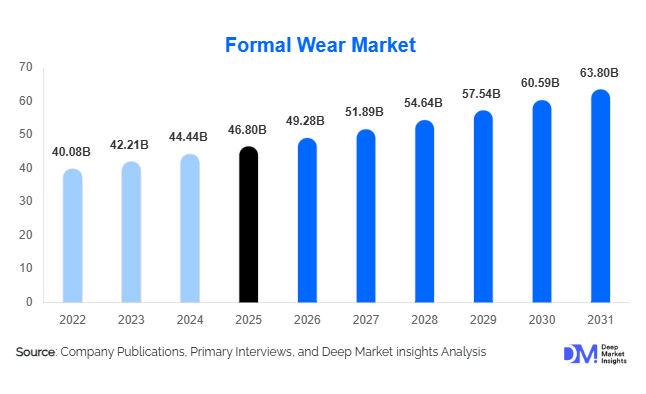
According to Deep Market Insights, the global formal wear market size was valued at USD 46.8 billion in 2025 and is projected to grow from USD 49.28 billion in 2026 to reach USD 63.80 billion by 2031, expanding at a CAGR of 5.3% during the forecast period (2026–2031). The market continues to benefit from increasing corporate employment, rising expenditure on weddings and ceremonial events, growing participation of women in professional workplaces, and the premiumization of apparel purchases across developed and emerging economies. While hybrid work arrangements have moderated demand for traditional business attire in certain markets, the resurgence of office attendance, expanding service-sector employment, and growing demand for tailored and occasion-specific apparel continue to support steady market expansion. Digital retailing, customization technologies, and sustainability-focused fabric innovations are further reshaping consumer purchasing behavior, creating new opportunities for both established brands and emerging formalwear specialists.
Key Market Insights
- Men's formal wear remains the largest product segment, accounting for approximately 42% of global market revenue in 2025, driven by strong corporate and ceremonial demand.
- Asia-Pacific dominates the global formal wear market, supported by expanding middle-class populations, rapid urbanization, and increasing workforce participation.
- Women's formal wear is the fastest-growing product category, fueled by rising female employment rates and increasing demand for professional attire.
- Online and direct-to-consumer channels are transforming apparel retailing, enabling greater customization, convenience, and global brand accessibility.
- Sustainable fabrics and ethical sourcing initiatives are becoming key purchasing criteria among younger consumers and premium buyers.
- AI-powered sizing, virtual fitting solutions, and digital tailoring platforms are improving customer experience and reducing product returns.
Formal Wear Market Trends
Growing Demand for Sustainable and Ethical Formal Apparel
Sustainability has become one of the most influential trends within the formal wear market. Consumers are increasingly seeking apparel manufactured using organic cotton, recycled polyester, ethically sourced wool, and environmentally responsible production processes. Global fashion brands are responding by implementing transparent supply chains, reducing water consumption, and investing in circular fashion initiatives. Corporate buyers and professional consumers are showing greater preference for durable, premium-quality garments that offer longer product lifecycles, supporting demand for higher-value formal wear products. Sustainable collections are becoming increasingly common among premium and luxury brands, creating differentiation opportunities and enhancing customer loyalty.
Digital Customization and AI-Enabled Tailoring
The formal wear industry is undergoing digital transformation through the adoption of AI-powered sizing technologies, virtual fitting rooms, and made-to-measure online platforms. Consumers increasingly expect personalized fits without visiting physical stores, driving investment in body-scanning applications and predictive sizing algorithms. Brands are leveraging customer data to provide customized recommendations and tailored garments while reducing return rates. Digital tailoring solutions have become particularly attractive among younger professionals and wedding customers seeking personalized designs and superior fit. The integration of omnichannel retailing, virtual consultations, and automated production technologies is expected to improve operational efficiency while enhancing customer satisfaction.
Formal Wear Market Drivers
Expansion of Global White-Collar Employment
The continued growth of white-collar employment across financial services, information technology, consulting, legal services, healthcare administration, and government sectors remains a major driver of formal wear demand. Emerging economies across Asia-Pacific, the Middle East, and Latin America are experiencing significant growth in professional employment, resulting in increased demand for business suits, formal shirts, blazers, and office-ready apparel. As multinational corporations expand operations globally, workplace dress standards continue to support demand for professional attire.
Increasing Wedding and Celebration Expenditure
Wedding-related spending has become a critical growth contributor for the formal wear market. Consumers are increasingly allocating higher budgets toward customized suits, tuxedos, bridal party apparel, and luxury formal garments. In countries such as India, China, the United States, and the United Kingdom, premium wedding wear categories continue to outperform broader apparel markets. Rising destination wedding trends and social media influence have further elevated consumer spending on formal attire.
Growing Female Workforce Participation
Women's participation in corporate employment continues to increase globally, creating strong demand for professional dresses, pantsuits, blazers, and business casual formal apparel. Organizations are increasingly emphasizing professional appearance standards, while fashion brands are introducing collections specifically designed for modern working women. This trend is particularly pronounced across North America, Europe, China, India, and Southeast Asia.
Formal Wear Market Restraints
Casualization of Workplace Dress Codes
The increasing adoption of business-casual and smart-casual workplace policies remains one of the primary challenges facing the formal wear industry. Technology companies, start-ups, and creative industries have significantly relaxed dress requirements, reducing demand for traditional suits and formal business attire. Hybrid working models have further accelerated this trend across developed economies.
Raw Material Price Volatility
Price fluctuations in wool, cotton, silk, and synthetic fibers continue to impact manufacturer profitability and pricing strategies. Supply chain disruptions, geopolitical tensions, transportation costs, and inflationary pressures have increased production expenses across global apparel markets. These challenges have forced many brands to optimize sourcing strategies and implement selective price increases.
Formal Wear Market Opportunities
Premiumization Across Emerging Markets
Rapid income growth across India, China, Indonesia, Vietnam, Saudi Arabia, and the UAE is creating substantial demand for premium and luxury formal wear. Consumers are increasingly prioritizing quality, craftsmanship, and brand reputation, enabling manufacturers to expand higher-margin product offerings. International brands are accelerating expansion into these markets through dedicated retail networks and localized product portfolios.
Expansion of Direct-to-Consumer Digital Platforms
The growth of e-commerce provides significant opportunities for formal wear brands to expand globally while reducing dependence on traditional retail channels. Direct-to-consumer platforms allow brands to improve margins, collect consumer insights, and offer personalized shopping experiences. Virtual fitting tools and AI-powered recommendations are expected to further accelerate online formal wear sales.
Corporate Uniform and Professional Services Demand
Hospitality, aviation, banking, luxury retail, and professional services industries continue to generate demand for standardized formal uniforms and corporate attire. Growing service-sector employment and increasing investments in customer-facing industries provide long-term opportunities for formal wear suppliers serving institutional buyers.
Report Scope
| Report Metric | Details |
|---|---|
| Market Size in 2025 | USD 46.8 Billion |
| Market Size in 2026 | USD 49.28 Billion |
| Market Size in 2031 | USD 63.80 Billion |
| CAGR | 5.3% (2026-2031) |
| Base Year for Estimation | 2025 |
| Historical Data | 2022-2024 |
| Forecast Period | 2026-2031 |
| Report Coverage | Revenue Forecast, Competitive Landscape, Supply Chain Disruption, Growth Factors, Environment & Regulatory Landscape and Trends |
| Geographies Covered | North America, Europe, APAC, Middle East and Africa, LATAM |
| Countries Covered | U.S., Canada, U.K., Germany, France, Spain, Italy, Russia, Nordic, Benelux, Rest of Europe, China, Korea, Japan, India, Australia, Singapore, Taiwan, South East Asia, Rest of Asia-Pacific, UAE, Turky, Saudi Arabia, South Africa, Egypt, Nigeria, Rest of MEA, Brazil, Mexico, Argentina, Chile, Colombia, Rest of LATAM |
Explore more data points, trends and opportunities Download Free Sample Report
Product Type Insights
Men's formal wear remained the largest product segment, accounting for approximately 42% of global formal wear market revenue in 2025. The segment continues to dominate due to the widespread adoption of formal business attire across corporate sectors, including banking, consulting, legal services, government administration, and professional services. Business suits, dress shirts, blazers, and tuxedos collectively represent the largest revenue contributors owing to their higher average selling prices and frequent replacement cycles among working professionals. Demand is particularly strong in North America, Europe, China, Japan, South Korea, and major urban centers across emerging economies where professional dress codes remain prevalent. In addition, growing expenditures on weddings, corporate events, and formal social gatherings continue to support premium suit sales globally. Women's formal wear accounted for approximately 34% of market revenue and represents the fastest-growing product category. Increasing female workforce participation, rising managerial representation of women in corporate organizations, and growing demand for professional apparel among working women are driving sustained growth. Demand for formal dresses, blazers, pantsuits, and business-casual formalwear continues to increase across developed and emerging economies. Furthermore, fashion brands are introducing contemporary office wear collections that combine comfort, functionality, and style, expanding the addressable customer base.
Formal footwear contributed nearly 12% of global revenue in 2025, supported by premiumization trends and increasing demand for leather dress shoes, formal loafers, and executive footwear. The growing popularity of coordinated professional attire and premium workplace dressing has strengthened footwear sales across corporate and ceremonial applications. Formal accessories represented approximately 8% of market demand, benefiting from growing consumer spending on premium ties, cufflinks, belts, pocket squares, and luxury gifting products. Increasing interest in personalization and premium fashion statements continues to drive value growth within the segment. Children's formal wear remains a relatively niche segment but is witnessing steady growth due to increasing spending on weddings, graduation ceremonies, religious events, and family celebrations. Rising disposable incomes in emerging markets and growing demand for coordinated family apparel are expected to support future expansion.
Application Insights
Corporate and office wear dominated the formal wear market, accounting for approximately 48% of global demand in 2025. The segment's leadership is primarily driven by the continued expansion of white-collar employment across financial services, information technology, healthcare administration, legal services, consulting, education, and government sectors. While workplace attire standards have evolved in certain industries, professional apparel remains an essential requirement in client-facing roles, executive positions, and regulated professions. The continued expansion of business process outsourcing (BPO), financial services, and technology sectors across Asia-Pacific further strengthens demand for corporate formalwear. Wedding and ceremonial wear represented nearly 28% of global demand and remains the fastest-growing application segment. Rising wedding expenditures, increasing demand for destination weddings, and growing consumer preference for customized and luxury garments are driving strong market expansion. Countries such as India, China, the United States, and the United Kingdom continue to generate significant demand for premium formal attire associated with weddings and celebrations.
Social events and formal celebrations accounted for approximately 15% of market revenue, supported by increasing participation in corporate functions, gala events, award ceremonies, and luxury social gatherings. Premiumization trends are encouraging consumers to invest in occasion-specific formal apparel. Hospitality and service industry uniforms are emerging as an important institutional demand segment. Growth in tourism, aviation, luxury hotels, and premium retail sectors is increasing procurement of formal uniforms, particularly across Asia-Pacific and the Middle East. Government functions, diplomatic events, educational ceremonies, and public-sector employment continue to provide stable baseline demand, particularly in developed economies where formal dress protocols remain institutionalized.
Distribution Channel Insights
Brand-owned stores and specialty apparel retailers remained the leading distribution channel, accounting for approximately 45% of global market revenue in 2025. Their dominance is largely attributed to the personalized shopping experience, professional fitting services, tailoring support, and premium customer engagement they offer. Formalwear purchases typically involve higher consumer involvement compared to casual apparel, making physical stores particularly important for ensuring fit, fabric evaluation, and style consultation. Premium and luxury brands continue to prioritize flagship stores and specialty retail networks to maintain brand positioning and customer loyalty.
Online sales channels accounted for approximately 35% of global demand and represent the fastest-growing distribution segment. Advances in virtual fitting technologies, AI-powered sizing recommendations, easy return policies, and omnichannel retailing have significantly improved consumer confidence in purchasing formal apparel online. Digital-native brands are increasingly leveraging direct-to-consumer models to improve margins and enhance customer engagement through personalized marketing and customization capabilities. Department stores continue to maintain relevance in North America and Europe by offering multi-brand selections and premium shopping experiences. Meanwhile, direct-to-consumer platforms are gaining traction globally as manufacturers seek greater control over customer relationships, pricing strategies, and product customization.
End User Insights
Men represented the largest end-user segment, contributing approximately 56% of global formal wear demand in 2025. The segment's leadership reflects the long-standing importance of formal business attire within male professional wardrobes. Demand remains particularly strong among executives, business professionals, government employees, and individuals participating in ceremonial events. The premium men's tailoring segment continues to benefit from customization trends and increasing demand for luxury formalwear.
Women accounted for approximately 38% of global demand and are expected to register the fastest growth through 2031. Rising female labor force participation, increasing representation in leadership roles, and expanding professional opportunities across emerging economies are driving sustained demand for formal dresses, blazers, trousers, and corporate apparel. The growing focus on workplace diversity and professional image management further supports segment expansion. Children accounted for the remaining share of market demand, supported by increasing spending on special occasions, educational ceremonies, weddings, and family events. Rising household incomes and premiumization of children's apparel categories are expected to strengthen future growth prospects.
Explore more data points, trends and opportunities Download Free Sample Report
Formal Wear Market Segmentations
By Product Type
- Men's Formal Wear
- Women's Formal Wear
- Children's Formal Wear
- Formal Footwear
- Formal Accessories
By Application
- Corporate & Office Wear
- Weddings
- Social Events & Celebrations
- Government & Diplomatic Functions
- Educational Ceremonies
- Hospitality & Service Uniform Formal Wear
By Distribution Channel
- Brand-Owned Stores
- Department Stores
- Specialty Apparel Stores
- Hypermarkets & Supermarkets
- Online Marketplaces
- Direct-to-Consumer E-commerce
By End User
- Men
- Women
- Children
By Price Positioning
- Economy/Mass Market
- Mid-Premium
- Premium
- Luxury/Bespoke
Regional Insights
Asia-Pacific
Asia-Pacific led the global formal wear market with approximately 38% market share in 2025 and is expected to remain the fastest-growing regional market through 2031. The region benefits from rapid urbanization, expanding middle-class populations, increasing disposable incomes, and strong growth in white-collar employment. China remains the largest market due to its massive corporate workforce, growing premium apparel consumption, and increasing adoption of luxury brands among younger professionals. India represents one of the highest-growth markets globally, supported by rapid expansion of IT services, financial services, startup ecosystems, and one of the world's largest wedding industries. Japan and South Korea continue to generate significant demand for premium business attire due to deeply embedded professional dress cultures and strong consumer preference for high-quality apparel. The expansion of modern retail infrastructure, e-commerce adoption, and increasing participation of women in the workforce further strengthen regional growth prospects.
North America
North America accounted for approximately 27% of global market revenue in 2025. The United States remains the dominant contributor, supported by its large professional workforce, high per-capita apparel spending, and strong demand for wedding and ceremonial attire. Major growth drivers include premiumization trends, increasing demand for customized formalwear, and continued spending by corporate professionals across financial services, consulting, healthcare, legal services, and government sectors. The growth of luxury menswear and digital tailoring platforms has also strengthened market expansion. Canada contributes additional demand through rising professional employment, increasing adoption of premium apparel, and strong consumer spending on special occasions.
Europe
Europe represented approximately 24% of global market revenue in 2025. The region benefits from a mature fashion ecosystem, strong tailoring traditions, and a high concentration of multinational corporations requiring professional attire. Germany remains the largest market due to its substantial corporate workforce and industrial economy. The United Kingdom continues to generate strong demand from financial services, legal professions, and professional consulting sectors. France and Italy are major contributors due to their global influence in luxury fashion and premium tailoring. Growth across the region is increasingly driven by sustainable fashion initiatives, premium product innovation, and growing consumer preference for high-quality, long-lasting formal apparel.
Middle East & Africa
The Middle East and Africa accounted for nearly 7% of global demand in 2025. The region is experiencing rising demand for premium formalwear driven by economic diversification initiatives, expanding business tourism, and growing luxury retail sectors. Saudi Arabia and the UAE are leading growth through Vision 2031-related investments, increasing foreign direct investment, and expanding corporate employment opportunities. International business conferences, hospitality expansion, and growth in financial services are creating additional demand for professional attire. Within Africa, South Africa remains the largest formal wear market, supported by a well-developed retail sector, corporate workforce expansion, and increasing demand for wedding and ceremonial apparel.
Latin America
Latin America contributed approximately 4% of global market revenue in 2025. Brazil and Mexico dominate regional demand owing to their large populations, growing urban professional workforce, and increasing expenditure on weddings and social celebrations. Economic modernization, expansion of service industries, and increasing penetration of international apparel brands continue to support market development. Furthermore, improvements in e-commerce infrastructure and digital retail adoption are enabling broader access to premium formalwear products across the region. Rising middle-class incomes and growing participation in professional occupations are expected to support long-term growth throughout Latin America.
Key Players in the Formal Wear Market
- Hugo Boss AG
- PVH Corporation
- Ralph Lauren Corporation
- Armani Group
- Marks & Spencer Group plc
- Brooks Brothers
- Suitsupply
- Mango
- Fast Retailing Co., Ltd.
- H&M Group
- NEXT plc
- Charles Tyrwhitt
- Ted Baker
- Van Heusen
- Moss Bros Group