Bridal Jewelry Market Size
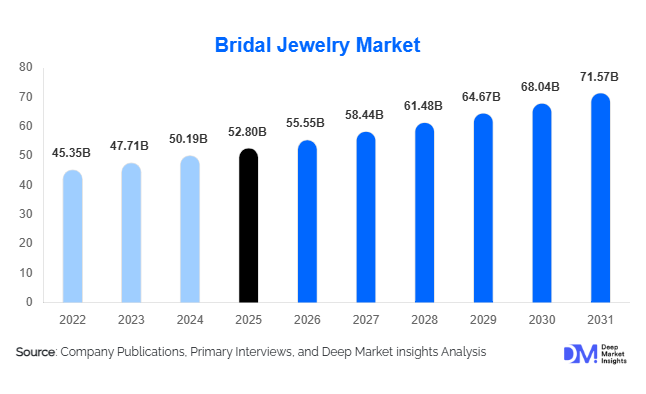
According to Deep Market Insights, the global bridal jewelry market size was valued at USD 52.8 billion in 2025 and is projected to grow from USD 55.55 billion in 2026 to reach USD 71.6 billion by 2031, expanding at a CAGR of 5.2% during the forecast period (2026–2031). The bridal jewelry market growth is primarily driven by rising wedding expenditures, increasing demand for personalized jewelry designs, growing luxury consumption among millennials and Gen Z consumers, and expanding adoption of premium diamonds and precious metal jewelry across both developed and emerging economies. Bridal jewelry remains one of the largest spending categories within the global wedding industry, supported by cultural traditions, rising disposable incomes, and growing consumer preference for customized engagement rings, wedding bands, necklaces, earrings, and complete bridal sets.
Key Market Insights
- Gold jewelry remains the largest material segment, accounting for nearly 38% of global bridal jewelry demand due to strong cultural significance across Asia-Pacific and the Middle East.
- Engagement rings dominate product demand, contributing approximately 32% of total market revenue owing to high average selling prices and increasing customization trends.
- Asia-Pacific dominates the global market, accounting for nearly 43% of global bridal jewelry consumption, supported by strong wedding traditions in India and China.
- India represents the fastest-growing national market, driven by rising middle-class incomes, urbanization, and increasing premium jewelry purchases.
- Lab-grown diamonds are rapidly transforming bridal jewelry purchasing patterns, offering affordability, sustainability, and premium aesthetics.
- Digital jewelry customization and virtual shopping technologies are reshaping consumer engagement through AI-assisted design, virtual try-ons, and omnichannel retail strategies.
What are the latest trends in the bridal jewelry market?
Lab-Grown Diamond Adoption Accelerating Globally
One of the most transformative trends in the bridal jewelry market is the rapid adoption of lab-grown diamonds. Younger consumers are increasingly seeking sustainable and ethically sourced alternatives to natural diamonds while maintaining the appearance and quality associated with traditional bridal jewelry. Lab-grown diamonds offer cost savings of 30–60% compared to natural diamonds, enabling consumers to purchase larger stones or higher-quality designs within the same budget. Retailers and luxury jewelry brands are expanding dedicated bridal collections featuring certified lab-grown diamonds, particularly across North America, Europe, India, and China. This trend is expected to significantly influence product development strategies over the coming decade.
Customization and Personalized Bridal Collections
Customization has become a defining feature of modern bridal jewelry purchasing. Consumers increasingly seek unique engagement rings, wedding bands, and bridal sets that reflect personal stories and individual preferences. Advanced technologies such as CAD/CAM design, 3D printing, AI-assisted customization, and virtual consultations are allowing manufacturers to offer bespoke jewelry solutions at scale. Personalized engravings, custom gemstone arrangements, heritage-inspired designs, and fusion aesthetics are becoming mainstream, enabling brands to command premium pricing and strengthen customer loyalty.
What are the key drivers in the bridal jewelry market?
Rising Global Wedding Expenditure
Wedding-related spending continues to increase globally, particularly across emerging economies where weddings remain highly significant cultural events. Bridal jewelry often represents one of the largest categories within wedding budgets, especially in countries such as India, China, Saudi Arabia, UAE, Indonesia, and Vietnam. As consumers allocate higher budgets toward premium wedding experiences, spending on engagement rings, wedding bands, and luxury bridal jewelry continues to rise. Multi-day wedding celebrations and destination weddings are further supporting demand for multiple jewelry purchases across different events.
Premiumization of Jewelry Purchases
Consumers increasingly view bridal jewelry as both an emotional and financial investment. Rising disposable incomes and wealth accumulation are encouraging purchases of higher-value diamonds, platinum jewelry, and luxury designer collections. Premium and luxury bridal jewelry segments are growing faster than mass-market categories as consumers prioritize quality craftsmanship, exclusivity, and long-term value retention. This trend is particularly evident in developed markets such as the United States, Canada, Germany, the United Kingdom, and Australia.
Expansion of Organized Retail and Digital Commerce
The growth of organized jewelry chains and omnichannel retailing is improving consumer confidence through certified products, transparent pricing, financing options, and enhanced after-sales services. Online platforms offering virtual try-on technologies, AI-based recommendations, and customized product visualization tools are making bridal jewelry more accessible to digitally native consumers. These developments are contributing significantly to market expansion across both developed and emerging economies.
What are the restraints for the global market?
Volatility in Precious Metal and Diamond Prices
Fluctuating prices of gold, platinum, and gemstones remain a major challenge for manufacturers and retailers. Significant increases in raw material costs can compress profit margins or result in higher retail prices that discourage consumer spending. Price volatility also complicates inventory planning and long-term procurement strategies for jewelry manufacturers.
Declining Marriage Rates in Developed Economies
Several mature markets, including Japan, Germany, Italy, and parts of North America, are experiencing declining marriage rates and delayed marriages. Although average spending per wedding continues to rise, lower wedding volumes may constrain long-term growth potential in some developed regions. Industry participants must increasingly focus on premiumization and product innovation to offset demographic challenges.
What are the key opportunities in the bridal jewelry industry?
Digital Customization Platforms
The integration of artificial intelligence, augmented reality, and 3D design software presents substantial opportunities for bridal jewelry manufacturers and retailers. Consumers increasingly prefer co-creating engagement rings and wedding jewelry online before purchase. Companies investing in digital customization platforms can improve customer engagement, command premium pricing, and reduce inventory-related costs through made-to-order production models.
Expansion Across Emerging Wedding Markets
Emerging economies represent some of the most attractive growth opportunities for the bridal jewelry industry. Rising disposable incomes, expanding middle-class populations, and strong wedding traditions are supporting increasing jewelry expenditure across India, Indonesia, Vietnam, Saudi Arabia, Nigeria, and the UAE. Localized product portfolios and culturally relevant designs can help manufacturers capitalize on these high-growth markets.
Report Scope
| Report Metric | Details |
|---|---|
| Market Size in 2025 | USD 52.8 Billion |
| Market Size in 2026 | USD 55.55 Billion |
| Market Size in 2031 | USD 71.57 Billion |
| CAGR | 5.2% (2026-2031) |
| Base Year for Estimation | 2025 |
| Historical Data | 2022-2024 |
| Forecast Period | 2026-2031 |
| Report Coverage | Revenue Forecast, Competitive Landscape, Supply Chain Disruption, Growth Factors, Environment & Regulatory Landscape and Trends |
| Geographies Covered | North America, Europe, APAC, Middle East and Africa, LATAM |
| Countries Covered | U.S., Canada, U.K., Germany, France, Spain, Italy, Russia, Nordic, Benelux, Rest of Europe, China, Korea, Japan, India, Australia, Singapore, Taiwan, South East Asia, Rest of Asia-Pacific, UAE, Turky, Saudi Arabia, South Africa, Egypt, Nigeria, Rest of MEA, Brazil, Mexico, Argentina, Chile, Colombia, Rest of LATAM |
Explore more data points, trends and opportunities Download Free Sample Report
Product Type Insights
Engagement rings dominate the global bridal jewelry market, accounting for approximately 32% of total market revenue in 2026, making them the single largest product category worldwide. Their leadership position is primarily driven by their universal role as the first and most significant bridal jewelry purchase across most cultures, coupled with substantially higher average selling prices compared to other bridal jewelry products. Rising consumer preference for customized engagement rings featuring unique diamond cuts, personalized engravings, colored gemstones, and designer settings continues to support premiumization within this segment. The growing influence of social media, celebrity engagements, and luxury branding has further elevated consumer spending on engagement rings, particularly in North America, Europe, China, and urban India. Wedding bands represent the second-largest product category, supported by consistent demand across virtually all marriage ceremonies worldwide. Increasing adoption of matching couple bands, diamond-studded wedding bands, and platinum wedding rings is contributing to segment growth. Meanwhile, bridal necklaces continue to experience robust demand across Asia-Pacific and Middle Eastern markets where elaborate jewelry remains deeply integrated into wedding traditions. Countries such as India, Saudi Arabia, UAE, Indonesia, and Malaysia continue to generate significant demand for heavy gold and gemstone bridal necklaces.
Earrings, bracelets, bangles, and complete bridal jewelry sets are witnessing increasing demand among premium and luxury consumers seeking coordinated wedding aesthetics. Bridal jewelry sets are particularly popular in Asian markets where families often purchase complete collections as part of wedding gifting traditions. The growing trend toward multi-event weddings, destination weddings, and themed celebrations is also encouraging consumers to purchase multiple jewelry pieces for different wedding functions, thereby increasing average transaction values across the category.
Material Type Insights
Gold jewelry remains the largest material segment, accounting for approximately 38% of global bridal jewelry revenue in 2026. The segment's dominance is driven by the unique dual role of gold as both a decorative asset and a long-term store of wealth. This characteristic is particularly important in countries such as India, China, Saudi Arabia, UAE, Turkey, and several Southeast Asian nations where gold jewelry is traditionally viewed as an investment asset transferred across generations. Rising disposable incomes and increasing wedding expenditures continue to strengthen demand for 18K, 22K, and 24K bridal gold jewelry.
Diamond jewelry represents the second-largest material category and continues to benefit from strong engagement ring demand, particularly in North America and Europe. Premium consumers increasingly view diamonds as symbols of status, exclusivity, and emotional commitment. Within this category, lab-grown diamonds represent the fastest-growing subsegment globally, driven by affordability advantages, ethical sourcing considerations, and increasing consumer acceptance among millennials and Gen Z buyers. Several leading jewelry brands are expanding their lab-grown bridal collections to address shifting consumer preferences.
Platinum jewelry continues to gain traction among affluent consumers seeking superior durability, rarity, and premium aesthetics. Demand is particularly strong in the United States, Japan, Germany, and the United Kingdom, where platinum engagement rings and wedding bands are increasingly perceived as luxury alternatives to gold. Meanwhile, colored gemstone bridal jewelry featuring sapphires, emeralds, and rubies is emerging as a niche growth category among consumers seeking personalization and uniqueness.
Distribution Channel Insights
Organized jewelry chains account for approximately 36% of global bridal jewelry sales, making them the leading distribution channel worldwide. Their market leadership is supported by consumer trust, certified products, transparent pricing structures, financing options, strong after-sales services, and extensive physical retail networks. Large jewelry retailers have also invested heavily in omnichannel strategies that integrate online browsing, virtual consultations, and in-store purchasing experiences, significantly enhancing customer engagement. Independent jewelry stores continue to maintain relevance, particularly in customized, handcrafted, and heritage-inspired bridal jewelry segments. Many consumers seeking bespoke engagement rings and culturally specific designs prefer local jewelers capable of offering personalized services and unique craftsmanship.
The online direct-to-consumer channel represents one of the fastest-growing segments within bridal jewelry retail. Advances in virtual try-on technology, augmented reality tools, AI-powered product recommendations, and 3D customization platforms are enabling consumers to confidently purchase high-value jewelry products online. Younger consumers, particularly millennials and Gen Z buyers, increasingly begin their purchasing journey through digital channels before completing transactions either online or in-store. Luxury brand boutiques continue to play a critical role within premium and ultra-luxury bridal jewelry categories by offering exclusive collections, personalized consultations, private appointments, and superior customer experiences that support high-margin sales.
Consumer Type Insights
Family-sponsored purchases represent the largest consumer segment, accounting for approximately 42% of global bridal jewelry demand in 2026. This dominance reflects the continued importance of family involvement in wedding expenditures across Asia-Pacific, the Middle East, and parts of Africa. In many cultures, bridal jewelry remains a key component of family gifting traditions, dowry-related customs, and wealth transfer practices, resulting in significant expenditure on gold jewelry, bridal sets, and luxury ornaments. Bride-led purchases are steadily increasing as women's workforce participation, financial independence, and discretionary spending power continue to rise globally. Increasing numbers of women are actively participating in engagement ring selection and bridal jewelry purchases, contributing to demand for personalized and contemporary designs.
Couple co-purchases represent one of the fastest-growing consumer segments, particularly across North America, Western Europe, Australia, and urban Asia. Millennials and Gen Z consumers increasingly view jewelry purchases as joint financial decisions, encouraging demand for customized rings, matching bands, and personalized bridal collections. Groom-led purchases continue to drive engagement ring sales, particularly within mature markets such as the United States, Canada, the United Kingdom, and Germany, where proposal traditions remain deeply embedded within consumer culture.
Price Positioning Insights
The premium segment leads the global bridal jewelry market with approximately 34% market share in 2026. The segment occupies a strategic position between affordability and luxury, attracting consumers seeking superior quality, branded products, and enhanced craftsmanship without entering ultra-luxury price ranges. Rising disposable incomes and increasing aspirational spending among middle- and upper-middle-income households continue to support strong demand for premium bridal jewelry globally. The luxury and ultra-luxury segments are expanding faster than the broader market due to increasing wealth creation, premiumization trends, and growing demand for exclusive bridal jewelry experiences. High-net-worth consumers increasingly favor bespoke collections featuring rare gemstones, designer craftsmanship, and one-of-a-kind creations. Personalized luxury jewelry also commands significantly higher profit margins, making it an attractive focus area for premium brands.
At the same time, mass-market bridal jewelry remains important in emerging economies where affordability and value-conscious purchasing decisions continue to influence consumer behavior. Manufacturers are increasingly introducing lightweight gold jewelry, lab-grown diamond collections, and flexible financing programs to broaden accessibility across price-sensitive consumer segments.
Explore more data points, trends and opportunities Download Free Sample Report
Bridal Jewelry Market Segmentations
By Product Type
- Engagement Rings
- Wedding Bands
- Bridal Necklaces
- Bridal Earrings
- Bridal Bracelets & Bangles
- Bridal Sets & Complete Collections
By Material Type
- Gold Jewelry
- Diamond Jewelry
- Platinum Jewelry
- Silver Jewelry
- Gemstone Jewelry
- Alternative Material Jewelry
By Price Positioning
- Mass Market
- Mid-Premium
- Premium
- Luxury
- Ultra-Luxury/Bespoke
By Distribution Channel
- Independent Jewelry Stores
- Organized Jewelry Chains
- Luxury Brand Boutiques
- Department Stores
- Online Direct-to-Consumer Platforms
- Marketplace E-Commerce
By Consumer Type
- Bride Purchases
- Groom Purchases
- Family-Sponsored Purchases
- Couple Co-Purchases
Regional Insights
Asia-Pacific
Asia-Pacific remains the largest regional market, accounting for approximately 43% of global bridal jewelry revenue in 2026. The region's dominance is driven by large population bases, strong marriage volumes, deeply rooted wedding traditions, and high cultural significance attached to gold and gemstone jewelry. India contributes nearly 17% of global demand and remains the single largest country market due to extensive gold purchasing during wedding ceremonies, rising middle-class incomes, and increasing urbanization. China contributes approximately 12% of global consumption, supported by luxury spending growth, premiumization trends, and increasing demand for diamond engagement rings among younger consumers.
Across Southeast Asia, countries including Indonesia, Vietnam, Thailand, and the Philippines are experiencing strong market expansion due to rising disposable incomes, growing female workforce participation, increasing wedding expenditures, and expanding organized jewelry retail networks. The region is also benefiting from strong domestic jewelry manufacturing ecosystems and increasing adoption of online jewelry purchasing platforms.
North America
North America accounts for approximately 24% of global bridal jewelry demand, with the United States representing nearly 21% of worldwide market revenue. Regional growth is primarily driven by high consumer spending power, strong engagement ring purchasing traditions, widespread adoption of premium diamonds, and increasing demand for customized bridal jewelry. Consumers increasingly prioritize personalization, ethical sourcing, and branded jewelry experiences, supporting higher average transaction values.
The region is also leading global adoption of lab-grown diamonds, with younger consumers increasingly attracted to sustainable and cost-effective alternatives to natural diamonds. Strong e-commerce penetration, omnichannel retailing, and advanced jewelry customization technologies continue to support market growth throughout the United States and Canada.
Europe
Europe represents approximately 18% of global bridal jewelry demand, led by the United Kingdom, Germany, France, Italy, and Spain. Growth within the region is supported by increasing consumer preference for ethically sourced jewelry, sustainable production practices, and high-quality craftsmanship. European consumers are increasingly seeking bespoke engagement rings, heritage-inspired collections, and designer bridal jewelry that emphasize exclusivity and personalization.
The region's strong luxury goods ecosystem, particularly in France and Italy, continues to support premium bridal jewelry demand. Additionally, rising adoption of recycled precious metals and responsibly sourced gemstones aligns with evolving consumer preferences and sustainability regulations across the European Union.
Middle East & Africa
The Middle East & Africa accounts for approximately 9% of global bridal jewelry revenue, with Saudi Arabia and the UAE serving as the primary demand centers. Regional growth is fueled by high disposable incomes, lavish wedding traditions, strong cultural affinity for gold jewelry, and increasing luxury spending among affluent consumers. Gold remains the dominant bridal jewelry material throughout the region due to its symbolic, cultural, and investment value.
Across Africa, emerging markets such as Nigeria, South Africa, Kenya, and Egypt are witnessing rising bridal jewelry demand as urbanization, income growth, and expanding middle-class populations improve purchasing power. Growing penetration of organized jewelry retail and international luxury brands is further supporting market development across key African economies.
Latin America
Latin America contributes approximately 6% of global bridal jewelry demand, with Brazil and Mexico accounting for the majority of regional revenue. Market growth is supported by increasing wedding expenditures, improving consumer confidence, expanding luxury retail infrastructure, and rising demand for premium jewelry products among urban consumers.
International jewelry brands continue expanding their footprint across major metropolitan centers in São Paulo, Mexico City, Rio de Janeiro, and Monterrey. Growing middle-class populations, increasing social media influence, and rising adoption of personalized bridal jewelry designs are expected to support steady regional growth over the forecast period.
Key Players in the Bridal Jewelry Market
- Signet Jewelers
- Tiffany & Co.
- Cartier
- Harry Winston
- Chow Tai Fook
- Pandora
- Bvlgari
- Van Cleef & Arpels
- Mikimoto
- Blue Nile
- Malabar Gold & Diamonds
- Titan Company
- Kalyan Jewellers
- Luk Fook Holdings
- Graff