Underwear Market Size
According to Deep Market Insights, the global underwear market size was valued at USD 95.0 billion in 2025 and is projected to grow from USD 101.94 billion in 2026 to reach USD 144.98 billion by 2031, expanding at a CAGR of 7.3% during the forecast period (2026–2031). The market growth is primarily driven by rising demand for comfort-focused apparel, increasing adoption of premium and functional underwear, expansion of e-commerce distribution channels, and growing consumer awareness regarding fabric quality, hygiene, and sustainability. The market has evolved from a basic necessity category into a lifestyle-driven and innovation-led apparel segment, strongly influenced by fashion trends, body inclusivity movements, and performance textile advancements.
Key Market Insights
- Women’s underwear dominates global consumption, driven by high product variety, fashion influence, and frequent replacement cycles.
- Premium and functional underwear categories are growing fastest, supported by demand for seamless, breathable, and performance-oriented fabrics.
- Asia-Pacific leads global production and demand, supported by strong textile manufacturing ecosystems and rising disposable income.
- E-commerce channels account for a rapidly increasing share, enabling discreet purchasing, subscription models, and better price transparency.
- Sustainability is reshaping product development, with rising demand for organic cotton, bamboo fiber, and recyclable packaging solutions.
- Performance underwear linked to fitness and sports is expanding, supported by global health and wellness trends.
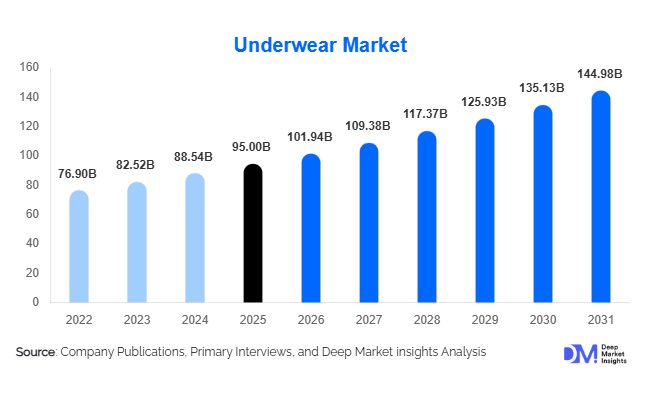
Underwear Market Trends
Premiumization and Fabric Innovation
The underwear market is experiencing strong premiumization, with consumers shifting toward high-quality, durable, and comfort-enhancing materials. Innovations such as moisture-wicking fabrics, antimicrobial textiles, seamless knitting, and temperature-regulating fibers are reshaping product offerings. Brands are increasingly focusing on positioning underwear as a wellness and lifestyle product rather than a basic necessity. Organic cotton, bamboo fiber, and recycled materials are gaining strong traction, especially in developed markets where sustainability awareness is high.
Rise of Direct-to-Consumer (DTC) and Digital Retail Models
DTC underwear brands and online-first retail models are disrupting traditional distribution channels. Subscription-based underwear services, AI-driven size recommendation tools, and virtual fitting technologies are improving customer experience and reducing return rates. Social media marketing and influencer-driven branding are significantly influencing purchasing decisions, especially among younger consumers. Emerging markets are also witnessing rapid digital penetration, enabling global brands to scale efficiently without heavy reliance on physical retail infrastructure.
Underwear Market Drivers
Rising Demand for Comfort and Everyday Wearability
Consumers are increasingly prioritizing comfort in daily wear, driving demand for soft fabrics, stretchable materials, and ergonomic designs. Hybrid lifestyles combining work-from-home and office routines have further strengthened demand for versatile underwear that offers both comfort and durability. This trend is particularly strong in urban populations across North America, Europe, and Asia-Pacific.
Expansion of Women’s Workforce Participation
Increasing female workforce participation globally is significantly boosting demand for premium and functional underwear. Women are increasingly investing in high-quality lingerie that combines aesthetics, comfort, and performance. This has led to rapid growth in seamless underwear, shapewear, and designer lingerie segments across both developed and emerging economies.
Growth of Fitness and Athleisure Culture
The global rise in fitness awareness and athleisure adoption is driving demand for performance underwear such as compression wear, sports briefs, and thermal undergarments. Increasing participation in gym activities, yoga, and outdoor sports is further accelerating this trend, especially among younger demographics.
Underwear Market Restraints
High Price Sensitivity in Emerging Economies
Despite growing demand, price sensitivity remains a major challenge in developing regions. Consumers often prioritize affordability over premium features, limiting penetration of high-margin products. This restricts brand expansion in certain market segments and forces manufacturers to balance pricing with quality.
Raw Material Price Volatility
Fluctuations in cotton, polyester, and elastane prices significantly impact production costs. Supply chain disruptions and dependence on agricultural output add further volatility, affecting profitability and pricing stability across the industry.
Underwear Market Opportunities
Sustainability-Driven Product Innovation
The increasing shift toward eco-friendly apparel presents a major opportunity for manufacturers. Brands investing in biodegradable materials, ethical sourcing, and circular production models are gaining competitive advantage. Regulatory pressure in Europe and growing consumer awareness globally are accelerating this transition.
Expansion in Emerging Markets
Rising disposable income, urbanization, and growing fashion awareness in Asia-Pacific, Latin America, and Africa are creating strong demand for branded underwear. These regions offer significant untapped potential for both premium and mass-market segments, supported by expanding retail infrastructure and digital adoption.
Smart and Functional Textile Integration
The integration of smart textiles, including temperature-regulating fabrics, odor-control materials, and body-mapping designs, is opening new innovation pathways. Performance-enhancing underwear designed for fitness, medical support, and specialized use cases is expected to drive future growth.
Report Scope
| Report Metric | Details |
|---|---|
| Market Size in 2025 | USD 95 Billion |
| Market Size in 2026 | USD 101.94 Billion |
| Market Size in 2031 | USD 144.98 Billion |
| CAGR | 7.3% (2026-2031) |
| Base Year for Estimation | 2025 |
| Historical Data | 2022-2024 |
| Forecast Period | 2026-2031 |
| Report Coverage | Revenue Forecast, Competitive Landscape, Supply Chain Disruption, Growth Factors, Environment & Regulatory Landscape and Trends |
| Geographies Covered | North America, Europe, APAC, Middle East and Africa, LATAM |
| Countries Covered | U.S., Canada, U.K., Germany, France, Spain, Italy, Russia, Nordic, Benelux, Rest of Europe, China, Korea, Japan, India, Australia, Singapore, Taiwan, South East Asia, Rest of Asia-Pacific, UAE, Turky, Saudi Arabia, South Africa, Egypt, Nigeria, Rest of MEA, Brazil, Mexico, Argentina, Chile, Colombia, Rest of LATAM |
Explore more data points, trends and opportunities Download Free Sample Report
Product Type Insights
The global underwear market is segmented into men’s underwear, women’s underwear, children’s underwear, functional underwear, and shapewear & lingerie, each driven by distinct consumption patterns, lifestyle shifts, and product innovation trends. Women’s underwear dominates the market with approximately 42% share, primarily driven by high product diversity, strong influence of fashion cycles, and increasing demand for seamless, comfortable, and aesthetic designs. The leading growth driver within this segment is the rapid shift toward premiumization and fashion-functional hybrid products, such as seamless briefs, lace-comfort hybrids, and shapewear-integrated lingerie, supported by rising workforce participation and body-positivity trends that encourage frequent wardrobe upgrades.
Men’s underwear accounts for around 35% of the market, supported by high replacement frequency and consistent functional demand. Growth in this segment is primarily driven by the rising adoption of performance-oriented and athleisure-inspired underwear, including boxer briefs, moisture-wicking fabrics, and anti-odor materials that align with modern active lifestyles. Brand loyalty and comfort-based purchasing behavior further reinforce steady demand across both premium and mass categories. Children’s underwear contributes nearly 10% of global demand, with growth largely supported by population expansion and rising disposable income in emerging economies. The key growth driver is the increasing preference for skin-friendly, hypoallergenic, and durable cotton-based products, along with growing parental awareness regarding hygiene and comfort standards.
Functional underwear holds approximately 8% share but represents one of the fastest-growing categories. The segment is driven by the expansion of fitness culture, outdoor activities, and sports participation globally. Thermal wear, compression underwear, and moisture-control garments are increasingly adopted by athletes and urban consumers seeking performance enhancement and climate adaptability. Shapewear & lingerie account for nearly 5% of the market, with strong demand in premium and fashion-driven segments. Growth is driven by the rising influence of body contouring fashion trends, social media-driven aesthetics, and luxury lingerie branding, particularly in developed markets where discretionary spending is higher.
End-Use Insights
Individual consumers dominate the underwear market, accounting for nearly 85% of total demand, driven by hygiene needs, frequent replacement cycles, and lifestyle-driven consumption behavior. The fastest-growing end-use segment is sports and fitness applications, supported by increasing global health awareness, gym memberships, and participation in recreational sports. This segment is further strengthened by rising demand for compression wear and performance-enhancing innerwear across both developed and emerging economies.
Fashion and luxury retail represents another expanding end-use segment, with premium lingerie and designer collections gaining strong traction among urban consumers. Meanwhile, institutional and export-driven demand continues to rise, particularly from large-scale manufacturing hubs in Asia that supply global retail chains and e-commerce platforms. The increasing integration of underwear into lifestyle and fashion ecosystems is further broadening its end-use scope beyond basic apparel consumption.
Explore more data points, trends and opportunities Download Free Sample Report
Underwear Market Segmentations
By Product Type
- Men’s Underwear
- Women’s Underwear
- Children’s Underwear
- Functional & Performance Underwear
- Shapewear & Lingerie
By End Use
- Individual Consumers
- Sports & Fitness Applications
- Fashion & Luxury Retail
- Institutional & Export Demand
By Distribution Channel
- Online Retail (E-commerce & DTC Brands)
- Specialty & Lingerie Stores
- Supermarkets & Hypermarkets
- Brand-Owned Retail Stores
Regional Insights
Asia-Pacific
Asia-Pacific leads the global underwear market with approximately 38% share in 2025, driven by strong textile manufacturing ecosystems, rising disposable incomes, and rapid urbanization. China remains a dominant production hub, particularly in mass and mid-premium segments, while India is emerging as a high-growth consumption market supported by expanding e-commerce penetration and young demographics. Southeast Asia is also witnessing rising demand due to increasing brand awareness and retail modernization. The key growth drivers in the region include cost-efficient manufacturing infrastructure, expanding middle-class population, and rapid digital retail adoption, which collectively support both supply-side dominance and consumption growth.
North America
North America accounts for around 27% share, led by the United States, which is one of the largest premium underwear markets globally. Demand is strongly driven by high disposable income levels, strong brand penetration, and widespread adoption of online retail channels. The key regional growth drivers include premiumization of apparel consumption, rising demand for sustainable and functional fabrics, and strong influence of athleisure culture. Additionally, subscription-based underwear models and direct-to-consumer brands are significantly reshaping purchasing behavior in the region.
Europe
Europe holds approximately 22% market share, with Germany, the UK, France, and Italy leading consumption. The region is highly influenced by sustainability regulations and strong consumer preference for eco-friendly and ethically produced apparel. Growth drivers include increasing demand for sustainable textiles, strong lingerie fashion culture, and rising adoption of premium intimate wear. European consumers also demonstrate high willingness to pay for quality, driving consistent growth in premium and designer underwear segments.
Latin America
Latin America represents nearly 7% share, with Brazil and Mexico as the key markets. Growth is driven by expanding middle-class populations, rising fashion consciousness, and improving retail infrastructure. The primary regional drivers include increasing urbanization, growing penetration of international apparel brands, and rising affordability of mid-range underwear products. E-commerce expansion is also playing a key role in improving market accessibility across the region.
Middle East & Africa
The Middle East & Africa (MEA) region accounts for approximately 6% market share, with demand concentrated in GCC countries such as the UAE, Saudi Arabia, and Qatar, along with South Africa. Growth is driven by rising urban populations, increasing adoption of branded apparel, and expanding retail infrastructure. Key drivers include high-income luxury consumption in GCC markets, growing young population base, and increasing penetration of international fashion brands. Additionally, tourism and expatriate populations further contribute to demand diversification across the region.
Key Players in the Global Underwear Market
- Hanesbrands Inc.
- PVH Corp.
- Victoria’s Secret & Co.
- Triumph International
- Jockey International
- Fruit of the Loom
- Marks & Spencer Group
- Fast Retailing (Uniqlo)
- Adidas AG
- NIKE Inc.