Top Companies in Smoked Sausage Market | Industry Leaders & Insights
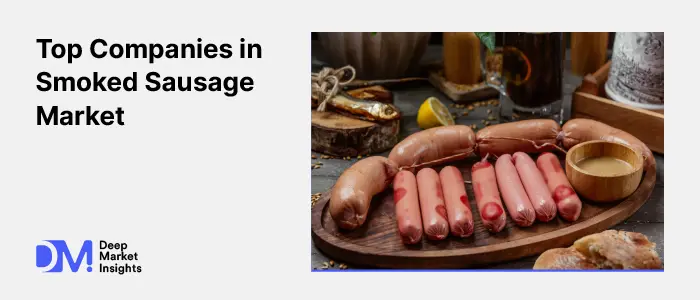
The Top Companies in Top Companies in Smoked Sausage Market play a critical role in shaping the global processed meat industry, driven by rising demand for ready-to-eat and convenience foods. Smoked sausages, valued for their extended shelf life and distinctive flavor, account for approximately 18–22% of the global processed meat segment. Annual global consumption exceeds 9 million metric tons, with North America and Europe collectively contributing over 55% of total demand.This market is highly consolidated, with multinational corporations leveraging vertically integrated supply chains and advanced processing technologies to maintain competitive advantage. Procurement professionals and distributors increasingly focus on supplier reliability, pricing consistency, and product diversification when evaluating key market players.
Market Overview with Data
The Top Companies in Top Companies in Smoked Sausage Market operate in a mature yet innovation-driven environment characterized by stable demand and evolving consumer preferences.Global smoked sausage production is estimated at over 10.5 million metric tons annually, with the United States alone contributing nearly 2.3 million metric tons. Europe follows closely, led by Germany and Poland, which together account for approximately 1.8 million metric tons of output.From a pricing perspective, wholesale smoked sausage prices typically range between $2.80 and $5.50 per kilogram, depending on meat type (pork, beef, poultry) and processing standards. Premium and organic variants can exceed $7.00 per kilogram, particularly in Western European markets.Regionally, North America holds around 32% market share, followed by Europe at 28%, and Asia-Pacific at 25%, where consumption is growing due to urbanization and dietary shifts. Retail and foodservice channels account for nearly 70% of total sales, with private label products capturing approximately 15–18% share in developed markets.
Top Companies in Top Companies in Smoked Sausage Market
Tyson Foods, Inc.
Tyson Foods is one of the largest protein processors globally, generating annual revenues exceeding $52 billion, with a significant portion derived from processed meat products, including smoked sausages. The company operates over 240 facilities worldwide, ensuring large-scale production and distribution capabilities.Its smoked sausage portfolio includes brands such as Hillshire Farm, offering a wide range of pork, beef, and turkey-based products. Tyson maintains a strong market position in North America, where it commands an estimated 12–15% share of the smoked sausage segment.Strategically, Tyson focuses on automation, supply chain integration, and product innovation, including reduced-sodium and clean-label offerings. Its investment in cold chain logistics enhances delivery efficiency and supports large-volume procurement contracts.
WH Group Limited (Smithfield Foods)

WH Group, through its subsidiary Smithfield Foods, is a dominant player in the global smoked sausage market, with annual revenues exceeding $28 billion. Smithfield operates more than 50 production facilities in the U.S., with a combined processing capacity of over 30 million hogs annually.The company’s smoked sausage portfolio includes well-known brands such as Eckrich and Nathan’s Famous. It holds approximately 10–12% market share in North America and has a growing presence in Asia.WH Group’s strategy centers on vertical integration, controlling everything from livestock production to distribution. This approach enables cost efficiency and consistent quality, making it a preferred supplier for large-scale retail and foodservice buyers.
Hormel Foods Corporation
Hormel Foods generates annual revenues of around $12 billion and is a key player in value-added meat products, including smoked sausages. Its portfolio features brands like Jennie-O and Hormel Natural Choice, with strong penetration in both retail and institutional channels.The company operates over 40 manufacturing facilities globally, with smoked sausage production contributing significantly to its refrigerated foods segment. Hormel holds an estimated 8–10% share in the U.S. smoked sausage market.Hormel emphasizes premiumization and innovation, introducing organic and antibiotic-free sausage lines. Its pricing strategy typically falls within the $4.00–$6.50 per kilogram range, positioning it in the mid-to-premium segment.
JBS S.A.

JBS S.A. is the world’s largest meat processing company, with revenues surpassing $70 billion. The company produces a wide range of processed meats, including smoked sausages, through its subsidiaries such as Pilgrim’s Pride and Seara.JBS operates in over 20 countries, with production facilities capable of processing more than 75,000 tons of meat daily. Its smoked sausage offerings are particularly strong in Latin America and North America, where it holds an estimated 9–11% market share.The company’s strategy focuses on global expansion, cost leadership, and product diversification. JBS leverages economies of scale to offer competitive pricing, often in the $2.80–$4.50 per kilogram range, appealing to price-sensitive markets.
Conagra Brands, Inc.
Conagra Brands, with annual revenues of approximately $12 billion, is a significant player in the packaged food sector, including smoked sausages. Its portfolio includes brands such as Armour and Hebrew National, which cater to both mainstream and niche consumer segments.The company operates multiple processing facilities across North America, producing a diverse range of smoked sausage products. Conagra holds an estimated 6–8% share of the U.S. market.Its strategy emphasizes brand strength, product innovation, and targeted marketing. Conagra focuses on convenience-oriented products, including pre-cooked and ready-to-heat sausages, with pricing typically ranging from $3.50 to $6.00 per kilogram.
Nestlé S.A. (Processed Meat Segment)

Nestlé, although primarily known for its diversified food portfolio, has a presence in the smoked sausage market through its processed meat and frozen food divisions. The company generates over $100 billion in annual revenue, with processed meats contributing a smaller but stable share.Nestlé’s smoked sausage products are more prominent in European and Latin American markets, where it leverages strong distribution networks. The company operates in over 180 countries, ensuring extensive market reach.Nestlé focuses on health-oriented innovation, including reduced-fat and plant-based alternatives. Its pricing strategy typically targets the premium segment, often exceeding $6.00 per kilogram in developed markets.
Competitive Landscape Insights
The Top Companies in Top Companies in Smoked Sausage Market exhibit a moderately consolidated structure, with the top five players collectively accounting for approximately 45–55% of global market share. Regional players and private labels make up the remaining 45–55%, intensifying competition in price-sensitive segments.
Pricing segmentation is clearly defined:
-
Economy segment: $2.50–$3.50/kg (bulk and private label)
-
Mid-range: $3.50–$5.50/kg (branded conventional products)
-
Premium: $5.50–$7.50/kg (organic, specialty, and gourmet)
Supply chain efficiency is a key differentiator. Leading companies maintain vertically integrated operations, reducing dependency on third-party suppliers and ensuring stable raw material costs. Cold chain logistics infrastructure plays a critical role, particularly in maintaining product quality across long-distance distribution.Procurement professionals increasingly prioritize suppliers with consistent production capacity, typically above 100,000 tons annually, and strong compliance with food safety standards.The Top Companies in Top Companies in Smoked Sausage Market demonstrate strong operational scale, diversified product portfolios, and strategic focus on innovation and supply chain optimization. Industry leaders such as Tyson Foods, WH Group, and JBS dominate through volume and cost efficiency, while companies like Hormel and Nestlé differentiate through premium offerings and brand positioning.For B2B buyers and procurement decision-makers, selecting the right supplier depends on balancing pricing, quality, and supply reliability. With global consumption exceeding 9 million metric tons annually and pricing variability across segments, the market offers significant opportunities for strategic sourcing and long-term partnerships.