Smoked Sausage Market Size
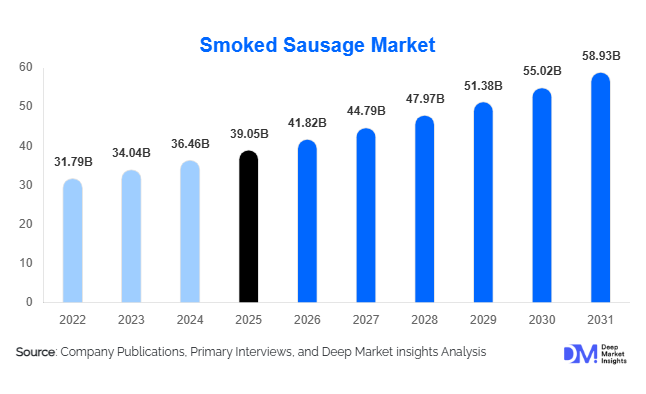
According to Deep Market Insights, the global smoked sausage market size was valued at USD 39.05 billion in 2025 and is projected to grow from USD 41.82 billion in 2026 to reach USD 58.93 billion by 2031, expanding at a CAGR of 7.1% during the forecast period (2026–2031). Market growth is primarily driven by rising global consumption of convenient protein-rich foods, expansion of organized retail and cold-chain infrastructure, and increasing demand for ready-to-eat meat products across both developed and emerging economies. Smoked sausages continue to gain popularity due to their extended shelf life, distinctive flavor profile, and versatility across household cooking, foodservice menus, and processed food manufacturing applications.
Key Market Insights
- Convenience food consumption is accelerating global demand, with ready-to-eat smoked sausages becoming staple protein products in urban households.
- Pork-based smoked sausages dominate globally, though poultry and plant-based variants are expanding rapidly due to changing dietary preferences.
- Europe leads global consumption, supported by strong sausage traditions and export-oriented processing industries.
- Asia-Pacific is the fastest-growing region, fueled by retail modernization, rising disposable income, and expanding foodservice sectors.
- Vacuum and modified atmosphere packaging technologies are improving shelf life and enabling international distribution.
- Premium and artisanal smoked sausages are gaining traction, driven by clean-label demand and gourmet flavor innovation.
What are the latest trends in the smoked sausage market?
Premiumization and Gourmet Flavor Innovation
The smoked sausage market is witnessing strong premiumization trends as consumers increasingly seek high-quality meat products featuring natural ingredients and authentic smoking techniques. Producers are introducing hardwood-smoked varieties, regionally inspired recipes, and specialty spice blends to differentiate offerings. Premium products emphasizing organic meat sourcing, nitrate-free curing, and artisanal processing methods are achieving higher margins and stronger brand loyalty. Retailers are allocating greater shelf space to gourmet sausages, while private-label premium ranges are expanding across supermarkets, reinforcing the shift toward value-added meat products.
Growth of Plant-Based and Hybrid Smoked Sausages
The rise of flexitarian diets is encouraging manufacturers to diversify portfolios through plant-based and hybrid smoked sausage products. Advances in plant protein structuring and smoke flavor infusion technologies allow alternatives to replicate traditional texture and taste. Younger consumers and environmentally conscious buyers are increasingly adopting these products, particularly in North America and Europe. Foodservice operators are also experimenting with plant-based sausage menu items, broadening category appeal and enabling companies to capture new customer segments without replacing traditional meat consumption entirely.
What are the key drivers in the smoked sausage market?
Expansion of Convenience and Ready-to-Eat Food Consumption
Urbanization and busy lifestyles are driving demand for foods that require minimal preparation while delivering nutritional value. Fully cooked smoked sausages align with these needs, offering quick meal solutions suitable for breakfast, snacks, and dinner applications. Growth of dual-income households and increasing reliance on packaged foods continue to strengthen demand globally. Retail chains are promoting multipack formats and microwave-ready options, further accelerating category adoption.
Foodservice Industry Growth and Menu Diversification
The rapid expansion of quick-service restaurants, cafés, and casual dining establishments is significantly increasing institutional demand. Smoked sausages are widely used in pizzas, sandwiches, hot dogs, and fusion cuisine dishes due to their versatility and consistent flavor. Global foodservice recovery and rising tourism are further boosting procurement volumes. Menu innovation incorporating international flavors has also expanded smoked sausage applications across cuisines.
What are the restraints for the global market?
Health Concerns Related to Processed Meat Consumption
Growing consumer awareness regarding sodium levels, preservatives, and processed meat consumption poses a challenge to market expansion. Regulatory authorities in several regions are tightening labeling and nutritional standards, encouraging manufacturers to reformulate products. Companies are responding through reduced-sodium variants and clean-label positioning; however, perception challenges remain a restraint in certain developed markets.
Volatility in Livestock and Raw Material Prices
Fluctuations in pork, beef, and poultry prices directly impact production costs and profit margins. Feed price variations, disease outbreaks, and supply chain disruptions create pricing instability. Manufacturers must continuously optimize sourcing strategies and operational efficiency to maintain competitive pricing without sacrificing product quality.
What are the key opportunities in the smoked sausage industry?
Expansion into Emerging Markets
Rapid retail modernization across Asia-Pacific and Latin America presents substantial growth opportunities. Expansion of cold-chain logistics and supermarket penetration allows smoked sausage manufacturers to access previously underserved markets. Countries such as India, Indonesia, and Brazil are witnessing rising meat consumption among younger urban populations, creating strong demand potential for packaged sausage products.
Premium Retail and Direct-to-Consumer Channels
Digital commerce and direct-to-consumer meat delivery platforms are enabling manufacturers to build stronger customer relationships. Subscription meat boxes, online specialty stores, and branded e-commerce channels allow premium storytelling and customized product offerings. These channels also provide pricing flexibility and higher margins compared to traditional distribution systems, making them attractive growth avenues for both established players and new entrants.
Report Scope
| Report Metric | Details |
|---|---|
| Market Size in 2025 | USD 39.05 Billion |
| Market Size in 2026 | USD 41.82 Billion |
| Market Size in 2031 | USD 58.93 Billion |
| CAGR | 7.1% (2026-2031) |
| Base Year for Estimation | 2025 |
| Historical Data | 2022-2024 |
| Forecast Period | 2026-2031 |
| Report Coverage | Revenue Forecast, Competitive Landscape, Supply Chain Disruption, Growth Factors, Environment & Regulatory Landscape and Trends |
| Geographies Covered | North America, Europe, APAC, Middle East and Africa, LATAM |
| Countries Covered | U.S., Canada, U.K., Germany, France, Spain, Italy, Russia, Nordic, Benelux, Rest of Europe, China, Korea, Japan, India, Australia, Singapore, Taiwan, South East Asia, Rest of Asia-Pacific, UAE, Turky, Saudi Arabia, South Africa, Egypt, Nigeria, Rest of MEA, Brazil, Mexico, Argentina, Chile, Colombia, Rest of LATAM |
Explore more data points, trends and opportunities Download Free Sample Report
Product Type Insights
The global smoked sausage market demonstrates strong diversification across product types, with pork smoked sausages continuing to dominate overall consumption and accounting for approximately 46% of total demand. The leadership of pork-based products is primarily driven by deep-rooted culinary traditions across Europe and North America, where smoked sausages form an integral part of everyday meals, barbecues, and processed food recipes. In addition, pork offers cost-efficient processing, favorable fat-to-protein ratios for smoking, and consistent flavor profiles that support large-scale manufacturing. The leading segment growth is further supported by well-established supply chains, advanced meat processing infrastructure, and strong consumer familiarity, enabling manufacturers to maintain high production volumes while introducing flavor innovations and regional variants.Poultry-based smoked sausages are emerging as one of the fastest-growing product categories as consumers increasingly prioritize healthier protein alternatives. Rising awareness regarding cholesterol intake, calorie control, and balanced diets has accelerated the shift toward chicken and turkey sausages, particularly in Asia-Pacific and Middle Eastern markets where dietary preferences and religious considerations favor poultry consumption. Beef smoked sausages maintain stable demand within premium and specialty segments, supported by gourmet positioning and high-quality ingredient perception. Mixed-meat variants continue to appeal to regional taste preferences by blending flavor profiles and optimizing production costs. Meanwhile, plant-based smoked sausages, though currently representing a smaller market share, are expanding rapidly as sustainability concerns, flexitarian diets, and advancements in alternative protein technologies encourage product innovation. Manufacturers are increasingly expanding portfolios to address both traditional meat consumers and emerging lifestyle-driven demand segments, strengthening long-term market resilience.
Application Insights
Household consumption remains the leading application segment, accounting for nearly 57% of global demand, primarily driven by the convenience factor associated with smoked sausages. The segment’s dominance is supported by changing consumer lifestyles characterized by time constraints, growing dual-income households, and rising preference for quick meal preparation solutions. Smoked sausages offer versatility across breakfast, snacks, and dinner applications, making them a staple protein option in retail grocery purchases. Increasing availability of pre-cooked, flavored, and easy-to-prepare products continues to reinforce household adoption, particularly as supermarkets expand ready-to-cook product assortments.Foodservice applications are witnessing significant expansion as smoked sausages gain prominence in quick-service restaurants, street food formats, and casual dining menus worldwide. The leading growth driver within this segment is menu diversification, where operators utilize smoked sausages in sandwiches, pizzas, hot dogs, and fusion cuisine offerings due to their consistent taste, extended shelf life, and operational efficiency. Industrial food processing applications, including frozen meals, packaged ready meals, and processed snacks, are also growing steadily as manufacturers seek reliable protein ingredients capable of maintaining flavor and texture during storage and reheating. The increasing incorporation of smoked sausages into protein snack kits, meal kits, and ready-to-eat food solutions reflects broader industry trends toward convenience-oriented consumption and on-the-go eating habits.
Distribution Channel Insights
Supermarkets and hypermarkets remain the dominant distribution channel, contributing nearly 48% of global sales. The leadership of this segment is primarily driven by strong cold-chain infrastructure, wide product assortment visibility, and promotional pricing strategies that encourage bulk purchasing behavior. Organized retail environments allow manufacturers to showcase branded and private-label smoked sausage products through attractive merchandising and in-store marketing campaigns, further strengthening consumer engagement. Expansion of modern retail formats in emerging economies continues to reinforce the channel’s leading position.Convenience stores play a critical supporting role, particularly in urban markets, by facilitating impulse purchases and single-serve consumption patterns. Online retail is emerging as a high-growth distribution channel as digital grocery platforms gain consumer trust and logistical capabilities improve. Direct-to-consumer strategies, subscription meal services, and e-commerce promotions are enabling brands to build stronger customer relationships while offering customized product bundles. Specialty butcher shops maintain relevance within premium and artisanal segments by emphasizing freshness, craftsmanship, and locally sourced ingredients, appealing to consumers seeking authenticity and quality differentiation. Foodservice distribution networks remain essential for bulk procurement, ensuring consistent supply to restaurants, hotels, and institutional buyers.
Price Tier Insights
The mid-range price tier leads the smoked sausage market with nearly 50% share, driven by its optimal balance between affordability and perceived quality. The leading segment driver is value-oriented consumer behavior, where buyers seek reliable taste and acceptable ingredient quality without premium pricing. This positioning allows manufacturers to achieve large-scale sales volumes while maintaining competitive margins through efficient production and standardized formulations.Economy-priced products continue to generate strong volume demand in price-sensitive markets across developing regions, where affordability remains a key purchasing factor. These products benefit from expanding urban populations and rising consumption of packaged protein foods. At the same time, premium and artisanal smoked sausages are experiencing accelerated growth as consumers increasingly prioritize ingredient transparency, traditional smoking techniques, organic certifications, and gourmet flavor innovation. Premiumization trends are enabling manufacturers to differentiate offerings, enhance brand value, and improve profitability while catering to evolving consumer expectations surrounding food quality and authenticity.
Explore more data points, trends and opportunities Download Free Sample Report
Smoked Sausage Market Segmentations
By Product Type
- Pork Smoked Sausage
- Beef Smoked Sausage
- Poultry Smoked Sausage
- Mixed Meat Smoked Sausage
- Plant-Based Smoked Sausage
By Application
- Household Consumption
- Foodservice Industry
- Industrial Food Processing
By Distribution Channel
- Supermarkets Hypermarkets
- Convenience Stores
- Online Retail
- Specialty Butcher Shops
- Foodservice Distributors
By Price Tier
- Economy Segment
- Mid-Range Segment
- Premium Artisanal Segment
Regional Insights
North America
North America accounts for approximately 29% of global market share, led by the United States, where smoked sausages are deeply embedded in barbecue traditions, sports events, and convenience-driven meal culture. Regional growth is supported by strong consumer demand for ready-to-cook protein products, widespread availability across retail and foodservice channels, and continuous product innovation in flavors and formulations. Increasing adoption of clean-label, organic, and nitrate-free smoked sausages is driving premium segment expansion, while advancements in cold-chain logistics and private-label retail offerings further strengthen market penetration. Canada contributes stable growth through rising demand for high-quality processed meats and growing multicultural culinary influences that expand product variety.
Europe
Europe holds the largest market share at nearly 32%, supported by centuries-old sausage-making traditions and highly developed meat processing industries across Germany, Poland, Spain, and France. Regional growth is driven by strong cultural consumption patterns, geographic indication products, and increasing exports to global markets. Innovation in specialty flavors, artisanal smoking techniques, and premium regional varieties continues to attract consumers seeking authenticity and heritage foods. Additionally, stringent food safety standards and advanced processing technologies enhance product quality and export competitiveness, reinforcing Europe’s position as both a leading consumption and production hub.
Asia-Pacific
Asia-Pacific represents the fastest-growing regional market, expanding at a CAGR exceeding 8%, fueled by rapid urbanization, rising disposable incomes, and growing acceptance of processed meat products. China leads regional consumption as modern retail expansion and changing dietary habits increase demand for convenient protein foods. Japan and South Korea drive premium product growth through demand for high-quality packaged foods and innovative flavor profiles. India is emerging as a significant growth market supported by expanding organized retail networks, increasing exposure to global cuisines, and rising adoption of convenience foods among urban consumers. The expansion of quick-service restaurant chains and e-commerce grocery platforms further accelerates regional demand.
Latin America
Latin America accounts for around 11% of global demand, with Brazil and Mexico serving as key contributors due to strong domestic meat production and established sausage consumption culture. Regional growth is driven by expanding supermarket penetration, improving cold storage infrastructure, and increasing consumption of packaged and processed foods among growing middle-class populations. Economic urbanization and rising participation in modern retail channels are encouraging manufacturers to introduce affordable product formats while also expanding premium offerings targeting evolving consumer preferences.
Middle East & Africa
The Middle East and Africa region is experiencing steady growth, supported by rising urbanization, expanding tourism and hospitality sectors, and improving food distribution infrastructure. Poultry-based smoked sausages are gaining significant traction due to cultural and religious dietary preferences, particularly in the UAE and Saudi Arabia. Regional growth is further driven by increasing expatriate populations, expanding quick-service restaurant networks, and investments in cold-chain logistics that improve product availability. Growing demand for convenient halal-certified processed foods and rising disposable incomes across urban centers continue to create new opportunities for manufacturers entering the market.
Key Players in the Smoked Sausage Market
- Tyson Foods Inc.
- WH Group Limited
- Hormel Foods Corporation
- Smithfield Foods Inc.
- JBS S.A.
- BRF S.A.
- Maple Leaf Foods Inc.
- Conagra Brands Inc.
- Nestlé S.A.
- OSI Group
- Danish Crown A/S
- Campofrío Food Group
- Johnsonville LLC
- Clemens Food Group
- Atria Plc