Pizza Cheese Market Size
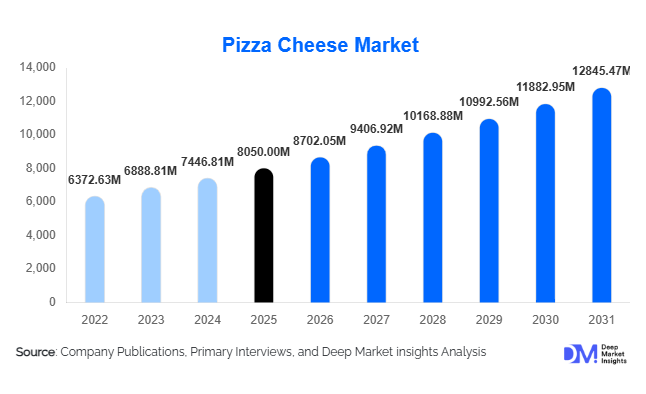
According to Deep Market Insights, the global pizza cheese market size was valued at USD 8,050 million in 2025 and is projected to grow from USD 8,702.05 million in 2026 to reach USD 12,845.47 million by 2031, expanding at a CAGR of 8.1% during the forecast period (2026–2031). The pizza cheese market growth is primarily driven by the increasing global consumption of pizza, expansion of quick-service restaurant (QSR) chains, and rising demand for convenience and ready-to-eat food products. The growing popularity of frozen pizzas, along with innovations in cheese processing and plant-based alternatives, is further supporting market expansion.
Key Market Insights
- Mozzarella cheese dominates the market, accounting for over 60% share due to its superior melting and stretchability characteristics essential for pizza applications.
- Foodservice channels lead demand, driven by QSR expansion, cloud kitchens, and increasing global pizza consumption trends.
- North America holds the largest market share, supported by high per capita pizza consumption and advanced dairy infrastructure.
- Asia-Pacific is the fastest-growing region, fueled by urbanization, rising disposable incomes, and westernization of diets in countries like India and China.
- Plant-based pizza cheese is emerging rapidly, driven by vegan diets, lactose intolerance awareness, and sustainability concerns.
- Technological advancements in cheese processing, including improved shelf-life and customized blends, are enhancing product innovation and distribution efficiency.
What are the latest trends in the pizza cheese market?
Rise of Plant-Based and Clean-Label Cheese
The pizza cheese market is witnessing a strong shift toward plant-based and clean-label alternatives. Consumers are increasingly demanding dairy-free cheese options made from almond, soy, and coconut bases due to health concerns and environmental awareness. Clean-label products with minimal additives and preservatives are gaining traction, particularly in developed markets such as North America and Europe. Manufacturers are investing in R&D to replicate the meltability and texture of traditional mozzarella in plant-based formats, creating new growth avenues. This trend is expected to accelerate as vegan and flexitarian diets continue to expand globally.
Growth of Frozen and Ready-to-Eat Pizza Segment
The rapid expansion of frozen and ready-to-eat food categories is significantly influencing the pizza cheese market. Frozen pizzas require processed and shredded cheese with extended shelf life and consistent quality, driving demand for technologically advanced cheese formulations. Retail sales of frozen pizza are increasing globally due to busy lifestyles and convenience-driven consumption patterns. Additionally, improved cold chain logistics and packaging technologies are enabling wider distribution, particularly in emerging markets. This trend is strengthening the demand for processed cheese variants tailored for industrial applications.
What are the key drivers in the pizza cheese market?
Expansion of Quick-Service Restaurant Chains
The rapid global expansion of QSR chains is a major growth driver for the pizza cheese market. International and regional pizza brands are continuously expanding their footprint, increasing the demand for standardized, high-quality cheese products. Cloud kitchens and online food delivery platforms have further accelerated pizza consumption, particularly in urban areas. This trend is especially strong in Asia-Pacific and the Middle East, where rising middle-class populations are driving fast-food adoption.
Urbanization and Changing Dietary Habits
Urbanization and rising disposable incomes are significantly influencing consumer food preferences, leading to increased consumption of Western-style foods such as pizza. Younger demographics, in particular, are driving demand for convenient and indulgent food options. As a result, pizza cheese consumption is rising across both developed and developing regions. The growing popularity of home cooking and DIY pizza kits is also contributing to increased retail demand for shredded and sliced cheese formats.
What are the restraints for the global market?
Volatility in Raw Milk Prices
The pizza cheese market is highly dependent on milk as a primary raw material, making it vulnerable to price fluctuations. Changes in dairy supply due to climatic conditions, feed costs, and government policies can significantly impact production costs and profit margins. This volatility poses a challenge for manufacturers in maintaining stable pricing and profitability.
Health Concerns Related to Processed Cheese
Increasing awareness about health issues such as obesity and cardiovascular diseases is restraining the consumption of high-fat and processed cheese products. Consumers are becoming more cautious about calorie intake and nutritional content, prompting manufacturers to reformulate products with reduced fat, sodium, and additives. This shift requires continuous innovation and investment, posing challenges for traditional product lines.
What are the key opportunities in the pizza cheese industry?
Emerging Market Expansion
Emerging economies such as India, China, and Brazil present significant growth opportunities due to increasing urbanization, rising disposable incomes, and expanding fast-food culture. The penetration of international pizza chains and local brands is creating consistent demand for cost-effective pizza cheese. Establishing local production facilities in these regions can help manufacturers reduce costs and improve supply chain efficiency.
Product Customization and Technological Innovation
Advancements in cheese processing technologies are enabling manufacturers to develop customized blends with specific meltability, stretch, and flavor characteristics. This is particularly important for catering to diverse pizza styles and regional preferences. Innovations in packaging and shelf-life extension are also improving product distribution, especially for frozen and export markets.
Report Scope
| Report Metric | Details |
|---|---|
| Market Size in 2025 | USD 8050 Million |
| Market Size in 2026 | USD 8702.05 Million |
| Market Size in 2031 | USD 12845.47 Million |
| CAGR | 8.1% (2026-2031) |
| Base Year for Estimation | 2025 |
| Historical Data | 2022-2024 |
| Forecast Period | 2026-2031 |
| Report Coverage | Revenue Forecast, Competitive Landscape, Supply Chain Disruption, Growth Factors, Environment & Regulatory Landscape and Trends |
| Geographies Covered | North America, Europe, APAC, Middle East and Africa, LATAM |
| Countries Covered | U.S., Canada, U.K., Germany, France, Spain, Italy, Russia, Nordic, Benelux, Rest of Europe, China, Korea, Japan, India, Australia, Singapore, Taiwan, South East Asia, Rest of Asia-Pacific, UAE, Turky, Saudi Arabia, South Africa, Egypt, Nigeria, Rest of MEA, Brazil, Mexico, Argentina, Chile, Colombia, Rest of LATAM |
Explore more data points, trends and opportunities Download Free Sample Report
Product Type Insights
The global pizza cheese market is strongly led by mozzarella cheese, which accounts for approximately 62% of the total market share in 2025, reflecting its unmatched suitability for pizza applications across both commercial and household settings. The dominance of mozzarella is primarily driven by its superior functional characteristics, including excellent melting behavior, optimal stretchability, and a mild, creamy flavor profile that complements a wide variety of toppings without overpowering them. These intrinsic properties make mozzarella the industry standard for traditional and modern pizza formats alike, from artisanal wood-fired pizzas to mass-produced quick-service offerings. In addition, the consistent quality of mozzarella produced through advanced dairy processing technologies has further reinforced its widespread adoption across global markets.Beyond mozzarella, processed cheese is steadily gaining traction, particularly in the frozen and ready-to-eat pizza segments. Its longer shelf life, uniform texture, and resistance to separation during freezing and reheating cycles make it highly suitable for industrial-scale production. Processed cheese also enables manufacturers to achieve cost efficiencies while maintaining consistent taste and texture, which is critical for large foodservice chains and retail brands. At the same time, blended cheese varieties, which combine mozzarella with cheddar, provolone, parmesan, or other specialty cheeses, are witnessing increased demand in premium and gourmet pizza segments. These blends offer enhanced flavor complexity, improved browning characteristics, and differentiated sensory experiences, allowing pizza brands to cater to evolving consumer preferences for indulgent and artisanal food experiences. The leading segment driver across product types remains the functional superiority and versatility of mozzarella, supported by innovation in blending techniques and flavor customization.
Form Insights
In terms of form, shredded pizza cheese leads the global market, capturing approximately 48% share, primarily due to its convenience, efficiency, and adaptability across multiple usage scenarios. Shredded cheese is widely preferred in both commercial kitchens and households because it allows for even distribution across pizza surfaces, ensuring consistent melting and coverage. This uniformity is particularly important in quick-service restaurants (QSRs) and large-scale foodservice operations, where speed, portion control, and product consistency are critical operational priorities. The pre-processed nature of shredded cheese significantly reduces preparation time, labor costs, and waste, making it an indispensable format in high-volume environments.Other forms such as cheese blocks and slices continue to hold relevance in specific applications, particularly in artisanal or specialty pizza preparation where customization and manual processing are preferred. Blocks allow chefs to control shredding size and texture, while slices are often used in niche formats such as stuffed crusts or layered dishes. Emerging formats such as diced and spreadable cheese are gradually gaining traction, especially in innovative product formulations and ready-to-cook meal kits. These formats cater to evolving consumer preferences for convenience and experimentation in home cooking. The primary growth driver within this segment is the operational efficiency and convenience offered by shredded cheese, which aligns with the increasing demand for time-saving solutions in both foodservice and retail environments.
Source Insights
Based on source, cow milk-based cheese dominates the pizza cheese market, accounting for nearly 72% share, owing to its widespread availability, cost-effectiveness, and well-established supply chains. Cow milk provides a consistent raw material base that supports large-scale production while maintaining the desired texture, taste, and functional properties required for pizza cheese. The global dairy industry’s extensive infrastructure, coupled with advancements in milk processing and quality control, has further strengthened the dominance of cow milk-based cheese across regions.However, plant-based cheese is emerging as the fastest-growing segment, driven by shifting consumer preferences toward vegan, lactose-free, and environmentally sustainable food options. Increasing awareness of lactose intolerance, coupled with ethical and environmental concerns associated with animal-based products, is accelerating the adoption of plant-based alternatives derived from sources such as almond, soy, coconut, and cashew. Although plant-based cheese currently represents a smaller share of the market, continuous innovation in texture, taste, and melting performance is narrowing the gap with traditional dairy-based cheese, making it a viable option for mainstream pizza applications.Additionally, alternative animal milk sources such as buffalo and goat milk are gaining popularity in premium and regional markets. Buffalo milk, known for its higher fat content, enhances creaminess and richness, while goat milk offers a distinct flavor profile that appeals to niche consumer segments. The leading driver in this segment remains the scalability and cost efficiency of cow milk-based cheese, complemented by the rapid growth of plant-based alternatives as consumer dietary preferences evolve.
Distribution Channel Insights
The distribution landscape of the pizza cheese market is heavily dominated by the foodservice segment, which accounts for approximately 64% share, reflecting the high-volume consumption patterns of quick-service restaurants, full-service dining establishments, and cloud kitchens. The rapid expansion of global and regional pizza chains, coupled with the proliferation of online food delivery platforms, has significantly increased the demand for pizza cheese in the foodservice sector. Bulk purchasing, standardized product specifications, and long-term supplier agreements further strengthen the position of foodservice channels in the overall market.Retail channels, however, are witnessing notable growth, driven by the rising popularity of home cooking and do-it-yourself (DIY) pizza preparation. Supermarkets, hypermarkets, and convenience stores continue to play a crucial role in product accessibility, while e-commerce platforms are rapidly transforming the retail landscape by offering a wide range of cheese products with doorstep delivery. The COVID-19 pandemic has had a lasting impact on consumer behavior, accelerating the shift toward home-based food consumption and increasing demand for packaged and ready-to-use ingredients, including pizza cheese.The primary driver for this segment is the dominance of foodservice demand, supported by the rapid expansion of QSR networks and digital food delivery ecosystems, alongside the growing influence of retail channels in meeting household consumption needs.
Application Insights
Commercial pizza production remains the leading application segment, accounting for approximately 58% share, underscoring the dominance of organized pizza chains and foodservice operators in driving global demand. Large-scale pizza manufacturers and QSR brands rely heavily on consistent, high-quality cheese supplies to maintain standardized product offerings across multiple locations. The ability of pizza cheese to deliver uniform melting, stretching, and flavor is critical in ensuring customer satisfaction and brand consistency.The frozen pizza segment is experiencing rapid growth, fueled by increasing consumer demand for convenient, ready-to-cook meal solutions. Busy lifestyles, urbanization, and the growing penetration of modern retail formats are contributing to the rising popularity of frozen pizzas, thereby boosting demand for pizza cheese that can withstand freezing and reheating processes without compromising quality. Additionally, pizza cheese is increasingly being utilized in other applications such as ready-to-eat meals, snack products, and food processing industries, further expanding its market scope.The leading driver for this segment is the large-scale demand from commercial pizza production, supported by the rapid growth of the frozen food industry and the increasing preference for convenience foods.
End-Use Insights
The foodservice industry represents the largest end-user segment in the pizza cheese market, driven by the continuous expansion of quick-service restaurant chains, casual dining establishments, and online delivery platforms. The increasing frequency of dining out and ordering in, particularly among urban populations, has significantly contributed to the growth of this segment. Foodservice operators prioritize consistency, efficiency, and cost-effectiveness, making pizza cheese a critical ingredient in their operations.The frozen food industry is one of the fastest-growing end-use segments, reflecting the rising demand for convenient and time-saving meal options. Technological advancements in freezing and packaging have improved the quality and shelf life of frozen pizzas, making them more appealing to consumers. Household consumption is also on the rise, driven by changing lifestyles, increased interest in home cooking, and the availability of easy-to-use cheese products in retail channels.Export-driven demand plays a significant role, particularly in regions with strong dairy production capabilities. For instance, European countries export large volumes of pizza cheese to emerging markets in Asia-Pacific and the Middle East, where local production may be limited. The leading driver across end-use segments is the sustained demand from the foodservice industry, complemented by the rapid growth of frozen foods and increasing household consumption.
Explore more data points, trends and opportunities Download Free Sample Report
Pizza Cheese Market Segmentations
By Cheese Type
- Mozzarella Cheese
- Processed Pizza Cheese
- Cheddar Cheese
- Parmesan Cheese
- Provolone Cheese
- Blended Cheese
By Form
- Shredded
- Diced/Cubed
- Sliced
- Blocks
- Spreadable
By Source
- Cow Milk
- Buffalo Milk
- Goat Milk
- Sheep Milk
- Plant-Based Cheese
By Processing Type
- Natural Cheese
- Processed Cheese
By Distribution Channel
- Foodservice
- Retail
Regional Insights
North America
North America holds the largest share of the global pizza cheese market, accounting for approximately 34% in 2025, with the United States alone contributing nearly 28% of global consumption. The region’s dominance is underpinned by a deeply ingrained pizza culture, high per capita consumption, and the strong presence of established quick-service restaurant chains. Advanced dairy farming practices, efficient supply chains, and continuous innovation in cheese processing technologies further strengthen the region’s leadership position. Additionally, the widespread adoption of frozen and ready-to-eat food products, coupled with high consumer spending on convenience foods, continues to drive demand for pizza cheese. The regional growth is also supported by increasing product innovation, including organic, low-fat, and specialty cheese variants that cater to health-conscious consumers.
Europe
Europe accounts for around 29% of the global pizza cheese market, with countries such as Italy, Germany, and France playing pivotal roles in both production and consumption. Italy, as the birthplace of pizza, remains a key producer and exporter of high-quality mozzarella cheese, while Germany leads in processed cheese consumption due to its strong food manufacturing sector. The region benefits from a well-established dairy industry, stringent quality standards, and a strong tradition of cheese production. Export demand from Asia-Pacific and the Middle East is a major growth driver, as European cheese is widely perceived as premium and authentic. Additionally, the increasing popularity of artisanal and gourmet pizzas across the region is driving demand for specialty and blended cheese varieties, further enhancing market growth.
Asia-Pacific
Asia-Pacific is the fastest-growing region in the pizza cheese market, with a projected CAGR exceeding 10%. Rapid urbanization, rising disposable incomes, and changing dietary preferences are key factors driving demand in countries such as China and India. The growing influence of Western food culture, particularly among younger consumers, has led to increased consumption of pizza and related products. The expansion of international and domestic pizza chains, along with the proliferation of online food delivery platforms, is further accelerating market growth. Additionally, the development of local dairy industries and investments in cold chain infrastructure are improving product availability and quality across the region. The primary regional driver is the increasing adoption of Western-style diets combined with a rapidly expanding middle-class population.
Latin America
Latin America is experiencing steady growth in the pizza cheese market, led by countries such as Brazil and Mexico. The region is benefiting from increasing urbanization, rising disposable incomes, and the growing penetration of international fast-food chains. Changing consumer lifestyles and a shift toward convenient food options are also contributing to increased pizza consumption. Local production of cheese is improving, supported by government initiatives and investments in the dairy sector, which is helping to reduce reliance on imports. The regional growth is primarily driven by the expansion of the foodservice industry and the increasing popularity of pizza as an affordable and convenient meal option.
Middle East & Africa
The Middle East & Africa region is gaining traction in the global pizza cheese market, particularly in countries such as the United Arab Emirates and Saudi Arabia. High expatriate populations, strong tourism activity, and increasing exposure to international cuisines are key factors driving pizza consumption in the region. Significant investments in foodservice infrastructure, including the expansion of restaurant chains and hospitality establishments, are further supporting market growth. Additionally, the rising popularity of online food delivery services is enhancing accessibility and convenience for consumers. Limited local dairy production in some countries is leading to increased reliance on imports, particularly from Europe, thereby strengthening global trade dynamics. The main growth driver in this region is the expanding foodservice sector supported by tourism and a diverse consumer base.
Key Players in the Pizza Cheese Market
- Nestlé S.A.
- Lactalis Group
- Fonterra Co-operative Group
- Saputo Inc.
- Arla Foods
- FrieslandCampina
- Bel Group
- Schreiber Foods
- Leprino Foods Company
- Kraft Heinz Company
- Savencia Fromage & Dairy
- Granarolo S.p.A.
- DMK Group
- Dairy Farmers of America
- Amul (GCMMF)