Smart Wheelchair Market Size
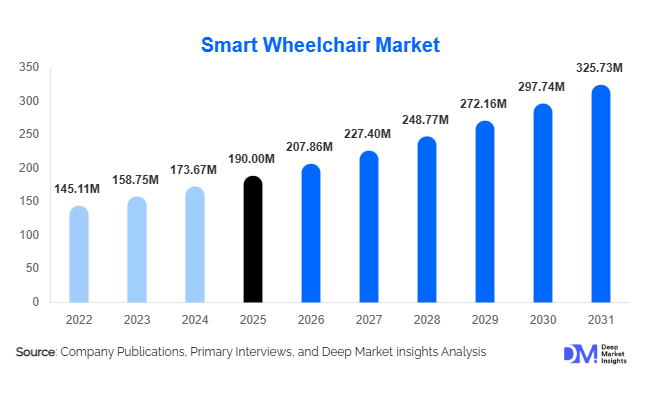
According to Deep Market Insights, the global smart wheelchair market size was valued at USD 190 million in 2025 and is projected to grow from USD 207.86 million in 2026 to reach USD 325.73 million by 2031, expanding at a CAGR of 9.4% during the forecast period (2026–2031). The smart wheelchair market growth is primarily driven by increasing adoption of advanced mobility assistance technologies, rising prevalence of neurological and mobility disorders, growing elderly populations, and rapid integration of artificial intelligence (AI), Internet of Things (IoT), and autonomous navigation capabilities into assistive healthcare devices. As healthcare systems increasingly prioritize independent living and home-based care, smart wheelchairs are evolving beyond mobility aids into intelligent healthcare platforms capable of enhancing user safety, autonomy, and quality of life.
Key Market Insights
- AI-powered navigation and obstacle avoidance technologies are becoming standard features, significantly improving user independence and safety.
- Homecare applications account for the largest share of smart wheelchair demand, supported by aging-in-place initiatives and healthcare decentralization trends.
- North America dominates the global market, accounting for approximately 37% of global revenue due to strong healthcare infrastructure and reimbursement systems.
- Asia-Pacific is the fastest-growing regional market, led by China, India, Japan, and South Korea as healthcare investments continue to expand.
- Lithium-ion battery technology represents the leading battery segment, accounting for nearly 58% of global market revenue in 2025.
- Advanced control interfaces including voice recognition, eye-tracking, and brain-computer interface systems are creating new opportunities for users with severe disabilities.
Smart Wheelchair Market Trends
AI-Enabled Autonomous Mobility Solutions Gaining Momentum
The integration of artificial intelligence, machine vision, LiDAR sensors, and machine learning algorithms is transforming the smart wheelchair industry. Manufacturers are increasingly developing semi-autonomous and fully autonomous mobility solutions capable of obstacle avoidance, route optimization, and environment recognition. These technologies significantly reduce caregiver dependence while enhancing user confidence and mobility. Healthcare providers and rehabilitation centers are increasingly adopting intelligent mobility solutions to improve patient outcomes and reduce long-term support requirements. As AI hardware becomes more affordable and software capabilities improve, autonomous navigation is expected to become a defining feature across premium and mid-range smart wheelchair categories.
Connected Healthcare and Remote Monitoring Integration
Smart wheelchairs are increasingly becoming connected healthcare devices rather than standalone mobility products. Cloud connectivity, IoT integration, smartphone applications, and remote diagnostics capabilities are enabling caregivers and healthcare providers to monitor wheelchair performance, battery status, maintenance requirements, and user activity patterns remotely. This trend is particularly valuable in homecare environments where continuous monitoring can improve patient safety and mobility management. The growing convergence between digital health ecosystems and mobility devices is creating opportunities for telehealth integration, predictive maintenance services, and personalized mobility assistance solutions.
Smart Wheelchair Market Drivers
Growing Global Aging Population
Population aging remains one of the strongest growth drivers for the smart wheelchair market. Countries such as Japan, Germany, Italy, China, and Canada are witnessing substantial increases in elderly populations that require mobility assistance due to age-related conditions including arthritis, osteoporosis, Parkinson’s disease, and stroke-related impairments. Smart wheelchairs offer enhanced independence and safety compared to conventional mobility devices, making them increasingly attractive for aging societies. Government healthcare programs and senior care initiatives are further supporting adoption, particularly in developed economies where aging demographics are creating sustained long-term demand.
Increasing Prevalence of Neurological and Mobility Disorders
The rising incidence of spinal cord injuries, cerebral palsy, muscular dystrophy, multiple sclerosis, and stroke-related disabilities is driving demand for advanced mobility solutions. Smart wheelchairs equipped with intelligent control systems, obstacle avoidance technologies, and adaptive interfaces provide improved mobility for individuals with complex physical limitations. Healthcare providers increasingly recommend technologically advanced mobility aids that can be customized to individual patient needs, further accelerating market penetration across rehabilitation and long-term care settings.
Smart Wheelchair Market Restraints
High Equipment and Technology Costs
Advanced smart wheelchairs incorporate sophisticated electronics, AI processors, sensors, connectivity modules, and premium battery systems that significantly increase manufacturing costs. Premium models can cost several times more than traditional electric wheelchairs, limiting accessibility for patients without comprehensive insurance coverage. Cost sensitivity remains particularly significant in emerging markets where healthcare reimbursement structures are still developing.
Reimbursement and Regulatory Challenges
Despite technological advancements, reimbursement frameworks for smart wheelchairs remain inconsistent across many countries. Insurance providers frequently reimburse basic mobility functions while excluding advanced features such as autonomous navigation, cloud connectivity, and intelligent monitoring systems. Additionally, compliance with evolving medical device regulations increases product development costs and extends commercialization timelines, creating barriers for smaller manufacturers entering the market.
Smart Wheelchair Market Opportunities
Expansion of Autonomous Mobility Technologies
Autonomous navigation represents one of the most significant opportunities in the smart wheelchair market. Advances in robotics, AI, computer vision, and sensor technologies are enabling development of wheelchairs capable of independently navigating complex indoor and outdoor environments. Manufacturers investing in autonomous mobility solutions can target premium healthcare facilities, rehabilitation centers, and individual users seeking greater independence. The commercialization of autonomous mobility is expected to create substantial differentiation opportunities and premium pricing potential over the next decade.
Government Accessibility and Disability Inclusion Programs
Governments worldwide are expanding investments in accessibility infrastructure, disability support programs, and mobility assistance initiatives. Countries including the United States, Germany, China, Japan, India, Saudi Arabia, and Canada are increasing funding for disability inclusion and independent living programs. Public procurement contracts, healthcare reimbursement programs, and veteran support initiatives represent attractive growth opportunities for manufacturers capable of meeting regulatory requirements and participating in government-funded healthcare projects.
Report Scope
| Report Metric | Details |
|---|---|
| Market Size in 2025 | USD 190 Million |
| Market Size in 2026 | USD 207.86 Million |
| Market Size in 2031 | USD 325.73 Million |
| CAGR | 9.4% (2026-2031) |
| Base Year for Estimation | 2025 |
| Historical Data | 2022-2024 |
| Forecast Period | 2026-2031 |
| Report Coverage | Revenue Forecast, Competitive Landscape, Supply Chain Disruption, Growth Factors, Environment & Regulatory Landscape and Trends |
| Geographies Covered | North America, Europe, APAC, Middle East and Africa, LATAM |
| Countries Covered | U.S., Canada, U.K., Germany, France, Spain, Italy, Russia, Nordic, Benelux, Rest of Europe, China, Korea, Japan, India, Australia, Singapore, Taiwan, South East Asia, Rest of Asia-Pacific, UAE, Turky, Saudi Arabia, South Africa, Egypt, Nigeria, Rest of MEA, Brazil, Mexico, Argentina, Chile, Colombia, Rest of LATAM |
Explore more data points, trends and opportunities Download Free Sample Report
Product Configuration Insights
Mid-wheel drive smart wheelchairs dominate the market and accounted for approximately 31% of global revenue in 2025. Their superior maneuverability, compact turning radius, and suitability for indoor environments make them highly preferred across hospitals, rehabilitation centers, and residential applications. Rear-wheel drive models continue to maintain strong demand for outdoor applications due to their stability and terrain-handling capabilities. Standing smart wheelchairs are gaining traction among users seeking improved circulation, posture management, and rehabilitation benefits, while stair-climbing and all-terrain variants are emerging as premium niche categories addressing mobility challenges in complex environments. Foldable smart wheelchairs are also experiencing growing demand as portability and travel convenience become increasingly important purchasing factors.
Control Interface Insights
Joystick-controlled smart wheelchairs remain the leading interface category, accounting for approximately 41% of total market revenue in 2025. Their simplicity, reliability, and widespread user familiarity contribute to continued market dominance. However, advanced interfaces are rapidly gaining market share. Voice-controlled systems are increasingly popular among users with upper limb limitations, while eye-tracking and head movement controls provide critical mobility solutions for individuals with severe disabilities. Brain-computer interface (BCI) technologies represent one of the most promising future segments, enabling direct neural control of mobility devices and expanding accessibility for users with highly restricted physical movement.
Battery Technology Insights
Lithium-ion battery systems account for approximately 58% of global smart wheelchair revenue and continue to dominate the market due to their superior energy density, reduced weight, faster charging capabilities, and extended lifecycle performance. Lead-acid batteries remain relevant within lower-cost product categories, particularly in price-sensitive markets. Lithium iron phosphate (LiFePO4) technologies are gaining adoption due to improved safety characteristics and longer operational life, while emerging solid-state battery technologies are expected to provide future opportunities for higher range, faster charging, and enhanced reliability in next-generation smart wheelchair platforms.
End User Insights
Homecare settings represent the largest end-user segment, accounting for approximately 39% of global market demand in 2025. Growing emphasis on independent living, aging-in-place strategies, and decentralized healthcare delivery continues to support strong adoption within residential environments. Hospitals and rehabilitation centers remain significant demand generators due to increasing use of smart wheelchairs for patient recovery and mobility training. Long-term care facilities, assisted living centers, and veteran care institutions are emerging as high-growth end-user categories as healthcare systems increasingly prioritize mobility assistance and patient quality of life improvements.
Explore more data points, trends and opportunities Download Free Sample Report
Smart Wheelchair Market Segmentations
By Product Configuration
- Rear-Wheel Drive Smart Wheelchairs
- Mid-Wheel Drive Smart Wheelchairs
- Front-Wheel Drive Smart Wheelchairs
- Standing Smart Wheelchairs
- Stair-Climbing Smart Wheelchairs
- All-Terrain Smart Wheelchairs
- Foldable/Portable Smart Wheelchairs
By Control Interface
- Joystick-Controlled
- Touchscreen-Controlled
- Voice-Controlled
- Head Movement-Controlled
- Eye-Tracking Controlled
- Brain-Computer Interface (BCI) Controlled
- Smartphone/App-Controlled
- Hybrid Multi-Modal Control Systems
By End User
- Homecare Settings
- Hospitals
- Rehabilitation Centers
- Long-Term Care Facilities
- Assisted Living Facilities
- Veterans Care Facilities
Regional Insights
North America
North America accounted for approximately 37% of global smart wheelchair market revenue in 2025, making it the largest regional market. The United States represents nearly 30% of global demand, supported by advanced healthcare infrastructure, strong reimbursement frameworks, and widespread adoption of assistive technologies. Veteran support programs, home healthcare expansion, and growing investments in disability inclusion continue to support market growth. Canada also contributes significantly through publicly funded healthcare programs and increasing adoption of advanced rehabilitation technologies.
Europe
Europe accounted for nearly 29% of global revenue in 2025, driven by strong demand from Germany, the United Kingdom, France, Italy, and the Netherlands. Germany remains the region’s largest market due to advanced rehabilitation infrastructure and comprehensive healthcare coverage. Aging populations, disability support programs, and regulatory emphasis on accessibility continue to support adoption across the region. European healthcare systems increasingly recognize smart wheelchairs as critical tools for independent living and long-term patient care.
Asia-Pacific
Asia-Pacific accounted for approximately 24% of global revenue and represents the fastest-growing regional market. China leads regional demand due to healthcare modernization initiatives and a rapidly aging population. Japan continues to benefit from one of the world's highest proportions of elderly citizens, driving substantial demand for advanced mobility technologies. India is emerging as the fastest-growing country globally, supported by healthcare infrastructure expansion, disability inclusion initiatives, and increasing awareness of advanced assistive devices. South Korea and Australia also contribute to regional growth through technology adoption and healthcare innovation.
Latin America
Latin America accounted for approximately 6% of global revenue in 2025. Brazil and Mexico remain the primary markets due to improving healthcare infrastructure, increasing rehabilitation investments, and growing awareness of assistive mobility technologies. While adoption remains lower than in developed markets, government healthcare modernization efforts and rising demand for rehabilitation services are creating long-term growth opportunities throughout the region.
Middle East & Africa
The Middle East & Africa region accounted for approximately 4% of global revenue in 2025. Saudi Arabia, the UAE, and South Africa represent the largest markets due to ongoing healthcare infrastructure investments and government-led disability inclusion initiatives. Rising healthcare expenditures and growing interest in advanced rehabilitation technologies are expected to support gradual market expansion throughout the forecast period.
Key Players in the Smart Wheelchair Market
- Permobil
- Sunrise Medical
- Invacare Corporation
- Pride Mobility Products
- Ottobock
- Meyra Group
- Drive DeVilbiss Healthcare
- WHILL
- Karma Medical
- Levo AG
- Magic Mobility
- Quantum Rehab
- Panthera AB
- Matsunaga Manufactory
- Yamaha Motor