Sewing and Quilting Market Size
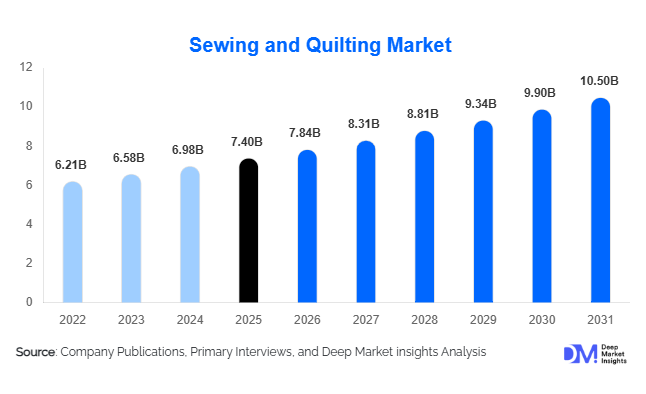
According to Deep Market Insights, the global sewing and quilting market size was valued at USD 7.4 billion in 2025 and is projected to grow from USD 7.84 billion in 2026 to reach USD 10.50 billion by 2031, expanding at a CAGR of 6.0% during the forecast period (2026–2031). The sewing and quilting market growth is primarily driven by increasing consumer interest in DIY crafts, growing demand for personalized apparel and home décor products, technological advancements in computerized sewing systems, and expanding investments in textile manufacturing automation. The market continues to benefit from rising participation in quilting communities, sustainable fashion initiatives encouraging garment repair and upcycling, and the proliferation of e-commerce platforms that provide easier access to sewing equipment, fabrics, and quilting accessories.
Key Market Insights
- Computerized and smart sewing machines are increasingly replacing conventional systems, improving productivity, precision, and user experience across both household and industrial applications.
- Sustainable fashion and textile circularity initiatives are boosting demand for sewing equipment used in garment repair, alterations, and upcycling activities.
- North America dominates the global sewing and quilting market, supported by a mature quilting culture, strong consumer spending, and widespread adoption of premium quilting equipment.
- Asia-Pacific is the fastest-growing regional market, driven by textile manufacturing expansion, rising disposable incomes, and increasing participation in hobby crafts.
- E-commerce platforms are transforming product distribution, enabling direct-to-consumer sales and expanding market access for sewing and quilting brands.
- AI-powered design software, IoT-enabled machines, and automated quilting systems are reshaping product innovation and driving premiumization across the industry.
Sewing and Quilting Market Trends
Smart and Computerized Sewing Systems Witness Rapid Adoption
The sewing and quilting industry is undergoing a significant technological transformation as consumers and industrial users increasingly adopt computerized sewing systems. Modern machines now feature touchscreen interfaces, wireless connectivity, programmable stitch libraries, automatic thread cutting, and cloud-based design integration. Manufacturers are also introducing AI-assisted pattern generation and automated quilting technologies that simplify complex sewing tasks. These innovations improve productivity, reduce errors, and enhance user convenience, making sewing and quilting more accessible to beginners while simultaneously increasing efficiency for professional users. The growing integration of Industry 4.0 technologies within textile manufacturing facilities is further accelerating demand for intelligent sewing solutions.
Sustainable Sewing and Upcycling Become Mainstream
Growing environmental awareness is encouraging consumers to repair, alter, and repurpose existing garments rather than discard them. This trend is creating substantial demand for household sewing machines, repair kits, and quilting supplies. Upcycling projects, handmade textile products, and sustainable crafting activities are gaining popularity across North America and Europe. Brands are responding by introducing eco-friendly fabrics, recycled batting materials, biodegradable threads, and sustainability-focused product lines. As governments and consumers increasingly support circular textile economies, sewing and quilting activities are expected to play an important role in reducing textile waste and extending product lifecycles.
Sewing and Quilting Market Drivers
Growing Popularity of DIY Crafting and Home-Based Creative Activities
The increasing popularity of do-it-yourself projects has become one of the strongest growth drivers for the sewing and quilting market. Consumers are increasingly engaging in sewing, quilting, embroidery, and home décor customization projects due to the availability of online tutorials, social media inspiration, and digital learning platforms. The expansion of quilting communities and craft-focused online marketplaces has further strengthened consumer participation. This trend is generating recurring demand for sewing machines, fabrics, quilting accessories, threads, and digital design software.
Rising Investments in Textile Manufacturing Automation
Industrial textile manufacturers are increasingly investing in automated sewing and quilting technologies to improve productivity and address labor shortages. Computerized sewing machines, programmable stitching systems, and automated quilting equipment enable manufacturers to reduce operational costs while maintaining product quality and consistency. These investments are particularly significant in major textile-producing countries such as China, India, Vietnam, Bangladesh, and Turkey, where export-oriented manufacturing remains a major economic contributor.
Sewing and Quilting Market Restraints
High Cost of Advanced Quilting and Sewing Equipment
Premium sewing machines, embroidery systems, and long-arm quilting equipment often require substantial capital investment, limiting adoption among entry-level users and hobbyists. Advanced computerized systems can cost several thousand dollars, creating affordability challenges in developing markets. Small businesses and independent sewing professionals may also delay equipment upgrades due to budget constraints, slowing the pace of market penetration for premium products.
Volatility in Fabric and Raw Material Prices
Fluctuating prices of cotton, polyester fibers, specialty fabrics, batting materials, and threads continue to affect the sewing and quilting ecosystem. Raw material cost increases impact both manufacturers and end users by raising production costs and retail prices. Such volatility can reduce discretionary spending on quilting and sewing projects, particularly during periods of economic uncertainty or inflationary pressure.
Sewing and Quilting Market Opportunities
Expansion of Sustainable Fashion and Textile Circularity Programs
Sustainability initiatives are creating significant opportunities for sewing and quilting equipment manufacturers. Consumers increasingly seek solutions for garment repair, alteration, and reuse as part of broader sustainability efforts. Governments promoting textile waste reduction and circular fashion initiatives are further supporting market growth. Manufacturers that develop eco-friendly product portfolios and educational resources focused on sustainable sewing practices are expected to gain competitive advantages in the coming years.
Growth of Digital Sewing Communities and Emerging Markets
The rapid expansion of online crafting communities and digital learning platforms is attracting younger demographics to sewing and quilting activities. Emerging economies such as India, Indonesia, Vietnam, Brazil, and Mexico are experiencing rising participation in creative hobbies, supported by increasing disposable incomes and greater internet penetration. Companies that leverage e-commerce, virtual training programs, and localized product offerings can access large untapped consumer segments. Additionally, AI-enabled design platforms and subscription-based pattern services present opportunities for recurring revenue generation.
Report Scope
| Report Metric | Details |
|---|---|
| Market Size in 2025 | USD 7.4 Billion |
| Market Size in 2026 | USD 7.84 Billion |
| Market Size in 2031 | USD 10.50 Billion |
| CAGR | 6% (2026-2031) |
| Base Year for Estimation | 2025 |
| Historical Data | 2022-2024 |
| Forecast Period | 2026-2031 |
| Report Coverage | Revenue Forecast, Competitive Landscape, Supply Chain Disruption, Growth Factors, Environment & Regulatory Landscape and Trends |
| Geographies Covered | North America, Europe, APAC, Middle East and Africa, LATAM |
| Countries Covered | U.S., Canada, U.K., Germany, France, Spain, Italy, Russia, Nordic, Benelux, Rest of Europe, China, Korea, Japan, India, Australia, Singapore, Taiwan, South East Asia, Rest of Asia-Pacific, UAE, Turky, Saudi Arabia, South Africa, Egypt, Nigeria, Rest of MEA, Brazil, Mexico, Argentina, Chile, Colombia, Rest of LATAM |
Explore more data points, trends and opportunities Download Free Sample Report
Product Type Insights
Sewing machines dominated the global sewing and quilting market, accounting for approximately 41% of total revenue in 2025. The segment maintains its leadership due to its broad applicability across household sewing, professional tailoring, quilting, embroidery, textile manufacturing, and apparel production activities. Demand is increasingly shifting toward computerized and electronic sewing machines, which offer automated stitch selection, embroidery integration, touchscreen interfaces, programmable patterns, and improved precision compared to conventional mechanical models. The growing popularity of DIY crafting, garment customization, and home-based sewing businesses has further strengthened demand for advanced sewing systems.
The sewing machine segment is also benefiting from rising investments in textile manufacturing automation across major production hubs such as China, India, Vietnam, Bangladesh, and Turkey. Industrial users continue to upgrade to high-speed computerized systems to improve productivity and reduce labor dependency, particularly as global apparel manufacturers face increasing pressure to improve operational efficiency. Additionally, sewing machine manufacturers are incorporating IoT connectivity, cloud-based pattern libraries, and AI-assisted design functions, creating opportunities for premium product sales.
Quilting equipment, including long-arm quilting systems, frame quilting machines, and automated stitch-regulation technologies, represents one of the fastest-growing equipment categories. Growth is being driven by expanding professional quilting businesses and rising demand for customized quilts and decorative textile products. Meanwhile, consumables such as fabrics, threads, batting materials, needles, and quilting accessories provide recurring revenue streams and contribute significantly to market stability. Specialty quilting fabrics continue to experience strong demand, particularly in North America and Europe, where handcrafted textile products, personalized home décor items, and sustainable crafting activities remain highly popular among consumers.
Application Insights
Apparel and fashion manufacturing remained the largest application segment, accounting for approximately 34% of global market demand in 2025. The segment's leadership is supported by continuous growth in global garment production, increasing demand for customized apparel, and rising adoption of automated sewing technologies within textile manufacturing facilities. Apparel manufacturers increasingly rely on advanced sewing equipment to improve production efficiency, maintain product consistency, and support fast-fashion and made-to-order business models.
The strong export orientation of major textile-producing economies such as China, India, Bangladesh, Vietnam, and Turkey continues to generate substantial demand for industrial sewing and quilting equipment. Government-led initiatives supporting domestic textile manufacturing and modernization programs are further accelerating equipment purchases across apparel production facilities. As global fashion brands increasingly prioritize shorter production cycles and greater customization capabilities, investments in sewing automation are expected to remain strong throughout the forecast period.
Home furnishing and interior décor applications represent another important demand center, supported by increasing consumer spending on customized bedding, quilts, curtains, upholstery, and decorative textiles. The quilting and hobby crafting segment is among the fastest-growing application categories globally, driven by expanding online sewing communities, social media-driven creativity, and rising participation in DIY activities. Educational institutions and vocational training centers are also contributing to market growth by integrating sewing and textile design programs into workforce development initiatives, particularly across emerging economies seeking to strengthen domestic textile industries.
Distribution Channel Insights
Specialty sewing and craft stores accounted for approximately 35% of global distribution revenue in 2025, making them the leading distribution channel. Their continued dominance is largely attributed to the technical nature of sewing and quilting products, which often require product demonstrations, hands-on training, maintenance support, and expert purchasing guidance. Consumers purchasing premium sewing machines, quilting systems, or embroidery equipment frequently rely on specialist retailers to evaluate product capabilities before making significant investments.
Authorized dealers continue to play a critical role in the distribution of mid-range and premium equipment by providing installation services, maintenance contracts, operator training, and technical support. This service-oriented approach remains particularly important for professional tailors, quilting businesses, educational institutions, and industrial users purchasing advanced machinery.
Despite the dominance of physical specialty retailers, e-commerce channels are emerging as the fastest-growing distribution segment. Online platforms offer broader product selections, competitive pricing, direct manufacturer engagement, and access to digital pattern marketplaces. The rapid growth of online sewing communities, virtual learning platforms, and social media marketing has significantly increased online purchasing activity. Manufacturers are also expanding direct-to-consumer sales channels through branded websites, subscription-based design libraries, and digital training ecosystems, enabling stronger customer engagement and higher margins while reducing reliance on traditional retail intermediaries.
End-User Insights
Household consumers represented approximately 38% of global market demand in 2025, making them the largest end-user segment. The segment's leadership is supported by increasing participation in garment repair, home décor customization, quilting projects, embroidery activities, and DIY crafting. Growing consumer awareness surrounding sustainable fashion and textile waste reduction has encouraged more households to engage in clothing alterations, repair work, and upcycling projects, further strengthening demand for household sewing equipment.
The expansion of digital sewing tutorials, online quilting communities, and influencer-driven content has significantly lowered entry barriers for new hobbyists. As a result, hobbyists and quilting enthusiasts have emerged as one of the fastest-growing user groups globally, particularly in North America, Europe, Australia, and increasingly in Asia-Pacific. These consumers frequently purchase specialty fabrics, premium threads, quilting accessories, and computerized sewing machines, contributing to recurring market demand.
Professional tailors, independent sewing businesses, and custom apparel providers continue to represent an important customer segment, driven by rising demand for personalized garments and alteration services. Industrial textile manufacturers remain major purchasers of automated sewing systems due to ongoing modernization initiatives and export-oriented production strategies. Educational institutions are also becoming increasingly relevant as governments and private organizations invest in vocational training programs focused on textile manufacturing, fashion design, and apparel production skills development.
Explore more data points, trends and opportunities Download Free Sample Report
Sewing and Quilting Market Segmentations
By Product Type
- Sewing Machines
- Quilting Equipment
- Sewing & Quilting Consumables
- Sewing & Quilting Tools
- Patterns, Designs & Digital Products
By Application
- Apparel & Fashion Manufacturing
- Home Furnishing & Interior Décor
- Quilting & Hobby Crafts
- Textile Manufacturing
- Educational & Training Activities
- Custom Tailoring & Alteration Services
By Distribution Channel
- Specialty Sewing & Craft Stores
- Sewing Machine Dealers
- Hypermarkets & Supermarkets
- E-Commerce Platforms
- Direct-to-Consumer Brand Channels
- Educational & Institutional Sales
By End User
- Household Consumers
- Hobbyists & Quilting Enthusiasts
- Professional Tailors
- Small & Medium Sewing Businesses
- Industrial Textile Manufacturers
- Educational Institutions
Regional Insights
North America
North America accounted for approximately 36% of the global sewing and quilting market in 2025, making it the largest regional market. The United States alone contributed nearly 29% of global demand, supported by one of the world's largest quilting communities, strong household spending power, and widespread adoption of premium sewing and quilting equipment. The region benefits from a highly developed hobby crafting ecosystem, extensive participation in quilting associations, and strong consumer demand for personalized home décor and handmade textile products.
Several structural factors continue to drive regional growth, including increasing interest in sustainable fashion, garment repair, and DIY home improvement projects. North America also leads global adoption of computerized sewing systems, embroidery technologies, and digital pattern software. The growing popularity of online learning platforms and social media-driven crafting communities continues to attract younger consumers, helping sustain long-term market expansion. Canada contributes additional demand through strong participation in crafting activities and growing interest in home-based creative hobbies.
Europe
Europe represented approximately 27% of global market demand in 2025, supported by a combination of strong textile heritage, sustainability initiatives, and a well-established sewing culture. Germany remains the largest market within the region due to its position as a leading manufacturer of sewing technology and advanced textile machinery. The United Kingdom, France, Italy, and the Netherlands also represent significant demand centers supported by active quilting communities and strong consumer spending on premium crafting products.
One of the primary growth drivers across Europe is the increasing emphasis on circular fashion and textile sustainability. Consumers are increasingly repairing, altering, and reusing garments rather than replacing them, creating additional demand for household sewing equipment. Government policies promoting waste reduction and sustainable consumption patterns further support sewing machine adoption. Rising demand for handmade products, customized furnishings, and artisanal textile goods continues to create opportunities throughout the region.
Asia-Pacific
Asia-Pacific accounted for approximately 28% of global market revenue in 2025 and is projected to be the fastest-growing regional market through 2031. China remains the largest regional market due to its dominant position in global textile and apparel manufacturing. Significant investments in industrial automation, export-oriented garment production, and advanced sewing technologies continue to generate substantial equipment demand throughout the country.
India is expected to emerge as one of the fastest-growing national markets, supported by expanding middle-class incomes, government textile modernization initiatives, increasing participation in hobby crafts, and strong growth in apparel manufacturing. Countries such as Vietnam, Bangladesh, Indonesia, and Cambodia are also witnessing rising demand due to continued growth in textile exports and foreign direct investment in manufacturing facilities. In developed markets such as Japan and South Korea, demand is increasingly driven by premium quilting products, advanced sewing technologies, and aging populations with strong participation in leisure crafting activities. Rapid urbanization, rising disposable incomes, expanding e-commerce penetration, and increasing consumer interest in personalized products remain key regional growth drivers.
Latin America
Latin America accounted for approximately 5% of global market demand in 2025, with Brazil and Mexico serving as the region's largest markets. Demand is primarily supported by growing apparel manufacturing activities, increasing interest in customized textile products, and rising participation in sewing and crafting hobbies. Improvements in internet penetration and e-commerce accessibility have made sewing products more readily available to consumers across the region.
Regional growth is also being supported by the expansion of small-scale tailoring businesses, home-based entrepreneurship, and localized textile production. Rising consumer demand for affordable garment repair and alteration services, particularly during periods of economic uncertainty, continues to create favorable conditions for sewing machine adoption. As textile manufacturing capacity expands across Mexico and Brazil, industrial equipment demand is expected to increase steadily.
Middle East & Africa
The Middle East and Africa represented approximately 4% of global market revenue in 2025. Turkey remains the largest market within the region due to its strong textile export industry and ongoing investments in sewing automation and manufacturing modernization. Turkey's strategic role as a supplier to European apparel brands continues to support robust demand for industrial sewing equipment.
In the Gulf Cooperation Council countries, including the UAE and Saudi Arabia, rising disposable incomes and growing demand for customized apparel, luxury embroidery, and premium home furnishings are supporting market growth. Across Africa, South Africa remains the largest consumer market, while countries such as Egypt, Ethiopia, and Kenya are investing in textile industrialization programs aimed at strengthening domestic apparel manufacturing capabilities. Government initiatives promoting local textile production, increasing foreign investment in manufacturing facilities, and growing interest in fashion entrepreneurship are expected to create new growth opportunities across the region during the forecast period.
Key Players in the Sewing and Quilting Market
- Brother Industries
- Singer
- JUKI Corporation
- Bernina International
- Janome Corporation
- Pfaff
- Husqvarna Viking
- Baby Lock
- Necchi
- Elna International
- Mitsubishi Electric
- Pegasus Sewing Machine
- ZSK Stickmaschinen
- Grace Company
- Handi Quilter