Seaweed Cosmetics Market Size
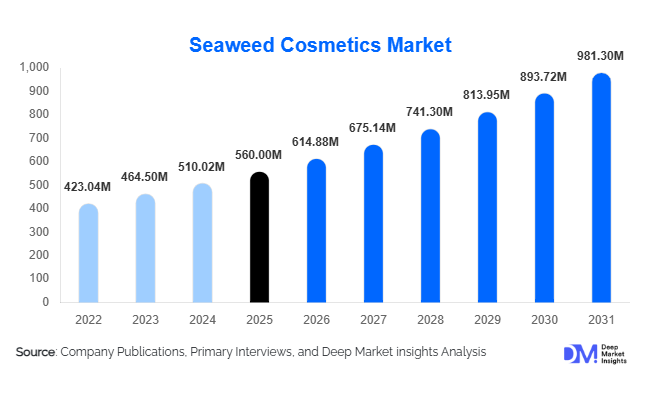
According to Deep Market Insights, the global seaweed cosmetics market size was valued at USD 560 million in 2025 and is projected to grow from USD 614 million in 2026 to reach USD 980 million by 2031, expanding at a CAGR of 9.8% during the forecast period (2026–2031). The seaweed cosmetics market growth is primarily driven by increasing consumer demand for clean-label skincare products, rising adoption of marine bioactive ingredients in anti-aging formulations, and growing preference for sustainable and vegan beauty products worldwide.
Seaweed-based cosmetics are gaining strong traction across skincare, haircare, and wellness applications due to their rich composition of vitamins, minerals, antioxidants, amino acids, and polysaccharides. Marine ingredients such as kelp, spirulina, chlorella, wakame, and red algae are increasingly integrated into premium cosmetic formulations because of their hydrating, anti-inflammatory, detoxifying, and collagen-boosting properties. Consumer awareness regarding natural and eco-friendly ingredients continues to reshape purchasing patterns within the global beauty industry, positioning marine-derived cosmetics as a high-growth segment within clean beauty.
The market is also benefiting from advances in marine biotechnology and algae extraction technologies, which are improving ingredient potency, stability, and commercial scalability. Luxury skincare brands, K-beauty manufacturers, and dermatologist-backed cosmetic companies are aggressively expanding their marine skincare portfolios to capitalize on rising consumer interest in multifunctional and sustainable beauty solutions.
Key Market Insights
- Seaweed cosmetics are increasingly positioned within premium anti-aging and hydration skincare categories, supported by rising demand for marine bioactive ingredients.
- Brown algae and kelp extracts are the dominant ingredients due to their antioxidant, moisturizing, and collagen-supporting properties.
- Asia-Pacific dominates the global market, led by South Korea, Japan, and China due to strong marine ingredient production and advanced skincare innovation.
- North America remains a major premium consumption hub, driven by clean beauty, vegan cosmetics, and dermatologist-backed skincare trends.
- E-commerce channels are accelerating product penetration globally, enabling direct-to-consumer marine skincare branding and influencer-driven marketing.
- Marine biotechnology and algae fermentation technologies are improving ingredient extraction efficiency and enabling large-scale commercialization.
Seaweed Cosmetics Market Trends
Blue Beauty and Sustainable Marine Skincare Gaining Momentum
The global beauty industry is increasingly shifting toward blue beauty concepts centered on ocean-safe, marine-derived, and environmentally sustainable formulations. Consumers are demanding transparency regarding ingredient sourcing, biodegradability, and sustainable harvesting practices, leading cosmetic brands to aggressively promote seaweed-based formulations as eco-conscious alternatives to synthetic chemicals. Seaweed cultivation requires lower freshwater consumption and minimal agricultural land usage compared with traditional botanical ingredients, strengthening its sustainability appeal.
Luxury skincare companies are integrating sustainably harvested marine algae into premium skincare lines while emphasizing recyclable packaging, cruelty-free certifications, and carbon-neutral production systems. European and North American consumers are particularly responsive to ocean-friendly cosmetic products, encouraging brands to invest in traceable marine ingredient supply chains and sustainability certifications. The trend is also driving collaborations between marine biotechnology companies and cosmetic manufacturers to develop high-performance algae-based ingredients with lower environmental footprints.
Biotechnology-Driven Marine Ingredient Innovation
Marine biotechnology is emerging as a major innovation trend within the seaweed cosmetics market. Cosmetic companies are increasingly utilizing fermentation systems, controlled algae cultivation, and advanced extraction technologies to isolate high-value compounds such as fucoidan, astaxanthin, alginate, carrageenan, and marine peptides. These compounds are widely utilized in anti-aging, skin repair, hydration, and antioxidant formulations.
Biotechnology integration is helping manufacturers improve ingredient stability, potency, and scalability while reducing dependence on seasonal harvesting cycles. AI-assisted formulation development and microbiome-focused skincare research are also reshaping product innovation. Korean and Japanese beauty companies are leading commercialization of multifunctional marine skincare products that combine hydration, UV protection, anti-inflammatory properties, and anti-aging benefits into single formulations. The growing popularity of clinically backed marine cosmeceuticals is expected to further accelerate biotechnology adoption across the industry.
Seaweed Cosmetics Market Drivers
Rising Consumer Demand for Natural and Clean-Label Beauty Products
Growing awareness regarding the harmful effects of synthetic chemicals in cosmetic products is driving consumer preference toward natural and clean-label skincare solutions. Consumers increasingly seek products free from parabens, sulfates, silicones, and artificial preservatives, positioning seaweed-based cosmetics as attractive alternatives. Seaweed ingredients are perceived as nutrient-rich, multifunctional, and environmentally friendly, making them highly appealing among millennials and Gen Z consumers.
The clean beauty movement has significantly strengthened demand for vegan, cruelty-free, and sustainable cosmetic products. Major beauty retailers and e-commerce platforms are actively expanding marine skincare offerings in response to changing consumer preferences. Ingredient transparency, sustainability certifications, and eco-conscious branding are increasingly influencing purchasing decisions globally.
Growing Demand for Anti-Aging and Functional Skincare
The expanding global anti-aging skincare market is another major growth driver for seaweed cosmetics. Seaweed extracts contain antioxidants, amino acids, vitamins, and polysaccharides that help improve skin elasticity, hydration, and collagen synthesis. Brown algae and microalgae-based ingredients are increasingly utilized in serums, eye creams, and anti-wrinkle products because of their ability to reduce oxidative stress and support skin barrier repair.
Aging populations in Japan, Europe, South Korea, and North America are driving demand for premium marine skincare products positioned within anti-aging categories. Cosmetic companies are aggressively marketing seaweed-derived ingredients as clinically effective bioactive compounds capable of improving skin health and reducing visible aging signs.
Seaweed Cosmetics Market Restraints
High Production and Ingredient Processing Costs
Seaweed cosmetics remain comparatively expensive due to high costs associated with marine ingredient harvesting, extraction, purification, and standardization. Sustainable seaweed cultivation and advanced extraction technologies require substantial investments, resulting in premium product pricing. These higher costs limit affordability in price-sensitive consumer markets and restrict mass-market penetration.
In addition, marine biotechnology research and formulation development involve significant R&D expenditure, particularly for clinically backed anti-aging and cosmeceutical products. Smaller companies often face financial challenges in scaling marine ingredient commercialization while maintaining profitability.
Supply Chain and Environmental Challenges
The seaweed cosmetics market is vulnerable to supply chain disruptions linked to climate change, ocean pollution, seasonal harvesting fluctuations, and marine ecosystem regulations. Variability in seaweed availability can affect raw material pricing and production stability for manufacturers. Environmental concerns regarding overharvesting and marine biodiversity protection are also resulting in stricter sustainability regulations across several regions.
Regulatory compliance related to marine ingredient approvals, clean-label claims, and cosmetic safety standards differs significantly across countries, creating operational complexities for global manufacturers. These challenges may slow expansion for companies lacking strong sourcing networks and regulatory expertise.
Seaweed Cosmetics Market Opportunities
Expansion of Premium Vegan and Marine Cosmeceuticals
The rapid growth of vegan beauty and premium cosmeceutical products presents significant opportunities for seaweed cosmetic manufacturers. Consumers increasingly prefer marine-based alternatives to animal-derived collagen and synthetic active ingredients. Seaweed-derived antioxidants, peptides, and polysaccharides are gaining traction within dermatology-focused skincare and clinical beauty applications.
Luxury skincare brands are investing heavily in biotechnology-derived marine formulations targeting hydration, anti-aging, skin sensitivity, and microbiome repair. The premium positioning of seaweed cosmetics enables manufacturers to achieve higher margins while attracting environmentally conscious consumers seeking science-backed skincare solutions.
Growth Potential in Emerging Asia-Pacific and Middle Eastern Markets
Emerging markets such as India, Indonesia, Thailand, UAE, and Saudi Arabia represent strong growth opportunities due to rising disposable incomes, increasing skincare awareness, and rapid premium beauty adoption. Consumers in these regions are increasingly influenced by Korean and Japanese beauty trends featuring marine ingredients.
Luxury wellness tourism, medical aesthetics, and spa industries are also driving demand for marine skincare treatments and professional-use seaweed formulations. Companies localizing products for climate-specific skincare concerns, such as pollution protection, hydration, and sensitive skin management, are expected to gain competitive advantages across emerging markets.
Report Scope
| Report Metric | Details |
|---|---|
| Market Size in 2025 | USD 560 Million |
| Market Size in 2026 | USD 614.88 Million |
| Market Size in 2031 | USD 981.30 Million |
| CAGR | 9.8% (2026-2031) |
| Base Year for Estimation | 2025 |
| Historical Data | 2022-2024 |
| Forecast Period | 2026-2031 |
| Report Coverage | Revenue Forecast, Competitive Landscape, Supply Chain Disruption, Growth Factors, Environment & Regulatory Landscape and Trends |
| Geographies Covered | North America, Europe, APAC, Middle East and Africa, LATAM |
| Countries Covered | U.S., Canada, U.K., Germany, France, Spain, Italy, Russia, Nordic, Benelux, Rest of Europe, China, Korea, Japan, India, Australia, Singapore, Taiwan, South East Asia, Rest of Asia-Pacific, UAE, Turky, Saudi Arabia, South Africa, Egypt, Nigeria, Rest of MEA, Brazil, Mexico, Argentina, Chile, Colombia, Rest of LATAM |
Explore more data points, trends and opportunities Download Free Sample Report
Product Type Insights
Skincare products dominate the seaweed cosmetics market, accounting for the largest share of global revenue due to strong consumer demand for anti-aging creams, hydrating serums, face masks, and marine-based moisturizers. Seaweed extracts are highly valued for their antioxidant, detoxifying, and collagen-supporting properties, making them widely utilized in premium skincare formulations. Haircare products are witnessing growing adoption as marine ingredients gain popularity in scalp nourishment, hair strengthening, and hydration applications. Bath and body care products such as body scrubs, lotions, and detox treatments are also expanding steadily within spa and wellness industries. Color cosmetics containing marine ingredients remain a niche but growing category, particularly within clean-label makeup and hybrid skincare-cosmetic formulations.
Ingredient Type Insights
Brown seaweed represents the largest ingredient segment within the market due to its high concentration of fucoidan, alginate, and antioxidant compounds. Kelp and wakame are extensively utilized in anti-aging and hydration-focused skincare products because of their ability to improve skin elasticity and moisture retention. Red algae ingredients are increasingly incorporated into sensitive skin and barrier repair formulations due to their soothing and anti-inflammatory benefits. Microalgae such as spirulina and chlorella are rapidly gaining traction because of their protein-rich composition and detoxifying properties. Biotechnology-derived algae extracts are also emerging as high-value ingredients within premium marine skincare and clinical cosmeceutical applications.
Distribution Channel Insights
E-commerce dominates global seaweed cosmetics distribution due to rapid growth in direct-to-consumer beauty brands, social media marketing, and influencer-driven skincare trends. Online platforms enable consumers to compare ingredients, review sustainability claims, and access premium marine skincare products across international markets. Brand-owned websites and online marketplaces remain critical growth channels, especially for independent marine beauty brands.
Offline retail channels such as specialty beauty stores, luxury department stores, pharmacies, and dermatology clinics continue playing important roles in premium product positioning. Wellness spas and salons are also increasingly adopting marine skincare products for professional treatments and thalassotherapy applications. Subscription-based skincare programs and digital skin analysis tools are further transforming consumer engagement across online channels.
Consumer Category Insights
Premium and luxury cosmetics account for the largest share of the seaweed cosmetics market because marine bioactive ingredients are strongly associated with scientific efficacy, sustainability, and high-performance skincare. Luxury consumers are willing to pay premium prices for clinically backed anti-aging products featuring sustainably sourced marine ingredients. Professional salon and spa products are also experiencing strong growth due to the increasing popularity of marine facials, detox wraps, and wellness-oriented skincare treatments.
Mass-market seaweed cosmetics are gradually expanding as ingredient commercialization improves affordability and distribution. Vegan and clean-label positioning is helping brands broaden consumer adoption beyond luxury skincare categories. Dermatology and cosmeceutical products represent another rapidly growing segment, driven by rising demand for sensitive skin treatments and clinically validated marine skincare solutions.
Explore more data points, trends and opportunities Download Free Sample Report
Seaweed Cosmetics Market Segmentations
By Product Type
- Skincare Products
- Haircare Products
- Bath & Body Care Products
- Color Cosmetics
- Nutricosmetic & Beauty Supplements
By Seaweed Type
- Brown Seaweed
- Red Seaweed
- Green Seaweed
- Microalgae-Based Ingredients
By Formulation Type
- Organic & Natural Formulations
- Vegan Formulations
- Clean-Label Formulations
- Biotechnology-Derived Marine Formulations
- Synthetic Blend Formulations with Seaweed Extracts
By Distribution Channel
- Online Retail/E-Commerce
- Specialty Beauty Stores
- Supermarkets & Hypermarkets
- Pharmacies & Drug Stores
- Department Stores
- Salons & Spas
By End User
- Individual Consumers
- Beauty Salons & Spas
- Dermatology Clinics
- Hospitality & Wellness Centers
- Professional Beauty Service Providers
Regional Insights
North America
North America remains one of the largest premium consumption markets for seaweed cosmetics, accounting for nearly 29% of global market revenue in 2025. The United States dominates regional demand due to rising adoption of clean beauty, vegan skincare, and anti-aging marine formulations. Consumers increasingly prioritize ingredient transparency, sustainability certifications, and dermatologist-recommended skincare products. Canada is also witnessing growing demand for marine-based organic cosmetics, particularly within premium wellness and natural beauty categories.
Europe
Europe represents a major hub for luxury marine skincare consumption, led by France, Germany, and the United Kingdom. France remains highly influential due to its strong luxury cosmetics industry and growing focus on marine biotechnology innovation. European consumers are particularly responsive to clean-label, cruelty-free, and sustainable skincare products, supporting expansion of seaweed-derived formulations. Nordic countries are emerging as important innovation centers for blue beauty and environmentally sustainable marine cosmetics.
Asia-Pacific
Asia-Pacific dominates the global seaweed cosmetics market with approximately 38% market share in 2025. South Korea and Japan lead innovation in marine skincare formulations due to strong beauty R&D ecosystems and consumer preference for functional skincare. Korean beauty companies are aggressively commercializing algae-based sheet masks, serums, and multifunctional skincare products. China is witnessing rapid growth because of rising disposable incomes and expanding premium beauty consumption. India and Southeast Asia are emerging as high-growth markets driven by increasing e-commerce penetration, wellness trends, and natural beauty adoption.
Latin America
Latin America is gradually emerging as a promising market for seaweed cosmetics, particularly in Brazil and Mexico. Rising awareness regarding organic and natural beauty products is supporting demand for marine-derived skincare. Premium beauty retailers and online channels are helping expand product availability across urban consumer segments. Growth in wellness tourism and spa industries is also contributing to increasing adoption of marine-based skincare treatments.
Middle East & Africa
The Middle East & Africa region is experiencing rising demand for luxury skincare and wellness-oriented beauty products. UAE and Saudi Arabia are emerging as major premium beauty markets due to increasing disposable incomes and strong luxury retail expansion. Seaweed-based hydration and anti-pollution skincare products are particularly popular due to harsh climatic conditions. Wellness tourism, luxury hospitality, and premium spa industries are also contributing to market growth across the region.