Retail Sporting Goods Market Size
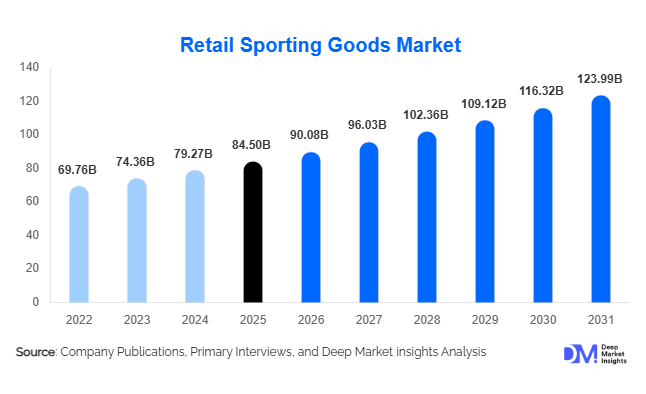
According to Deep Market Insights, the global retail sporting goods market size was valued at USD 84.5 billion in 2025 and is projected to grow from USD 90.08 billion in 2026 to reach USD 123.99 billion by 2031, expanding at a CAGR of 6.6% during the forecast period (2026–2031). The retail sporting goods market growth is primarily driven by increasing participation in sports and fitness activities, rising consumer spending on athletic apparel and footwear, rapid expansion of e-commerce channels, and growing demand for premium performance products. The convergence of sports, wellness, and lifestyle trends has significantly broadened the consumer base beyond professional athletes to include recreational users, fitness enthusiasts, and health-conscious consumers. Technological advancements in sporting equipment, smart wearables, and performance-enhancing materials continue to reshape product innovation, while omnichannel retail strategies are improving accessibility and customer engagement globally.
Key Market Insights
- Athleisure continues to blur the line between sportswear and everyday fashion, driving sustained demand for athletic apparel and footwear across multiple consumer demographics.
- Smart fitness equipment and wearable technologies are creating new revenue streams, enabling retailers to integrate digital health tracking and connected fitness ecosystems.
- North America dominates the global retail sporting goods market, supported by high consumer spending, strong sports culture, and mature retail infrastructure.
- Asia-Pacific is the fastest-growing regional market, driven by rising disposable incomes, urbanization, and government initiatives promoting sports participation.
- E-commerce and omnichannel retail models are transforming purchasing behavior, allowing brands to reach consumers directly while enhancing customer experiences.
- Sustainability has become a major purchasing criterion, encouraging adoption of recycled materials, circular product programs, and environmentally responsible manufacturing practices.
Retail Sporting Goods Market Trends
Rise of Connected Fitness and Smart Sporting Goods
Connected fitness products are becoming a significant growth area within the retail sporting goods market. Consumers increasingly seek integrated solutions that combine hardware, software, and real-time performance tracking. Smart treadmills, connected bicycles, wearable fitness trackers, GPS-enabled sports devices, and AI-driven coaching platforms are gaining widespread adoption. Sporting goods retailers are expanding their offerings to include subscription-based fitness services and digital training ecosystems that generate recurring revenue streams. The integration of health analytics, personalized coaching, and mobile applications is further strengthening consumer engagement and encouraging higher spending on premium sporting products.
Sustainability and Circular Retail Models Expanding
Sustainability has emerged as a defining trend across the sporting goods industry. Consumers are actively seeking products manufactured from recycled materials, ethically sourced inputs, and environmentally responsible production processes. Leading brands are launching repair programs, resale initiatives, and product take-back schemes to support circular economy objectives. Retailers are also investing in sustainable packaging, carbon-neutral logistics, and transparent supply chains. As regulatory pressure increases and consumer awareness grows, sustainability is becoming a competitive differentiator and an important factor influencing purchasing decisions across both developed and emerging markets.
Retail Sporting Goods Market Drivers
Growing Global Health and Fitness Awareness
Increasing awareness regarding physical health, wellness, and preventive healthcare is driving demand for sporting goods worldwide. Rising participation in activities such as running, cycling, gym workouts, yoga, and recreational sports has expanded the customer base for athletic footwear, sports apparel, fitness equipment, and accessories. Governments, healthcare organizations, and employers are actively promoting healthier lifestyles, further supporting long-term market growth. Fitness-focused consumer spending continues to increase across both developed and emerging economies, creating consistent demand across multiple product categories.
Expansion of Athleisure and Lifestyle Sportswear
The athleisure trend has transformed sporting goods from performance-focused products into mainstream lifestyle purchases. Consumers increasingly wear athletic apparel and footwear for everyday activities, travel, work-from-home environments, and casual social settings. This shift has significantly expanded market potential beyond traditional sports participants. Premium sportswear brands continue introducing fashion-oriented collections, collaborations, and limited-edition products that command higher margins and encourage more frequent replacement cycles. The growing influence of social media, fitness influencers, and celebrity endorsements further supports demand for athleisure products globally.
Retail Sporting Goods Market Restraints
Supply Chain Volatility and Raw Material Cost Fluctuations
The sporting goods industry remains vulnerable to disruptions in global supply chains, transportation networks, and raw material availability. Price volatility in synthetic fibers, rubber, plastics, metals, and packaging materials can significantly impact manufacturing costs and retail pricing strategies. Geopolitical tensions, labor shortages, and logistics bottlenecks further contribute to operational uncertainty, affecting inventory management and profit margins for manufacturers and retailers alike.
Intense Market Competition and Margin Pressure
The retail sporting goods market is highly competitive, characterized by the presence of global brands, specialty retailers, direct-to-consumer platforms, and digital marketplaces. Aggressive pricing strategies, promotional campaigns, and increasing online competition can place significant pressure on profitability. Smaller retailers often struggle to compete with large multinational brands that benefit from economies of scale, stronger brand recognition, and advanced digital capabilities.
Retail Sporting Goods Market Opportunities
Expansion Across Emerging Markets
Emerging economies such as India, Indonesia, Vietnam, Brazil, and several Middle Eastern countries present significant growth opportunities for sporting goods retailers. Rising disposable incomes, growing middle-class populations, expanding urbanization, and increasing sports participation rates are creating favorable demand conditions. Government investments in sports infrastructure, fitness promotion programs, and international sporting events are further supporting market development. Companies establishing strong retail networks and localized product offerings in these regions are expected to benefit from substantial long-term growth opportunities.
Digital Commerce and Omnichannel Retail Innovation
The continued evolution of digital commerce presents significant opportunities for both established retailers and new entrants. Advanced personalization, virtual product trials, AI-powered recommendations, and integrated omnichannel experiences are improving customer acquisition and retention. Retailers investing in data analytics, customer loyalty programs, and direct-to-consumer channels can increase profitability while strengthening brand engagement. The ability to seamlessly integrate online and offline shopping experiences is becoming a key competitive advantage across the global sporting goods industry.
Report Scope
| Report Metric | Details |
|---|---|
| Market Size in 2025 | USD 84.5 Billion |
| Market Size in 2026 | USD 90.08 Billion |
| Market Size in 2031 | USD 123.99 Billion |
| CAGR | 6.6% (2026-2031) |
| Base Year for Estimation | 2025 |
| Historical Data | 2022-2024 |
| Forecast Period | 2026-2031 |
| Report Coverage | Revenue Forecast, Competitive Landscape, Supply Chain Disruption, Growth Factors, Environment & Regulatory Landscape and Trends |
| Geographies Covered | North America, Europe, APAC, Middle East and Africa, LATAM |
| Countries Covered | U.S., Canada, U.K., Germany, France, Spain, Italy, Russia, Nordic, Benelux, Rest of Europe, China, Korea, Japan, India, Australia, Singapore, Taiwan, South East Asia, Rest of Asia-Pacific, UAE, Turky, Saudi Arabia, South Africa, Egypt, Nigeria, Rest of MEA, Brazil, Mexico, Argentina, Chile, Colombia, Rest of LATAM |
Explore more data points, trends and opportunities Download Free Sample Report
Product Category Insights
Sports apparel represents the largest product category, accounting for approximately 32.5% of the global market in 2025. Growth is driven by the widespread adoption of athleisure and increasing demand for performance-enhancing apparel across fitness, team sports, and outdoor recreation activities. Athletic footwear follows closely with a market share of nearly 28.8%, supported by innovation in cushioning technologies, sustainability initiatives, and lifestyle-driven purchases. Sports equipment remains a substantial category, particularly within fitness equipment, cycling products, golf equipment, and outdoor recreation gear. Protective equipment continues to benefit from stricter safety standards in organized sports, while sports accessories, including fitness wearables and recovery products, are among the fastest-growing categories due to increasing consumer focus on performance monitoring and health optimization.
Sport Type Insights
Team sports account for the largest share of sporting goods demand, representing approximately 27.4% of the overall market. Popular sports such as football, basketball, baseball, cricket, and hockey continue to generate significant demand for apparel, footwear, and equipment. Fitness and gym activities represent one of the fastest-growing sport categories globally as consumers prioritize personal health and wellness. Outdoor recreation, including hiking, camping, and cycling, is experiencing strong growth due to increasing participation in adventure and lifestyle activities. Water sports, winter sports, and combat sports continue to create niche opportunities, particularly in regions with strong cultural and geographic alignment to these activities.
Retail Channel Insights
Sporting goods specialty stores remain the dominant retail channel, accounting for approximately 38.5% of global market revenue. Consumers continue to value expert guidance, extensive product selection, and experiential shopping environments offered by specialized retailers. Online retail channels are expanding rapidly, driven by convenience, broader product availability, competitive pricing, and personalized shopping experiences. Brand-owned stores and direct-to-consumer channels are also gaining market share as manufacturers seek greater control over customer relationships and profit margins. Omnichannel retail models that integrate digital platforms with physical stores are increasingly becoming the preferred strategy among leading market participants.
Consumer Group Insights
Men account for the largest consumer segment, representing approximately 47.8% of the global retail sporting goods market. Higher participation rates in equipment-intensive sports and greater spending on performance products contribute to segment leadership. Women represent the fastest-growing consumer category as female participation in fitness activities, recreational sports, and outdoor pursuits continues to increase globally. The children and youth segment remains strategically important, supported by school sports programs, youth leagues, and growing parental investment in health and physical activity. Product innovation tailored to specific demographic needs continues to expand addressable market opportunities.
Price Range Insights
The mid-range segment dominates the market, supported by its ability to balance affordability, quality, and performance. Premium sporting goods continue to gain share as consumers increasingly seek advanced technologies, superior materials, and enhanced durability. Luxury sports products represent a niche but rapidly growing segment, particularly among affluent consumers interested in exclusive collections and high-performance equipment. Economy products remain important in price-sensitive markets, especially across emerging economies where affordability remains a key purchasing factor.
Explore more data points, trends and opportunities Download Free Sample Report
Retail Sporting Goods Market Segmentations
By Product Category
- Sports Apparel
- Athletic Footwear
- Sports Equipment
- Protective Gear
- Sports Accessories
By Sport Type
- Team Sports
- Individual Sports
- Fitness & Gym Activities
- Outdoor Recreation
- Adventure Sports
- Water Sports
- Winter Sports
- Esports-Related Physical Accessories
By Consumer Group
- Men
- Women
- Children & Youth
By Retail Channel
- Sporting Goods Specialty Stores
- Brand-Owned Stores
- Department Stores
- Hypermarkets & Supermarkets
- Franchise Sports Stores
- Brand-Owned E-commerce
- Third-Party Marketplaces
- Omnichannel Retail Platforms
By Price Positioning
- Economy
- Mid-Range
- Premium
- Luxury Sports Products
Regional Insights
North America
North America accounted for approximately 34.5% of global market revenue in 2025, making it the largest regional market. The United States represents nearly 28% of global demand due to high disposable incomes, strong sports culture, extensive participation in organized sports, and widespread fitness awareness. Canada contributes significantly through demand for outdoor recreation products, winter sports equipment, and premium sporting apparel. Continuous innovation, strong brand presence, and advanced retail infrastructure support market leadership across the region.
Europe
Europe accounted for approximately 27.2% of global market revenue in 2025. Germany, the United Kingdom, France, Italy, and Spain are the primary demand centers, supported by strong participation in football, cycling, running, and fitness activities. Sustainability considerations play a major role in purchasing decisions, encouraging demand for environmentally responsible products. The region also benefits from mature retail networks and strong consumer spending on premium sporting goods.
Asia-Pacific
Asia-Pacific accounted for approximately 25.8% of global market revenue and represents the fastest-growing regional market. China remains the largest market within the region, contributing approximately 11.5% of global demand. India is emerging as one of the fastest-growing national markets, supported by rising sports participation, government initiatives, and expanding middle-class spending power. Japan, South Korea, Australia, and Southeast Asian countries continue contributing to regional growth through increasing adoption of fitness and outdoor recreation activities.
Latin America
Latin America represents approximately 6.4% of global market demand, with Brazil and Mexico serving as the region's largest markets. Football remains a major demand driver, while increasing fitness participation and rising disposable incomes are supporting broader product adoption. Retailers are expanding digital commerce capabilities to improve market penetration and consumer accessibility throughout the region.
Middle East & Africa
The Middle East & Africa region accounts for approximately 6.1% of global market revenue. Saudi Arabia, the United Arab Emirates, South Africa, and Egypt represent key growth markets. Government investments in sports infrastructure, fitness promotion programs, and international sporting events are driving demand across multiple product categories. Increasing participation in recreational sports and fitness activities continues to create new growth opportunities throughout the region.
Key Players in the Retail Sporting Goods Market
- Nike, Inc.
- Adidas AG
- Decathlon Group
- Dick's Sporting Goods, Inc.
- JD Sports Fashion Plc
- Academy Sports + Outdoors
- Frasers Group Plc
- Puma SE
- Under Armour, Inc.
- Hibbett, Inc.
- Big 5 Sporting Goods Corporation
- Lululemon Athletica Inc.
- ASICS Corporation
- Anta Sports Products Limited
- Skechers U.S.A., Inc.