Sailing Apparel Market Size
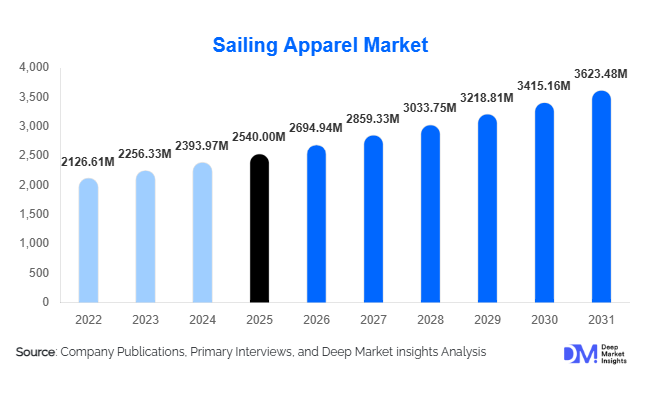
According to Deep Market Insights, the global sailing apparel market size was valued at USD 2,540 million in 2025 and is projected to grow from USD 2,694.94 million in 2026 to reach USD 3,623.48 million by 2031, expanding at a CAGR of 6.1% during the forecast period (2026–2031). The market growth is primarily driven by rising participation in recreational sailing, increasing demand for high-performance waterproof and breathable marine clothing, expansion of yacht tourism, and continuous advancements in technical textile technologies such as Gore-Tex-based membranes, recycled performance fabrics, and lightweight insulation systems.
Key Market Insights
- Recreational sailing dominates global demand, supported by expanding yacht tourism, sailing clubs, and coastal leisure activities across Europe and North America.
- Technical innovation in waterproof and breathable fabrics is driving product premiumization and higher replacement cycles for sailing apparel.
- Europe remains the largest regional market, driven by strong sailing culture in the UK, France, Italy, Spain, and the Nordic countries.
- Asia-Pacific is the fastest-growing region, fueled by rising disposable incomes, marina development, and growing marine tourism in Australia, China, India, and Thailand.
- Premium sailing apparel is gaining traction, with consumers increasingly preferring durable, high-performance, and weather-resistant clothing over basic marine wear.
- E-commerce and direct-to-consumer channels are expanding rapidly, improving accessibility to technical sailing apparel across emerging markets.
Sailing Apparel Market Trends
Rising Demand for Sustainable Marine Apparel
Sustainability is becoming a defining trend in the sailing apparel industry, with manufacturers increasingly adopting recycled polyester, recycled nylon, and bio-based waterproof coatings. Brands are actively reducing environmental impact by eliminating fluorocarbon-based DWR treatments and shifting toward circular production models. Consumers, particularly in Europe and North America, are increasingly prioritizing eco-certified sailing gear, encouraging manufacturers to invest in transparent supply chains and green manufacturing practices. This trend is also supporting premium pricing strategies and strengthening brand differentiation in a competitive market.
Integration of Advanced Performance Textile Technologies
The market is witnessing rapid adoption of advanced textile technologies designed for extreme marine conditions. Multi-layer waterproof systems, breathable membranes, seam-sealed construction, and stretchable performance fabrics are improving comfort and safety for sailors. Innovations such as body-mapped ventilation, abrasion-resistant reinforcements, and lightweight thermal insulation are becoming standard in premium sailing apparel. These advancements are encouraging professional sailors and recreational users to upgrade frequently, increasing product replacement cycles and supporting sustained revenue growth for manufacturers.
Sailing Apparel Market Drivers
Growth in Recreational Sailing and Yacht Tourism
The increasing popularity of recreational sailing and yacht tourism is one of the most significant drivers of market growth. Rising disposable incomes, expanding coastal tourism infrastructure, and growing interest in marine leisure activities are encouraging more consumers to participate in sailing. Countries such as the United States, France, Italy, Australia, and Thailand are witnessing strong demand for sailing apparel due to the expansion of yacht clubs, charter services, and sailing schools. This shift is broadening the consumer base beyond professional sailors to include casual and first-time participants.
Technological Advancements in Marine Apparel
Continuous innovation in fabric engineering is enhancing the performance and durability of sailing apparel. The integration of waterproof-breathable membranes, UV-resistant coatings, and thermal regulation systems has significantly improved user comfort and safety. Manufacturers are also introducing lightweight and ergonomic designs that reduce fatigue during long offshore journeys. These advancements are increasing product value, encouraging premium purchases, and strengthening long-term demand across both professional and recreational sailing segments.
Premiumization and Brand Loyalty Expansion
Consumers are increasingly shifting toward premium sailing apparel that offers superior durability, protection, and comfort. High-end sailing jackets, dry suits, and offshore gear are witnessing strong demand among yacht owners and professional sailors. Brand loyalty is also strengthening as established players invest in product innovation, performance testing, and professional sponsorships in global sailing competitions. This trend is contributing to higher average selling prices and improved profitability across the industry.
Sailing Apparel Market Restraints
High Product Costs and Limited Affordability
Sailing apparel requires advanced materials, waterproof membranes, and precision manufacturing, resulting in high production costs. As a result, premium sailing jackets, trousers, and dry suits are often priced significantly higher than conventional outdoor apparel. This limits adoption among entry-level users and price-sensitive consumers, particularly in emerging markets. High retail prices remain a key barrier to broader market penetration.
Seasonal Demand Fluctuations
The sailing apparel market is highly seasonal, especially in regions such as Europe and North America where sailing activity is concentrated in warmer months. Demand declines during off-season periods, creating inventory management challenges for manufacturers and retailers. Weather variability and economic uncertainty also influence discretionary spending on marine leisure products, adding volatility to market growth patterns.
Sailing Apparel Market Opportunities
Expansion in Emerging Marine Tourism Destinations
Rapid development of marine tourism infrastructure in Asia-Pacific, the Middle East, and Latin America presents significant growth opportunities. Countries such as China, India, UAE, Thailand, and Brazil are investing heavily in marinas, coastal resorts, and yacht tourism. This is creating new demand for sailing apparel among first-time users and recreational sailors, significantly expanding the addressable market beyond traditional sailing regions.
Growth of Direct-to-Consumer and Digital Retail Channels
The expansion of e-commerce and direct-to-consumer platforms is transforming sailing apparel distribution. Brands are increasingly bypassing traditional retail networks to offer personalized sizing tools, customized products, and faster delivery systems. Digital channels are also enabling global market access for niche sailing brands, improving visibility and customer engagement while reducing distribution costs.
Report Scope
| Report Metric | Details |
|---|---|
| Market Size in 2025 | USD 2540 Million |
| Market Size in 2026 | USD 2694.94 Million |
| Market Size in 2031 | USD 3623.48 Million |
| CAGR | 6.1% (2026-2031) |
| Base Year for Estimation | 2025 |
| Historical Data | 2022-2024 |
| Forecast Period | 2026-2031 |
| Report Coverage | Revenue Forecast, Competitive Landscape, Supply Chain Disruption, Growth Factors, Environment & Regulatory Landscape and Trends |
| Geographies Covered | North America, Europe, APAC, Middle East and Africa, LATAM |
| Countries Covered | U.S., Canada, U.K., Germany, France, Spain, Italy, Russia, Nordic, Benelux, Rest of Europe, China, Korea, Japan, India, Australia, Singapore, Taiwan, South East Asia, Rest of Asia-Pacific, UAE, Turky, Saudi Arabia, South Africa, Egypt, Nigeria, Rest of MEA, Brazil, Mexico, Argentina, Chile, Colombia, Rest of LATAM |
Explore more data points, trends and opportunities Download Free Sample Report
Product Type Insights
Sailing jackets represent the most dominant product category in the global sailing apparel market, accounting for the largest share of revenue due to their critical role in protecting users from harsh marine environments such as high winds, saltwater exposure, and fluctuating offshore temperatures. Their leadership is primarily driven by continuous innovation in waterproof and breathable membrane technologies, including multi-layer laminates, seam-sealed construction, and advanced thermal insulation systems. Increasing participation in offshore sailing and yacht racing has further strengthened demand for high-performance jackets, as professional sailors prioritize durability, weather resistance, and safety. Additionally, premiumization trends and frequent product replacement cycles among recreational sailors are supporting sustained revenue growth in this segment.
Sailing trousers and bibs form the second most important category, driven by the need for full-body protection in offshore and coastal sailing conditions. Growth in this segment is supported by rising adoption among professional sailors and yacht crews who require reinforced abrasion resistance and ergonomic mobility during long-duration voyages. Meanwhile, base layers and mid layers are experiencing steady expansion, supported by increasing awareness of thermal regulation and moisture-wicking performance, especially in colder sailing regions such as Northern Europe and North America. Accessories including gloves, boots, UV-protective wear, and headgear are also gaining traction, supported by rising safety standards and the growing emphasis on comfort and protection during extended marine exposure.
Application Insights
Recreational sailing remains the largest application segment in the global sailing apparel market, driven by expanding yacht tourism, increasing participation in sailing clubs, and rising interest in coastal leisure activities. This segment benefits significantly from growing disposable incomes, especially in developed economies, and the expansion of marina infrastructure across emerging coastal destinations. Competitive sailing and racing represent a high-value application segment, where demand is driven by professional athletes and offshore racing teams requiring advanced technical apparel with superior waterproofing, flexibility, and aerodynamic performance. The presence of global sailing events and regattas continues to reinforce innovation and premium product adoption within this segment.
Commercial marine applications, including yacht crews, port operators, and maritime professionals, contribute stable institutional demand due to the necessity for durable, safety-compliant apparel designed for extreme operating environments. Sailing academies, training institutions, and naval applications also generate consistent demand, particularly in developed marine economies where structured training programs and government-supported maritime operations require standardized apparel kits. Collectively, these application segments ensure a diversified demand base, reducing dependency on any single end-use category while supporting long-term market stability.
Distribution Channel Insights
Specialty marine stores and sailing equipment retailers continue to dominate the distribution landscape due to their ability to provide expert guidance, product fitting services, and access to premium technical brands. These channels are particularly important for high-value purchases such as offshore jackets and dry suits, where product performance and technical specifications play a critical role in buying decisions.
However, online platforms and direct-to-consumer (DTC) channels are expanding at a significantly faster pace, driven by increasing digital adoption, wider product accessibility, and competitive pricing advantages. Manufacturers are leveraging e-commerce platforms to offer personalized sizing tools, virtual fitting technologies, and customized product configurations, which enhance consumer engagement and reduce dependency on intermediaries. Brand-owned stores are also witnessing steady global expansion, enabling manufacturers to strengthen brand positioning, improve customer loyalty, and increase profit margins through direct engagement. Overall, the distribution landscape is undergoing a structural shift toward digital-first and hybrid retail models.
Explore more data points, trends and opportunities Download Free Sample Report
Sailing Apparel Market Segmentations
By Product Type
- Sailing Jackets
- Sailing Trousers & Bibs
- Base Layers
- Mid Layers
- Sailing Shirts & Tops
- Sailing Footwear
- Sailing Gloves
- UV Protective Apparel
- Dry Suits & Wet Weather Gear
- Sailing Accessories
By Application
- Recreational Sailing
- Competitive Sailing & Racing
- Commercial Marine Applications
- Sailing Training Academies
- Naval & Coast Guard Applications
By Material Type
- Polyester & Recycled Polyester
- Nylon & Polyamide
- Neoprene
- Gore-Tex & Waterproof Membranes
- Blended Performance Fabrics
- Cotton & Natural Blends
By Consumer Type
- Professional Sailors
- Recreational Sailors
- Yacht Owners
- Sailing Clubs & Academies
- Marine Professionals
By Distribution Channel
- Specialty Marine Stores
- Online Retail & E-commerce Platforms
- Direct-to-Consumer (Brand Websites)
- Sporting Goods Retailers
- Department Stores & Lifestyle Retail
Regional Insights
Europe
Europe remains the largest regional market for sailing apparel, supported by a deeply embedded sailing culture, extensive coastline infrastructure, and strong participation in competitive and recreational sailing activities. The United Kingdom, France, Italy, Spain, Germany, and Nordic countries collectively drive the majority of regional demand. Europe’s leadership is further reinforced by frequent international sailing events, established yacht clubs, and a strong preference for premium and technically advanced sailing apparel. Key growth drivers include increasing investments in sustainable marine tourism, rising popularity of offshore racing events, and growing demand for eco-certified technical apparel among environmentally conscious consumers.
North America
North America holds a significant share of the global sailing apparel market, led primarily by the United States. Strong recreational boating participation, high disposable income levels, and a growing preference for outdoor and marine leisure activities are key demand drivers. Coastal states such as Florida, California, Massachusetts, and New York serve as major consumption hubs. Regional growth is further supported by the expansion of yacht clubs, increasing participation in sailing schools, and rising demand for premium performance apparel. Additionally, growing awareness of UV protection and marine safety standards is encouraging adoption of high-quality technical sailing gear.
Asia-Pacific
Asia-Pacific is the fastest-growing regional market, driven by rapid expansion of marine tourism, increasing yacht ownership, and significant government investments in coastal infrastructure and marina development. Australia and New Zealand represent mature sailing markets with strong competitive sailing cultures, while China, India, Japan, and Southeast Asia are emerging as high-growth demand centers. Growth is further supported by rising disposable incomes, increasing popularity of luxury coastal tourism, and expanding sailing education programs. Improved international connectivity and growing awareness of sailing as a recreational activity are accelerating regional market expansion.
Latin America
Latin America is witnessing steady but gradual growth, led by Brazil, Mexico, Argentina, and Chile. Expanding coastal tourism infrastructure and increasing interest in recreational boating are key growth enablers. Brazil dominates regional demand due to its extensive coastline and growing yacht tourism industry. The region is also benefiting from rising investments in marina development and increasing participation in water sports activities. Long-term growth potential remains strong as economic development improves access to premium recreational marine products.
Middle East & Africa
The Middle East & Africa region is emerging as a niche but rapidly developing market for sailing apparel, particularly in the UAE, Saudi Arabia, and South Africa. Growth is strongly supported by luxury tourism development, government-backed marina projects, and increasing investment in coastal infrastructure. The UAE is positioning itself as a global yachting and marine tourism hub, while Saudi Arabia is investing heavily in Red Sea tourism projects under long-term economic diversification strategies. South Africa continues to serve as a key sailing destination with an established recreational sailing community. Rising high-net-worth populations and expansion of luxury marine experiences are expected to further accelerate regional demand.
Key Players in the Sailing Apparel Market
- Musto
- Helly Hansen
- Gill Marine
- Zhik
- Henri-Lloyd
- North Sails Apparel
- Decathlon (Tribord Marine Range)
- Patagonia
- Arc’teryx
- Dubarry of Ireland
- Mustang Survival
- Quiksilver (Marine Segment)
- Columbia Sportswear (Marine Line)
- O’Neill
- Hobie