Power Sports Market Size
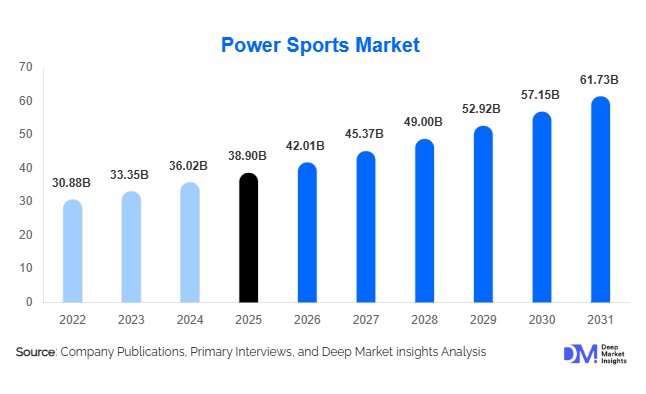
According to Deep Market Insights, the global power sports market size was valued at USD 38.9 billion in 2025 and is projected to grow from USD 42.01 billion in 2026 to reach USD 61.73 billion by 2031, expanding at a CAGR of 8.0% during the forecast period (2026–2031). The power sports market growth is being driven by rising participation in outdoor recreational activities, increasing consumer spending on adventure tourism, expanding demand for utility vehicles across agriculture and industrial sectors, and continuous technological advancements in electric and connected power sports vehicles. The industry has evolved significantly beyond traditional recreational applications, with side-by-side vehicles (UTVs), all-terrain vehicles (ATVs), snowmobiles, personal watercraft, and off-road motorcycles increasingly being adopted across commercial, government, defense, and utility applications. Manufacturers are focusing heavily on electrification, smart vehicle integration, lightweight materials, and safety-enhancing technologies to attract new customer segments while complying with increasingly stringent environmental regulations. Growing interest in outdoor lifestyles among younger demographics, combined with rising disposable incomes in emerging economies, continues to create favorable market conditions. Additionally, rental operators, adventure tourism providers, and utility fleet operators are increasingly investing in power sports fleets, creating new revenue streams for manufacturers and dealers worldwide.
Key Market Insights
- Side-by-side vehicles (UTVs) account for the largest vehicle category, representing approximately 31% of the global power sports market value in 2025.
- Gasoline-powered vehicles continue to dominate the industry, contributing nearly 82% of total market revenue, although electric models are experiencing the fastest growth.
- North America remains the largest regional market, accounting for approximately 42% of global revenue due to strong recreational vehicle ownership and extensive off-road infrastructure.
- Asia-Pacific is the fastest-growing regional market, driven by increasing disposable incomes and growing adventure tourism participation.
- Electric power sports vehicles are gaining significant momentum, supported by government incentives, battery advancements, and sustainability initiatives.
- Commercial and utility applications are becoming increasingly important, particularly in agriculture, forestry, mining, and defense sectors.
Power Sports Market Trends
Electrification Transforming the Industry
Electric power sports vehicles are becoming a major focus area for manufacturers globally. Improvements in battery energy density, charging infrastructure, and electric drivetrain efficiency have enabled OEMs to launch electric ATVs, UTVs, motorcycles, and personal watercraft that offer competitive performance compared to traditional internal combustion engine models. Companies are investing heavily in research and development to improve range, durability, and charging times while reducing overall vehicle weight. Environmental regulations across North America and Europe are accelerating the transition toward low-emission recreational vehicles. Electric models are particularly attractive for eco-tourism operators, national parks, and urban recreational users seeking lower operating costs and reduced environmental impact.
Connected Vehicle Technologies Enhancing User Experience
The adoption of connected technologies is reshaping the power sports landscape. Modern vehicles increasingly incorporate GPS navigation, real-time diagnostics, vehicle-to-mobile connectivity, geofencing capabilities, remote monitoring, and predictive maintenance systems. Manufacturers are integrating smartphone applications that allow riders to monitor performance metrics, plan routes, receive maintenance alerts, and share riding experiences digitally. Connected technologies are also improving fleet management capabilities for commercial operators and rental companies, enabling improved utilization rates and operational efficiency. These innovations are helping manufacturers differentiate their offerings while creating recurring revenue opportunities through digital services and subscriptions.
Power Sports Market Drivers
Growing Popularity of Outdoor Recreation and Adventure Tourism
Increasing consumer interest in outdoor recreational activities is significantly driving demand for power sports vehicles. Activities such as trail riding, off-road racing, snowmobiling, water sports, and adventure tourism have gained popularity among younger consumers and affluent households. Governments and tourism agencies are actively promoting outdoor recreation infrastructure, including trails, parks, and adventure tourism destinations, creating favorable conditions for market expansion. Adventure tourism operators are also investing heavily in fleet expansion to meet growing customer demand for experiential travel activities.
Expanding Utility Applications Across Industries
Power sports vehicles are increasingly being utilized beyond recreation. Agriculture, forestry, mining, construction, utilities, and defense organizations are adopting UTVs and ATVs for transportation, surveillance, maintenance, and operational support. Their ability to access difficult terrain at relatively low operating costs makes them highly valuable in remote and rugged environments. Growing infrastructure projects and resource exploration activities globally are further supporting demand for utility-focused power sports vehicles.
Continuous Product Innovation and Premiumization
Manufacturers are introducing advanced safety systems, enhanced suspension technologies, autonomous features, infotainment systems, and premium comfort features to attract consumers. High-performance models featuring turbocharged engines, adaptive suspension systems, and integrated digital dashboards are commanding premium pricing. The trend toward premiumization is particularly strong among affluent consumers seeking enhanced performance, exclusivity, and advanced technology, contributing to higher average selling prices and industry profitability.
Power Sports Market Restraints
Stringent Environmental Regulations
Governments across major markets are implementing increasingly strict emissions and noise regulations for recreational vehicles. Compliance requires significant investment in cleaner engine technologies, emission-control systems, and electrification programs. These additional costs can increase vehicle prices and potentially affect affordability for certain consumer segments. Smaller manufacturers may face greater challenges meeting regulatory requirements compared to larger industry participants with stronger R&D capabilities.
Economic Cyclicality and Discretionary Spending Dependence
The power sports industry remains highly dependent on discretionary consumer spending. Economic slowdowns, inflationary pressures, rising interest rates, and consumer confidence fluctuations can significantly impact vehicle purchases. Since many power sports products are considered discretionary or lifestyle purchases, economic uncertainty can delay replacement cycles and reduce new vehicle demand. Seasonal demand patterns also contribute to revenue volatility across several product categories.
Power Sports Market Opportunities
Rapid Expansion of Electric Power Sports Platforms
The transition toward electric mobility presents a substantial growth opportunity for both established manufacturers and new entrants. Advances in battery technology, combined with increasing environmental awareness among consumers, are creating strong demand for electric recreational vehicles. Companies capable of delivering competitive performance and reliability while maintaining affordability are expected to capture significant market share during the forecast period.
Growth of Adventure Tourism and Rental Fleets
The expansion of adventure tourism worldwide is creating opportunities for fleet sales and commercial partnerships. Tourism operators, resorts, recreational parks, and adventure travel companies are increasingly investing in power sports vehicles to enhance customer experiences. Rental fleets provide consumers with access to premium vehicles without ownership commitments, helping expand the overall customer base.
Emerging Market Penetration
Rapid urbanization, rising disposable incomes, and growing middle-class populations across Asia-Pacific, Latin America, and parts of the Middle East are creating substantial untapped demand. Manufacturers are expanding dealer networks, local production facilities, and financing programs to improve accessibility in these high-growth markets. Localization strategies and affordable product offerings are expected to accelerate adoption rates significantly.
Report Scope
| Report Metric | Details |
|---|---|
| Market Size in 2025 | USD 38.9 Billion |
| Market Size in 2026 | USD 42.01 Billion |
| Market Size in 2031 | USD 61.73 Billion |
| CAGR | 8% (2026-2031) |
| Base Year for Estimation | 2025 |
| Historical Data | 2022-2024 |
| Forecast Period | 2026-2031 |
| Report Coverage | Revenue Forecast, Competitive Landscape, Supply Chain Disruption, Growth Factors, Environment & Regulatory Landscape and Trends |
| Geographies Covered | North America, Europe, APAC, Middle East and Africa, LATAM |
| Countries Covered | U.S., Canada, U.K., Germany, France, Spain, Italy, Russia, Nordic, Benelux, Rest of Europe, China, Korea, Japan, India, Australia, Singapore, Taiwan, South East Asia, Rest of Asia-Pacific, UAE, Turky, Saudi Arabia, South Africa, Egypt, Nigeria, Rest of MEA, Brazil, Mexico, Argentina, Chile, Colombia, Rest of LATAM |
Explore more data points, trends and opportunities Download Free Sample Report
Vehicle Type Insights
Side-by-side vehicles (UTVs) dominate the global power sports market, accounting for approximately 31% of total market revenue in 2025. Their versatility across recreational, agricultural, industrial, and defense applications has positioned them as the industry's fastest-growing vehicle category. All-terrain vehicles (ATVs) represent approximately 24% of market value, supported by widespread use in utility and recreational applications. Personal watercraft account for nearly 15% of market revenue, benefiting from increasing participation in water-based recreational activities. Off-road motorcycles continue to experience strong demand among enthusiasts and competitive riders, while snowmobiles maintain stable demand across cold-weather regions including North America and Northern Europe. Premium heavyweight motorcycles are increasingly benefiting from the growing popularity of adventure touring and long-distance recreational travel.
Propulsion Type Insights
Gasoline-powered vehicles remain the dominant propulsion category, representing approximately 82% of global market revenue in 2025 due to their established infrastructure, performance capabilities, and widespread consumer acceptance. Electric power sports vehicles account for approximately 9% of the market but are expected to register the highest growth rate through 2031. Hybrid vehicles are gradually emerging in select segments where range extension and fuel efficiency are important purchasing factors. Technological advancements and regulatory support are expected to accelerate electrification across multiple vehicle categories during the forecast period.
Application Insights
Recreation and leisure applications account for approximately 54% of global market demand, supported by increasing participation in outdoor sports and adventure tourism. Utility and work-related applications contribute nearly 27% of market revenue, driven by adoption across agriculture, forestry, mining, and infrastructure sectors. Sports and competitive racing continue to generate strong demand for high-performance models. Rental and tourism applications are expanding rapidly as operators invest in premium fleets to enhance customer experiences. Government and defense applications remain a specialized but growing segment, particularly for utility-focused vehicles capable of operating in challenging environments.
End-User Insights
Individual consumers represent the largest end-user category, accounting for approximately 68% of global market revenue. Commercial operators, including tourism providers, rental companies, and industrial users, represent nearly 22% of market demand and are among the fastest-growing customer segments. Government agencies increasingly utilize power sports vehicles for park management, emergency response, and law enforcement applications. Defense organizations continue to adopt specialized off-road vehicles for reconnaissance, logistics, and mobility operations in difficult terrain.
Explore more data points, trends and opportunities Download Free Sample Report
Power Sports Market Segmentations
By Vehicle Type
- All-Terrain Vehicles (ATVs)
- Side-by-Side Vehicles (UTVs)
- Off-Road Motorcycles
- Snowmobiles
- Personal Watercraft (PWC)
- Heavyweight On-Road Motorcycles (>500cc)
By Propulsion Type
- Gasoline-Powered
- Diesel-Powered
- Electric Power Sports Vehicles
- Hybrid Power Sports Vehicles
By Application
- Recreation & Leisure
- Utility & Work Operations
- Sports & Competitive Racing
- Rental & Tourism Activities
- Military & Government Applications
By Sales Channel
- OEM Dealer Network
- Direct-to-Consumer Sales
- Online Sales Platforms
- Fleet & Institutional Procurement
By End User
- Individual Consumers
- Commercial Operators
- Government Agencies
- Defense Organizations
Regional Insights
North America
North America accounted for approximately 42% of global power sports market revenue in 2025, maintaining its position as the largest regional market worldwide. The United States represents the dominant contributor to regional demand, supported by one of the world's largest recreational vehicle ownership bases, extensive off-road trail networks, favorable terrain for outdoor activities, and a deeply rooted culture of adventure sports and outdoor recreation. The country continues to benefit from strong participation in ATV riding, side-by-side vehicle activities, snowmobiling, motocross racing, and personal watercraft recreation. Canada remains a significant market, particularly for snowmobiles, utility ATVs, and off-road motorcycles, driven by vast recreational landscapes and long winter seasons.
Several structural factors continue to support market growth across North America, including high disposable incomes, well-established dealer and service networks, widespread availability of consumer financing programs, and a mature aftermarket ecosystem. In addition, increasing demand for utility vehicles in agriculture, forestry, ranching, mining, and infrastructure maintenance applications is expanding the addressable market beyond recreational users. The growing adoption of electric power sports vehicles, supported by sustainability initiatives and consumer interest in low-maintenance alternatives, is further driving innovation and replacement demand across the region.
Europe
Europe accounted for approximately 26% of global power sports market revenue in 2025, with Germany, France, the United Kingdom, Italy, Sweden, Norway, and Finland serving as the region's primary demand centers. The European market is characterized by strong demand for premium motorcycles, adventure touring vehicles, snowmobiles, and increasingly electric power sports products. Adventure tourism continues to play a major role in stimulating demand, particularly across Alpine regions and Nordic countries where outdoor recreation forms a significant part of leisure spending.
Regional growth is being driven by rising participation in outdoor and experiential tourism, increasing consumer preference for premium mobility products, and supportive government policies promoting low-emission transportation technologies. Europe has emerged as a key hub for electric motorcycle and electric off-road vehicle adoption due to stringent emissions regulations and growing environmental awareness among consumers. Additionally, the presence of several leading motorcycle manufacturers and advanced engineering ecosystems supports continuous product innovation. The expansion of cross-border adventure tourism routes, coupled with investments in charging infrastructure and sustainable mobility solutions, is expected to further accelerate market development throughout the forecast period.
Asia-Pacific
Asia-Pacific accounted for approximately 22% of global market revenue in 2025 and is projected to be the fastest-growing regional market through 2031. China, Japan, Australia, India, and South Korea collectively represent the largest opportunities within the region. China serves as both a major manufacturing hub and a rapidly expanding consumer market, benefiting from rising disposable incomes, increasing domestic tourism, and growing participation in recreational activities. Australia remains one of the most mature power sports markets in the region, supported by extensive use of ATVs and UTVs across agriculture, livestock management, mining operations, and recreational activities.
The region's growth is being fueled by rapid urbanization, expansion of the middle-class population, increasing adventure tourism expenditure, and improving access to financing for recreational vehicle purchases. India is witnessing growing demand for off-road motorcycles and adventure touring motorcycles as domestic tourism and motorsports participation increase. Meanwhile, Japan and South Korea continue to support demand through technologically advanced products and premium recreational vehicle ownership. The expansion of tourism infrastructure, government support for outdoor recreation industries, and increasing investments by global manufacturers in regional production facilities are expected to strengthen Asia-Pacific's position as the industry's highest-growth region.
Latin America
Latin America is emerging as an attractive growth market for power sports manufacturers, led by Brazil, Mexico, Argentina, and Chile. While overall market penetration remains lower than in North America and Europe, demand is steadily increasing across both recreational and utility vehicle segments. Brazil represents the region's largest market due to its sizable agricultural sector, growing adventure tourism industry, and expanding middle-class consumer base. Mexico continues to benefit from increasing participation in motorsports, recreational vehicle ownership, and proximity to major North American manufacturers.
The primary growth drivers across Latin America include rising investments in mining, agriculture, forestry, and infrastructure development, all of which require utility-focused ATVs and UTVs capable of operating in challenging terrain. Adventure tourism activities such as desert riding, trail exploration, and eco-tourism are also creating new demand opportunities. Improvements in economic stability, expanding dealer networks, and growing awareness of recreational power sports activities are supporting broader market adoption. Additionally, increasing foreign investment in tourism infrastructure is expected to contribute to stronger rental fleet demand and commercial vehicle purchases across the region.
Middle East & Africa
The Middle East & Africa region is experiencing steady expansion in the power sports market, supported by growing tourism investments, increasing participation in desert-based recreational activities, and expanding infrastructure development projects. The United Arab Emirates, Saudi Arabia, South Africa, Qatar, and Morocco represent the most significant markets within the region. The UAE and Saudi Arabia have emerged as key demand centers for premium off-road vehicles, side-by-side vehicles, and adventure motorcycles, supported by strong consumer spending power and growing interest in motorsports events and outdoor leisure activities.
Regional growth is being driven by government-led tourism diversification programs, particularly under initiatives such as Saudi Vision 2031, which are promoting adventure tourism, eco-tourism, and outdoor recreation industries. Desert tourism activities, including dune riding, off-road expeditions, and motorsports events, continue to generate substantial demand for ATVs and UTVs. In Africa, utility vehicles are increasingly being adopted across agriculture, wildlife conservation, mining, and infrastructure maintenance sectors. Investments in tourism infrastructure, expanding recreational vehicle rental fleets, and rising international visitor arrivals are expected to further strengthen market growth throughout the forecast period. Additionally, improving distribution networks and increasing availability of premium recreational vehicles are enhancing market accessibility across several emerging economies within the region.
Key Players in the Power Sports Market
- Polaris Inc.
- BRP Inc.
- Honda Motor Co., Ltd.
- Yamaha Motor Co., Ltd.
- Kawasaki Motors Ltd.
- Harley-Davidson Inc.
- KTM AG
- Suzuki Motor Corporation
- CFMOTO
- Textron Inc.
- Triumph Motorcycles
- Royal Enfield
- Zero Motorcycles
- Segway Powersports
- Arctic Cat