Personal Hygiene Market Size
According to Deep Market Insights, the global personal hygiene market size was valued at USD 587.4 billion in 2025 and is projected to grow from USD 607.37 billion in 2026 to reach USD 717.89 billion by 2031, expanding at a CAGR of 3.4% during the forecast period (2026–2031). The personal hygiene market growth is primarily driven by increasing consumer awareness regarding preventive healthcare, rising urbanization, expanding disposable incomes, and growing demand for premium hygiene products across both developed and emerging economies. The market includes oral hygiene products, bath and shower products, feminine hygiene products, baby hygiene products, adult incontinence solutions, deodorants, sanitizers, tissues, wipes, and grooming products.
The industry continues to experience stable long-term demand due to the essential nature of hygiene products in daily life. Post-pandemic consumer behavior has permanently reinforced hand hygiene, sanitization, and infection prevention habits across households, healthcare facilities, educational institutions, hospitality, and workplaces. In addition, governments worldwide continue to invest in sanitation awareness programs, public healthcare infrastructure, and hygiene education initiatives, particularly across Asia-Pacific and Africa.
Premiumization trends are reshaping the competitive landscape, with consumers increasingly preferring organic, dermatologically tested, sustainable, and refillable hygiene products. Digital commerce and subscription-based purchasing models are also accelerating market transformation. The growing adoption of biodegradable materials, smart oral care devices, antimicrobial technologies, and eco-friendly packaging continues to support product innovation globally.
Key Market Insights
- Asia-Pacific dominates the global personal hygiene market, supported by large population bases, rising disposable income, and rapid urbanization across China, India, and Southeast Asia.
- Oral hygiene products remain the leading segment, accounting for nearly 22.8% of the global market in 2025 due to high product penetration and repeat consumption patterns.
- Sustainable and reusable hygiene products are gaining significant traction, particularly in Europe and North America, driven by environmental concerns and regulatory pressures.
- Online retail and direct-to-consumer platforms are the fastest-growing distribution channels, supported by subscription models and personalized product offerings.
- Adult incontinence products represent one of the fastest-growing categories, fueled by rising aging populations across Japan, Europe, China, and North America.
- Technological innovation in smart hygiene products, including electric toothbrushes, antimicrobial formulations, and biodegradable absorbent materials, is reshaping market competition.
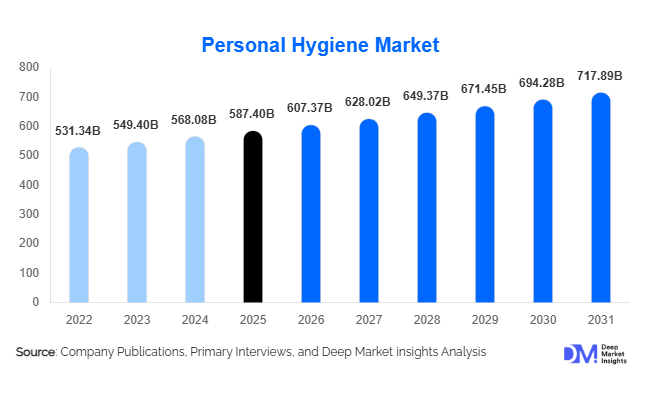
Personal Hygiene Market Trends
Sustainable and Eco-Friendly Hygiene Products Gaining Momentum
Consumers are increasingly shifting toward environmentally responsible hygiene products as concerns surrounding plastic waste and landfill accumulation intensify globally. Demand for biodegradable sanitary pads, compostable wipes, refillable deodorants, bamboo-based tissues, and reusable menstrual products continues to rise across developed economies. Manufacturers are investing heavily in sustainable packaging, plant-based materials, and low-carbon manufacturing processes to comply with tightening environmental regulations. Europe remains a leading market for sustainable hygiene innovation, while North America and urban Asia-Pacific markets are rapidly increasing adoption. Brands focusing on ethical sourcing, recyclable packaging, and plastic-free product formulations are gaining premium pricing advantages and stronger consumer loyalty.
Premiumization and Wellness-Oriented Hygiene Consumption
Consumers are increasingly willing to pay premium prices for hygiene products offering added wellness benefits such as dermatological protection, organic ingredients, antibacterial properties, odor control, and sensitive skin formulations. Premium oral care products, natural deodorants, intimate hygiene products, and baby care solutions are witnessing strong demand growth globally. The wellness trend is particularly visible among urban consumers and younger demographics who prioritize ingredient transparency, vegan certifications, and skin-safe formulations. Companies are also introducing multifunctional hygiene products combining skincare, antimicrobial protection, and fragrance enhancement, thereby increasing value-added consumption patterns.
Personal Hygiene Market Drivers
Rising Awareness Regarding Preventive Healthcare and Hygiene
One of the strongest growth drivers in the personal hygiene market is increasing consumer awareness regarding disease prevention, infection control, and personal wellness. The COVID-19 pandemic significantly accelerated global hygiene-conscious behavior, increasing consumption of sanitizers, disinfectants, antibacterial cleansers, and hand hygiene products. Consumers now view hygiene products as an essential component of preventive healthcare rather than purely cosmetic or convenience items. This shift continues to support long-term demand growth across residential, institutional, and healthcare sectors.
Urbanization and Rising Disposable Income
Rapid urbanization across emerging economies such as India, Indonesia, Vietnam, Brazil, and African countries has expanded access to branded hygiene products through organized retail and e-commerce channels. Rising disposable incomes are enabling consumers to shift from unorganized and low-cost products toward premium and specialized hygiene solutions. Urban consumers increasingly prefer convenience-oriented products such as liquid hand washes, disposable wipes, electric toothbrushes, premium diapers, and organic feminine hygiene products. Expanding middle-class populations continue to support strong market penetration across developing regions.
Personal Hygiene Market Restraints
Volatility in Raw Material Prices
The personal hygiene industry remains heavily dependent on raw materials such as pulp, superabsorbent polymers, fragrances, petrochemicals, packaging plastics, and specialty chemicals. Fluctuations in crude oil prices and supply chain disruptions can significantly impact production costs and profitability. Manufacturers operating in highly price-sensitive markets often struggle to fully transfer increased production costs to consumers, particularly within mass-market product categories such as tissues, soaps, diapers, and sanitary products.
Environmental Concerns Regarding Disposable Waste
Disposable hygiene products such as sanitary pads, diapers, wet wipes, and plastic-based packaging continue to face increasing environmental criticism globally. Governments and environmental organizations are pressuring manufacturers to reduce plastic content, improve recyclability, and invest in sustainable product innovation. Compliance with sustainability regulations requires substantial research and development investments, while transitioning to biodegradable materials can increase manufacturing costs and operational complexity.
Personal Hygiene Market Opportunities
Expansion of Hygiene Penetration Across Emerging Economies
Large populations across India, Southeast Asia, Africa, and Latin America continue to demonstrate relatively low per-capita consumption of feminine hygiene products, oral care solutions, and adult incontinence products compared with developed economies. Government sanitation initiatives, increasing female workforce participation, rising urbanization, and improving healthcare awareness are significantly expanding addressable consumer bases. Public-private partnerships and hygiene education programs are further supporting product penetration in rural and semi-urban regions.
Growth of Digital Commerce and Subscription-Based Hygiene Models
E-commerce and direct-to-consumer business models are transforming the global personal hygiene industry. Subscription-based oral care products, personalized hygiene routines, refillable product systems, and AI-powered product recommendations are generating recurring revenue streams for manufacturers. Younger consumers increasingly prefer convenience-driven digital purchasing experiences, particularly for products such as razors, feminine hygiene products, oral care kits, and premium skincare-linked hygiene products. Online retail also enables niche sustainable brands to rapidly scale market presence globally.
Report Scope
| Report Metric | Details |
|---|---|
| Market Size in 2025 | USD 587.4 Billion |
| Market Size in 2026 | USD 607.37 Billion |
| Market Size in 2031 | USD 717.89 Billion |
| CAGR | 3.4% (2026-2031) |
| Base Year for Estimation | 2025 |
| Historical Data | 2022-2024 |
| Forecast Period | 2026-2031 |
| Report Coverage | Revenue Forecast, Competitive Landscape, Supply Chain Disruption, Growth Factors, Environment & Regulatory Landscape and Trends |
| Geographies Covered | North America, Europe, APAC, Middle East and Africa, LATAM |
| Countries Covered | U.S., Canada, U.K., Germany, France, Spain, Italy, Russia, Nordic, Benelux, Rest of Europe, China, Korea, Japan, India, Australia, Singapore, Taiwan, South East Asia, Rest of Asia-Pacific, UAE, Turky, Saudi Arabia, South Africa, Egypt, Nigeria, Rest of MEA, Brazil, Mexico, Argentina, Chile, Colombia, Rest of LATAM |
Explore more data points, trends and opportunities Download Free Sample Report
Product Type Insights
Oral hygiene products dominate the personal hygiene market, accounting for approximately 22.8% of global revenue in 2025. Toothpaste and toothbrushes remain highly penetrated across both developed and emerging economies due to their essential daily usage patterns. Electric toothbrushes, whitening toothpaste, herbal formulations, and sensitivity-focused products are driving premium segment expansion. Bath and shower hygiene products, including soaps, shower gels, and antibacterial cleansing products, represent another major segment supported by high-frequency consumption. Feminine hygiene products continue to witness strong growth due to increasing awareness regarding menstrual health and rising adoption of reusable and organic products. Baby hygiene products, particularly disposable diapers and baby wipes, remain highly demanded because of convenience and growing expenditure on infant care globally.
Distribution Channel Insights
Supermarkets and hypermarkets remain the leading distribution channel, accounting for nearly 41% of global personal hygiene product sales in 2025 due to wide product variety, strong promotional activity, and bulk purchasing convenience. Pharmacies and specialty personal care stores continue to perform strongly in premium and healthcare-oriented product categories. However, online retail is emerging as the fastest-growing distribution channel globally. E-commerce platforms, direct-to-consumer brands, and subscription-based purchasing models are significantly reshaping consumer buying behavior. Digital commerce growth is especially strong in China, India, Southeast Asia, and North America, where younger consumers increasingly prioritize convenience, personalized recommendations, and home delivery services.
Consumer Group Insights
Women represent the largest consumer group within the personal hygiene market due to strong demand for feminine hygiene products, skincare-linked hygiene products, and premium personal care solutions. Baby and infant hygiene products continue to drive substantial household expenditure globally, while aging populations are significantly increasing demand for adult incontinence products. Male grooming and hygiene products are also expanding steadily, particularly within premium deodorants, beard care, and shaving products. Gender-neutral and unisex hygiene products are emerging as an important category among younger demographics seeking inclusive and minimalist product positioning.
Explore more data points, trends and opportunities Download Free Sample Report
Personal Hygiene Market Segmentations
By Product Type
- Oral Hygiene Products
- Bath & Shower Hygiene Products
- Deodorants & Antiperspirants
- Feminine Hygiene Products
- Baby Hygiene Products
- Adult Incontinence Products
- Hand Hygiene & Sanitization Products
- Shaving & Grooming Hygiene Products
- Tissue & Disposable Hygiene Products
By Ingredient Profile
- Conventional Chemical-Based Products
- Natural & Herbal Products
- Organic-Certified Products
- Vegan Products
- Hypoallergenic Products
- Dermatologically Tested Products
By Distribution Channel
- Supermarkets & Hypermarkets
- Convenience Stores
- Pharmacies & Drug Stores
- Specialty Personal Care Stores
- Department Stores
- Online Retail/E-Commerce
- Direct-to-Consumer Subscription Platforms
By Consumer Group
- Men
- Women
- Children & Infants
- Geriatric Population
- Gender-Neutral/Unisex Users
By End Use
- Household/Residential Consumers
- Hospitals & Healthcare Facilities
- Hospitality Industry
- Corporate Offices & Commercial Facilities
- Educational Institutions
- Travel & Transportation Sector
- Industrial Workplaces
Regional Insights
Asia-Pacific
Asia-Pacific accounted for approximately 44.6% of the global personal hygiene market in 2025, making it the largest regional market worldwide. China remains the leading country due to its large population, expanding middle class, and rapidly growing e-commerce ecosystem. India is among the fastest-growing markets globally, driven by sanitation awareness initiatives, increasing female hygiene awareness, and improving retail penetration. Japan remains a mature but highly innovative market, particularly within adult incontinence products, premium oral care, and technologically advanced hygiene solutions.
North America
North America represented nearly 23.5% of global market revenue in 2025. The United States dominates regional demand due to high per-capita spending on premium hygiene products, advanced retail infrastructure, and strong consumer preference for sustainable and dermatologist-approved formulations. Canada also demonstrates stable market expansion supported by premiumization trends and rising adoption of eco-friendly hygiene products.
Europe
Europe accounted for approximately 21.3% of the global market in 2025. Germany, the United Kingdom, France, and Italy remain the largest consumers within the region. Europe leads global sustainable hygiene innovation, with strong adoption of biodegradable sanitary products, refillable deodorants, and recyclable packaging systems. Strict environmental regulations continue to accelerate investments in sustainable product reformulation and packaging technologies.
Latin America
Latin America continues to witness stable growth supported primarily by Brazil and Mexico. Brazil remains the largest regional market due to strong demand for deodorants, oral care products, and feminine hygiene products. Rising urbanization, increasing digital commerce penetration, and growing middle-class spending continue to support long-term regional market expansion.
Middle East & Africa
The Middle East and Africa region is emerging as a high-potential growth market due to improving sanitation infrastructure, expanding retail networks, and rising awareness regarding personal healthcare and hygiene. Gulf countries exhibit strong demand for premium imported hygiene brands, while African nations continue to benefit from NGO-led hygiene education initiatives and government sanitation programs aimed at improving product accessibility.
Key Players in the Personal Hygiene Market
- Procter & Gamble
- Unilever
- Kimberly-Clark Corporation
- Colgate-Palmolive Company
- Essity AB
- Unicharm Corporation
- Johnson & Johnson
- Reckitt Benckiser Group
- Kao Corporation
- Henkel AG & Co. KGaA
- Beiersdorf AG
- Edgewell Personal Care
- Church & Dwight Co.
- Hengan International Group
- Ontex Group