Luxury Perfume Market Size
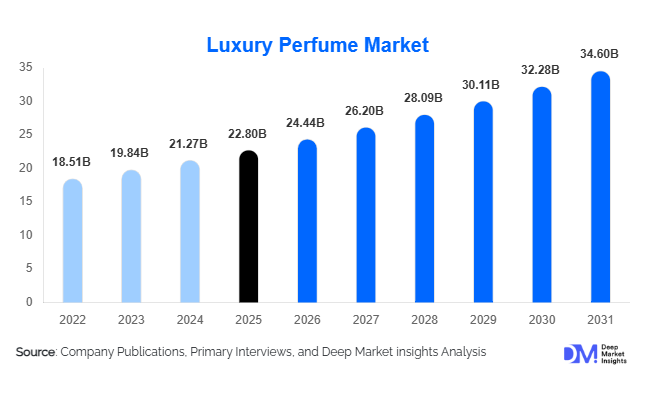
According to Deep Market Insights, the global luxury perfume market size was valued at USD 22.8 billion in 2025 and is projected to grow from USD 24.44 billion in 2026 to reach USD 34.60 billion by 2031, expanding at a CAGR of 7.2% during the forecast period (2026–2031). The luxury perfume market growth is primarily driven by increasing premiumization in the beauty and personal care industry, rising demand for niche and artisanal fragrances, and growing consumer preference for personalized and high-end scent experiences.
Key Market Insights
- Luxury fragrances are increasingly positioned as lifestyle and identity products, with consumers prioritizing exclusivity, craftsmanship, and emotional connection over mass-market scent offerings.
- Niche and artisanal perfume brands are gaining rapid traction globally, supported by demand for unique fragrance compositions, limited-edition collections, and premium ingredient sourcing.
- Europe dominates the global luxury perfume market, led by France, Italy, and the U.K., owing to strong heritage brands, advanced fragrance manufacturing capabilities, and established luxury retail ecosystems.
- Asia-Pacific is the fastest-growing regional market, driven by rising disposable income, expanding luxury consumption, and increasing premium beauty adoption in China, India, South Korea, and Southeast Asia.
- Sustainability and refillable packaging solutions are becoming mainstream trends, as consumers increasingly prefer ethically sourced ingredients and environmentally responsible luxury products.
- Technological integration, including AI-based fragrance personalization, virtual scent discovery tools, and omnichannel retail experiences, is reshaping customer engagement and purchasing behavior.
Luxury Perfume Market Trends
Rise of Niche and Personalized Fragrances
The luxury perfume market is increasingly shifting toward niche, artisanal, and customized fragrance offerings. Consumers are moving beyond mainstream designer perfumes and seeking unique scent profiles that reflect personal identity and exclusivity. Luxury fragrance houses are responding by launching limited-edition collections, bespoke fragrance services, and AI-enabled scent recommendation systems. Personalized perfume consultations, custom blending experiences, and fragrance layering concepts are becoming increasingly popular among affluent consumers. This trend is particularly strong among Millennials and Gen Z consumers, who value authenticity, storytelling, and individuality in premium beauty products. Niche perfume houses are also benefiting from social media-driven fragrance discovery, with influencers and fragrance communities significantly shaping consumer preferences.
Sustainable Luxury and Refillable Packaging Expansion
Sustainability has become a major focus area across the luxury perfume industry. Consumers increasingly prefer eco-conscious luxury products featuring refillable bottles, recyclable packaging, vegan formulations, and ethically sourced ingredients. Leading fragrance companies are investing heavily in sustainable ingredient cultivation, biodegradable packaging materials, and carbon-neutral manufacturing operations. Refillable perfume systems are becoming especially popular in Europe and North America, where environmental awareness is significantly influencing purchasing decisions. Luxury brands are also improving supply chain transparency by highlighting ingredient traceability and responsible sourcing practices. In addition, clean-label fragrance formulations free from controversial synthetic compounds are gaining traction among environmentally conscious consumers.
Luxury Perfume Market Drivers
Growing Premiumization in Beauty and Personal Care
The increasing global trend of premiumization is one of the primary growth drivers for the luxury perfume market. Consumers are increasingly prioritizing high-quality, emotionally engaging, and aspirational products over standard mass-market alternatives. Luxury perfumes are viewed as accessible luxury items that allow consumers to participate in premium lifestyle consumption at relatively attainable price points compared with luxury fashion or jewelry. This trend is especially prominent among younger consumers seeking self-expression through premium beauty and grooming products. The expansion of luxury retail stores, digital commerce channels, and influencer-led marketing campaigns is further supporting premium fragrance adoption globally.
Strong Demand for Niche and Oud-Based Fragrances
Demand for niche and oud-based luxury fragrances has increased significantly over the last few years. Consumers increasingly prefer exclusive scent compositions with strong longevity, premium ingredients, and unique olfactory experiences. Oud-based fragrances, in particular, have witnessed substantial growth across the Middle East, Europe, and Asia due to their rich scent profiles and premium positioning. Niche fragrance houses are capitalizing on this demand by offering artisanal blends, heritage storytelling, and limited production runs. The growing influence of fragrance-focused social media communities and luxury beauty influencers has also accelerated consumer interest in rare and high-value perfume products.
Luxury Perfume Market Restraints
Volatility in Raw Material Prices
The luxury perfume industry remains highly sensitive to fluctuations in raw material prices and supply chain disruptions. Premium natural ingredients such as jasmine, rose oil, sandalwood, vanilla, patchouli, and oud are heavily influenced by climate conditions, geopolitical instability, and agricultural limitations. Rising costs of rare natural ingredients can increase production expenses and reduce manufacturer profit margins. Seasonal shortages and sustainability-related sourcing restrictions are further intensifying supply challenges for fragrance manufacturers globally.
Counterfeit Luxury Perfume Products
The growing presence of counterfeit luxury perfumes remains a major challenge for market participants. Fake products sold through unauthorized online platforms and grey-market distributors negatively impact brand credibility, pricing integrity, and consumer trust. Counterfeit fragrances often use inferior ingredients that may create health concerns while reducing perceived brand quality. The rapid expansion of e-commerce platforms has further complicated enforcement efforts, particularly in emerging markets where counterfeit regulation remains inconsistent.
Luxury Perfume Market Opportunities
Expansion Across Emerging Luxury Markets
Emerging economies such as China, India, Saudi Arabia, Indonesia, Vietnam, and Brazil are creating substantial growth opportunities for luxury perfume manufacturers. Rising disposable income, urbanization, and expanding middle-class populations are significantly increasing demand for premium beauty and personal care products. Luxury perfumes are increasingly viewed as status symbols among younger affluent consumers in these markets. International fragrance brands are therefore expanding retail footprints, localized marketing strategies, and premium e-commerce capabilities across emerging regions to capitalize on long-term demand growth.
Integration of Fragrance with Wellness and Lifestyle Experiences
The convergence of luxury fragrances with wellness, hospitality, and experiential retail is creating new revenue opportunities for the industry. Luxury hotels, wellness resorts, spas, and lifestyle brands are increasingly adopting signature scent strategies to strengthen customer engagement and brand identity. Fragrance companies are also expanding into adjacent categories such as scented candles, home fragrances, body mists, and aromatherapy products. Wellness-oriented perfumes featuring calming, mood-enhancing, or stress-relief properties are gaining popularity among consumers seeking emotional and sensory experiences beyond traditional fragrance applications.
Report Scope
| Report Metric | Details |
|---|---|
| Market Size in 2025 | USD 22.8 Billion |
| Market Size in 2026 | USD 24.44 Billion |
| Market Size in 2031 | USD 34.60 Billion |
| CAGR | 7.2% (2026-2031) |
| Base Year for Estimation | 2025 |
| Historical Data | 2022-2024 |
| Forecast Period | 2026-2031 |
| Report Coverage | Revenue Forecast, Competitive Landscape, Supply Chain Disruption, Growth Factors, Environment & Regulatory Landscape and Trends |
| Geographies Covered | North America, Europe, APAC, Middle East and Africa, LATAM |
| Countries Covered | U.S., Canada, U.K., Germany, France, Spain, Italy, Russia, Nordic, Benelux, Rest of Europe, China, Korea, Japan, India, Australia, Singapore, Taiwan, South East Asia, Rest of Asia-Pacific, UAE, Turky, Saudi Arabia, South Africa, Egypt, Nigeria, Rest of MEA, Brazil, Mexico, Argentina, Chile, Colombia, Rest of LATAM |
Explore more data points, trends and opportunities Download Free Sample Report
Product Type Insights
Eau de Parfum (EDP) products dominate the luxury perfume market, accounting for the largest share of global revenue due to their high fragrance concentration, premium positioning, and long-lasting performance. Consumers increasingly prefer EDP formulations because they provide stronger scent projection and extended wear duration compared with Eau de Toilette and Eau de Cologne variants. Parfum and extrait de parfum products are also witnessing rapid growth within the ultra-premium category, particularly among affluent consumers seeking exclusivity and superior ingredient quality. Niche and artisanal fragrances continue to gain popularity globally, driven by demand for unique scent identities and limited-edition collections. Gender-neutral and unisex perfumes are emerging as strong growth segments, reflecting changing consumer attitudes toward traditional fragrance classifications.
Fragrance Family Insights
Oriental and amber fragrance families represent one of the largest and fastest-growing categories within the luxury perfume market. These fragrances, featuring oud, vanilla, spices, amber, and woody accords, are particularly popular in the Middle East, Europe, and Asia-Pacific. Floral fragrances continue to maintain strong demand among women consumers, especially rose-based and white floral compositions. Woody and gourmand fragrances are also experiencing significant growth, driven by changing consumer preferences toward deeper, warmer, and longer-lasting scent profiles. Fresh citrus and aquatic fragrances remain popular in North America and Europe, particularly for daily wear and summer-oriented collections.
Distribution Channel Insights
Offline retail channels continue to dominate the luxury perfume market, supported by the experiential nature of fragrance purchasing. Luxury boutiques, department stores, specialty beauty retailers, and airport duty-free outlets remain critical sales channels because consumers often prefer physical scent testing before purchase. However, online retail is rapidly expanding due to improvements in digital sampling technologies, virtual consultations, and AI-powered fragrance recommendation systems. Brand-owned e-commerce platforms are increasingly important for premium fragrance companies because they provide higher margins, stronger customer engagement, and direct consumer insights. Social commerce and influencer-driven fragrance marketing are also significantly shaping online purchasing behavior among younger demographics.
Consumer Group Insights
Women consumers account for the largest share of the luxury perfume market, driven by strong demand for premium floral, gourmand, and oriental fragrances. However, men’s luxury fragrances are witnessing faster growth due to rising grooming awareness and increasing premium personal care expenditure. Unisex and gender-neutral fragrances are emerging as important growth categories, particularly among younger consumers seeking inclusive and versatile scent experiences. Millennials represent the largest luxury fragrance purchasing demographic because of their strong preference for premium beauty products, while Gen Z consumers are increasingly influencing niche fragrance trends through digital platforms and social media-driven discovery.
Price Range Insights
Premium luxury perfumes priced between USD 100 and USD 200 account for the largest share of the market because they balance prestige positioning with broader accessibility. This segment benefits from strong brand recognition, aspirational purchasing behavior, and growing demand for premium self-care products. Ultra-luxury perfumes priced above USD 500 are also experiencing strong growth among high-net-worth individuals seeking exclusivity, personalized fragrances, and collectible packaging. Entry-level luxury fragrances continue to attract younger consumers entering the prestige beauty segment, particularly through designer fragrance collections and travel-sized offerings.
Explore more data points, trends and opportunities Download Free Sample Report
Luxury Perfume Market Segmentations
By Product Type
- Eau de Parfum (EDP)
- Parfum / Extrait de Parfum
- Eau de Toilette (EDT)
- Eau de Cologne (EDC)
- Niche & Artisan Perfumes
- Gender-Neutral / Unisex Luxury Perfumes
- Limited Edition & Collector Fragrances
- Sustainable & Clean Luxury Fragrances
By Fragrance Family
- Floral
- Oriental / Amber
- Woody
- Fresh
- Gourmand
- Fruity
- Leather & Tobacco
- Musk-Based
By Consumer Group
- Women
- Men
- Unisex
- Millennials
- Gen Z Consumers
- Gen X & Baby Boomers
By Distribution Channel
- Luxury Brand Boutiques
- Department Stores
- Specialty Beauty Retailers
- Duty-Free Stores
- Brand-Owned E-commerce
- Luxury Online Marketplaces
- Omni-channel Retail Platforms
By Price Range
- Entry Luxury
- Premium Luxury
- Ultra-Luxury
- Prestige & Bespoke Perfumes
Regional Insights
North America
North America represents one of the largest luxury perfume markets globally, accounting for approximately 28% of total market revenue in 2025. The United States dominates regional demand due to high disposable income, widespread luxury beauty adoption, and strong consumer interest in niche and celebrity fragrances. Consumers increasingly prefer clean-label perfumes, sustainable packaging, and gender-neutral scent profiles. Canada is also witnessing rising demand for artisanal and refillable luxury fragrances, supported by growing environmental awareness and premium beauty spending.
Europe
Europe remains the largest regional market, contributing nearly 34% of global luxury perfume revenue in 2025. France continues to dominate the industry due to its strong fragrance heritage, globally recognized luxury perfume houses, and advanced manufacturing ecosystem. Italy, Spain, Germany, and the United Kingdom are also major luxury fragrance markets supported by established fashion industries, tourism, and high luxury consumer spending. European consumers are particularly receptive to sustainable packaging innovations and ethically sourced fragrance ingredients.
Asia-Pacific
Asia-Pacific is the fastest-growing regional market and is projected to expand at a CAGR exceeding 9% during the forecast period. China represents the largest market in the region because of rapidly increasing luxury consumption, expanding middle-class populations, and strong digital commerce penetration. India is emerging as a key growth market due to rising urbanization, premium beauty adoption, and increasing luxury retail expansion. South Korea and Japan continue to demonstrate strong demand for minimalist, niche, and premium fragrance collections, while Southeast Asia is witnessing rising consumption among younger affluent consumers.
Latin America
Latin America is witnessing gradual expansion in luxury perfume consumption, particularly in Brazil, Mexico, and Argentina. Brazil remains the largest regional market because of strong beauty and grooming culture combined with increasing premium beauty spending. Imported European luxury fragrances continue to witness rising demand among urban affluent consumers. Growing e-commerce penetration and influencer-driven beauty marketing are further supporting premium fragrance sales across the region.
Middle East & Africa
The Middle East & Africa region remains a highly influential luxury fragrance market, particularly for oud-based and concentrated perfume products. Saudi Arabia and the UAE are key demand centers because of strong cultural affinity toward premium fragrances and high luxury spending levels. Consumers in the region often prefer long-lasting perfume oils, amber-based scents, and ultra-premium fragrance collections. Africa is also witnessing increasing premium fragrance demand in countries such as South Africa and Nigeria, supported by rising urbanization and growing middle-class consumer segments.
Key Players in the Luxury Perfume Market
- L’Oréal Groupe
- LVMH Moët Hennessy Louis Vuitton
- The Estée Lauder Companies
- Coty Inc.
- Puig
- Chanel
- Hermès International
- Kering Beauté
- Prada Group
- Shiseido Company
- Inter Parfums Inc.
- Dolce & Gabbana
- Burberry Group
- Amouage
- Creed