Fine Fragrance Market Size
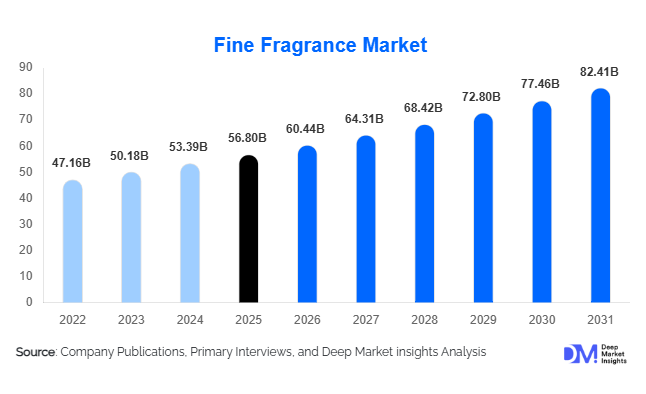
According to Deep Market Insights, the global fine fragrance market size was valued at USD 56.8 billion in 2025 and is projected to grow from USD 60.44 billion in 2026 to reach USD 82.41 billion by 2031, expanding at a CAGR of 6.4% during the forecast period (2026–2031). The fine fragrance market growth is primarily driven by rising global luxury consumption, increasing demand for premium personal grooming products, and expanding consumer preference for niche, artisanal, and long-lasting fragrances. The growing influence of social media platforms, celebrity-backed perfume launches, and digital-first fragrance brands is accelerating global product visibility and consumer engagement.
Consumers are increasingly treating fragrances as lifestyle and identity products rather than occasional grooming essentials. Premiumization across beauty and personal care categories has significantly boosted demand for Eau de Parfum, extrait de parfum, gender-neutral fragrances, and personalized scent collections. Younger consumers, particularly millennials and Gen Z, are fueling market growth through rising interest in fragrance layering, limited-edition launches, clean-label perfumes, and sustainable luxury products.
The rapid expansion of e-commerce and omnichannel luxury retail has further transformed the market landscape. AI-powered fragrance recommendation tools, subscription-based scent discovery services, and influencer-driven product marketing are improving accessibility for both established luxury brands and niche fragrance houses. Emerging economies across Asia-Pacific and the Middle East are becoming major growth engines due to increasing disposable incomes, urbanization, and rising luxury beauty consumption. In addition, sustainability trends such as refillable packaging, biodegradable ingredients, and ethically sourced raw materials are reshaping product development strategies globally.
Key Market Insights
- Luxury and niche fragrances are witnessing accelerated global demand, driven by premiumization and rising consumer preference for exclusive scent experiences.
- Asia-Pacific dominates the fine fragrance market, supported by expanding luxury beauty consumption in China, India, Japan, and South Korea.
- Middle Eastern demand for oud-based and ultra-premium fragrances continues to rise, making the region one of the fastest-growing luxury fragrance markets globally.
- E-commerce and AI-powered personalization platforms are reshaping fragrance discovery, allowing consumers to access tailored recommendations and virtual scent experiences.
- Consumers are increasingly preferring sustainable and refillable fragrances, encouraging investments in eco-friendly packaging and natural ingredient sourcing.
- Gender-neutral and clean-label fragrances are rapidly expanding, particularly among millennials and Gen Z consumers seeking authenticity and individuality.
Fine Fragrance Market Trends
Growing Demand for Niche and Artisanal Fragrances
The fine fragrance industry is witnessing strong demand for niche and artisanal perfume brands offering exclusivity, unique scent compositions, and limited-edition collections. Consumers are increasingly moving away from mass-market designer fragrances toward highly personalized fragrance experiences. Niche brands are emphasizing craftsmanship, rare ingredients, and storytelling-driven marketing strategies to attract affluent consumers seeking individuality and authenticity. Oud-based scents, gourmand fragrances, and high-concentration extrait perfumes are particularly gaining popularity among luxury buyers. Social media platforms and fragrance influencers are accelerating awareness around artisanal perfume houses, enabling smaller brands to rapidly build global customer bases. This trend is also encouraging major luxury beauty companies to launch premium sub-brands and boutique fragrance collections to compete within the fast-growing niche segment.
Sustainable and Refillable Fragrance Solutions Expanding
Sustainability has become a defining trend across the global fine fragrance market. Consumers are increasingly prioritizing eco-friendly packaging, cruelty-free formulations, biodegradable ingredients, and responsibly sourced raw materials. Luxury fragrance brands are introducing refillable perfume bottles, reusable packaging systems, and carbon-conscious manufacturing processes to align with evolving consumer preferences. Several global fragrance houses are investing in biotechnology and synthetic biology to create sustainable aroma compounds while reducing dependency on climate-sensitive natural ingredients. Retailers are also adopting refill stations and circular packaging initiatives to improve customer retention and reduce packaging waste. Sustainable fragrance positioning is increasingly becoming a premium differentiator within luxury beauty retail, particularly in Europe and North America where environmental regulations and consumer awareness remain high.
Fine Fragrance Market Drivers
Rising Global Luxury Consumption
The increasing global demand for luxury beauty and premium personal care products remains one of the strongest drivers of the fine fragrance market. Rising disposable incomes, urbanization, and expanding affluent populations across Asia-Pacific and the Middle East are significantly boosting luxury fragrance consumption. Fine fragrances are increasingly viewed as status symbols and lifestyle accessories rather than occasional grooming products. Consumers are demonstrating greater willingness to spend on premium scents offering long-lasting performance, exclusive ingredients, and sophisticated packaging. Luxury fashion houses are also aggressively expanding fragrance portfolios due to the category’s high operating margins and strong brand extension capabilities. This trend is particularly visible among younger affluent consumers seeking aspirational luxury experiences.
Digital Beauty Culture and Social Media Influence
Social media platforms such as TikTok, Instagram, and YouTube are significantly transforming fragrance discovery and purchasing behavior. Influencer reviews, celebrity endorsements, and fragrance trend discussions are accelerating consumer awareness regarding premium and niche perfumes. Viral product campaigns and online fragrance communities are driving strong digital engagement, especially among Gen Z and millennial consumers. Social commerce integration and AI-driven fragrance recommendation engines are improving online conversion rates and enhancing customer personalization. Digital-first fragrance brands are increasingly leveraging influencer partnerships and direct-to-consumer business models to rapidly scale global visibility and profitability. The growing importance of online fragrance reviews and experiential digital storytelling continues to reshape competitive dynamics within the market.
Fine Fragrance Market Restraints
Volatility in Natural Raw Material Prices
The fine fragrance market faces substantial challenges associated with fluctuating prices of natural raw materials such as rose oil, sandalwood, oud, jasmine, citrus extracts, and vanilla. Climatic disruptions, agricultural instability, geopolitical risks, and limited availability of premium botanical ingredients continue to create supply chain uncertainty. Luxury fragrance manufacturers heavily dependent on natural extracts face margin pressure due to rising procurement costs and unpredictable sourcing conditions. The increasing demand for sustainably sourced ingredients has also raised production expenses for premium perfume brands, especially those positioning themselves within clean-label and eco-friendly categories.
Stringent Regulatory Compliance Requirements
Fragrance manufacturers are increasingly required to comply with strict international safety regulations, allergen disclosure standards, sustainability mandates, and ingredient transparency requirements. Regulatory agencies across Europe and North America are imposing tighter restrictions on synthetic chemicals, animal testing, and environmentally harmful compounds. Compliance with evolving technical standards increases operational complexity, product reformulation costs, and time-to-market for new launches. Smaller fragrance companies often face greater challenges in adapting to complex international regulatory frameworks, limiting scalability and cross-border market expansion opportunities.
Fine Fragrance Market Opportunities
Expansion of Premium Fragrance Demand in Emerging Markets
Emerging economies such as China, India, Saudi Arabia, Indonesia, and the UAE present significant growth opportunities for fine fragrance manufacturers. Rising middle-class incomes, urbanization, and increasing luxury spending are fueling demand for premium beauty and grooming products across these regions. Consumers are increasingly adopting international luxury brands while also showing strong interest in culturally inspired fragrances featuring ingredients such as oud, saffron, sandalwood, and amber. International fragrance companies are expanding their retail footprint through luxury malls, airport duty-free channels, and digital commerce platforms to capitalize on rapidly growing regional demand. The premiumization of beauty consumption across Asia-Pacific and the Middle East is expected to remain a major long-term market opportunity.
AI-Based Personalization and Digital Fragrance Discovery
The integration of artificial intelligence and advanced digital technologies into fragrance retailing is creating new growth opportunities for the industry. AI-powered fragrance recommendation tools, scent profiling platforms, virtual consultation services, and personalized fragrance subscriptions are transforming consumer engagement. Online fragrance discovery platforms are reducing dependency on physical retail sampling while improving digital conversion rates. Direct-to-consumer fragrance brands are increasingly leveraging consumer data analytics to create customized scent experiences tailored to individual preferences. Virtual scent storytelling, interactive packaging technologies, and digital loyalty ecosystems are further strengthening brand engagement and customer retention within the premium fragrance market.
Report Scope
| Report Metric | Details |
|---|---|
| Market Size in 2025 | USD 56.8 Billion |
| Market Size in 2026 | USD 60.44 Billion |
| Market Size in 2031 | USD 82.41 Billion |
| CAGR | 6.4% (2026-2031) |
| Base Year for Estimation | 2025 |
| Historical Data | 2022-2024 |
| Forecast Period | 2026-2031 |
| Report Coverage | Revenue Forecast, Competitive Landscape, Supply Chain Disruption, Growth Factors, Environment & Regulatory Landscape and Trends |
| Geographies Covered | North America, Europe, APAC, Middle East and Africa, LATAM |
| Countries Covered | U.S., Canada, U.K., Germany, France, Spain, Italy, Russia, Nordic, Benelux, Rest of Europe, China, Korea, Japan, India, Australia, Singapore, Taiwan, South East Asia, Rest of Asia-Pacific, UAE, Turky, Saudi Arabia, South Africa, Egypt, Nigeria, Rest of MEA, Brazil, Mexico, Argentina, Chile, Colombia, Rest of LATAM |
Explore more data points, trends and opportunities Download Free Sample Report
Product Type Insights
Eau de Parfum (EDP) dominates the global fine fragrance market, accounting for the largest revenue share due to its higher fragrance oil concentration, long-lasting performance, and strong premium positioning. Consumers increasingly prefer EDP formulations because they offer enhanced scent longevity and greater perceived luxury value compared to lighter fragrance concentrations. Eau de Toilette (EDT) remains widely popular among mainstream consumers due to its affordability and versatility for everyday use. Parfum and extrait de parfum segments are rapidly gaining traction within ultra-luxury categories, supported by affluent consumers seeking exclusivity and artisanal craftsmanship. Perfume oils and alcohol-free fragrances are also expanding steadily, particularly across Middle Eastern markets where traditional scent preferences remain strong. In addition, refillable fragrances, hair perfumes, and layering fragrances are emerging as innovative premium segments driven by sustainability trends and consumer interest in customized scent experiences.
Ingredient Composition Insights
Hybrid fragrances combining natural and synthetic ingredients represent the largest segment within the market due to their balance between performance, scalability, and cost efficiency. Synthetic aroma molecules provide improved fragrance stability, enhanced longevity, and consistent scent replication, making them highly valuable for large-scale production. Natural fragrances based on botanical extracts and essential oils continue to attract premium consumers prioritizing sustainability and clean-label beauty products. Vegan and cruelty-free fragrances are rapidly gaining market share, particularly in Europe and North America where ethical beauty consumption trends remain strong. Biotechnology-driven fragrance ingredients are also emerging as a critical innovation area, allowing companies to reduce dependency on volatile agricultural raw materials while improving sustainability credentials.
Distribution Channel Insights
Offline retail channels continue to dominate the fine fragrance market due to the importance of physical scent testing and experiential luxury shopping. Department stores, specialty beauty retailers, duty-free outlets, and brand-owned boutiques remain key sales channels for premium fragrances. Luxury consumers often prefer in-store consultations and personalized fragrance discovery experiences before making high-value purchases. However, online retail is witnessing the fastest growth globally due to expanding e-commerce infrastructure, influencer-driven marketing, and AI-enabled recommendation technologies. Direct-to-consumer fragrance brands are leveraging subscription services, virtual consultations, and social commerce integration to improve digital customer engagement. Online marketplaces and beauty-focused e-commerce platforms are increasingly becoming important channels for niche fragrance brands seeking international expansion.
Consumer Group Insights
Women continue to represent the largest consumer group within the fine fragrance market, supported by higher fragrance penetration rates, gifting culture, and frequent product purchases. Luxury women’s fragrances remain heavily influenced by fashion houses, celebrity endorsements, and premium packaging innovations. However, the men’s fragrance segment is experiencing strong growth driven by increasing grooming awareness, rising disposable incomes, and digital beauty influence among younger male consumers. Unisex and gender-neutral fragrances are emerging as one of the fastest-growing segments globally, particularly among Gen Z consumers seeking individuality and non-traditional scent identities. Luxury collectors and niche fragrance enthusiasts are also contributing significantly to ultra-premium market growth through demand for artisanal, rare, and limited-edition fragrances.
Explore more data points, trends and opportunities Download Free Sample Report
Fine Fragrance Market Segmentations
By Product Type
- Eau de Parfum (EDP)
- Eau de Toilette (EDT)
- Parfum/Extrait de Parfum
- Eau de Cologne (EDC)
- Perfume Oils & Attars
- Body Mists & Fragrance Sprays
- Hair Perfumes
- Solid Perfumes
- Alcohol-Free Fine Fragrances
- Refillable Fine Fragrances
By Ingredient Composition
- Natural Fragrances
- Synthetic Fragrances
- Hybrid Fragrances
- Vegan & Cruelty-Free Fragrances
- Clean Label Fragrances
By Fragrance Family
- Floral
- Oriental/Amber
- Woody
- Fresh/Citrus
- Gourmand
- Fruity
- Aquatic/Marine
- Spicy
- Oud-Based Fragrances
By Consumer Group
- Women
- Men
- Unisex/Gender-Neutral
- Teen Consumers
- Luxury Gift Buyers
- Niche Fragrance Enthusiasts
By Distribution Channel
- Offline Retail
- Department Stores
- Specialty Beauty Stores
- Brand-Owned Boutiques
- Duty-Free & Travel Retail
- Online Retail
- Brand-Owned E-Commerce
- Online Marketplaces
- Beauty Subscription Platforms
Regional Insights
North America
North America accounted for approximately 24% of the global fine fragrance market revenue in 2025, led primarily by the United States. High consumer spending power, strong luxury retail infrastructure, and widespread adoption of premium beauty products continue to support regional market growth. The U.S. remains one of the largest markets for celebrity-backed fragrances, niche perfume brands, and digital-first fragrance retailing. Consumers increasingly prefer sustainable, refillable, and personalized fragrance offerings. Canada is also witnessing strong growth in clean-label and artisanal fragrance demand, particularly among younger urban consumers.
Europe
Europe represented nearly 29% of global market share in 2025 and remains a major fragrance manufacturing and export hub globally. France continues to dominate regional fragrance production due to its historical luxury perfume heritage and strong concentration of premium fragrance houses. Germany and the United Kingdom demonstrate high demand for prestige and sustainable fragrances, while Italy and Spain remain important artisanal fragrance manufacturing centers. European consumers are highly responsive to eco-friendly packaging, natural ingredients, and refillable luxury perfume systems, making sustainability a major regional purchasing driver.
Asia-Pacific
Asia-Pacific emerged as the largest regional market in 2025, accounting for nearly 36% of global revenue. China remains the primary growth engine due to expanding luxury beauty consumption, rising disposable incomes, and strong digital commerce penetration. India is among the fastest-growing fragrance markets globally, supported by urbanization, premium grooming trends, and increasing middle-class spending. Japan maintains stable demand for luxury and artisanal fragrances, while South Korea continues to benefit from social media-driven beauty culture and premium cosmetic innovation. Southeast Asian markets are also witnessing rising adoption of international luxury fragrance brands.
Latin America
Latin America represents a steadily growing fine fragrance market led by Brazil and Mexico. Brazil’s strong beauty and personal care culture supports high fragrance consumption rates across multiple income groups. Premium fragrance adoption is increasing among urban consumers seeking luxury lifestyle products and international designer brands. Mexico is witnessing rising demand for prestige fragrances through expanding retail distribution networks and e-commerce platforms. Regional growth is also supported by younger consumers increasingly influenced by digital beauty trends and social media marketing.
Middle East & Africa
The Middle East & Africa region is experiencing rapid growth within the global fine fragrance market, particularly in the UAE and Saudi Arabia. High per-capita fragrance spending, strong cultural affinity for oud-based perfumes, and luxury gifting traditions continue to support premium demand across the region. Dubai has emerged as a major luxury fragrance retail and re-export hub connecting Europe, Asia, and Africa. Saudi Arabia is expected to register one of the highest CAGR rates globally due to expanding luxury retail investments and rising youth spending on prestige beauty products. South Africa also represents an important regional market for international fragrance brands.