Digital Comic Book Market Size
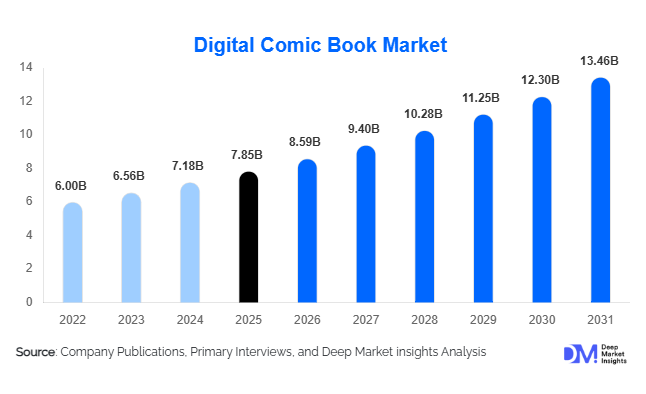
According to Deep Market Insights, the global digital comic book market size was valued at USD 7.85 billion in 2025 and is projected to grow from USD 8.59 billion in 2026 to reach USD 13.46 billion by 2031, expanding at a CAGR of 9.4% during the forecast period (2026–2031). The market growth is primarily driven by the rapid adoption of smartphones and tablets, increasing consumer preference for digital entertainment, rising popularity of webtoons and manga outside traditional markets, and the growing monetization of intellectual property (IP) through film, television, gaming, and merchandising adaptations. The emergence of subscription-based content platforms and microtransaction-driven comic ecosystems has further transformed how consumers discover, purchase, and engage with digital comics globally.
Key Market Insights
- Webtoons represent the fastest-growing content format, accounting for nearly 32% of global digital comic revenues in 2025.
- Asia-Pacific dominates the global market, contributing approximately 46% of worldwide revenues, led by South Korea, Japan, and China.
- Subscription-based monetization models are gaining market share as readers increasingly prefer unlimited-access content libraries.
- Manga remains the largest genre segment globally, supported by strong demand from Japan, North America, and Europe.
- Digital-first publishing is accelerating, enabling independent creators to reach global audiences without physical distribution constraints.
- AI-powered content localization and recommendation engines are improving reader engagement and platform monetization rates.
Digital Comic Book Market Trends
Global Expansion of Webtoon Ecosystems
Vertical-scroll webtoons have emerged as one of the most disruptive innovations in the digital comic book industry. Originally popularized in South Korea, webtoons have expanded rapidly across North America, Europe, Southeast Asia, and Latin America. Mobile-first consumption habits, shorter content formats, and easy accessibility have contributed to widespread adoption among younger readers. Publishers are increasingly investing in creator development programs, localized translations, and exclusive original content to attract and retain users. The success of webtoon-based adaptations in streaming, gaming, and animation has further enhanced monetization opportunities, making webtoons a strategic growth pillar across the digital comic ecosystem.
Cross-Media Intellectual Property Monetization
Digital comic publishers are increasingly transforming successful comic franchises into multi-platform intellectual properties. Popular digital comics are being adapted into television series, films, mobile games, anime productions, merchandise collections, and licensing agreements. This trend significantly increases revenue per title while reducing dependence on direct reader purchases. Major entertainment companies are actively acquiring comic intellectual property portfolios to strengthen content pipelines for streaming platforms and gaming studios. The growing convergence between comics, gaming, animation, and streaming entertainment is expected to remain a defining trend throughout the forecast period.
Digital Comic Book Market Drivers
Rapid Growth in Mobile Entertainment Consumption
Smartphones have become the primary reading device for digital comics globally. Increasing mobile internet penetration, affordable smartphones, and widespread 5G deployment have significantly expanded the addressable audience for comic publishers. Mobile-first reading formats, particularly webtoons and episodic comics, have enabled publishers to engage younger demographics that rarely consume physical comic books. This shift toward mobile entertainment continues to drive subscription revenues and microtransaction spending across digital comic platforms.
Rising Popularity of Manga and Asian Content Worldwide
Japanese manga, Korean webtoons, and Chinese manhua are experiencing unprecedented global demand. Streaming adaptations have introduced new audiences to comic-based content, creating a powerful feedback loop between comics and visual entertainment. International publishers are investing heavily in localized translations, digital distribution agreements, and exclusive content licensing. The globalization of Asian comic formats is accelerating market expansion across North America and Europe, particularly among readers aged 18–34 years.
Advancements in Digital Publishing Technologies
Cloud publishing, AI-driven recommendation engines, machine-learning-based translation systems, and automated content management tools are improving operational efficiency throughout the value chain. These technologies enable publishers to scale content distribution globally while reducing localization costs and improving reader personalization. Enhanced user engagement, improved content discoverability, and increased reader retention have positively impacted platform revenues over recent years.
Digital Comic Book Market Restraints
Digital Piracy and Unauthorized Distribution
Piracy remains one of the most significant challenges facing digital comic publishers. Unauthorized scanlations, content sharing websites, and illegal distribution platforms continue to impact revenues globally. Although publishers are investing in anti-piracy technologies and legal enforcement mechanisms, piracy remains particularly prevalent in emerging markets where consumers may be unwilling or unable to pay for premium content.
Intense Content Competition Across Digital Media
Digital comics compete directly with streaming video, gaming, social media, podcasts, and short-form content platforms for consumer attention. Younger audiences have increasingly fragmented entertainment consumption habits, requiring publishers to continuously invest in exclusive content, platform innovation, and user engagement features. The competitive nature of digital entertainment can slow subscriber growth and increase customer acquisition costs.
Digital Comic Book Market Opportunities
AI-Powered Content Localization and Translation
The expansion of digital comics into international markets presents significant opportunities for AI-driven translation and localization technologies. Publishers can leverage artificial intelligence to reduce translation costs, accelerate release schedules, and improve accessibility across multiple languages. Faster localization enables creators to monetize content globally while improving user experiences for non-native audiences. Companies investing in AI-supported publishing infrastructure are expected to achieve significant competitive advantages over the forecast period.
Growth of Independent Creator Economies
Digital platforms have dramatically lowered barriers to entry for comic creators. Independent artists can now self-publish content globally through creator-focused marketplaces and subscription platforms. Growing creator ecosystems are expanding content diversity while attracting niche audience segments. Platform operators can benefit through revenue-sharing arrangements, advertising income, and creator monetization tools, creating sustainable long-term growth opportunities.
Expansion into Educational and Corporate Applications
Digital comics are increasingly being adopted for educational content delivery, employee training, and corporate communication. Interactive storytelling formats improve engagement and information retention compared to traditional text-based materials. Educational institutions and corporate training providers are exploring comics as tools for digital learning, creating new demand channels beyond traditional entertainment applications.
Report Scope
| Report Metric | Details |
|---|---|
| Market Size in 2025 | USD 7.85 Billion |
| Market Size in 2026 | USD 8.59 Billion |
| Market Size in 2031 | USD 13.46 Billion |
| CAGR | 9.4% (2026-2031) |
| Base Year for Estimation | 2025 |
| Historical Data | 2022-2024 |
| Forecast Period | 2026-2031 |
| Report Coverage | Revenue Forecast, Competitive Landscape, Supply Chain Disruption, Growth Factors, Environment & Regulatory Landscape and Trends |
| Geographies Covered | North America, Europe, APAC, Middle East and Africa, LATAM |
| Countries Covered | U.S., Canada, U.K., Germany, France, Spain, Italy, Russia, Nordic, Benelux, Rest of Europe, China, Korea, Japan, India, Australia, Singapore, Taiwan, South East Asia, Rest of Asia-Pacific, UAE, Turky, Saudi Arabia, South Africa, Egypt, Nigeria, Rest of MEA, Brazil, Mexico, Argentina, Chile, Colombia, Rest of LATAM |
Explore more data points, trends and opportunities Download Free Sample Report
Content Format Insights
Webtoons emerged as the leading content format, accounting for approximately 32% of the global digital comic book market in 2025. The segment's dominance is primarily driven by the widespread adoption of smartphones and changing consumer content consumption patterns. Unlike traditional comic layouts, webtoons are specifically designed for vertical scrolling, making them highly compatible with mobile devices and significantly improving user engagement. The format has gained substantial traction among Gen Z and millennial readers, who increasingly prefer short-form, episodic content that can be consumed on-the-go.
The growth of webtoons has also been supported by highly effective monetization mechanisms such as microtransactions, premium chapter unlocks, advertising integrations, and subscription memberships. In addition, major webtoon platforms have successfully transformed popular titles into television series, films, anime adaptations, and gaming content, creating a robust intellectual property monetization ecosystem that further enhances platform revenues. South Korea, Japan, China, and increasingly North America have become major markets for webtoon consumption, reinforcing the format's global leadership position.
Traditional digital comic issues accounted for approximately 24% of market revenues in 2025, supported by established publishers digitizing extensive print comic libraries. Digital graphic novels represented nearly 18% of revenues, benefiting from premium pricing, longer reading durations, and strong demand among mature readers seeking immersive storytelling experiences. Meanwhile, motion comics, interactive comics, and multimedia-enhanced comic formats remain relatively niche but are witnessing increasing adoption as publishers experiment with animation, audio integration, gamification, and augmented reality technologies to enhance reader engagement.
Revenue Model Insights
Subscription-based platforms dominated the revenue model segment, contributing approximately 38% of global market revenues in 2025. The leadership of this segment reflects broader shifts in digital media consumption, where consumers increasingly prefer unlimited content access through recurring monthly subscriptions. The success of streaming platforms across video, music, and gaming industries has conditioned consumers toward subscription-based content ecosystems, a trend now strongly influencing digital comic consumption.
The subscription model provides predictable recurring revenue streams for publishers while encouraging greater user retention and content discovery. Readers gain access to extensive libraries containing thousands of comic titles across multiple genres, significantly improving value perception compared to individual content purchases. The segment has further benefited from the growing popularity of bundled entertainment subscriptions that combine comics with streaming services, gaming benefits, or exclusive content access.
Pay-per-chapter monetization represented approximately 27% of market revenues in 2025 and remains particularly important within webtoon ecosystems where readers are willing to purchase early access to premium content. Advertisement-supported models accounted for around 15% of revenues and continue attracting price-sensitive consumers in emerging markets. Freemium models are also gaining momentum as publishers balance audience acquisition with premium monetization strategies, allowing users to access basic content for free while charging for advanced features, exclusive releases, and early-access chapters.
Genre Insights
Manga remained the largest genre segment, accounting for approximately 34% of global digital comic book revenues in 2025. The segment's leadership is driven by its massive international fanbase, strong publishing infrastructure, and increasing cross-media adaptation opportunities. The global popularity of anime streaming has significantly expanded manga readership, creating a mutually reinforcing ecosystem that continuously attracts new consumers into the market.
Japan remains the largest manga-producing and consuming market globally; however, demand growth has accelerated substantially across North America, Europe, Southeast Asia, and Latin America. Digital distribution has eliminated historical barriers associated with physical imports and localization, enabling publishers to rapidly scale international readership. Manga's broad genre diversity, spanning action, romance, fantasy, science fiction, horror, slice-of-life, and educational content, further strengthens its appeal across multiple demographic groups.
Superhero comics accounted for nearly 22% of market revenues, benefiting from the continued success of major cinematic universes and franchise-based storytelling ecosystems. Romance and fantasy genres collectively represented approximately 20% of demand and continue to benefit from the rapid growth of webtoon platforms, where these genres consistently rank among the highest-performing content categories. Educational comics, historical narratives, and science fiction titles are also witnessing increasing adoption as publishers diversify content portfolios to address emerging reader preferences.
Platform Insights
Smartphones represented the leading consumption platform, accounting for approximately 58% of global digital comic readership in 2025. The dominance of smartphones reflects the industry's transition toward mobile-first publishing strategies. Improvements in smartphone display quality, affordable mobile internet access, and widespread 4G and 5G network deployment have transformed mobile devices into the preferred reading platform for digital comic consumers worldwide.
Mobile accessibility has been particularly important in emerging markets where smartphones often serve as the primary internet access device. The rapid growth of webtoon content, which is optimized specifically for vertical smartphone viewing, has further strengthened mobile platform leadership. Publishers increasingly prioritize mobile user experiences through adaptive interfaces, personalized recommendations, offline reading capabilities, and integrated social engagement features.
Tablets accounted for approximately 18% of readership due to their larger displays and superior visual presentation, making them particularly attractive for graphic novels and high-resolution comic content. PCs and laptops represented around 16% of readership, primarily among professional readers and long-form content consumers. Although Smart TVs and dedicated e-readers currently account for a relatively small market share, technological improvements and enhanced content optimization are expected to support gradual adoption across these platforms over the forecast period.
End-User Insights
Individual consumers remained the dominant end-user segment, accounting for nearly 86% of total market demand in 2025. Entertainment-driven consumption continues to be the primary growth engine for the digital comic book industry. Growing consumer preference for on-demand digital entertainment, increasing smartphone penetration, and the availability of affordable subscription services have significantly expanded the global reader base.
The segment's dominance is further supported by rising engagement among younger demographics who increasingly view digital comics as an alternative to traditional books, television content, and social media entertainment. Furthermore, publishers have expanded content personalization capabilities, enabling readers to discover highly targeted content aligned with their interests.
While individual consumers remain the largest demand center, educational institutions represent one of the fastest-growing end-user segments. Schools and universities are increasingly utilizing digital comics as interactive learning tools to improve student engagement and knowledge retention. Libraries are expanding digital content licensing programs to provide remote access to comic collections, while entertainment studios actively acquire comic intellectual properties for film, television, animation, and gaming adaptations. Corporate training organizations are also beginning to adopt comic-based learning materials for employee education and internal communications, creating entirely new commercial opportunities for content providers.
Explore more data points, trends and opportunities Download Free Sample Report
Digital Comic Book Market Segmentations
By Content Format
- Webtoons
- Traditional Digital Comic Issues
- Digital Graphic Novels
- Motion Comics
- Interactive Comics
- Episodic Serialized Comics
- AI-Assisted Dynamic Comics
By Revenue Model
- Subscription-Based Access
- Pay-Per-Chapter / Microtransaction Model
- Advertisement-Supported Model
- Freemium Model
- Bundled Platform Membership Model
By Genre
- Manga
- Superhero
- Romance
- Fantasy
- Action & Adventure
- Science Fiction
- Horror & Thriller
- Comedy
- Slice of Life
- Educational & Informational
- Historical & Cultural
- LGBTQ+ Content
- Others
By Platform
- Smartphones
- Tablets
- PCs/Laptops
- Smart TVs & Connected Devices
- E-Readers
By End User
- Individual Consumers
- Educational Institutions
- Libraries
- Entertainment Studios
- Corporate Learning & Training Organizations
Regional Insights
Asia-Pacific
Asia-Pacific dominated the global digital comic book market with approximately 46% market share in 2025. The region's leadership is driven by the presence of the world's largest comic ecosystems, including Japan's manga industry, South Korea's webtoon market, and China's rapidly expanding digital publishing sector. Japan continues to generate the highest digital manga revenues globally, supported by a deeply established comic-reading culture and strong publisher infrastructure.
South Korea remains the global innovation hub for webtoon platforms, pioneering monetization models that have subsequently been replicated worldwide. China's market growth is being driven by increasing mobile entertainment consumption, expanding digital payment adoption, and strong government support for domestic digital content industries. India represents one of the fastest-growing opportunities globally due to its large young population, affordable mobile data costs, increasing smartphone penetration, and growing popularity of manga, anime, and digital storytelling platforms. The region additionally benefits from advanced digital payment ecosystems and high consumer willingness to engage with serialized content.
North America
North America accounted for approximately 27% of global market revenues in 2025. The United States remains the largest regional market due to its strong comic book heritage, well-established intellectual property franchises, and significant consumer spending on digital entertainment. The rapid growth of manga readership, webtoon adoption, and subscription-based content platforms has transformed the region into one of the most attractive markets for international publishers.
Regional growth is supported by high disposable incomes, widespread broadband and mobile connectivity, strong adoption of digital subscription services, and the growing integration of comics into broader entertainment ecosystems. Major streaming adaptations of comic-based intellectual properties continue to drive readership growth by introducing new audiences to source material. Canada contributes through strong digital media consumption trends, expanding creator communities, and increasing investments in digital publishing technologies.
Europe
Europe represented approximately 18% of global revenues in 2025, with France, Germany, the United Kingdom, Italy, and Spain serving as the primary revenue-generating markets. France remains one of the world's largest comic-consuming nations outside Asia due to its long-standing graphic novel and bande dessinée culture.
Growth across Europe is being driven by increasing digital content consumption, growing demand for translated manga and webtoons, and expanding multilingual content libraries. High internet penetration rates, strong digital literacy, and rising adoption of subscription-based entertainment services continue to support market expansion. Additionally, the region's growing creator economy and increasing investments in digital publishing platforms are accelerating local content production and distribution.
Latin America
Latin America accounted for approximately 5% of global market revenues in 2025, with Brazil and Mexico emerging as the region's largest digital comic markets. Demand is being driven by rising smartphone ownership, improving internet connectivity, and expanding access to localized digital content.
The growing popularity of anime and manga among younger demographics has created substantial opportunities for digital comic publishers. Social media platforms and creator communities are also contributing to readership expansion by increasing content discoverability. Improvements in digital payment infrastructure and the availability of affordable subscription models are expected to further accelerate market growth throughout the forecast period.
Middle East & Africa
The Middle East & Africa represented approximately 4% of global market revenues in 2025, with the UAE, Saudi Arabia, South Africa, and Egypt emerging as key growth markets. Although currently smaller than other regions, the market is experiencing robust growth due to increasing smartphone penetration, expanding digital media consumption, and a rapidly growing youth population.
Government-led digital transformation initiatives, particularly in Gulf Cooperation Council countries, are supporting broader adoption of digital entertainment services. Rising investments in local content creation, growing acceptance of subscription-based media platforms, and improving broadband infrastructure are creating favorable market conditions. Furthermore, the increasing popularity of manga, anime, and mobile-first entertainment among younger consumers is expected to drive sustained regional expansion through 2031.
Key Players in the Digital Comic Book Market
- WEBTOON Entertainment
- Kakao Entertainment
- Shueisha Inc.
- Kodansha Ltd.
- Marvel Entertainment
- DC Entertainment
- ComiXology
- BOOK WALKER
- Lezhin Entertainment
- Tapas Media
- Toomics Global
- Naver Webtoon
- Piccoma
- Tencent Animation & Comics
- Manga Plus