Condoms Market Size
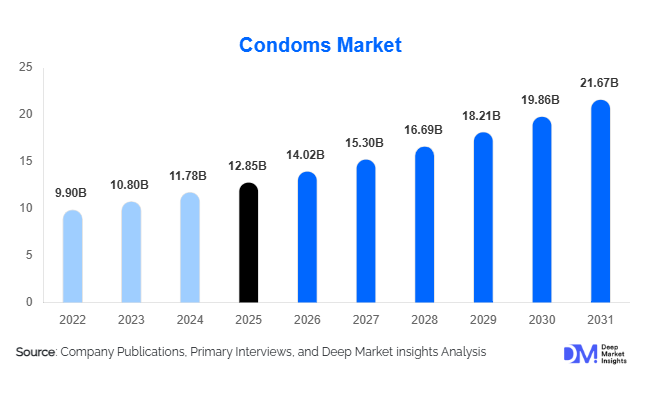
According to Deep Market Insights, the global condoms market size was valued at USD 12.85 billion in 2025 and is projected to grow from USD 14.02 billion in 2026 to reach USD 21.67 billion by 2031, expanding at a CAGR of 9.1% during the forecast period (2026–2031). The market growth is primarily driven by increasing awareness regarding sexually transmitted infections (STIs), expanding government-supported family planning initiatives, rising demand for sexual wellness products, and the growing penetration of e-commerce distribution channels. Condoms remain one of the most effective and accessible contraceptive solutions globally, offering dual protection against unintended pregnancies and sexually transmitted diseases. Continuous innovation in ultra-thin materials, premium formulations, non-latex alternatives, and sustainable product development is further supporting market expansion. Moreover, the increasing acceptance of sexual wellness products among younger consumers and the expansion of public health programs in emerging economies are creating strong growth opportunities across both developed and developing markets.
Key Market Insights
- Male condoms account for over 95% of global market revenue, supported by widespread consumer adoption and extensive public health procurement programs.
- Asia-Pacific dominates the global condoms market, accounting for approximately 52% of total revenue, driven by large populations and strong family planning initiatives.
- Non-latex condoms are among the fastest-growing product categories, supported by increasing consumer demand for allergy-free and premium alternatives.
- Online retail channels are witnessing double-digit growth rates, driven by privacy, convenience, subscription-based purchasing, and direct-to-consumer sales models.
- Public health agencies remain major volume purchasers, particularly across Africa, Asia, and Latin America, where HIV prevention and reproductive health programs continue to expand.
- Premiumization is reshaping consumer purchasing behavior, with increasing demand for ultra-thin, textured, flavored, and specialty condoms globally.
Condoms Market Trends
Premiumization Driving Product Innovation
The condoms market is increasingly shifting from a volume-driven industry toward a value-driven marketplace. Consumers are showing growing preference for premium products offering enhanced comfort, ultra-thin construction, improved lubrication, natural ingredients, and innovative textures. Manufacturers are introducing specialized variants including graphene-inspired materials, skin-like sensation technologies, and organic lubricant formulations to differentiate themselves in an increasingly competitive environment. Premium product categories are generating significantly higher margins than traditional products, encouraging manufacturers to expand their premium portfolios. The trend is particularly visible in North America, Europe, Japan, South Korea, and urban markets across Asia-Pacific, where consumers are willing to pay more for quality and enhanced user experience.
Rapid Expansion of E-Commerce and Direct-to-Consumer Channels
Digital commerce continues to transform condom purchasing patterns globally. Consumers increasingly prefer online channels due to privacy concerns, wider product availability, and competitive pricing. Direct-to-consumer subscription services are gaining popularity, particularly among younger demographics seeking convenience and discretion. Leading manufacturers are investing heavily in digital marketing, influencer partnerships, and online brand-building initiatives. Artificial intelligence-driven product recommendations, personalized subscription models, and digital sexual wellness platforms are further enhancing consumer engagement. This trend is expected to accelerate market penetration in traditionally underserved regions while supporting premium product adoption worldwide.
Condoms Market Drivers
Increasing Awareness of Sexual Health and STI Prevention
Growing awareness of sexually transmitted infections remains one of the most important drivers of market growth. Governments, healthcare organizations, and educational institutions continue to promote safe sex practices through awareness campaigns, school-based programs, and public health initiatives. The ongoing need to reduce HIV transmission rates in developing economies has strengthened public-sector procurement programs, particularly in Sub-Saharan Africa and Southeast Asia. As sexual health education expands globally, condom usage rates continue to increase across multiple demographic groups.
Expansion of Family Planning Programs
Government-sponsored family planning initiatives continue to drive demand worldwide. National healthcare agencies and international organizations are investing heavily in reproductive health programs to reduce unintended pregnancies and improve maternal health outcomes. Public procurement contracts provide manufacturers with stable, high-volume demand while expanding access to affordable contraceptive products. Countries including India, Indonesia, Nigeria, Kenya, and Ethiopia have significantly increased investments in reproductive healthcare, creating long-term growth opportunities for market participants.
Condoms Market Restraints
Cultural and Social Stigma in Emerging Markets
Despite increasing awareness, social stigma and cultural barriers continue to limit condom adoption in several regions. Conservative societal norms, religious considerations, and limited sexual health education reduce market penetration in parts of the Middle East, Africa, and South Asia. Such barriers affect both consumer purchasing behavior and retail distribution, particularly in rural areas where access to sexual health products remains limited.
Competition from Alternative Contraceptive Methods
The availability of alternative contraceptive methods such as oral contraceptive pills, intrauterine devices (IUDs), hormonal implants, and injectable contraceptives presents a challenge to market growth. Although condoms remain unique in providing protection against both pregnancy and STIs, long-term contraceptive solutions are increasingly preferred by certain consumer groups seeking convenience and higher efficacy rates for pregnancy prevention.
Condoms Market Opportunities
Growth of Non-Latex and Sustainable Products
The increasing prevalence of latex allergies and growing environmental awareness are creating substantial opportunities for non-latex and eco-friendly condom manufacturers. Polyisoprene, polyurethane, and biodegradable alternatives are attracting consumers seeking enhanced comfort and sustainability. Companies investing in sustainable materials, recyclable packaging, and environmentally responsible production processes are expected to gain competitive advantages in premium market segments.
Expansion Through Public Health Partnerships
Emerging economies continue to represent significant growth opportunities due to increasing investments in reproductive healthcare and HIV prevention programs. Partnerships with governments, NGOs, and international organizations provide manufacturers access to long-term procurement contracts and high-volume distribution networks. Countries across Africa and Asia are expected to remain key growth markets as healthcare infrastructure and public health funding continue to expand.
Report Scope
| Report Metric | Details |
|---|---|
| Market Size in 2025 | USD 12.85 Billion |
| Market Size in 2026 | USD 14.02 Billion |
| Market Size in 2031 | USD 21.67 Billion |
| CAGR | 9.1% (2026-2031) |
| Base Year for Estimation | 2025 |
| Historical Data | 2022-2024 |
| Forecast Period | 2026-2031 |
| Report Coverage | Revenue Forecast, Competitive Landscape, Supply Chain Disruption, Growth Factors, Environment & Regulatory Landscape and Trends |
| Geographies Covered | North America, Europe, APAC, Middle East and Africa, LATAM |
| Countries Covered | U.S., Canada, U.K., Germany, France, Spain, Italy, Russia, Nordic, Benelux, Rest of Europe, China, Korea, Japan, India, Australia, Singapore, Taiwan, South East Asia, Rest of Asia-Pacific, UAE, Turky, Saudi Arabia, South Africa, Egypt, Nigeria, Rest of MEA, Brazil, Mexico, Argentina, Chile, Colombia, Rest of LATAM |
Explore more data points, trends and opportunities Download Free Sample Report
Product Type Insights
Male condoms dominate the global market, accounting for approximately 95.8% of total revenue in 2025. Their leadership position is supported by widespread consumer familiarity, affordability, extensive retail availability, and large-scale institutional procurement. Within the male condom segment, ultra-thin, textured, flavored, and climax-control products are experiencing the strongest growth as consumers increasingly seek enhanced experiences and premium offerings. Female condoms represent a smaller but rapidly growing niche segment, supported by rising awareness of women-controlled contraceptive options and increasing support from public health organizations. The female condom market is expected to expand at a faster pace than the overall market, particularly in regions where women’s reproductive health initiatives are gaining momentum.
Material Insights
Latex condoms continue to dominate the market, representing approximately 82% of global revenue due to their superior elasticity, cost-effectiveness, and well-established manufacturing infrastructure. However, non-latex alternatives such as polyisoprene, polyurethane, and nitrile condoms are experiencing strong growth driven by increasing awareness of latex allergies and consumer demand for premium products. Polyisoprene condoms, in particular, are gaining popularity due to their natural feel and enhanced comfort characteristics. Sustainable material innovation is expected to play a crucial role in future market development as manufacturers seek to balance performance, affordability, and environmental responsibility.
Distribution Channel Insights
Pharmacies and drug stores remain the leading distribution channel, accounting for approximately 44.8% of global market revenue in 2025. Consumers continue to trust pharmacy channels for product authenticity, accessibility, and professional guidance. However, online retail is emerging as the fastest-growing channel globally. E-commerce platforms offer greater product variety, privacy, and convenience while enabling manufacturers to establish direct relationships with consumers. Supermarkets, hypermarkets, convenience stores, and specialty sexual wellness retailers continue to play important roles in expanding product accessibility across urban and semi-urban markets.
End-User Insights
Men remain the primary end-user segment, accounting for nearly 89% of global demand due to the overwhelming dominance of male condom products. Public health agencies and NGOs also represent significant end-user groups through large-scale procurement programs focused on HIV prevention, reproductive health, and family planning initiatives. Female consumers represent a growing opportunity as awareness of female condoms and women-controlled contraceptive solutions increases globally. The expansion of sexual wellness products targeted toward women is expected to support future market diversification.
Application Insights
Dual protection applications account for approximately 63% of total market demand, reflecting the unique ability of condoms to provide simultaneous protection against unintended pregnancies and sexually transmitted infections. Contraception remains a major application area globally, particularly in developed markets where family planning remains a key purchasing consideration. STI prevention continues to be a critical growth driver across developing economies, supported by government awareness campaigns and public health interventions. The growing emphasis on comprehensive sexual health is expected to strengthen demand across all application segments during the forecast period.
Explore more data points, trends and opportunities Download Free Sample Report
Condoms Market Segmentations
By Product Type
- Male Condoms
- Female Condoms
By Material
- Latex Condoms
- Polyurethane Condoms
- Polyisoprene Condoms
- Nitrile Condoms
- Lambskin/Natural Membrane Condoms
By Distribution Channel
- Pharmacies & Drug Stores
- Supermarkets & Hypermarkets
- Convenience Stores
- Online Retail/E-Commerce
- Specialty Sexual Wellness Stores
- Institutional Procurement Channels
By Application
- Contraception/Pregnancy Prevention
- STI/HIV Prevention
- Dual Protection
By End User
- Men
- Women
- Public Health Programs
- NGOs & International Aid Organizations
Regional Insights
Asia-Pacific
Asia-Pacific leads the global condoms market with approximately 52% market share in 2025. China and India collectively account for a significant portion of regional demand due to large populations, expanding healthcare infrastructure, and extensive family planning initiatives. Japan and South Korea continue to drive premium product adoption, while Southeast Asian countries such as Indonesia, Thailand, and Vietnam are experiencing robust growth supported by increasing urbanization and healthcare awareness.
North America
North America accounts for approximately 22% of global market revenue. The United States dominates regional demand through high consumer spending, premium product adoption, and strong sexual wellness awareness. Canada continues to exhibit steady growth driven by healthcare education and increasing demand for specialty and sustainable condom products.
Europe
Europe remains a mature and highly profitable market, led by Germany, the United Kingdom, France, Italy, and Spain. Strong healthcare systems, widespread sexual health education, and high consumer acceptance of premium products support market growth. Sustainability-focused purchasing behavior is encouraging innovation in eco-friendly and biodegradable product categories.
Latin America
Brazil and Mexico dominate regional demand, supported by large populations and increasing government investment in reproductive healthcare. Rising urbanization and expanding retail distribution networks continue to improve product accessibility throughout the region.
Middle East & Africa
The Middle East and Africa currently account for a relatively small share of global revenue but represent the fastest-growing regional market. Countries including South Africa, Nigeria, Kenya, Egypt, and Ethiopia are witnessing increasing demand due to HIV prevention programs, expanding healthcare access, and growing family planning initiatives. The region is expected to record the highest CAGR through 2031.
Key Players in the Condoms Market
- Reckitt (Durex)
- Karex Berhad
- Church & Dwight (Trojan)
- LifeStyles Healthcare
- Okamoto Industries
- Sagami Holdings
- Cupid Limited
- HLL Lifecare
- Mayer Laboratories
- Veru Inc.
- Thai Nippon Rubber Industry
- Fuji Latex
- Graphic Armor LLC
- RRT Medcon
- Mankind Pharma