IQF Food Market Size
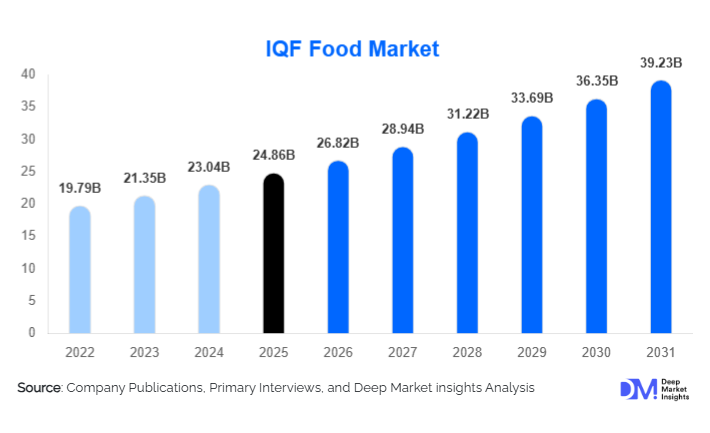
According to Deep Market Insights, the global IQF food market size was valued at USD 24.86 billion in 2025 and is projected to grow from USD 26.82 billion in 2026 to reach USD 39.23 billion by 2031, expanding at a CAGR of 7.9% during the forecast period (2026–2031). The IQF food market growth is primarily driven by rising demand for convenient frozen food products, expansion of cold-chain infrastructure, increasing adoption of advanced freezing technologies, and growing consumption of ready-to-cook and ready-to-eat food products across retail, foodservice, and food processing sectors.
Key Market Insights
- Vegetables represent the largest product segment, accounting for a significant share of global IQF food consumption due to year-round availability and extended shelf life.
- Foodservice remains the leading application segment, supported by strong procurement from restaurants, hotels, institutional catering providers, and quick-service restaurant chains.
- Asia-Pacific dominates the global market, driven by large-scale agricultural production, expanding frozen food exports, and growing urban consumption.
- Middle East & Africa is the fastest-growing regional market, supported by investments in refrigerated logistics and increasing frozen food imports.
- Automation and advanced freezing technologies, including spiral freezers, cryogenic systems, and fluidized-bed freezing equipment, are improving processing efficiency and product quality.
- Growing demand for premium frozen fruits, vegetables, and seafood is creating new opportunities for manufacturers focused on export-oriented and value-added products.
IQF Food Market Latest Trends
Rapid Adoption of Advanced Freezing Technologies
Food manufacturers are increasingly investing in high-capacity individual quick freezing systems to improve productivity, maintain product integrity, and reduce processing losses. Advanced technologies such as fluidized-bed freezers, cryogenic nitrogen freezing systems, and automated spiral freezers are becoming standard across large-scale facilities. These technologies enable rapid freezing at extremely low temperatures while preserving texture, flavor, color, and nutritional content. As food processors seek higher operational efficiency and lower wastage rates, investments in automated IQF systems continue to accelerate across developed and emerging markets.
Growing Demand for Premium Frozen Convenience Foods
Consumer lifestyles are increasingly favoring convenient meal solutions that offer longer shelf life without compromising quality. Demand for frozen fruits, vegetables, seafood, ready-to-cook meals, and healthy snack products continues to rise across supermarkets, hypermarkets, and online retail channels. The expansion of e-commerce grocery platforms and increasing freezer ownership among households are further supporting market expansion. Premium frozen products featuring organic ingredients, clean-label formulations, and minimally processed characteristics are also gaining popularity among health-conscious consumers.
IQF Food Market Drivers
Expansion of Cold-Chain Infrastructure and Frozen Food Consumption
The continuous expansion of global cold-chain networks is a major factor supporting market growth. Investments in refrigerated warehouses, cold transportation fleets, and temperature-controlled logistics systems are improving the availability and distribution of frozen food products. Growing urbanization, changing dietary preferences, and increasing demand for convenient meal options are driving higher consumption of frozen fruits, vegetables, seafood, and processed food products. The ability of IQF technology to preserve food quality while reducing waste further strengthens adoption across retail and foodservice channels.
Increasing Demand from Foodservice and Food Processing Industries
Restaurants, hotels, catering providers, and food manufacturers increasingly rely on IQF ingredients because of their consistency, extended shelf life, and operational efficiency. IQF products reduce preparation time, minimize waste, and ensure year-round availability of seasonal ingredients. The rapid expansion of quick-service restaurants, cloud kitchens, and industrial food production facilities continues to generate substantial demand for high-quality frozen ingredients globally.
IQF Food Market Restraints
High Processing and Energy Costs
The establishment and operation of IQF processing facilities require substantial capital investment in freezing equipment, refrigeration systems, and cold-storage infrastructure. Energy consumption remains a significant operational expense, particularly in regions experiencing high electricity costs. Smaller manufacturers often face challenges in adopting advanced freezing technologies due to financial constraints, limiting market penetration in certain developing economies.
Complex Cold-Chain Management Requirements
Maintaining uninterrupted temperature control throughout transportation, storage, and distribution remains critical for preserving product quality. Any temperature fluctuation can affect food safety, texture, and shelf life, leading to product losses and increased operational costs. Inadequate cold-chain infrastructure in some emerging regions continues to create logistical challenges for manufacturers and distributors.
IQF Food Industry Key Opportunities
Growth of Organic and Premium Frozen Food Categories
Consumers are increasingly seeking frozen products made from organic, non-GMO, and sustainably sourced ingredients. This trend is creating opportunities for manufacturers to expand their premium product portfolios and target health-conscious consumers. Rising demand for frozen berries, tropical fruits, specialty vegetables, and premium seafood products is encouraging investments in value-added processing capabilities.
Expansion of Export-Oriented Frozen Food Manufacturing
Growing international demand for frozen fruits, vegetables, seafood, and prepared food products presents significant opportunities for producers in agricultural export markets. Countries across Asia-Pacific and Latin America are increasing processing capacities to meet export requirements. The development of advanced cold-chain infrastructure and compliance with international food safety standards are further supporting export growth.
Report Scope
| Report Metric | Details |
|---|---|
| Market Size in 2025 | USD 24.86 Billion |
| Market Size in 2026 | USD 26.82 Billion |
| Market Size in 2031 | USD 39.23 Billion |
| CAGR | 7.9% (2026-2031) |
| Base Year for Estimation | 2025 |
| Historical Data | 2022-2024 |
| Forecast Period | 2026-2031 |
| Report Coverage | Revenue Forecast, Competitive Landscape, Supply Chain Disruption, Growth Factors, Environment & Regulatory Landscape and Trends |
| Geographies Covered | North America, Europe, APAC, Middle East and Africa, LATAM |
| Countries Covered | U.S., Canada, U.K., Germany, France, Spain, Italy, Russia, Nordic, Benelux, Rest of Europe, China, Korea, Japan, India, Australia, Singapore, Taiwan, South East Asia, Rest of Asia-Pacific, UAE, Turky, Saudi Arabia, South Africa, Egypt, Nigeria, Rest of MEA, Brazil, Mexico, Argentina, Chile, Colombia, Rest of LATAM |
Explore more data points, trends and opportunities Download Free Sample Report
Product Type Insights
Vegetables dominate the IQF food market, accounting for the largest share of global revenue due to strong demand from retail consumers, foodservice operators, and food manufacturers. Frozen peas, corn, carrots, broccoli, spinach, and mixed vegetables remain widely consumed because they provide convenience, nutritional retention, and year-round availability. Fruits represent another major segment, supported by increasing consumption of berries, mangoes, pineapples, peaches, and tropical fruit blends used in smoothies, desserts, and bakery products. Seafood continues to gain traction due to growing demand for frozen shrimp, fish fillets, squid, and shellfish that offer extended shelf life and reduced spoilage. Other IQF products, including meat, poultry, herbs, bakery ingredients, and dairy components, are witnessing growing adoption across commercial food processing applications.
Application Insights
Foodservice remains the leading application segment, supported by extensive usage in restaurants, hotels, catering operations, institutional kitchens, and quick-service restaurant chains. IQF products enable foodservice operators to maintain consistent quality, reduce labor requirements, and minimize ingredient waste. Retail applications continue to expand through supermarkets, hypermarkets, convenience stores, and online grocery platforms offering a broad range of frozen food products. Food processing represents another important application area, where IQF ingredients are extensively utilized in ready meals, soups, sauces, bakery products, dairy products, snacks, and processed food formulations. The growing demand for convenience foods and efficient manufacturing processes continues to strengthen adoption across all application categories.
Distribution Channel Insights
Modern retail channels dominate IQF food distribution through supermarkets, hypermarkets, warehouse clubs, and specialty frozen food stores. These channels provide extensive product availability and strong consumer accessibility. Online grocery platforms are emerging as a rapidly expanding distribution channel, benefiting from increasing digital adoption and home-delivery services. Direct supply agreements between manufacturers and foodservice operators remain important, particularly for large-volume procurement by restaurant chains, hotels, and institutional buyers. Wholesale distributors also play a critical role in ensuring efficient product movement across regional and international markets.
End-User Insights
Commercial end users account for a substantial share of market demand, led by restaurants, hotels, catering companies, hospitals, educational institutions, and food manufacturing facilities. These organizations prioritize product consistency, operational efficiency, and reduced inventory losses. Household consumers represent a rapidly growing end-user segment as frozen food products become increasingly integrated into daily meal preparation. Rising urbanization, busy lifestyles, and increasing freezer ownership are encouraging greater adoption of IQF products among residential consumers globally.
Explore more data points, trends and opportunities Download Free Sample Report
IQF Food Market Segmentations
By Product Type
- Fruits
- Vegetables
- Seafood
- Others
By Application
- Retail
- Foodservice
- Food Processing
By Distribution Channel
- Supermarkets & Hypermarkets
- Convenience Stores
- Online Retail
- Wholesale Distributors
- Direct Sales
Regional Insights
North America
North America represents one of the most established markets for IQF food products, supported by advanced cold-chain infrastructure, high frozen food consumption, and strong retail penetration. The United States accounts for the majority of regional demand, driven by widespread adoption of convenience foods, expanding foodservice operations, and substantial investments in frozen food manufacturing. Canada also contributes significantly through frozen vegetable, fruit, and seafood production. The region benefits from strong consumer awareness regarding food quality, nutrition preservation, and food safety standards, supporting sustained market growth.
Europe
Europe remains a major producer and consumer of IQF food products, with countries such as Germany, France, Poland, Belgium, Italy, and the Netherlands serving as key processing and export hubs. Strong demand for frozen vegetables, fruits, seafood, and ready meals continues to support market expansion. European consumers increasingly prefer premium frozen products featuring clean-label ingredients and sustainable sourcing practices. Advanced processing technologies, stringent quality regulations, and well-developed cold-chain networks further strengthen the region’s competitive position.
Asia-Pacific
Asia-Pacific dominates the global IQF food market due to its extensive agricultural production base, expanding food processing sector, and rapidly growing urban population. China leads regional production and consumption, while India, Thailand, Vietnam, and Indonesia are emerging as important contributors to frozen food manufacturing and exports. Rising disposable incomes, increasing demand for convenience foods, and ongoing investments in refrigerated storage and transportation infrastructure continue to support robust market growth throughout the region.
Latin America
Latin America is experiencing steady growth in IQF food production and exports, particularly in Brazil, Mexico, Chile, Peru, and Argentina. The region benefits from abundant agricultural resources and increasing investments in food processing facilities. Frozen fruits and vegetables represent major export categories, while rising domestic consumption of convenience foods is creating additional growth opportunities. Improvements in cold-chain infrastructure are helping regional manufacturers expand access to international markets.
Middle East & Africa
The Middle East & Africa market is expanding steadily due to increasing urbanization, rising disposable incomes, and growing demand for imported frozen food products. Countries such as Saudi Arabia, the United Arab Emirates, and South Africa are investing heavily in cold storage facilities and refrigerated logistics networks. Growing retail modernization and expanding foodservice industries are supporting greater consumption of frozen fruits, vegetables, seafood, and processed foods. The region is expected to witness strong long-term growth as infrastructure development continues.
Key Players in the IQF Food Market
- Ardo NV
- Bonduelle Group
- Greenyard NV
- Dole Food Company
- SunOpta Inc.
- J.R. Simplot Company
- Lamb Weston Holdings Inc.
- McCain Foods Limited
- Uren Food Group
- Conagra Brands Inc.
- General Mills Inc.
- Pinnacle Foods
- Mazza Innovation Ltd.
- Fruveco S.A.
- Titan Frozen Fruit