Packaged Ice Market Size
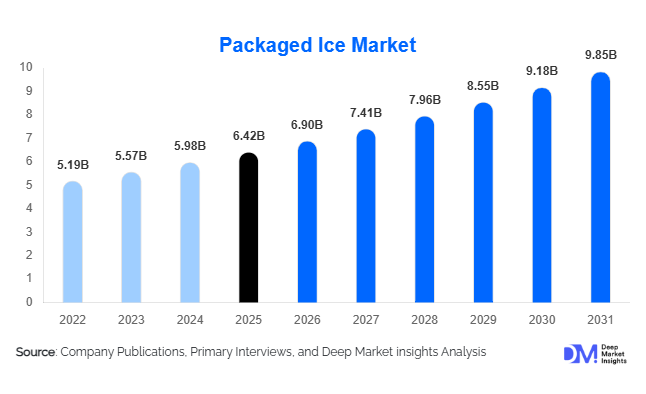
According to Deep Market Insights, the global packaged ice market size was valued at USD 6.42 billion in 2025 and is projected to grow from USD 6.90 billion in 2026 to reach USD 9.85 billion by 2031, expanding at a CAGR of 7.4% during the forecast period (2026–2031). The packaged ice market growth is primarily driven by the expansion of foodservice infrastructure, increasing cold beverage consumption, rising demand for temperature-controlled logistics, and growing commercial adoption across hospitality, healthcare, fisheries, and retail industries.
Key Market Insights
- Packaged ice demand is increasingly becoming year-round rather than seasonal, supported by rapid growth in foodservice, hospitality, and cold-chain logistics industries globally.
- Premium and specialty ice products are gaining traction, particularly in luxury hospitality, bars, and cocktail-focused beverage segments demanding slow-melting and visually appealing ice formats.
- North America dominates the global packaged ice market, led by strong convenience retail penetration, large-scale beverage consumption, and mature cold-chain infrastructure.
- Asia-Pacific remains the fastest-growing regional market, driven by urbanization, organized retail expansion, rising temperatures, and rapid growth in quick-service restaurants.
- Healthcare and pharmaceutical cold-chain applications are emerging as high-growth opportunities, particularly for sterile and medical-grade packaged ice solutions.
- Automation and smart refrigeration technologies are transforming the industry through energy-efficient manufacturing, contamination control, and improved production scalability.
packaged ice market latest trends
Premium and Specialty Ice Products Gaining Popularity
The packaged ice market is increasingly shifting toward premium and specialty ice categories, particularly within hospitality and beverage applications. Luxury hotels, cocktail bars, premium restaurants, and entertainment venues are adopting gourmet cube ice, crystal-clear ice spheres, sculpted ice, and slow-melting premium products to enhance beverage presentation and customer experience. Consumers are becoming more quality-conscious regarding ice purity, shape consistency, transparency, and melting performance. This trend is encouraging manufacturers to invest in advanced water purification systems, precision freezing technologies, and customized ice production capabilities. Premium packaged ice products also generate significantly higher profit margins compared to conventional cube ice, making them an attractive segment for organized market participants. As cocktail culture continues to expand globally, particularly across North America, Europe, and Asia-Pacific, specialty ice demand is expected to accelerate further.
Automation and Smart Ice Manufacturing Expansion
Manufacturers are increasingly adopting automated and smart ice production systems to improve operational efficiency, reduce contamination risks, and lower long-term production costs. Fully automated packaging lines, IoT-enabled refrigeration systems, AI-based quality monitoring, and energy-efficient freezing technologies are becoming standard investments among organized producers. Smart ice plants are enabling real-time monitoring of temperature, storage conditions, and production output, improving consistency and reducing wastage. Automation is also helping companies address rising labor costs and stricter food safety regulations. In addition, sustainable refrigeration systems utilizing low-emission refrigerants and energy-efficient compressors are gaining adoption as governments tighten environmental compliance standards. Companies investing in technologically advanced facilities are increasingly gaining competitive advantages in terms of scalability, product quality, and operational margins.
packaged ice market drivers
Expansion of Foodservice and Beverage Industries
The rapid growth of restaurants, bars, cafés, quick-service restaurants, catering services, and entertainment venues remains one of the strongest drivers for the packaged ice market. Beverage-serving establishments require large quantities of ice for soft drinks, alcoholic beverages, iced coffee products, frozen desserts, and food preservation applications. Urbanization and changing consumer lifestyles are increasing out-of-home dining frequency, particularly across emerging economies in Asia-Pacific and Latin America. The global expansion of tourism and hospitality infrastructure is also contributing significantly to commercial packaged ice demand. Large sporting events, festivals, concerts, and entertainment venues continue to increase year-round consumption volumes, supporting stable long-term market growth.
Growing Demand for Cold-Chain Logistics
Cold-chain logistics expansion across pharmaceutical, healthcare, seafood, and food processing industries is accelerating packaged ice adoption globally. Packaged ice plays a critical role in short-duration cooling applications for vaccine transportation, seafood preservation, biological sample handling, and pharmaceutical distribution. Governments and private logistics companies are investing heavily in temperature-controlled supply chains, especially in emerging markets where healthcare infrastructure modernization is accelerating. Seafood-exporting nations including Norway, India, Vietnam, and Chile continue to generate substantial industrial demand for flake and block ice products used during transportation and export handling. The increasing globalization of food and pharmaceutical supply chains is expected to further strengthen long-term packaged ice demand.
packaged ice market restraints
High Energy Consumption and Operating Costs
Packaged ice production remains highly energy intensive due to continuous refrigeration and freezing requirements. Electricity costs represent a major operational expense for manufacturers, particularly in regions with volatile industrial power tariffs. Smaller producers operating outdated refrigeration infrastructure often face profitability challenges during periods of rising utility prices. In addition, energy-efficiency regulations in developed markets are forcing manufacturers to invest heavily in modern refrigeration systems, increasing capital expenditure requirements. Rising packaging material costs and fuel prices also contribute to margin pressures across the industry.
Distribution and Transportation Challenges
Packaged ice products require specialized cold transportation systems to minimize melting losses during delivery. Long-distance transportation increases wastage risks, logistics complexity, and operating expenses. Seasonal demand fluctuations additionally create inventory and production planning challenges for manufacturers. During summer peaks, smaller producers may struggle to maintain consistent quality standards and reliable supply. Limited cold-chain infrastructure in developing regions further restricts market penetration, particularly in remote and rural areas where transportation efficiency remains weak.
packaged ice industry key opportunities
Healthcare and Pharmaceutical Cold-Chain Expansion
The rapid growth of healthcare logistics and pharmaceutical cold-chain transportation presents a major opportunity for packaged ice manufacturers. Medical-grade packaged ice is increasingly being utilized for vaccine transportation, biologics handling, emergency medical logistics, and laboratory sample preservation. Governments across Asia-Pacific, Africa, and Latin America are investing heavily in healthcare infrastructure and immunization programs, increasing demand for reliable cooling products. Pharmaceutical exporters are also strengthening cold-chain capabilities to comply with international transportation standards. Manufacturers offering sterile, contamination-free packaged ice products with validated temperature-control performance are expected to benefit from long-term institutional contracts and premium pricing opportunities.
Quick-Commerce and Online Grocery Expansion
The rise of online grocery delivery platforms and quick-commerce ecosystems is creating a new retail distribution channel for packaged ice products. Consumers increasingly purchase packaged ice alongside beverages, party supplies, frozen foods, and recreational products through same-day delivery applications. Urban convenience demand is particularly strong across densely populated metropolitan regions in North America, Europe, India, and Southeast Asia. Manufacturers partnering with digital retail platforms can improve consumer accessibility while reducing dependency on traditional retail formats. Quick-commerce integration is also enabling smaller premium ice brands to access wider customer bases through digital distribution models.
Report Scope
| Report Metric | Details |
|---|---|
| Market Size in 2025 | USD 6.42 Billion |
| Market Size in 2026 | USD 6.90 Billion |
| Market Size in 2031 | USD 9.85 Billion |
| CAGR | 7.4% (2026-2031) |
| Base Year for Estimation | 2025 |
| Historical Data | 2022-2024 |
| Forecast Period | 2026-2031 |
| Report Coverage | Revenue Forecast, Competitive Landscape, Supply Chain Disruption, Growth Factors, Environment & Regulatory Landscape and Trends |
| Geographies Covered | North America, Europe, APAC, Middle East and Africa, LATAM |
| Countries Covered | U.S., Canada, U.K., Germany, France, Spain, Italy, Russia, Nordic, Benelux, Rest of Europe, China, Korea, Japan, India, Australia, Singapore, Taiwan, South East Asia, Rest of Asia-Pacific, UAE, Turky, Saudi Arabia, South Africa, Egypt, Nigeria, Rest of MEA, Brazil, Mexico, Argentina, Chile, Colombia, Rest of LATAM |
Explore more data points, trends and opportunities Download Free Sample Report
Product Type Insights
Cube ice dominates the packaged ice market, accounting for the largest share of global demand due to its extensive use across restaurants, bars, convenience stores, hotels, and household beverage applications. Full cube and gourmet cube variants are particularly popular because of their slower melting properties and premium presentation in beverages. Crushed ice continues to experience strong demand from foodservice and cocktail applications, especially within cafés and quick-service restaurants serving blended beverages and frozen desserts. Nugget and pellet ice segments are gaining traction due to rising consumer preference for chewable ice formats in specialty beverage outlets. Specialty ice products, including crystal-clear cocktail ice, sculpted ice, and spherical ice, are rapidly emerging within luxury hospitality and premium beverage sectors, generating higher revenue margins for organized producers. Block and flake ice remain critical within industrial applications such as fisheries, seafood transportation, construction cooling, and healthcare logistics.
Application Insights
Beverage cooling remains the largest application segment within the global packaged ice market, supported by rising consumption of carbonated drinks, alcoholic beverages, energy drinks, iced coffee, and frozen cocktails. Restaurants, bars, cafés, and event venues collectively account for substantial beverage-related ice demand globally. Food preservation applications continue to expand across seafood processing, meat transportation, and grocery retail sectors where packaged ice is utilized to maintain freshness and reduce spoilage. Healthcare and pharmaceutical cooling applications are among the fastest-growing segments, driven by increasing vaccine transportation and biologics logistics requirements. Hospitality and event management applications are additionally supporting strong demand for premium packaged ice products across weddings, concerts, sports arenas, and entertainment venues. Industrial cooling applications, including construction and emergency relief operations, are also emerging as niche growth areas, particularly in high-temperature regions.
Distribution Channel Insights
Supermarkets and hypermarkets remain the leading distribution channel for packaged ice products due to their established refrigeration infrastructure, strong consumer footfall, and high visibility within urban retail environments. Convenience stores represent another important distribution segment, particularly across North America where impulse ice purchases are common during travel, outdoor activities, and recreational events. Foodservice distributors continue to play a critical role in supplying restaurants, hotels, catering companies, and entertainment venues through long-term commercial contracts. Online grocery platforms and quick-commerce channels are emerging as one of the fastest-growing distribution formats globally, enabling direct-to-consumer ice delivery within short timeframes. Wholesale cash-and-carry channels are additionally supporting bulk procurement for institutional and hospitality customers. Event-based distribution networks are expanding rapidly during festivals, concerts, sports events, and tourism seasons, generating substantial seasonal revenue opportunities for producers.
End-Use Industry Insights
The foodservice industry represents the largest end-use sector for packaged ice globally, driven by restaurants, cafés, bars, catering businesses, and quick-service restaurant chains requiring continuous ice supply for beverages and food handling operations. The hospitality sector is another major contributor, with hotels, resorts, cruise operators, and entertainment venues increasingly demanding premium packaged ice solutions to enhance customer experience. Healthcare and pharmaceutical industries are emerging as high-growth end-use segments due to expanding cold-chain logistics requirements. Fisheries and seafood processing industries continue to generate substantial industrial demand for flake and block ice products used during storage and transportation. Retail household consumption is also increasing steadily due to outdoor recreational activities, social gatherings, camping, and convenience-oriented consumer behavior. Sports and entertainment venues are additionally increasing packaged ice procurement volumes to support large-scale public events and athlete recovery applications.
Explore more data points, trends and opportunities Download Free Sample Report
Packaged Ice Market Segmentations
By Product Type
- Cube Ice
- Crushed Ice
- Block Ice
- Nugget Ice
- Flake Ice
- Specialty Ice
By Packaging Type
- Small Packaged Ice
- Medium Packaged Ice
- Large Commercial Packs
- Bulk Industrial Ice Containers
- Reusable/Insulated Ice Packaging
By Application
- Beverage Cooling
- Food Preservation
- Healthcare & Medical Cooling
- Fisheries & Seafood Transportation
- Hospitality & Events
- Construction & Industrial Cooling
- Sports & Recreation
- Emergency Relief & Disaster Management
- Pharmaceutical Cold Chain Support
By Distribution Channel
- Supermarkets & Hypermarkets
- Convenience Stores
- Online Retail & Quick Commerce
- Foodservice Distributors
- Direct Commercial Supply Contracts
- Gas Stations & Travel Retail
- Event-Based Distribution
- Wholesale Cash & Carry
By End-Use Industry
- Foodservice Industry
- Retail Consumers
- Hospitality Industry
- Healthcare Industry
- Seafood & Meat Processing Industry
- Industrial Sector
- Sports & Entertainment Sector
- Aviation & Transportation
Regional Insights
North America
North America remains the dominant regional market for packaged ice, accounting for nearly 34% of global market revenue in 2025. The United States leads demand due to extensive convenience retail penetration, mature foodservice infrastructure, high beverage consumption, and strong recreational ice usage. Outdoor activities, sports events, tourism, and entertainment industries significantly contribute to year-round packaged ice demand across the country. Canada continues to experience stable growth driven by organized retail expansion and hospitality demand, while Mexico is witnessing increasing adoption due to urbanization and tourism growth. North American producers are also among the most technologically advanced globally, with widespread adoption of automated packaging systems and energy-efficient refrigeration technologies.
Europe
Europe accounted for approximately 22% of the global packaged ice market in 2025. Germany, the United Kingdom, France, Italy, and Spain remain the leading markets within the region due to strong hospitality industries, growing tourism activity, and premium beverage culture. Cocktail bars, luxury hotels, and entertainment venues are driving rising demand for gourmet cube ice and specialty cocktail ice products. Sustainability regulations are additionally encouraging manufacturers to invest in environmentally friendly refrigeration technologies and recyclable packaging solutions. Western European consumers are increasingly prioritizing premium and hygienic packaged ice products, particularly within organized retail and hospitality channels.
Asia-Pacific
Asia-Pacific is projected to be the fastest-growing regional market during the forecast period, supported by rapid urbanization, organized retail growth, rising temperatures, and expanding foodservice industries. China remains the largest market in the region due to extensive quick-service restaurant expansion and cold-chain logistics development. India is expected to register one of the highest growth rates globally as urban commercial demand, healthcare logistics, and hospitality infrastructure continue to expand rapidly. Southeast Asian countries including Thailand, Vietnam, Indonesia, and the Philippines are also witnessing strong demand growth due to tourism expansion and tropical climatic conditions. The region’s growing middle-class population is further increasing consumption of packaged beverages and convenience products.
Latin America
Latin America accounted for nearly 8% of global market revenue in 2025, led primarily by Brazil, Argentina, Chile, and Colombia. Brazil remains the largest regional market due to strong beverage consumption, tourism activity, and large-scale public festivals generating seasonal packaged ice demand. Increasing urbanization and retail modernization are improving packaged ice availability across metropolitan areas. Foodservice and hospitality expansion are additionally supporting commercial ice procurement growth across major cities within the region.
Middle East & Africa
The Middle East & Africa region is witnessing strong packaged ice demand growth due to high ambient temperatures, rapid tourism infrastructure development, and expanding hospitality industries. GCC countries including Saudi Arabia and the UAE are investing heavily in entertainment venues, hotels, and large-scale tourism projects that require significant commercial ice supply. South Africa and Egypt are also emerging as important regional markets due to growing organized retail and foodservice sectors. The fisheries industry additionally contributes to industrial ice demand across several African coastal economies.
Key Players in the Packaged Ice Market
- Arctic Glacier Inc.
- Reddy Ice Holdings Inc.
- Home City Ice Company
- The Ice Co.
- Kooler Ice Inc.
- Packaged Ice LLC
- Nichirei Corporation
- Polar Ice Ltd.
- Glacier Ice Company
- Party Time Ice